
Oil and gas storage tanks may look like simple cylinders, but their fabrication chain is not forgiving. Shell courses must be cut, rolled, fitted, rotated, welded, inspected, and documented in a sequence that controls distortion and keeps the joint within code tolerance. When the product is welded steel storage covered by API 650, the equipment decision is not separate from weld procedure, layout, and inspection planning [1].
1. Start with Code Requirements, Not the Machine
For most welded oil storage tanks, API 650 governs material selection, shell design, fit-up, inspection, and testing expectations [1]. Low-pressure or refrigerated tank designs may fall under API 620, which introduces a different set of design and welding controls [6]. In-service tank repair, shell course replacement, or floor work is generally planned through API 653, especially when the scope includes altered or reconstructed tank components [2].
Welding procedure qualification and welder performance qualification are typically controlled by ASME BPVC Section IX and the purchaser’s project specification [4]. Structural steel around the tank, such as platforms, stairways, wind girders, and nozzle reinforcement, commonly follows AWS D1.1 requirements [3]. The important planning point is that the fabrication equipment must support the code-required joint quality, traceability, and inspection access, not simply move material through the shop.
2. Equipment Chain: Cutting, Fit-Up, Rotating, and Welding
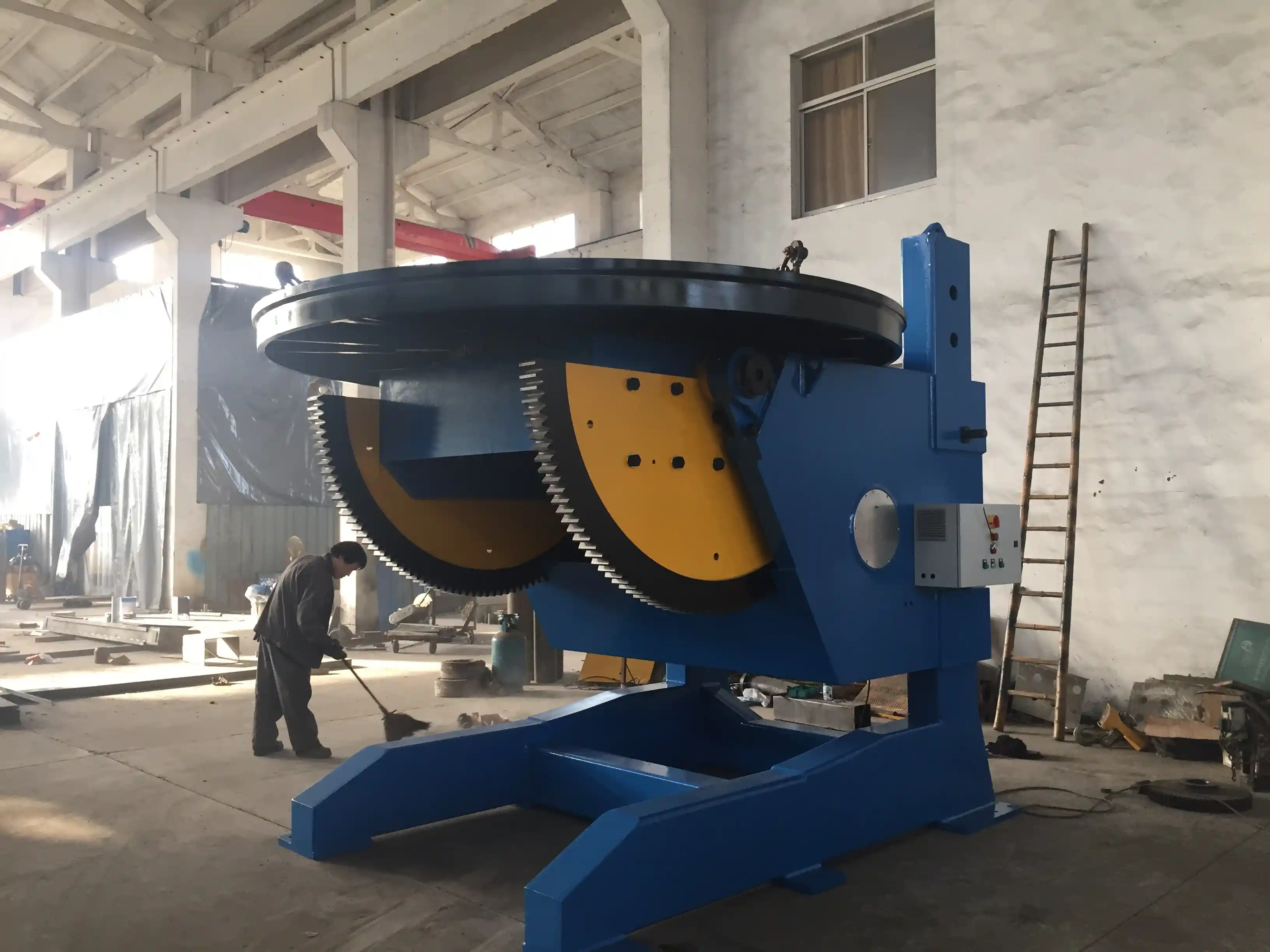
A tank fabrication line moves through plate cutting and bevel preparation, rolling, shell course fit-up, longitudinal welding, course assembly, girth welding, nozzle installation, testing, and documentation. Each operation exposes the tolerance left by the previous step. A shell course with poor edge alignment increases fill volume and drives repair cost before the weld is even made.
The equipment package must therefore be evaluated as a chain. WUXI ABK offers Tank Welding Solutions that include automatic girth welding, submerged arc welding tractors, vertical electrogas welding, and hydraulic jacking systems. For long shell seams, Submerged Arc Welding Suppliers provide mechanized deposition for consistent weld quality. For vertical field-erected seams, Vertical Electrogas Welding Manufacturers supply the process-specific systems needed when the project specification permits electrogas welding.
3. Rotator, Positioner, and Girth Welding Selection
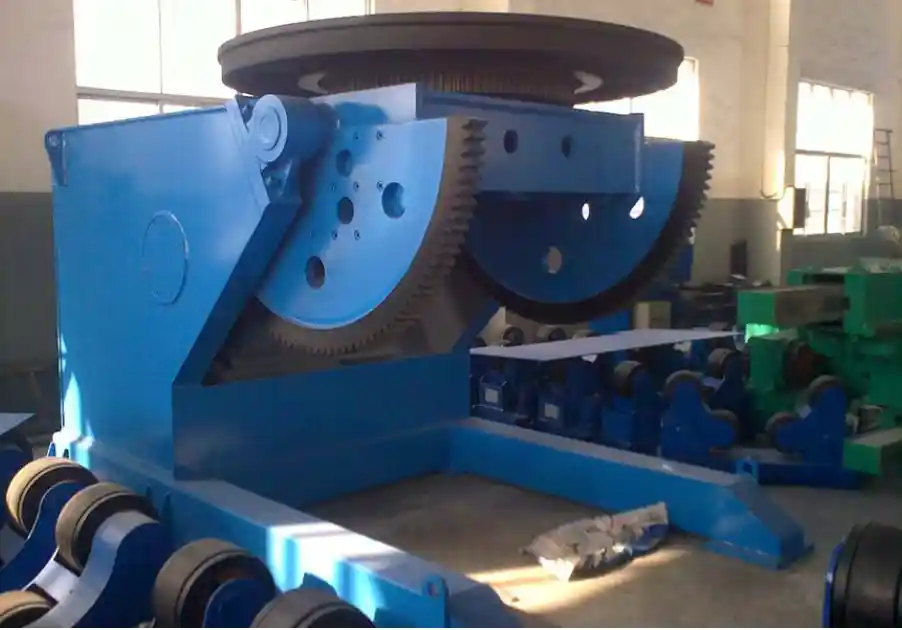
For tank shell courses, the welding rotator is the central production tool. It must carry the total steel weight while maintaining smooth rotation, controlling axial creep, and keeping the weld seam in position for the operator or automatic torch. Shell diameter, plate thickness, and welding speed determine rotator class, roller spacing, and whether adjustable-height or self-aligning configuration is needed. A heavy-duty pipe rotator such as the Rotador de tubos de alta resistencia supports large cylindrical workpieces and provides the diameter range needed for tank shell courses.
Shell rotation and pipe turning are not add-ons; they are the most direct control point for weld position and travel speed. <Rotadores y rodillos giratorios: Equipos esenciales para la fabricación moderna de tuberías> covers roller configuration, diameter range, and fit-up handling for cylindrical fabrication.
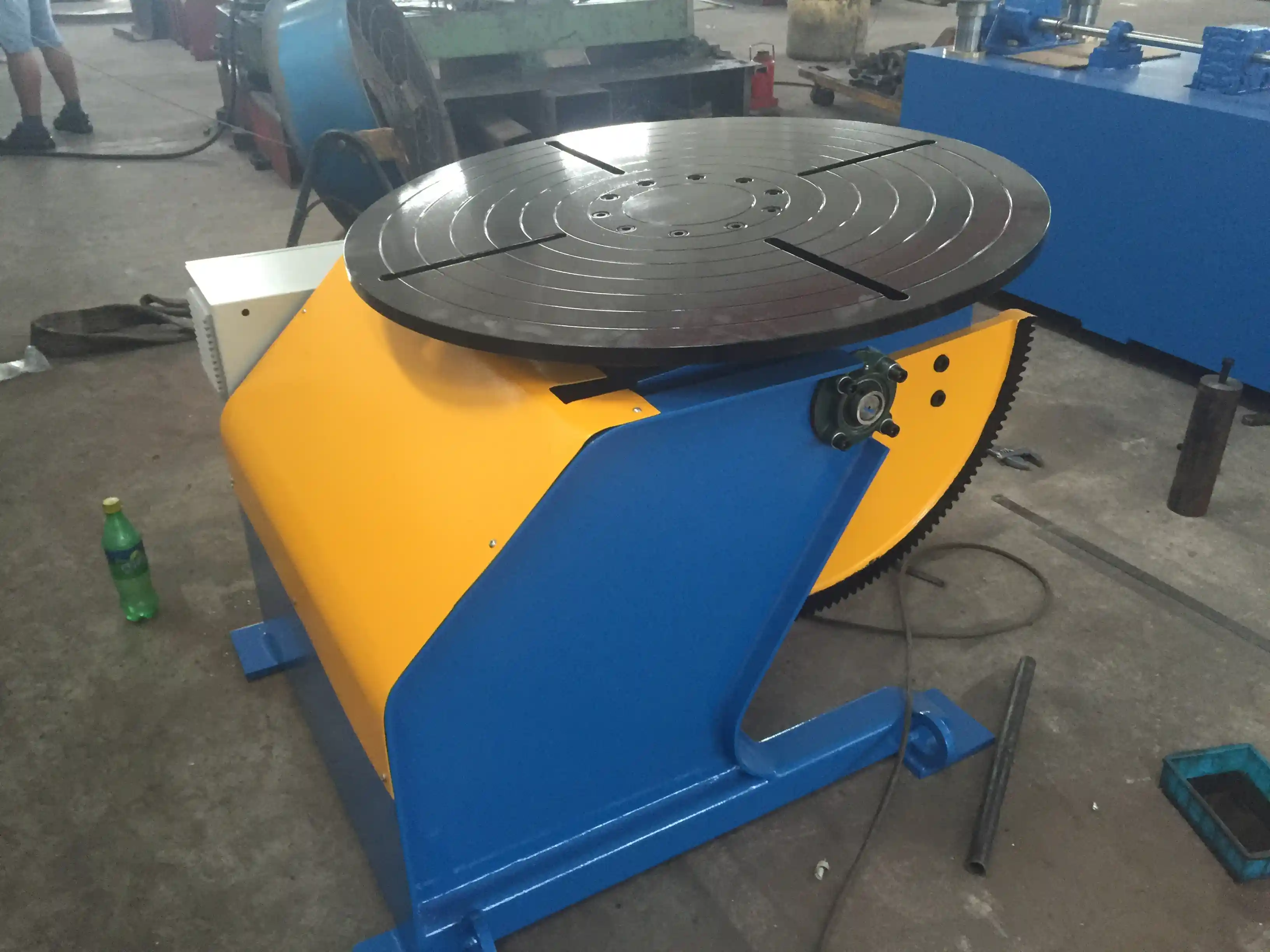
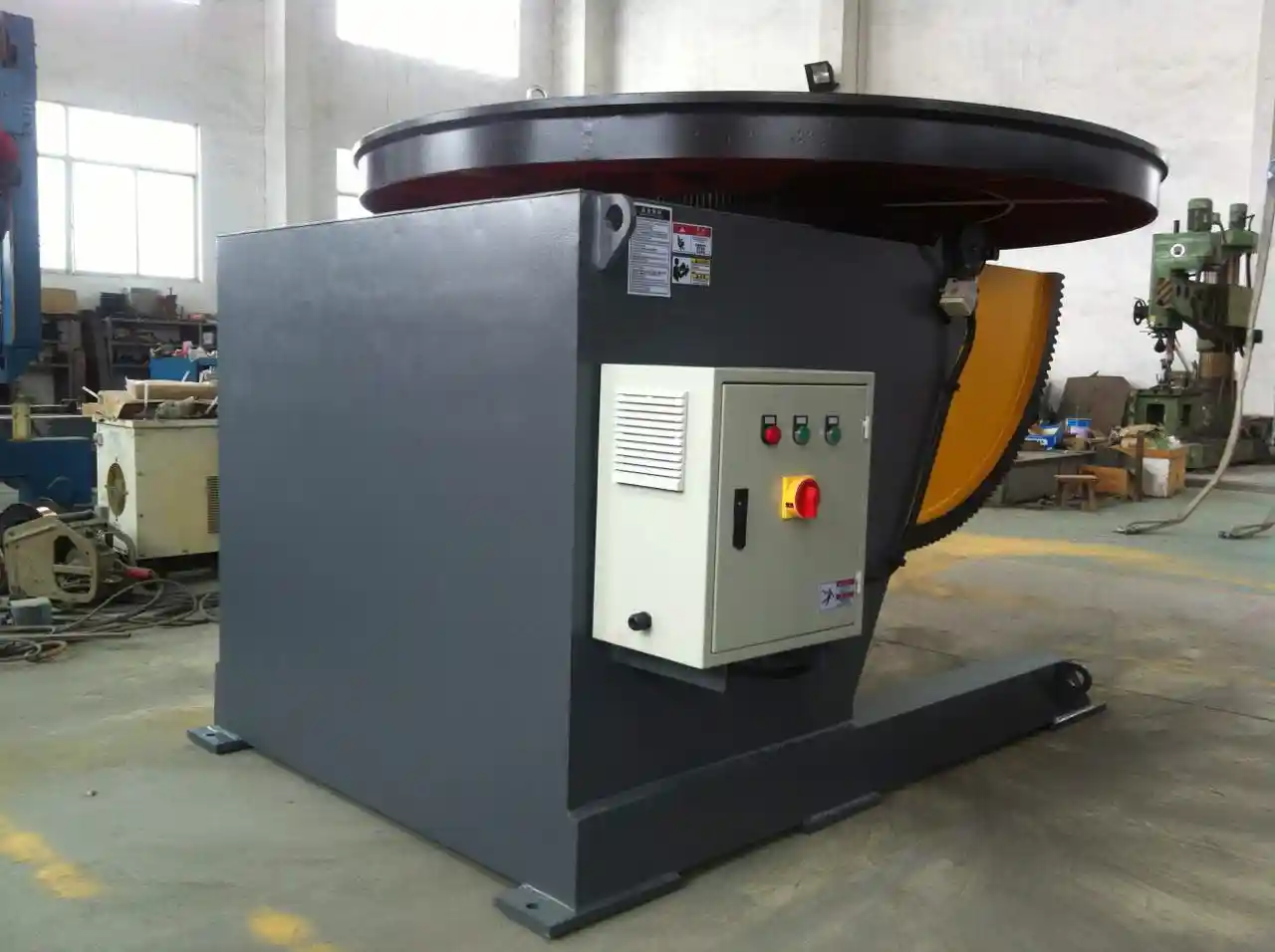
For nozzles, manways, flanges, and smaller cylindrical fittings, a welding positioner provides controlled rotation and tilt so the welder can work in a stable position rather than fighting gravity. Load capacity, center-of-gravity distance, and table diameter are more important than the positioner’s nominal tonnage alone. The Posicionador de soldadura ajustable line supports heavy workpieces where height adjustment and controlled rotation reduce fit-up time before nozzle and fitting welds.
For pressure-retaining tank seams and nozzle work, positioner accuracy changes how easily the operator holds the weld position. <Solución revolucionaria para la soldadura de recipientes a presión: Análisis técnico de los posicionadores de soldadura giratorios de 360 grados> covers 360° rotation and alignment methods for cylindrical and nozzle-type components.
For girth seams, the production decision is whether to use a mechanized automatic girth welding system or a column and boom setup with a submerged arc package. The table below summarizes the main equipment decisions for a tank cell.
| Equipment | What to confirm | Typical tank application |
|---|---|---|
| Rotador de tubos de alta resistencia | Shell course diameter, weight, roller spacing | Rotating shell courses for longitudinal and girth welding |
| Posicionador de soldadura ajustable | Nozzle or flange weight and eccentricity | Manways, fittings, small cylindrical parts |
| Automatic Girth Welding Suppliers | Shop-built or field-erected, shell diameter, plate thickness | Circumferential shell seams |
| Vertical Electrogas Welding Manufacturers | Vertical seam length, thickness, process approval | Field-erected tank vertical joints |
Fit-up tolerance is where many tank projects accumulate weld rework. <Desalineación excesiva en la soldadura de tuberías: solución de posicionamiento de precisión con mesa giratoria de soldadura de Wuxi ABK> covers how precision positioning reduces joint misalignment before welding begins.
4. Welding Processes and Quality Verification for Tank Seams
Submerged arc welding is widely used for longitudinal and girth seams on carbon steel tank shells because it provides high deposition, deep penetration, and a controlled automated arc [1][4]. Vertical seams on larger field-erected shells may use mechanized vertical welding where approved, while nozzle and reinforcement welds commonly use GMAW or FCAW depending on position and material requirements.
After welding, inspection scope is driven by the code and the purchaser’s specification. Vacuum box testing is common for floor seams, magnetic particle or liquid penetrant inspection for fittings and attachments, and radiographic or ultrasonic examination for shell seams where specified [1][2]. This is why equipment capable of recording travel speed, voltage, current, and seam tracking adds value beyond productivity. It produces the process record that supports quality documentation and later API 653 inspection planning [2][5]. WUXI ABK builds this control capability into its Manipulador de soldadura systems, which combine column and boom movement with stable longitudinal seam control.
Engineering checkpoint: If you are preparing a tank project RFQ, send the shell course diameter and length, plate thickness and material, preferred longitudinal and girth welding process, and annual production target to jay@weldc.com. A WUXI ABK welding automation engineer can check the rotator load class, boom reach, and seam-tracking configuration against the tank drawings before you commit to a machine envelope.
5. Planning the Fabrication Line for Throughput
A high-throughput tank line is not a collection of independent machines. It is a flow from plate storage and cutting to rolling, fit-up, welding, inspection, and testing. For shop-built tanks, the line can be arranged around rolling, fit-up, and submerged arc stations. For field-erected tanks, the same equipment functions may be containerized or skid-mounted near the tank pad.
Layout should keep longitudinal welding and girth welding close to the rotator and jacking system, reduce crane moves, and leave room for NDT and repair before the shell rises too high. Joint numbering should be established early so every longitudinal and girth seam can be traced to the machine, procedure, and operator that produced it [4][5]. That record set is what the inspector expects and what maintenance engineers later use when planning API 653 repairs [2].
Plan Your Oil and Gas Tank Fabrication Line with WUXI ABK
WUXI ABK MACHINERY CO., LTD has supplied welding automation and heavy fabrication equipment since 1999, with engineering focus on tank, pressure vessel, wind tower, and structural steel production. Our team provides equipment selection guidance for manipulador de soldaduras, rotators, girth welding systems, and positioners rather than a generic machine list.
To reduce quotation cycles, include the following with your inquiry:
- Tank diameter, height, and shell thickness range
- Material grades and whether design follows API 650, API 620, or another project specification
- Preferred welding process for longitudinal and girth seams
- Production targets per shift and required automation level
- Shop layout or site constraints
Correo electrónico: jay@weldc.com
Móvil: +86-13815101750
Teléfono: +86-510-83555592
Website: https://www.weldmc.com
Preguntas frecuentes
What welding standard applies to oil and gas tank fabrication?
Most welded steel oil storage tanks are designed and fabricated to API 650. Low-pressure or refrigerated tanks may fall under API 620, and in-service inspection or repair work is planned through API 653. Welding procedure and welder qualification commonly follow ASME BPVC Section IX and the owner’s project specification [1][2][4][6].
Which equipment is most critical for tank shell welding?
Welding rotators and fit-up systems are usually the most critical equipment because they control shell alignment, rotation speed, and weld position. Automatic girth welding equipment, submerged arc tractors, and a suitable welding manipulator are also central to repeatable tank seam production.
How do I size a welding rotator for a tank course?
Start with the shell course diameter, total weight, length, and plate thickness. The rotator must handle the maximum diameter and weight without excessive deflection or axial creep. Roller spacing, wheel surface, drive speed, and anti-creep control should be matched to the welding speed and process.
Can the same equipment support shop-built and field-erected tanks?
It can, but the equipment may need to be specified differently. Shop-built tanks tend to favor fixed line integration, while field-erected tanks may require containerized, skid-mounted, or modular configurations. The decision should be based on logistics, crane access, power supply, and welding process requirements.
What information should I prepare before requesting a tank equipment quote?
Prepare tank diameter, height, shell thickness, material grade, welding process, production targets, and site constraints. This allows the equipment supplier to check rotator capacity, boom reach, girth welding configuration, and the required control and documentation level.
References
[1] American Petroleum Institute, API Standard 650: Welded Tanks for Oil Storage, Washington, DC: API, 2020.
[2] American Petroleum Institute, API Standard 653: Tank Inspection, Repair, Alteration, and Reconstruction, Washington, DC: API, 2020.
[3] American Welding Society, AWS D1.1/D1.1M: Structural Welding Code—Steel, Miami, FL: AWS, 2020.
[4] American Society of Mechanical Engineers, ASME BPVC Section IX: Welding, Brazing, and Fusing Qualifications, New York, NY: ASME, 2023.
[5] International Organization for Standardization, ISO 3834-2:2021 Quality Requirements for Fusion Welding of Metallic Materials — Part 2: Comprehensive Quality Requirements, Geneva: ISO, 2021.
[6] American Petroleum Institute, API Standard 620: Design and Construction of Large, Welded, Low-Pressure Storage Tanks, Washington, DC: API, 2020.
Si te interesa, echa un vistazo a estos artículos relacionados:
Soldaduras perfectas en tubos de gran diámetro con equipos de laminación profesionales
Revolution in Ship Welding: How Welding Positioners Improve Quality and Efficiency
Baja eficiencia en la soldadura de conjuntos de tuberías: cómo los soportes de rodillos inteligentes aumentan la productividad en un 501 %
 English
 Español
 Français
 Deutsch
 Português
 Русский