Heavy vessel manufacturing sits at the intersection of brute force and surgical precision. Getting welds right on pressure vessels, storage tanks, and wind towers isn’t just about following procedures—it’s about understanding how metal behaves under stress, heat, and time. Since 1999, we’ve watched this industry evolve, and one thing remains constant: the quality of welded joints determines whether these structures last decades or fail catastrophically. What follows examines how integrated welding approaches deliver results that matter.
Heavy Vessel Fabrication Depends on Welding Quality
Heavy vessel fabrication covers pressure vessels, storage tanks, and wind towers. The structural integrity and service life of these components tie directly to weld quality. Precision welding functions as a core engineering discipline that supports safety and performance, not simply a manufacturing step.
Large-scale fabrication projects frequently involve thick materials and complex geometries. These conditions require advanced techniques to prevent defects like porosity, cracks, and distortion. Material science guides the selection of appropriate filler metals and welding parameters, ensuring compatibility and optimal mechanical properties.
Wind tower welding presents particular challenges. The immense scale and cyclical loading demand welds capable of withstanding significant fatigue stresses over decades. Pressure vessel welding requires joints that contain high internal pressures and temperatures without compromise.
Meeting these foundational requirements calls for rigorous process control and current equipment. The focus stays on achieving consistent penetration, minimal heat-affected zones, and superior metallurgical characteristics in every weld.
Article Recommendation: If you’re interested, check 《Wuxi ABK Professional Welding Rotary Equipment: Precision Welding Solution for Pressure Vessel Manufacturing》.
Advanced Welding Technologies Drive Better Vessel Production
Optimal heavy vessel production requires advanced welding technologies. These solutions enhance efficiency, improve weld quality, and reduce manufacturing costs.
Automated welding systems deliver consistent results that manual welding cannot match, particularly over long seams or repetitive tasks. Welding process optimization techniques fine-tune parameters for specific materials and joint configurations.
Submerged arc welding (SAW) sees frequent use for its high deposition rates and deep penetration, making it well-suited for thick-walled vessels. Narrow gap welding reduces weld volume and heat input, minimizing distortion and material consumption.
Robotic welding systems integrate into production lines and provide accuracy and repeatability that human welders struggle to maintain over extended periods. These systems handle complex paths and maintain precise torch angles, which matters for critical applications. Integrating such technologies helps each weld meet stringent industry standards.
Automated Welding Benefits in Heavy Vessel Production
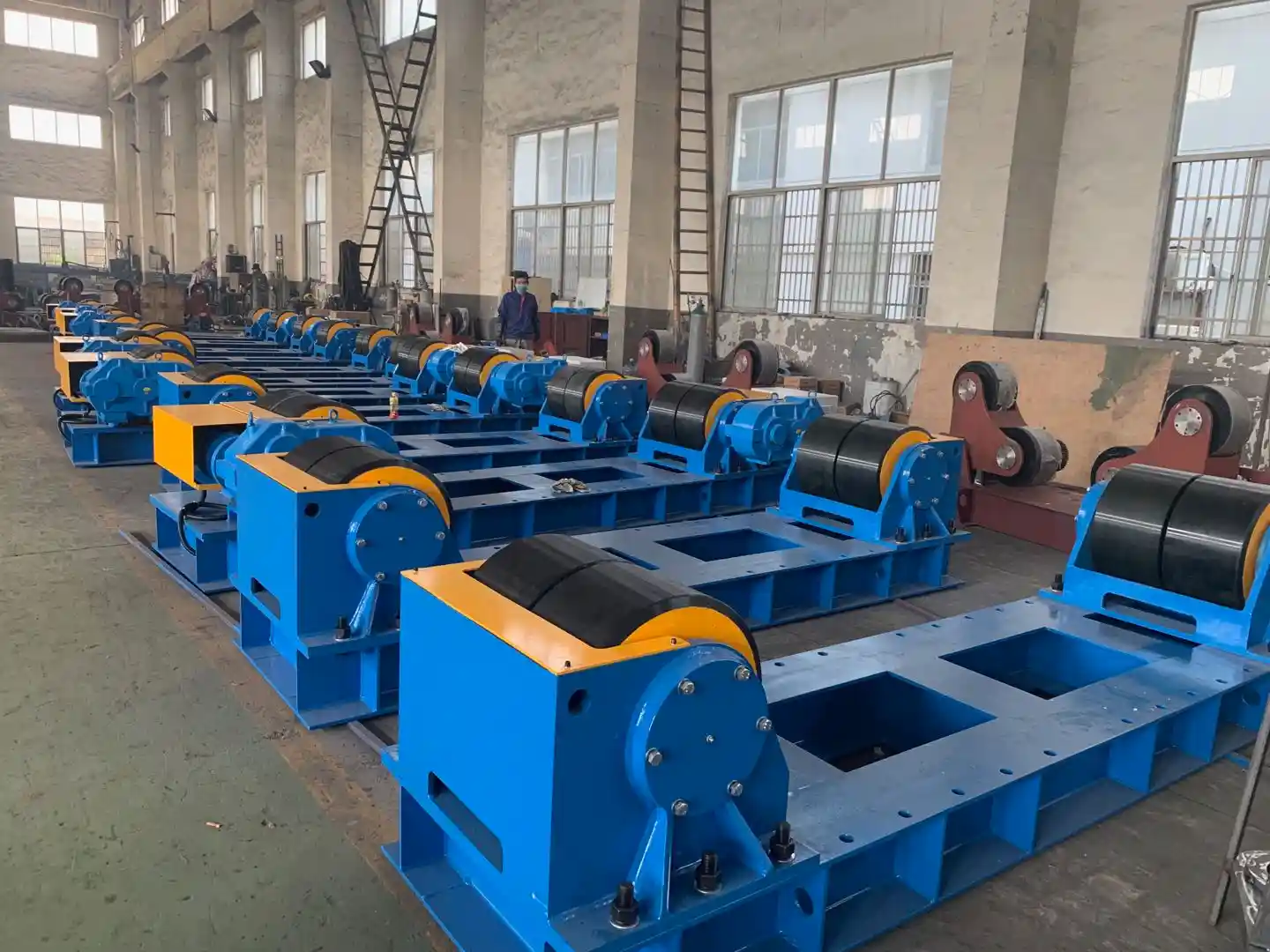
Automated welding systems bring substantial benefits to heavy vessel production. They increase production efficiency by reducing cycle times and minimizing human error.
Consistent weld quality stands out as a primary advantage. Automated processes maintain precise control over welding parameters, leading to fewer defects and reduced rework. This consistency translates into cost reduction by optimizing material usage and lowering labor expenses.
Automation also improves safety by removing operators from hazardous environments. These systems ensure compliance with strict regulatory requirements and provide verifiable data for quality assurance.
| Welding Technique | Beneficio clave | Typical Application | WUXI ABK Equipment |
|---|---|---|---|
| Submerged Arc Welding (SAW) | High deposition rate, deep penetration | Large diameter pipes, pressure vessels | Welding Manipulator, Welding Rotator Equipment |
| Narrow Gap Welding | Reduced heat input, minimal distortion | Thick section butt welds | Posicionador de soldadura ajustable |
| Robotic Welding | High precision, repeatability | Complex geometries, automated cells | Posicionador de soldadura de 3 ejes |
| MIG/MAG Welding | Versatility, speed | General fabrication, structural steel | Soluciones de mesas giratorias de soldadura |
Integrating Welding Equipment Creates Efficient Manufacturing Workflows
Effective manufacturing workflows in heavy vessel production depend on how well welding equipment works together. Combining various machines into a cohesive production line makes the difference between smooth operations and constant bottlenecks.
Welding manipulators position welding heads precisely for longitudinal and circumferential seams. The LH8080 model offers 8000mm horizontal and vertical travel for large-scale applications. Welding positioners like the Triple Axis Positioner with 5000 kg capacity provide synchronized rotation, tilting, and turning, enabling optimal workpiece orientation.
For cylindrical components, pipe welding solutions often involve specialized pipe rotators that ensure smooth, controlled rotation during welding. These systems work in harmony, minimizing material handling and maximizing arc-on time. The goal is creating continuous flow from component assembly to final welding. This integrated approach reduces bottlenecks and improves overall throughput.
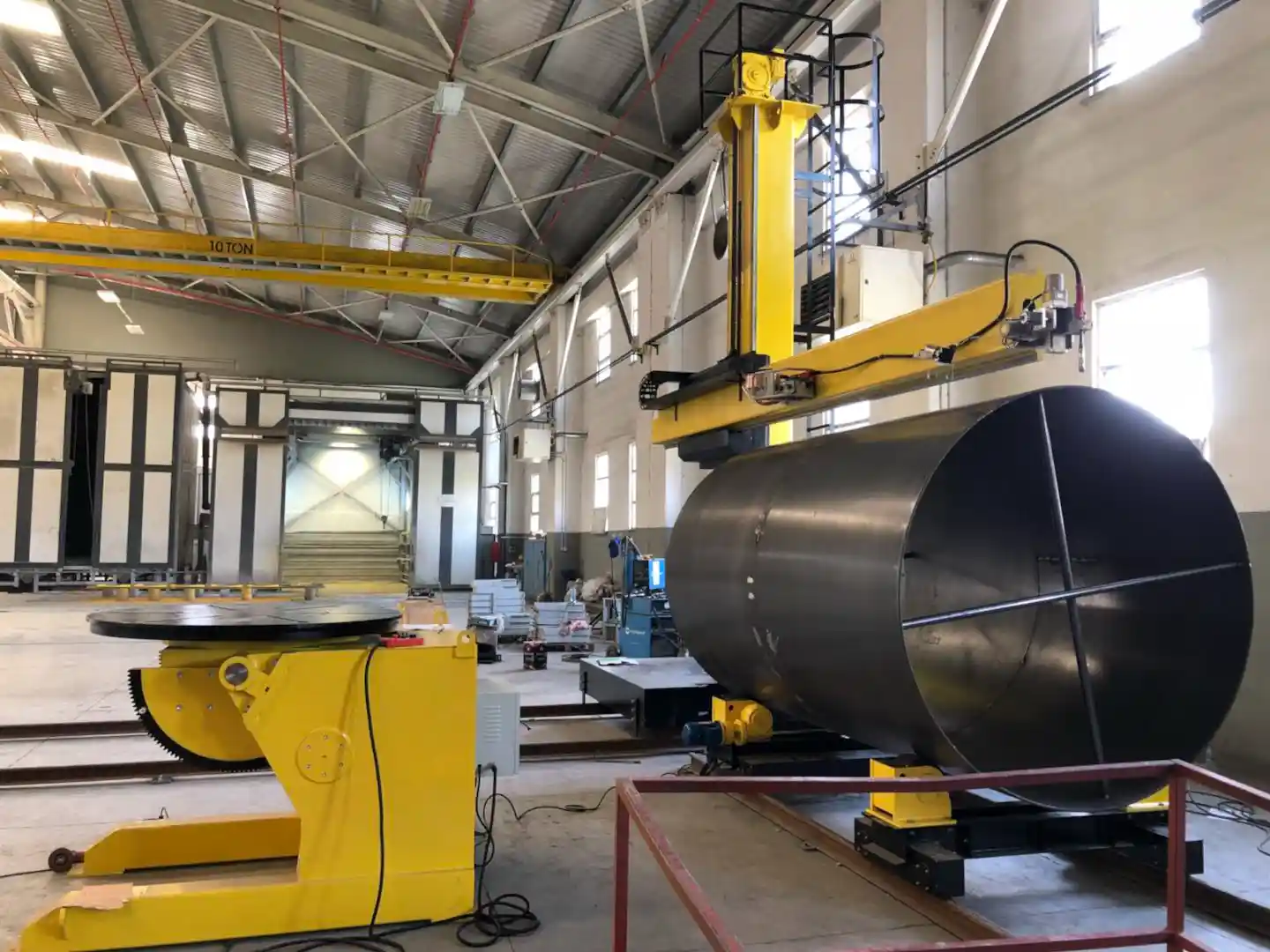
Getting various pieces of equipment to communicate effectively matters. Systems often include PLC and touchscreen controls for centralized management. Operators can monitor and adjust parameters across multiple machines from a single interface. The result is an efficient and adaptable manufacturing environment capable of handling diverse heavy vessel projects.
Article Recommendation: To learn more about optimizing your workshop space and boosting safety, check out 《Workshop Space Too Small? How Column Booms Save 50% Floor Space While Boosting Safety & Efficiency》.
Quality Control and Compliance Standards Cannot Be Compromised
Quality control in fabrication and welding compliance standards are non-negotiable in heavy vessel manufacturing. Weld failure consequences can be catastrophic, making rigorous inspection protocols a requirement rather than an option.
Comprehensive non-destructive testing (NDT) methods detect internal and surface defects. These include ultrasonic testing, radiographic testing, and magnetic particle inspection. Each welding inspection step gets documented to ensure traceability and adherence to project specifications.
Regulatory requirements like ASME Boiler and Pressure Vessel Code and various international standards dictate specific procedures and acceptance criteria. Integrated solutions incorporate real-time monitoring and data logging capabilities, providing a verifiable record of welding parameters throughout the process.
This proactive approach minimizes costly rework risk and ensures final product reliability. Welder qualification and continuous training maintain high skill levels. This commitment to quality assurance protects both reputation and client investments.
Strategic Equipment Selection Shapes Long-Term Success
Strategic welding equipment selection shapes operations in heavy industry. Procurement specialists and technical directors need to consider several factors beyond initial cost.
Equipment durability matters because heavy industrial environments demand robust machinery capable of continuous operation. Long-term return on investment comes from reliable, high-performance solutions rather than the cheapest option available.
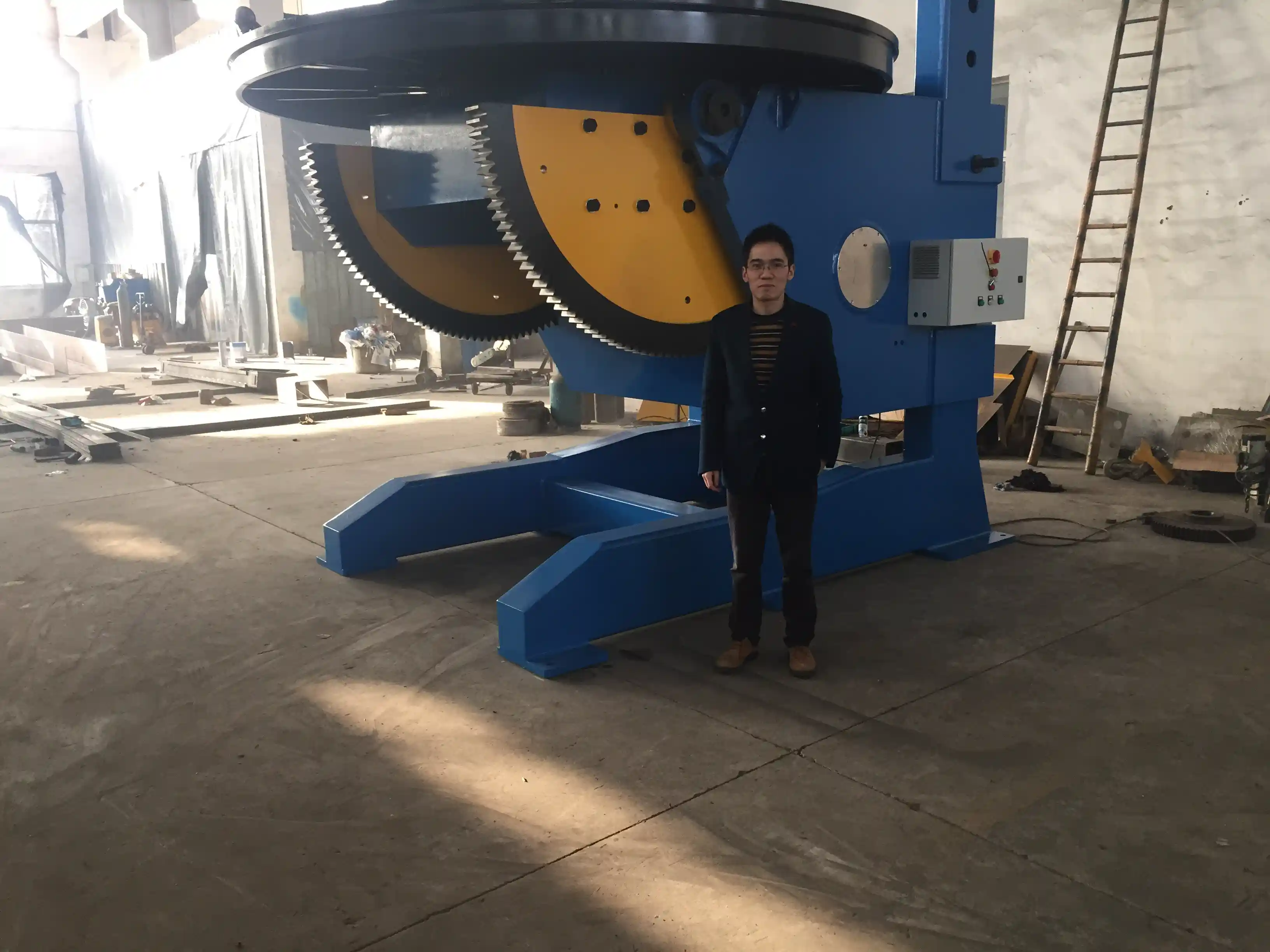
Custom welding solutions often prove necessary for specific heavy vessel projects. A wind tower welding line requires specialized manipulators and rotators to handle large, cylindrical sections. A Welding Manipulator like the LH8080, with its 8-meter horizontal and vertical travel, handles such large-scale applications well, offering precise longitudinal and circumferential seam welding. For heavy-duty pressure vessel welding, a Triple Axis Positioner with 5000 kg load capacity provides the necessary stability and maneuverability.
Key Factors When Choosing Heavy Vessel Welding Equipment
Selecting welding equipment for heavy vessel manufacturing involves several factors that deserve careful evaluation.
First, assess welding machine criteria including load capacity, precision, and automation level required for your specific applications. Second, evaluate equipment lifecycle by considering maintenance requirements, spare parts availability, and expected operational lifespan. Third, investigate supplier reputation with focus on experience and after-sales support. Finally, analyze potential return on investment by accounting for improvements in efficiency, quality, and safety.
These factors collectively guide appropriate machinery procurement.
| Consideration | Description | WUXI ABK Solution Example |
|---|---|---|
| Capacidad de carga | Maximum weight and dimensions the equipment can handle | Triple Axis Positioner (5000 kg capacity) |
| Precision | Accuracy of positioning and repeatability of welds | 3 Axis Welding Positioner (±0.05 mm accuracy) |
| Automation Level | Degree of manual intervention required | Automated Welding Positioner with PLC control |
| Durability | Robustness for heavy industrial environments | Heavy-duty Q235-A steel box-type base on positioners |
| Aplicación | Specific type of welding task or vessel | Welding Manipulator for boiler/pressure vessel fabrication |
Frequently Asked Questions About Heavy Vessel Welding
How does advanced welding technology improve structural integrity in large-scale fabrication?
Advanced welding technologies like automated submerged arc welding and narrow gap welding enhance structural integrity in large-scale heavy vessel fabrication by providing more consistent, deeper penetration and fewer defects. These integrated welding solutions ensure uniform material properties across critical joints, which matters for vessels operating under extreme pressures and temperatures. WUXI ABK’s equipment delivers this precision.
What are the common challenges in heavy vessel manufacturing welding and how are they overcome?
Common challenges in heavy vessel manufacturing welding include managing distortion, achieving consistent weld quality across thick sections, and ensuring compliance with stringent safety standards. These get addressed through precise process control, advanced welding positioners and manipulators for optimal access, and robust quality control systems. WUXI ABK’s equipment handles these specific challenges with reliable and efficient solutions.
Can WUXI ABK MACHINERY provide custom integrated welding solutions for unique heavy vessel projects?
Yes, WUXI ABK MACHINERY CO., LTD. specializes in custom integrated welding solutions tailored to unique heavy vessel project requirements. With experience since 1999 in manufacturing welding equipment like wind tower welding lines and H beam welding lines, we design and implement bespoke systems that optimize specific heavy vessel manufacturing processes, ensuring both efficiency and superior weld quality.
Asóciese con WUXI ABK para obtener soluciones avanzadas de soldadura
Strengthen your heavy vessel manufacturing capabilities with WUXI ABK MACHINERY CO., LTD.’s engineered welding equipment and integrated solutions. Contact us today to discuss how our technology can optimize your production efficiency, ensure quality, and support your project success. We’ve been building welding solutions since 1999. Email us at jay@weldc.com or call us at +86-510-83555592.
 English
  Español
  Français
  Deutsch
  Português
  Русский