Handling a 30-ton pressure vessel head or a 6-meter-diameter wind tower section is not a job for improvised lifting and tack welding. In heavy fabrication, the positioning equipment that holds and rotates the workpiece is what determines whether a weld is consistent around a full circumference, whether an operator can access the joint safely, and whether the assembly meets the dimensional tolerance the engineering drawing demands. After more than two decades of designing and integrating these systems for factories that produce boilers, wind towers, and large structural steel, I have seen that most positioning failures begin not with a weak drive motor, but with a mismatch between the component’s real center of gravity and how the machine was sized. The right heavy-duty positioning equipment transforms oversized component welding from a bottleneck into a controlled, repeatable process, and that is the selection approach this article is built around.
Types of Heavy-Duty Positioning Equipment for Oversized Workpieces
Fabrication shops handling oversized components tend to rely on three categories of positioning equipment: welding positioners, manipulador de soldaduras, and welding rotators. Each serves a different purpose, and in many heavy production lines they operate together.
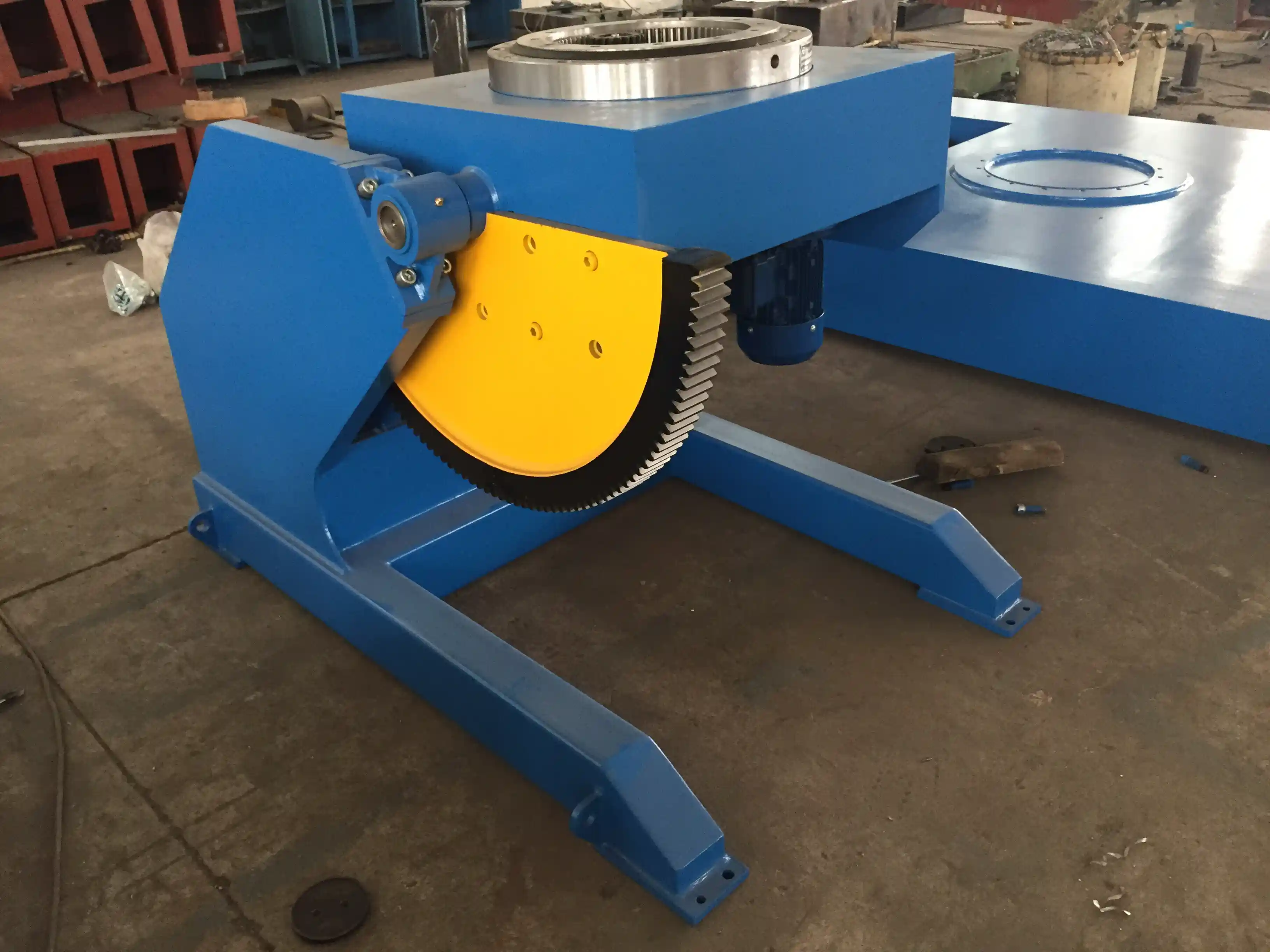
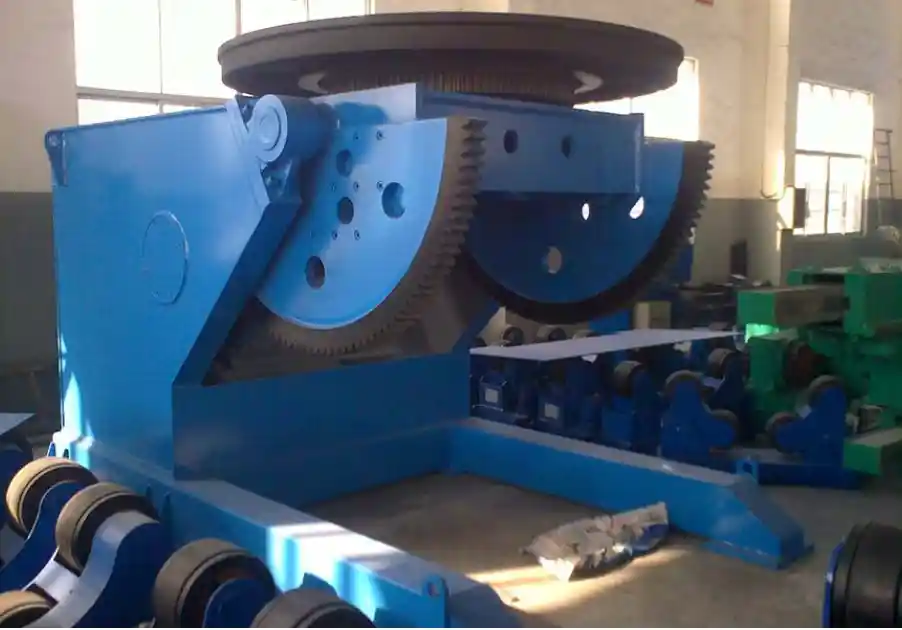
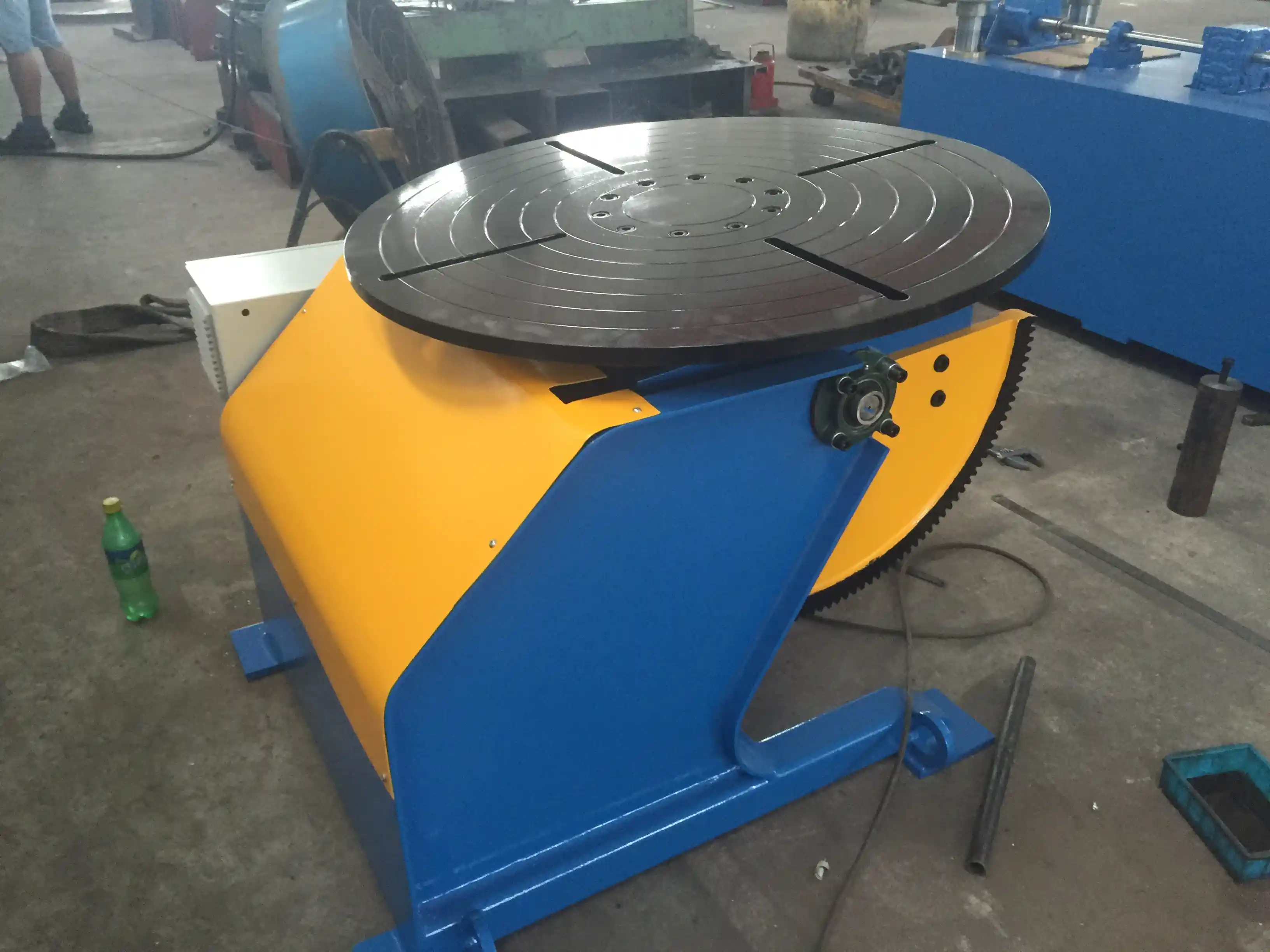
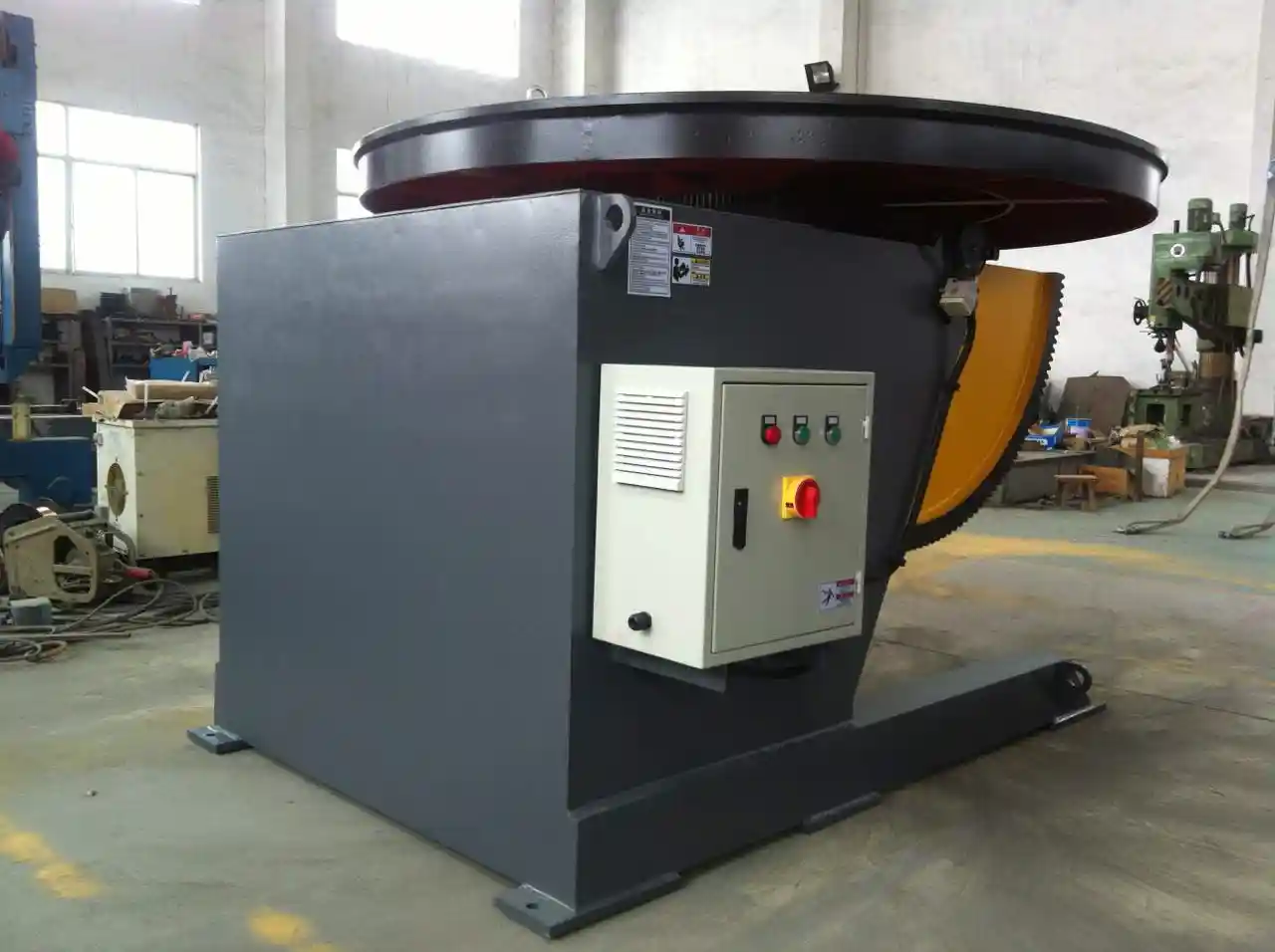
Welding positioners grip the workpiece and rotate or tilt it to present the weld joint at the optimal flat or horizontal position. For oversized parts, L-type positioners and adjustable-height positioners are the most common. An L-type design supports the workpiece on a faceplate with an extended support arm, which is why it is often used for long, asymmetrical components like excavator booms or crane segments. An adjustable-height positioner can raise or lower the table to match different trunnion heights or to coordinate with a welding manipulator column. For example, our LHBJ-50 model with 5,000 kg load capacity offers a worktable height range of 1,000–2,000 mm and a ±0.5° positioning accuracy, which we have found sufficient for most medium-sized pressure vessel subassemblies.
Welding manipulators consist of a vertical column and a horizontal boom that carries the welding head, while the heavy workpiece is moved by a positioner or a rotator. In oversized component production, the manipulator’s travel range and boom rigidity are what matter most. A manipulator with 8,000 mm horizontal travel and a rigid box-beam structure, like our LH8080, can reach the full length of a large tank shell without repositioning the column.
For rotating cylindrical parts such as vessel shells, pipe sections, and wind tower cans, welding rotators are the foundation. Standard rotators, adjustable-height rotators, and fit-up rotators handle different stages of production. The key selection metric for oversized work is not just the tonnage rating but the vessel diameter range and the anti-creep stability. A heavy-duty rotator rated for 100 tons and designed for diameters from 1,000 to 5,000 mm with an anti-creep deviation of under 0.5 mm will keep a large shell from walking off the rollers during multi-pass submerged arc welding.
The table below gives a quick reference for matching equipment type to typical oversized applications seen in our projects.
| Equipment Category | Example Capacity | Typical Oversized Application | Key Positioning Feature |
|---|---|---|---|
| L-Type Welding Positioner | 5 toneladas | Pressure vessel dish heads, crane segments | ±0.5° tilt accuracy, L-support for long parts |
| Adjustable-Height Positioner | 30 tons | Wind tower flanges, structural steel | Hydraulic lift 1,000–2,000 mm, continuous 360° rotation |
| Manipulador de soldadura | 8,000 mm boom | Tank shell longitudinal seams | Rigid box-beam, stepless speed, ±180° rotation |
| Heavy-Duty Rotator | 100 toneladas | Wind tower cans, storage tank shells | Anti-creep roller design, 1,000–5,000 mm diameter range |
Load Capacity and Stability: Why Static Ratings Are Not Enough
A catalog number that says “100-ton capacity” is a static rating, and in oversized component welding the dynamic load that matters more. When a positioner table rotates a workpiece that is 5 meters in diameter, the mass distribution is almost never symmetric. A wind tower flange, for instance, may have a heavy ring on one side and a thinner shell section on the other. That off-center mass creates a moment that the drive system and bearings must sustain through every degree of rotation.
The first thing I check in a specification is the eccentric distance and center-of-gravity distance the positioner is rated for. A model with a 1,000 kg load rating but a maximum eccentric distance of 150 mm cannot safely hold a 900 kg part whose center of gravity extends 300 mm from the table face. On the other hand, our HBJ-30 positioner with 3,000 kg capacity specifies a maximum center-of-gravity distance of 400 mm, which we routinely use for excavator booms that are long rather than symmetrical. Ignoring these distances is what leads to uneven rotation speed, excessive load on the slewing bearing, and poor weld bead consistency.
Another stability factor that shops rarely evaluate early enough is the anti-creep performance of the rotator rollers. For vessels above 4 meters in diameter, even a slight taper in the shell or misalignment of the roller frames can cause the workpiece to drift axially during rotation. With a weld seam active and a submerged arc flux bed in place, that drift ruins the weld. Our 100-ton adjustable-height rotator includes a hydraulic anti-creep system and German NOVO displacement sensors that track axial movement in real time, which we have integrated into several wind tower production lines to keep the shell within 0.5 mm of the target path. That is the kind of detail that separates a rotator that can hold the weight from one that can hold the position.
Precision Control for Automated Welding of Large Components
When a 50-ton workpiece is mounted on a positioner, manual repositioning between weld passes is neither safe nor productive. In automated setups, the positioner’s rotation speed, tilt angle, and synchronization with the welding torch must be repeatable within a fraction of a degree, or the weld bead will wander. This is where servo-driven axes, PLC control, and encoder feedback become non-negotiable.
Our 3-axis positioners, from 1 ton up to 5 tons, use servo motors with THK linear guides and SEW reducers to hold ±0.05 mm positioning accuracy and 0.02 mm repeatability. For larger oversized work, the adjustable-height models with AC frequency control and cycloidal reducers deliver ±0.5° accuracy, which is sufficient for structural steel and pressure vessel code work. I have found that the real step-change in welding quality comes when the positioner is paired with a seam tracking system on the manipulator boom. In a wind tower line we commissioned last year, the combination of a LH8080 manipulator and a 30-ton adjustable positioner reduced the average girth weld repair rate from 12% to under 3% across the first 100 towers, because the torch followed the joint exactly as the positioner rotated, without manual intervention.
Workshop Layout and Crane Coordination
Adding a machine that handles 60-ton, 6-meter-long workpieces is as much a material flow decision as a welding decision. The bay needs enough overhead crane capacity to load and unload safely, and if the positioner or rotator sits on rails, the crane’s hook path must clear the column boom or the positioner in its tilted position.
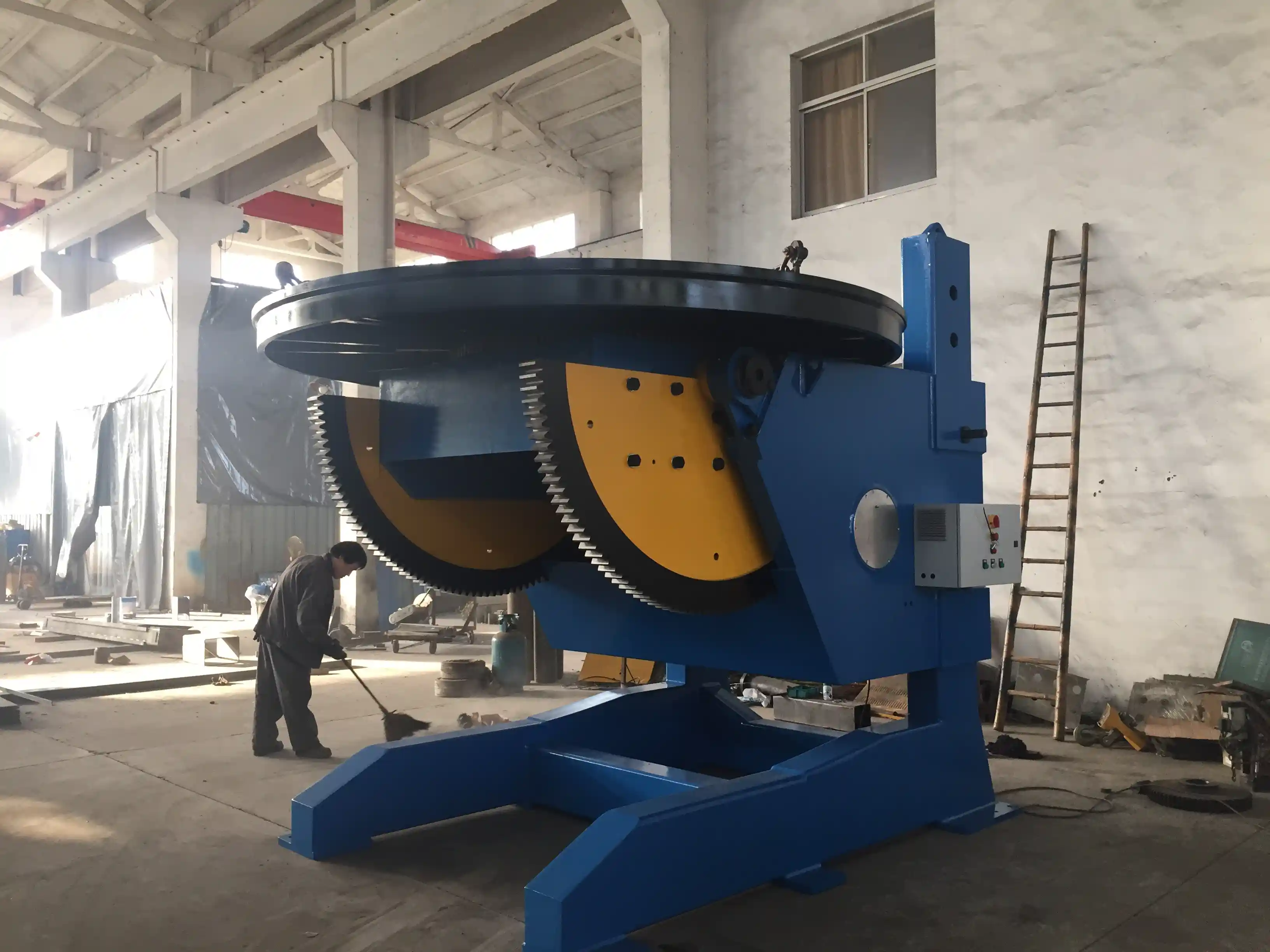
I usually recommend starting with a simple 2D layout sketch that includes the positioner’s envelope at full tilt, the manipulator boom at maximum extension, and the crane hook coverage. For example, a 30-ton adjustable positioner with a 1,500 mm worktable and a tilting range of 0–120° needs a minimum vertical clearance of about 3.5 meters above the table when fully tilted, allowing room for a workpiece up to 3 meters in radius. If the same bay also runs a welding manipulator on a track, the track centerline must be offset enough that the manipulator can reach the positioner’s work zone without the boom colliding with the tilted part.
For shops that are physically constrained, a head-and-tail positioner configuration often works better than a single large positioner. In this setup, a drive headstock and a tailstock support a long workpiece at both ends, and the assembly can be rotated without the need for a massive faceplate. Our HBT series head-and-tail positioners, rated for 1 to 3 tons, are frequently deployed in pipe and shaft fabrication where a standard L-type positioner would have difficulty supporting the long workpiece.
If your program involves components that exceed the bay’s existing crane capacity or require a dedicated foundation, it is worth confirming the civil works scope before finalizing the equipment specification. Reach out at jay@weldc.com with your layout constraints, and we can share typical floor loading and clearance data for our standard models.
Production Efficiency and ROI from Specialized Positioning
For the same welding task, a fabricator using a manual chain hoist and a fixed stand might take four hours to rotate and reposition a 5-ton part for multi-position welds. That same job on a 3-axis positioner with a 100-program PLC controller might take under an hour, with the added benefit that the operator can stay in the flat position for the entire seam. Labor savings alone often recover the positioner cost within the first year of multi-shift production.
The larger payback, though, is in reduced rework and improved first-pass yield. In pressure vessel fabrication, every repair weld on a longitudinal or circumferential seam costs consumables, inspection time, and schedule risk. A ±0.5° positioner that holds the joint orientation constant reduces undercut and lack-of-fusion defects that a manual positioner with a slip-clutch or worn gears would introduce. I have tracked similar improvements across boiler panel welding lines where a consistent rotation speed eliminated the over-welding that can warp thin membrane panels.
Beyond the direct weld quality, the ability to reposition a heavy part in seconds, rather than minutes, opens up the possibility of multi-machine operation. One operator can load the positioner, initiate the automated weld cycle, and spend the welding time on another station. That increase in utilization per operator has become a major factor in how we justify the investment to fabrication shop owners.
Frequently Asked Questions About Heavy-Duty Workpiece Positioning
Heavy-duty positioners are rated for several tons, but what happens if the part shape is uneven?
If the mass distribution is uneven, the effective load on the positioner’s drive and bearing exceeds the static rating. You need to verify the eccentric distance and center-of-gravity distance specified by the manufacturer. If the real load center exceeds those limits, the rotation will be jerky, the motor may overheat, and the weld quality will suffer. In our factory, we always model the worst-case orientation during the quoting stage to ensure the positioner or rotator stays within its rated dynamic envelope.
Can one positioner handle both small and oversized components?
It is possible, but not always cost-effective. A positioner sized for a 100-ton vessel will have a large table and high torque at low speed, which may be impractical for small precise parts. Many shops use a combination: a 1–3 ton positioner for smaller subassemblies and a larger adjustable-height model for the main vessel sections. The key is that the control system remains consistent across sizes, which is why we standardize on Siemens PLC and touchscreen interfaces across the HBJ and LHBJ series.
Is it true that the heavier the positioner, the less precision it offers?
Not inherently, but the cost to achieve the same precision rises with capacity. A 1-ton positioner with a THK linear guide and servo drive can hold ±0.05 mm repeatability. To reach ±0.5° rotation accuracy on a 100-ton positioner, the gear train must be designed with minimal backlash, and the slewing bearing needs high surface hardness. Our 100-ton adjustable positioner uses a cycloidal-worm dual-stage reducer and a ZG45 alloy slewing bearing to combine capacity with useful precision for structural code work.
How does the positioner integrate with a welding manipulator that is also moving?
The manipulator column and the positioner table need a common reference coordinate. In automated cells, the PLC controls both axes, coordinating the boom travel with the positioner rotation for multi-pass girth welds. Some systems use laser seam tracking on the manipulator to compensate for slight workpiece ovality, while the positioner maintains a constant linear weld speed. We have implemented this coordination in wind tower lines and pressure vessel shops using the same PLC platform across both machines.
What foundation does a 60-ton rotator require?
A concrete pad at least 300 mm thick reinforced with rebar, typically tied into the factory floor slab. The load is spread across multiple roller frames, but the dynamic forces can induce vibration. We provide foundation drawings with bolt patterns, leveling pad requirements, and crane clearance zones for every rotator above 10 tons.
We fabricate one-of-a-kind large vessels; is it better to buy a positioner or a welding manipulator first?
If you are welding large cylindrical shells, start with a welding rotator and a column-and-boom manipulator. The rotator handles rotation, the manipulator reaches the joint. A positioner is added later when you need to reposition the ends or flanges. I have seen too many shops buy an expensive positioner first and then realize they cannot reach the weld joint without the manipulator boom. We typically help new buyers map the first six months of work to sequence the equipment purchase in the order that generates the quickest payback. Share your project’s typical part dimensions and weight range at jay@weldc.com or call +86-510-83555592, and we will confirm stock readiness and a configuration that fits your bay.
Si te interesa, echa un vistazo a estos artículos relacionados:
Equipos rotativos de soldadura profesional ABK de Wuxi: solución de soldadura de precisión para la fabricación de recipientes a presión
Baja eficiencia en la soldadura de conjuntos de tuberías: cómo los soportes de rodillos inteligentes aumentan la productividad en un 501 %
 English
  Español
  Français
  Deutsch
  Português
  Русский