Shipbuilding welding automation succeeds when the technology is matched to the way a yard actually builds — long panel seams, heavy block rotations, and repetitive pipe spool girth welds. A narrow focus on robotic arms misses the real bottleneck: positioning, fit-up, and process repeatability. The systems that usually create the strongest production impact are column booms and manipulador de soldaduras, welding positioners, pipe rotators, and coordinated fit-up roller beds. When these are selected around maximum panel dimensions, block mass, pipe diameters, and classification requirements, a yard reduces out-of-position manual welding and improves the repeatability of weld profiles that NDT inspectors review. This article maps the main welding automation solutions for the shipbuilding industry and how to size them around panel dimensions, block mass, pipe diameter, and classification requirements.
Where Shipbuilding Welding Automation Has the Greatest Impact
Shipyard welding differs from general structural fabrication in three ways. First, panel lines consist of long butt and fillet joints that can be welded with submerged arc or multi-wire processes, but only if the work is positioned consistently and the weld head tracks accurately. Second, block assembly involves curved shell plates, stiffeners, and heavy sub-assemblies that would otherwise require overhead or vertical manual welding. Third, outfitting includes large numbers of pipe spools, brackets, and thin-wall stainless lines that need controlled root pass conditions.
Automation does not replace the need for classification-approved welding procedure specifications (WPS) or qualified welders. It changes where those welders spend their time. In shipyards, the greatest return usually comes from converting repeated long seams and circular girth welds from manual out-of-position work to mechanized, repeatable work. This also improves documentation: PLC and servo-driven equipment can record travel speed, current, voltage, rotation speed, and operator identification, which supports traceable weld data in class-reviewed construction.
Ship welding workflows improve most when the positioner, manipulator, and rotator are selected together around block mass and weld orientation. <Revolution in Ship Welding: How Welding Positioners Improve Quality and Efficiency> covers how coordinated positioning systems improve quality and throughput in shipyard welding operations.
Core Automation Systems for Shipyard Fabrication
Column booms and welding manipulators
A rail-mounted or floor-mounted column boom carries a submerged arc or multi-wire welding head over long horizontal seams. For hull panel work, the key parameters are horizontal travel, vertical travel, and boom reach. In the WUXI ABK LH series, horizontal travel ranges from 1,200 mm to 8,000 mm, vertical travel from 3,500 mm to 8,000 mm, and boom travel can be stepless from 0.12 to 1.2 m/min. Positioning accuracy is specified at ±0.1 mm/m. This equipment is used for flat panel butt welds and long fillet joints on stiffened panels, reducing repeated set-up along the seam. For panel lines, a Manipulador de soldadura should be specified as part of a complete rail system rather than as an isolated boom.
Three-axis positioners and turntables
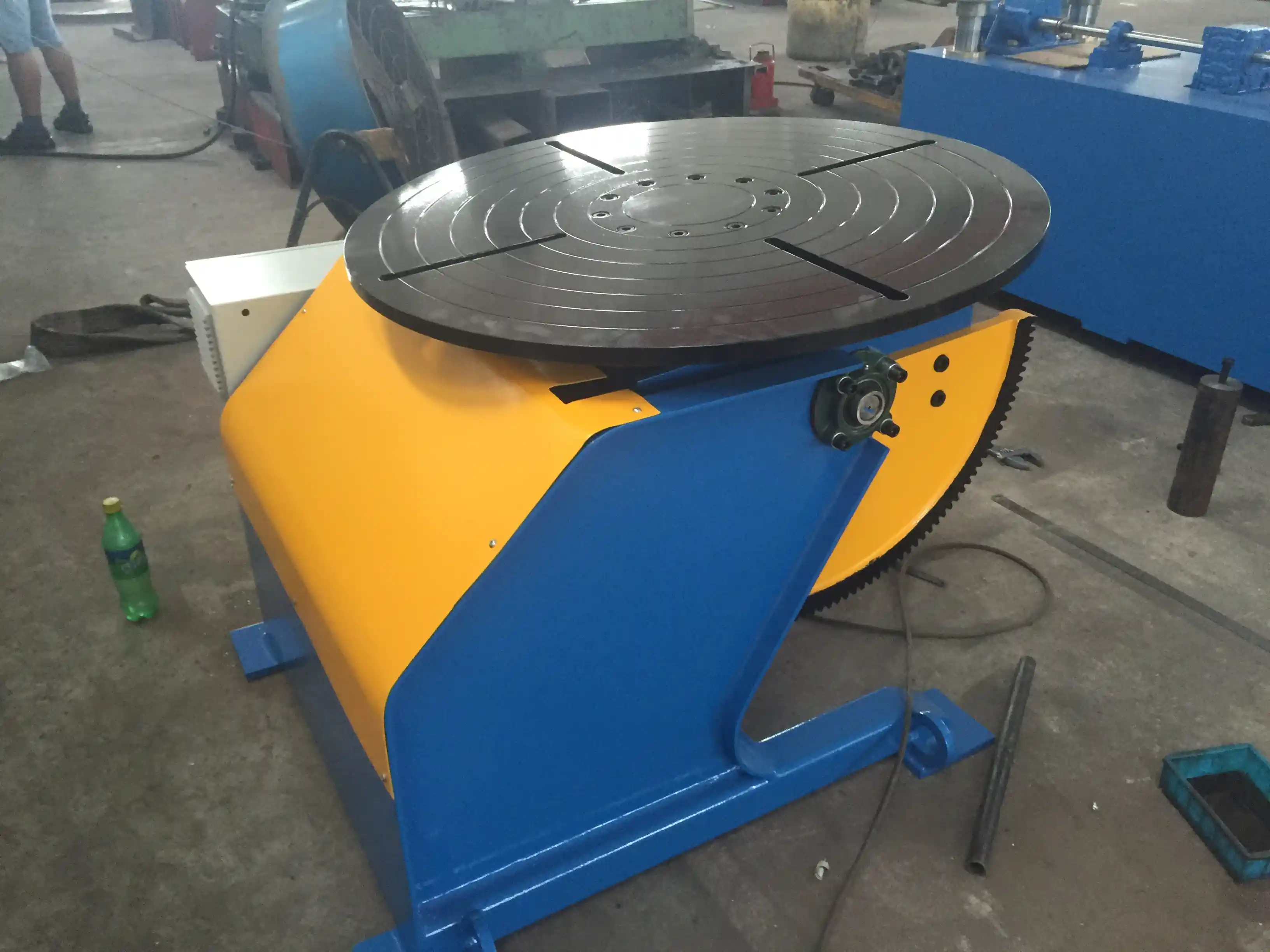
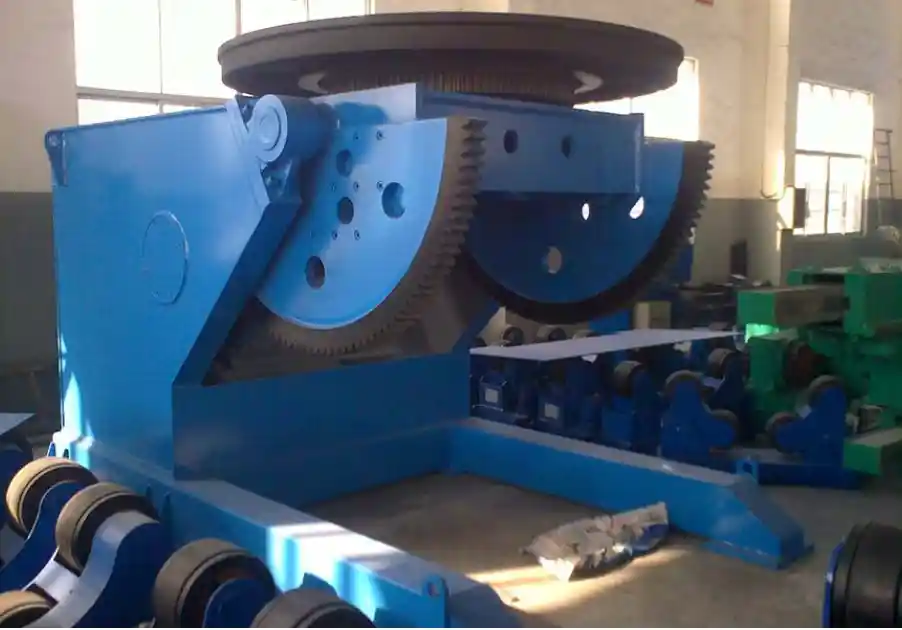
Sub-assemblies, brackets, rudder parts, and small block components require repeated orientation changes. A three-axis welding positioner provides 360° continuous rotation, 0–90° tilting, and 180° turning. ABK 1-ton to 5-ton three-axis positioners use servo drives, THK linear guides, and SEW reducers; selected models achieve ±0.05 mm positioning accuracy and 0.02 mm repeatability. These positioners can connect with ABB, KUKA, FANUC, and Yaskawa robots. For shipyard sub-assembly cells, the torque and third axis are more important than raw table diameter: a compact block can be welded in the flat position by coordinated rotation and tilt, reducing manual repositioning time. Shipyards with limited floor space often use fixed-height positioners for repeated bracketry and small block work because they exchange tilt complexity for a smaller footprint and simpler foundation. A Posicionador de soldadura de 3 ejes is the preferred class for robotic sub-assembly and curved panel components.
Fixed-height positioners are a practical entry point for offshore and shipbuilding yards that need repeatable positioning without taking up excessive floor space. <Valor de aplicación excepcional: Cómo los posicionadores de soldadura de altura fija impulsan los avances en la fabricación en alta mar y la construcción naval> covers application value and setup considerations for shipbuilding and offshore manufacturing.
Welding rotators and pipe roller beds
Piping systems in a vessel account for thousands of girth welds. A welding rotator supports the pipe spool while a fixed or mechanized welding head welds the girth seam in the flat position. For shipbuilding pipe shops, the selection must match pipe outside diameter and total assembled weight. ABK adjustable welding rotators span from 5 tons to 300 tons, with wheel diameters from 250 mm to 800 mm and vessel diameter ranges extending from roughly 250 mm to 6,000 mm depending on model. Higher-capacity units include hydraulic height adjustment, anti-creep control, and PLC integration. Self-aligning rollers help maintain root gap and alignment during continuous rotation. A Rotador de tubos de alta resistencia should be considered when spool weight exceeds the capacity of standard pipe stands.
Shipyard pipe lines face more than weld defects; fit-up and coating continuity determine final pass rates. <Problemas de descuelgue en el recubrimiento de tuberías de buques: cómo los soportes inteligentes para rodillos de pintura aumentan la tasa de aprobación hasta el 98%> covers how controlled rotation improves coating consistency and final pass rates in shipyard pipe operations.
Fit-up rotators and heavy roller beds
Large shell plate sections need to be aligned before welding. Fit-up rotators combine driven and driven roller frames with hydraulic alignment carriages, often with laser guidance. They align root gap and plate edges before the main welding pass, which is critical because poor fit-up in hull welding creates excess weld metal, distortion, and a higher likelihood of NDT indications. A fit-up rotator is not a replacement for a crane; it is a controlling station between crane lift and welding start. The key selection data are maximum shell diameter, load per roller, and alignment stroke. A Heavy Duty Fit-Up Rotator provides the alignment control needed for large-diameter shell courses.
Process Control, Classification Compliance, and Workflow Integration
Shipbuilding welding is governed by class society rules and international welding quality standards. Many shipyards work to comprehensive quality requirements under ISO 3834-2 [1]. Structural steel used in hull construction must meet the basic requirements for hull structural steel under IACS UR W11 [2]. For structural welding of steel in shipyard block and panel work, yards often align with AWS D1.1 or an equivalent class-approved structural welding code [3]. Actual acceptance criteria for weld profile, surface imperfections, and internal indications come from the relevant class rules and the shipbuilding quality standard in IACS Recommendation No. 47 [4].
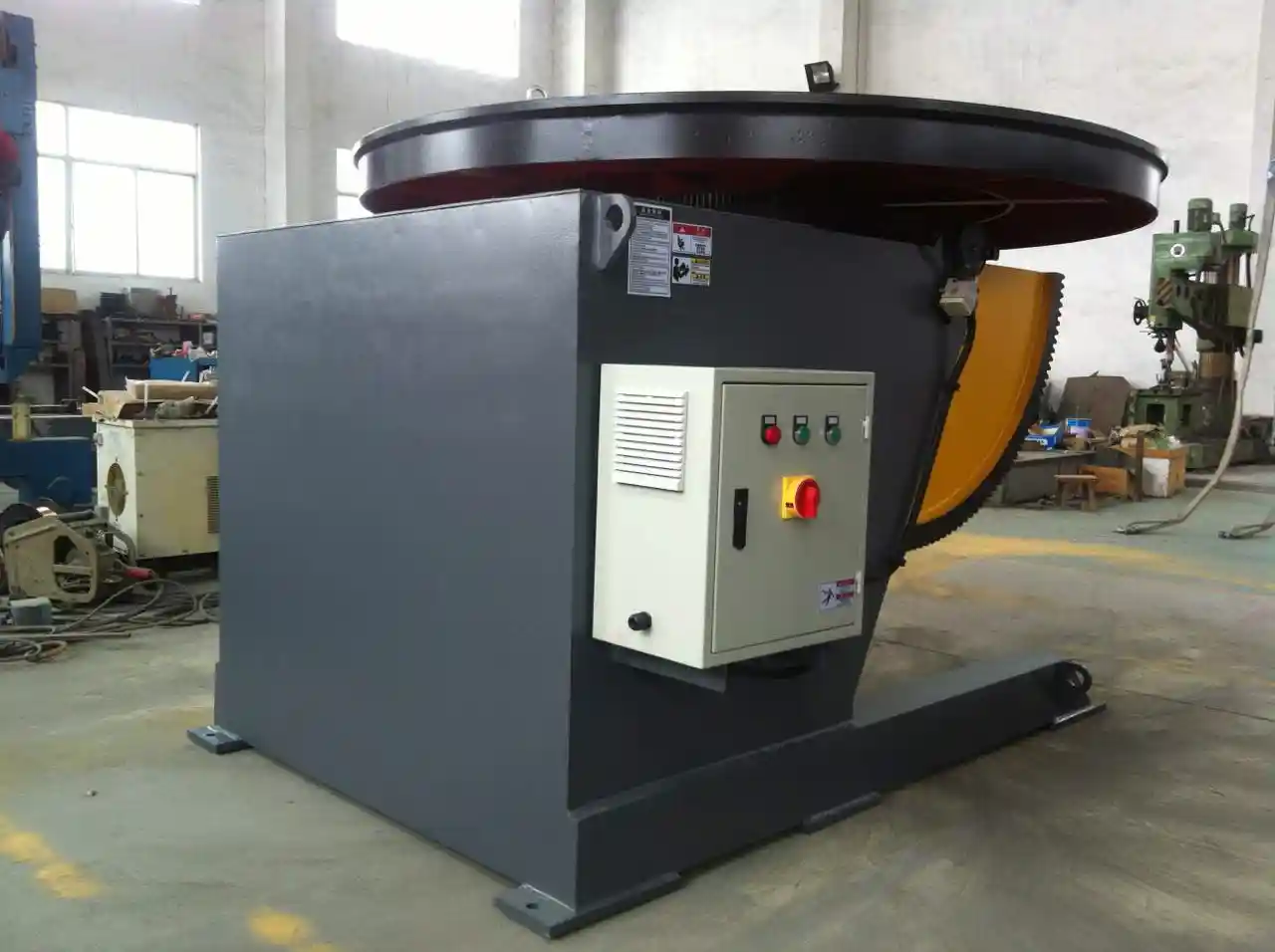
This means automation should be specified from the WPS backward. The WPS defines heat input limits, travel speed, interpass temperature, and permitted processes. The automation system must maintain those parameters across a full seam. A positioner that rotates consistently at 0.05–0.5 RPM may be appropriate for certain circular welds, but shipyard workpieces can require different rotational speed ranges. The selection should confirm that the rotator or positioner speed band matches the weld-metal deposition rate and seam diameter, not merely the equipment catalog rating. Digital control with recipe storage also makes it easier to repeat a qualified parameter set and to collect weld log data.
Integration should also follow the material flow. In a new panel line, the column boom works best when there is a flat, level bed, a fixed work datum, and enough bay length for the vessel section to move without repeated crane lifts. In a block assembly cell, the positioner should be centered under the crane path and connected to the robot or welding tractor interface. In a pipe shop, rotators should feed directly into the weld booth, with roller frames aligned by centerline rather than by eye. The right layout reduces waiting time between fit-up, welding, and inspection.
Equipment Selection Model for Shipyards
A practical way to select automation is to divide the shipyard into three welding families: long linear seams, rotating block sub-assemblies, and circular pipe spool seams. Each family has one parameter that usually decides the specification.
| Welding family | Primary automation platform | Key parameters to verify |
|---|---|---|
| Long panel seams | Column boom or gantry with SAW/multi-wire head | Horizontal travel, vertical travel, seam tracking, WPS speed range |
| Block sub-assembly | 3-axis welding positioner or turntable | Load capacity, tilt/turn angles, positioning accuracy, robot interface |
| Pipe spool girth welds | Adjustable welding rotator | Vessel diameter range, total load, anti-creep, rotational speed control |
| Shell plate fit-up | Heavy-duty fit-up rotator | Diameter capacity, alignment stroke, number of roller frames, load per roller |
For example, a 2 m × 12 m hull panel may be served by a column boom with at least 4,500–8,000 mm horizontal travel, while a 20-ton pipe spool station would use a 40-ton rotator system if the fixture and dynamic load are considered. These numbers should be checked against the maximum workpiece weight including tacked attachments. If the equipment share is too low, load distribution problems appear later as creep, irregular rotation, and uneven weld toe lines.
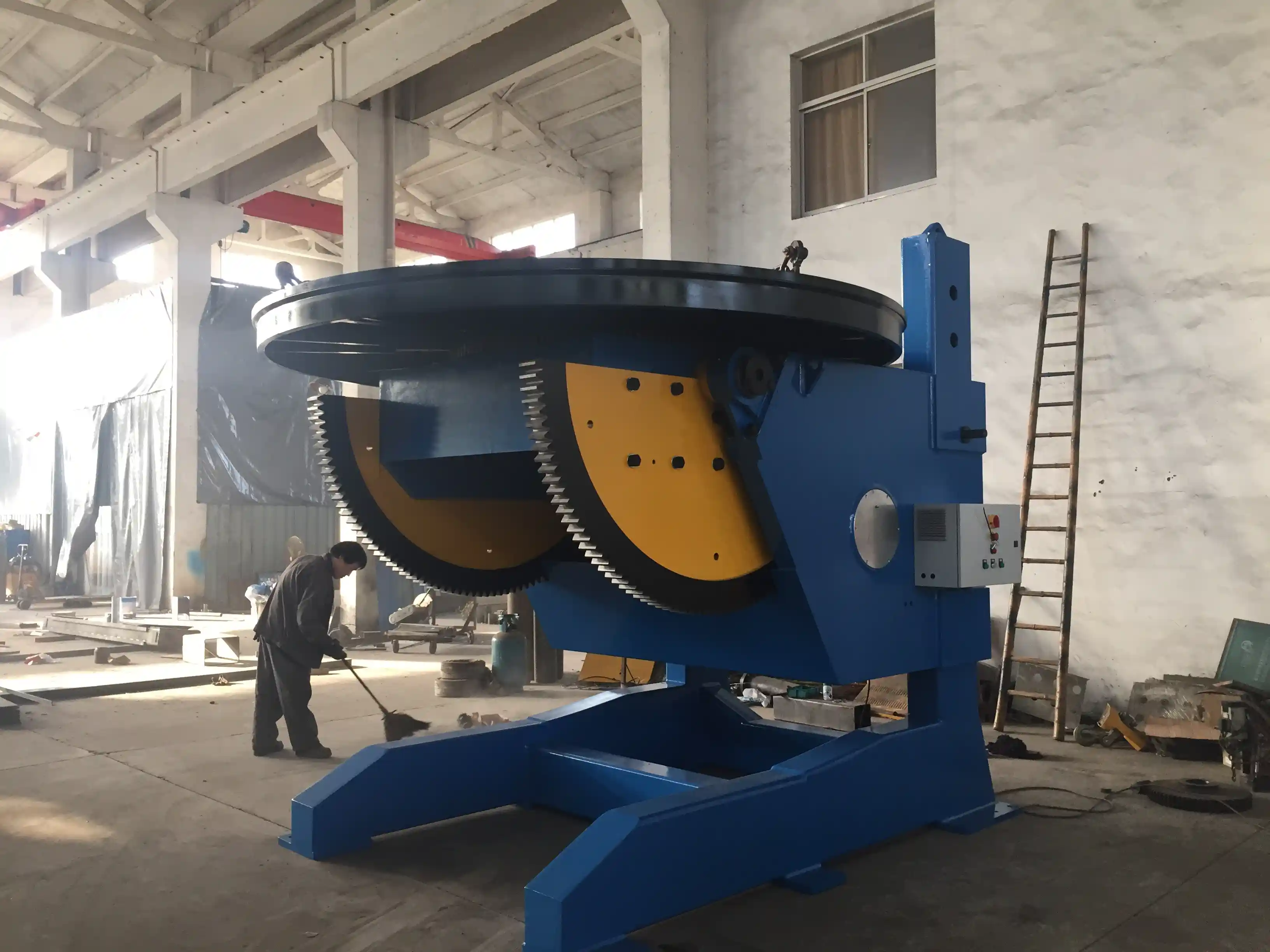
The third axis is often the difference between a positioner and a roll manipulator. A standard pipe rotator rotates around the longitudinal axis. A three-axis positioner also tilts and turns the part, which is useful for brackets, skeg structures, and small block inserts. The right choice depends on whether the weld can be kept in the flat or horizontal position by rotation alone, or whether the part must be turned to bring additional joints into reach.
Maintenance and Reliability in Shipyard Conditions
Shipyards are harsh environments: salt air, grinding dust, weld spatter, and high humidity. Any automation system should be specified with IP54 or better control enclosures, protected linear guides, and accessible lubrication points. Daily slag removal, monthly bolt torque checks, and annual calibration of rotary axes support positioning accuracy over time. For rotators, anti-creep systems and self-aligning rollers should be inspected because roller wear changes contact angle and can cause axial drift. For positioners, the slewing bearing, reverse gears, and gear reducer should be checked for backlash, and the safety interlocks should be tested at scheduled intervals.
Preventive maintenance is not separate from weld quality. A positioner with worn gears may still rotate but may not hold the travel speed required by the WPS. A rotator with damaged rollers may appear functional but can introduce periodic root gap changes mid-weld. In shipyard work, where NDT detects both internal and surface indications, mechanical stability is part of the welding process.
Request a Shipbuilding Welding Automation Proposal
If you are planning a panel line upgrade, block assembly cell, or pipe spool line, send Wuxi ABK Machinery the following project data:
- Hull steel grades and thickness range
- Maximum panel length, width, and block mass
- Pipe spool diameter, wall thickness, and material
- Target shift output or weld meters per day
- Class society, code, or buyer specification
- Bay dimensions and crane capacity
Correo electrónico: jay@weldc.com
Tel: +86-510-83555592
PREGUNTAS FRECUENTES
Is welding automation suitable for shipyards with low-volume or repair work?
Yes, but not every cell needs a robot. Low-volume and repair yards often benefit from fixed-height positioners, pipe rotators, and column booms because these systems reduce manual repositioning and support repeatable weld parameters without requiring a fully automated line. The best entry point is usually the most frequently repeated joint family.
Which class rules apply to automated SAW or robotic welding in shipbuilding?
The specific acceptance criteria come from the relevant class society rules, but the common engineering baseline includes ISO 3834 for welding quality management, IACS UR W11 for hull structural steel, and IACS Recommendation No. 47 for shipbuilding and repair quality. A WPS must still be qualified with the process and parameter range used in production.
How should a yard size a welding positioner for a typical block sub-assembly?
Start with the actual block weight, then add the fixture, tacked attachments, and the eccentric moment when the center of gravity is offset from the table center. Load capacity alone is not enough; tilt range, turning angle, positioning accuracy, and the dynamic load rating must be checked. If the block is not symmetrical, a three-axis positioner or adjustable-height positioner may be required instead of a simple turntable.
Does shipyard automation require replacing existing cranes or floor layouts?
Not necessarily. Column booms can be rail-mounted along an existing bay, positioners can be integrated under an existing crane path, and rotators can be placed in a pipe shop without major structural changes. The main requirements are level foundations, adequate power supply, and enough clearance for the largest workpieces.
References
[1] ISO 3834-2:2021, Quality requirements for fusion welding of metallic materials — Part 2: Comprehensive quality requirements.
[2] IACS UR W11, Normal and Higher Strength Hull Structural Steels, International Association of Classification Societies.
[3] AWS D1.1/D1.1M:2020, Structural Welding Code — Steel.
[4] IACS Recommendation No. 47, Shipbuilding and Repair Quality Standard, International Association of Classification Societies.
Si te interesa, echa un vistazo a estos artículos relacionados:
¿Espacio de taller demasiado pequeño? Cómo las columnas ahorran espacio 50% a la vez que aumentan la seguridad y la eficiencia
Tired of Complex Welding Challenges? How a 3-Axis Positioner Can Boost Productivity by 70%
Principales puntos débiles y soluciones de alta precisión de los posicionadores de soldadura en los sectores de la energía eólica y la construcción naval: Análisis técnico exhaustivo
Manipuladores de soldadura para la fabricación de torres eólicas: Revolucionando la eficiencia de la producción
Desafíos de la soldadura de torres eólicas: Cómo los sistemas avanzados de elevación hidráulica aumentan la producción por 40%
 English
  Español
  Français
  Deutsch
  Português
  Русский