When a welding fabrication shop pursues ISO 3834 welding quality certification, the initial focus typically falls on documentation manuals and management system design. After more than twenty years of integrating automation equipment into certified production lines across heavy fabrication, I have observed that the machinery itself sets the ceiling on quality. Welding positioners, rotators, and manipulators do not simply move workpieces. They must deliver the repeatable positioning precision and process control that make audit-worthy weld records possible in the first place.
Understanding ISO 3834 Welding Quality Requirements
ISO 3834 is a family of standards that defines quality requirements for fusion welding of metallic materials. It applies across fabrication sectors from structural steel and pressure vessels to wind tower production. The standard has three compliance levels. ISO 3834-2 addresses comprehensive quality requirements, ISO 3834-3 covers standard requirements, and ISO 3834-4 focuses on elementary quality requirements. A fabricator selects the level based on the criticality of the welded structure and the demands of the end customer or regulation.
What many shops overlook is that ISO 3834 extends beyond welding procedure specifications, welder qualification records, and non-destructive testing plans. It requires demonstrable control over the production process itself. Welding coordination personnel must prove that every piece of equipment involved in production, from the cutting machine that prepares edge bevels to the positioner that orients a heavy cylinder for circumferential welding, operates within defined and documented parameters. This is where the equipment conversation starts.
Equipment Capabilities That Support ISO 3834 Compliance
The standard does not prescribe specific machine brands or models. It demands that the fabricator demonstrate process capability. In practice, this means the equipment must provide repeatable movement, consistent parameter execution, and traceable performance records. Three categories of equipment carry the heaviest weight during an ISO 3834 certification audit.
Welding positioners are central. When a fabricator welds a pressure vessel shell or a wind tower section, the positioner controls rotational speed, tilt angle, and workpiece stability. If the table rotates unevenly or the tilt drifts during a pass, the weld profile changes, and the quality record becomes inconsistent. Machines like the WUXI ABK 3-axis welding positioners, with positioning accuracy of ±0.05 mm and repeatability of 0.02 mm, remove that variable. Their Siemens PLC and HMI touchscreen store multiple pre-set programs, so an operator can recall the exact parameters for a recurring part number. This programmability directly supports the traceability requirement in ISO 3834-2.
Manipulador de soldaduras handle longitudinal and circumferential seams on large structures. A column and boom system must maintain travel speed within a tight window while keeping the welding head stable. The ABK manipulator series, with linear guideways and stepless speed control from 0.12 to 1.2 m/min for horizontal travel, provides that stability. Adjustable height welding rotators then complement the manipulator by turning the workpiece. For ISO 3834 work, the rotator must prevent axial creep. Even 0.5 mm of creep over a few rotations can shift the welding position outside the qualified range. Rotators with anti-creep mechanisms and NOVO displacement sensors, as used in our higher-capacity models, maintain the required alignment.
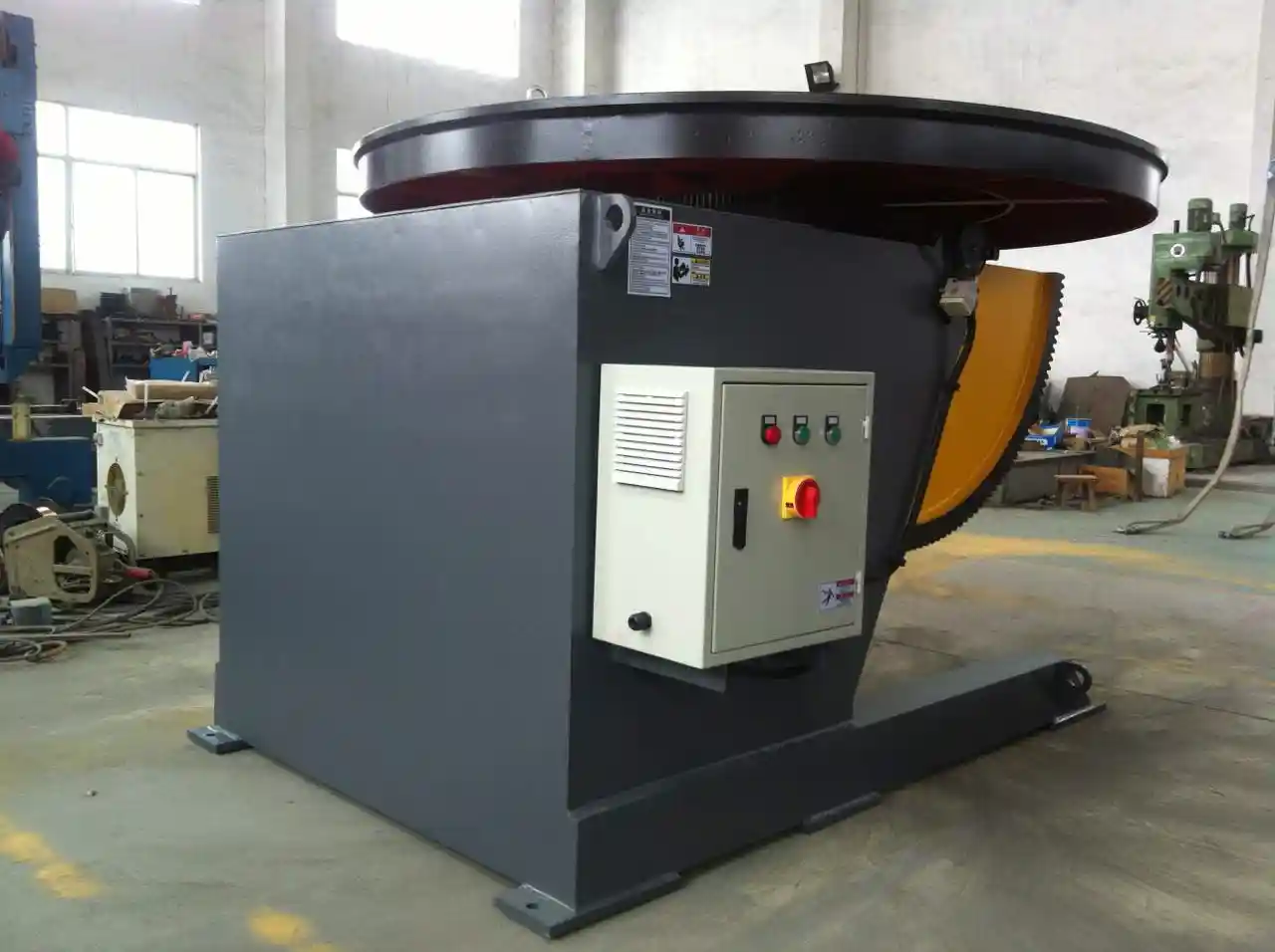
Below is a representative comparison of small-to-medium capacity positioners that satisfy the positioning precision expected in ISO 3834 environments.
| Modelo | Capacidad de carga | Rotation Accuracy | Repetibilidad | Sistema de control |
|---|---|---|---|---|
| 1 Ton Posicionador de 3 ejes | 1 tonelada | ±0,05 mm | 0,02 mm | PLC Siemens + HMI |
| Posicionador de 2 Ton y 3 ejes | 2 toneladas | ±0,05 mm | 0,02 mm | PLC + pantalla táctil |
| Posicionador de soldadura de 3 ejes 3 Tons | 3 toneladas | ±0,05 mm | 0,02 mm | PLC + pantalla táctil |
| Mesa de posicionamiento de triple eje 5 toneladas | 5 toneladas | ±0,05 mm | 0,02 mm | PLC + HMI |
These figures are not just specifications on a data sheet. An auditor reviewing your welding quality records will expect to see that the equipment consistently operates within its stated accuracy range. Machines with documented calibration and performance history make those audit conversations straightforward.
If your program involves large cylindrical sections with wall thicknesses above 30 mm, the rotator’s creep prevention specification becomes a pass-fail criterion for circumferential weld quality. It is worth confirming the creep spec and anti-drift design before finalizing your BOM. Reach out at jay@weldc.com with your workpiece diameter and weight, and we will check the correct rotator configuration for your application.
How Equipment Precision Translates to Audit-Ready Quality
A consistent theme in ISO 3834 audits is that the welding process must produce repeatable results under defined conditions. Equipment precision directly determines the floor of that repeatability.
Consider the welding positioner. If its rotation accuracy deviates by even ±1° during a multi-pass girth weld, the travel speed at the torch tip changes very slightly but continuously along the circumference. The resulting heat input fluctuation can produce variations in penetration and bead profile. Under ISO 3834-2, those variations must be explainable or eliminated. Using positioners with servo-driven axes and closed-loop feedback, such as the ABK 1-Ton Fixed Height Welding Positioner with ±0.5° rotation accuracy and cycloidal-worm dual-stage reducer, narrows the variation envelope. The same logic applies to welding manipulators. A boom that deflects under load changes the contact-tip-to-work distance, altering arc voltage. Machines engineered with box-beam structures and linear guideways keep that distance stable.
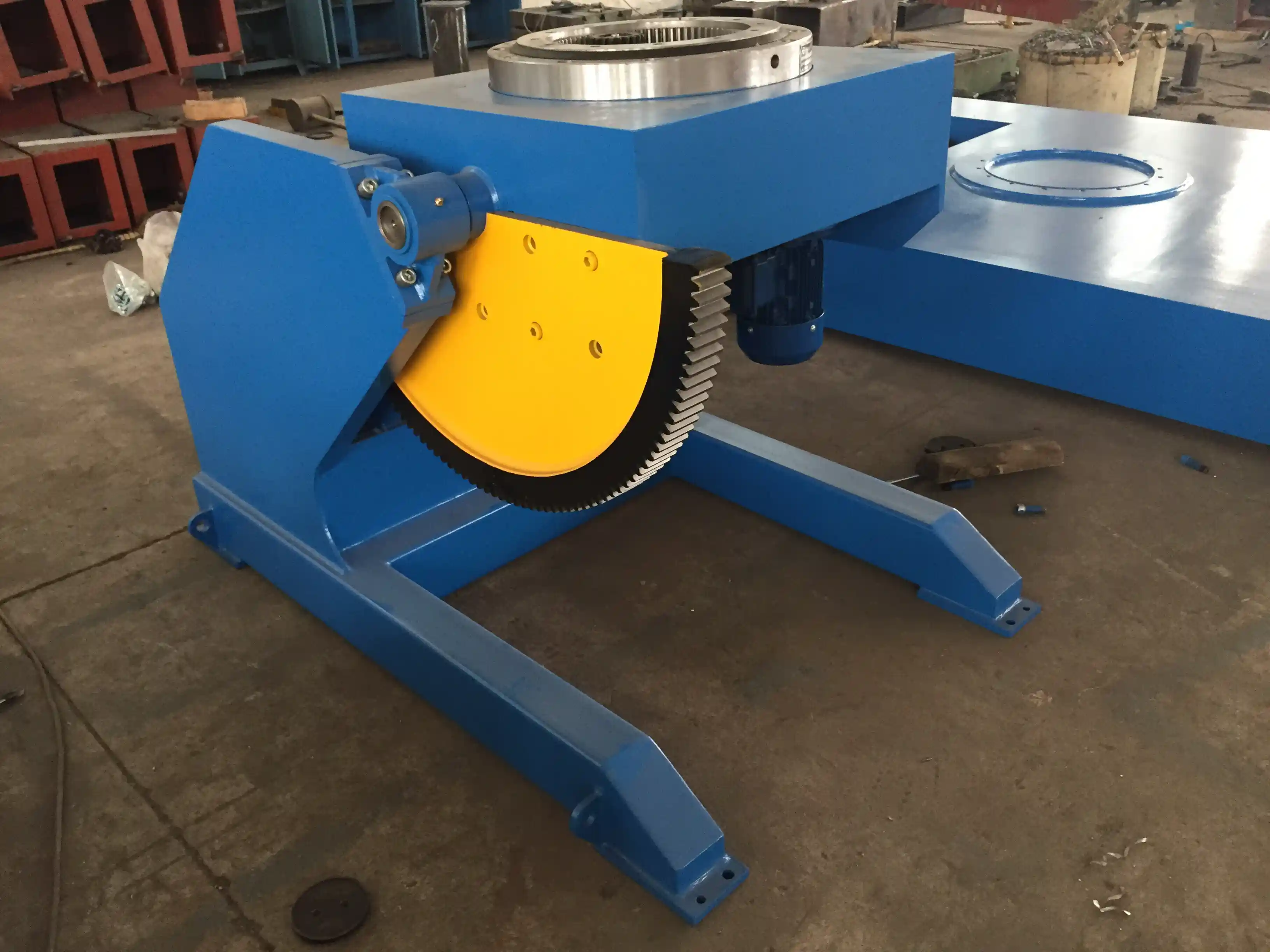
We have worked with fabricators who initially attempted to qualify under ISO 3834 using older manual positioners and simple roller beds. During the audit trial runs, the weld parameter logs showed deviations exceeding the allowable range. The root cause was not the welding procedure. It was the equipment’s inability to hold a steady rotational speed and alignment across the full length of the workpiece. After upgrading to digitally controlled positioners and rotators, the same welding procedure produced compliant records on the first re-audit.
Documentation traceability is the other half. Modern welding automation equipment includes data logging capabilities. The PLC can record rotational speed, tilt angle, and welding current for each pass, then export those records for the quality management system. This moves traceability from a manual, error-prone process to an automatic function of the machine. For ISO 3834-2, where comprehensive quality records are mandatory, this integration saves significant preparation time before each surveillance audit.
Preparing Your Workshop for an ISO 3834 Certification Run
Equipment capability is necessary but not sufficient. A systematic preparation approach bridges the gap between having the right machines and passing the audit.
First, establish a calibration schedule for all positioning and motion control equipment. The welding positioner’s rotation accuracy and the rotator’s alignment should be verified with laser measurement tools at intervals defined in your quality plan. Many shops align calibration to the maintenance schedule. For ABK positioners, the annual deep maintenance includes recalibration of the rotary positioning system, which we recommend documenting as part of the equipment’s certification dossier.
Second, create Standard Operating Procedures that reference the equipment’s programmable features. Instead of relying on the operator to set parameters, pre-program welding recipes in the HMI for each part number. This locks the procedure into the machine, reducing variability between shifts. A shop producing boiler panels, for instance, can store separate programs for different tube diameters and wall thicknesses, each with validated travel speed and rotation settings.
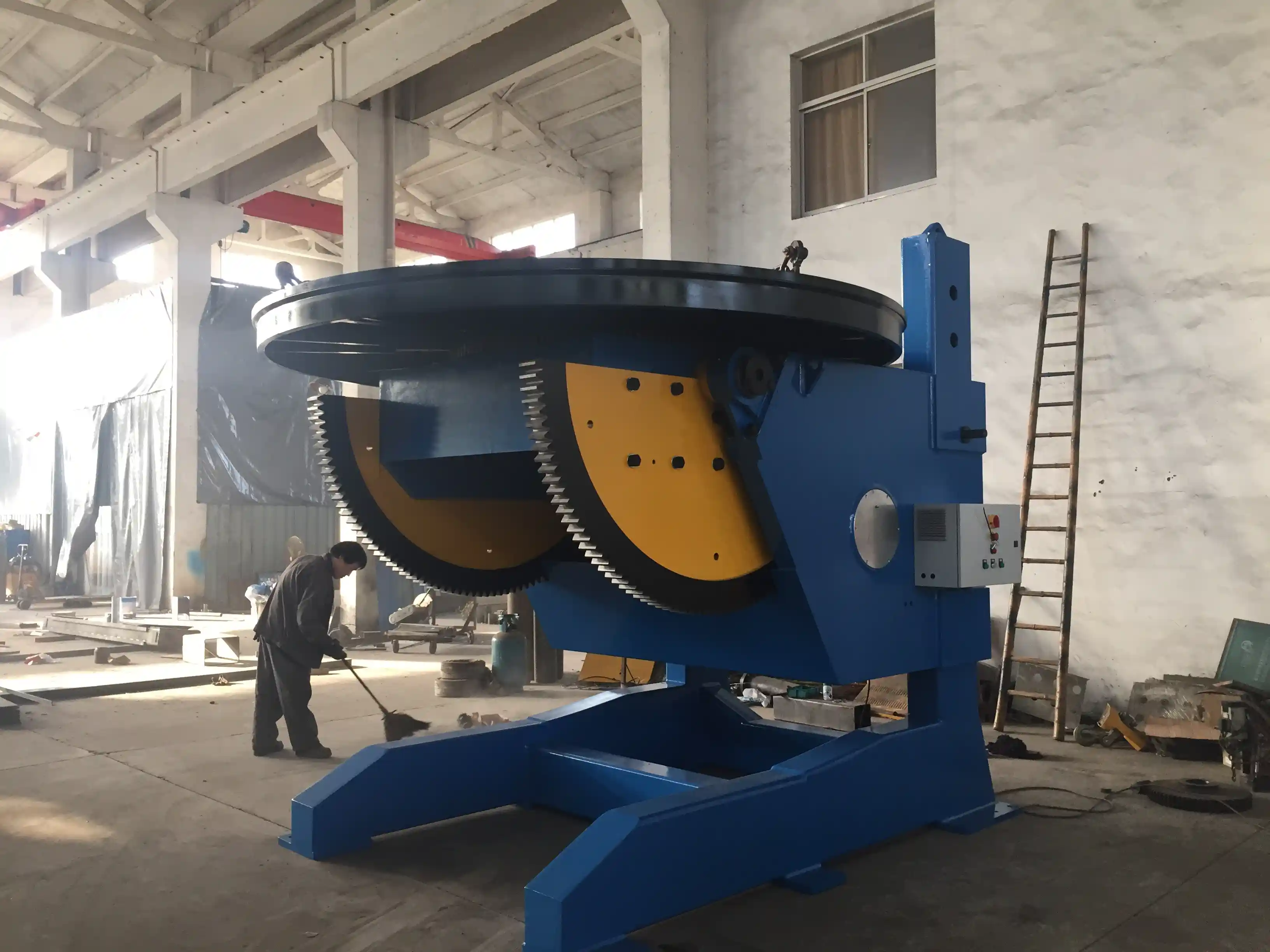
Third, verify that the equipment supports the required inspection access. ISO 3834 requires that welds be accessible for visual inspection and non-destructive testing. The positioner’s tilt range, such as 0–135° on the 5-ton fixed height model, and the manipulator’s boom reach must allow the inspector full visual and UT probe access to the weld seam during pre-weld fit-up and post-weld inspection.
Finally, conduct a pre-audit dry run. Run a representative production batch using the documented procedures and the calibrated equipment. Collect the equipment parameter logs, inspection records, and welder qualification certificates for that batch. Review them as an auditor would. Any gap between the equipment’s logged performance and the procedure’s specified ranges must be closed before the formal audit.
Common Questions About ISO 3834 and Fabrication Equipment
What is the minimum equipment needed to achieve ISO 3834 certification?
There is no minimum list specified in the standard, but the equipment must provide the process control required by the selected compliance level. For ISO 3834-3, a shop welding structural steel may qualify with well-maintained manual positioners and calibrated welding machines. For ISO 3834-2, especially in pressure vessel or wind tower fabrication, digitally controlled positioners, rotators with anti-creep, and manipulators with documented speed control become essentially mandatory to produce the required consistency and quality records.
Does the equipment need to come from a certified supplier?
No. ISO 3834 does not require that equipment manufacturers hold ISO 3834 themselves. However, the fabricator remains responsible for proving that the equipment performs within specification. Purchasing from a manufacturer that provides CE certification, calibration documentation, and detailed specification sheets simplifies the evidence collection. Our positioners and rotators ship with CE and ISO 9001 certification, and we supply the performance data needed for the fabricator’s own quality dossier.
Can we use our existing manual welding equipment for ISO 3834?
It depends on the compliance level and the specific audit criteria. If the manual equipment can repeatedly hold the parameters within the qualified range and you can document that performance, it may be acceptable for elementary requirements. In practice, shops pursuing ISO 3834-2 or supplying safety-critical components find that automated positioning equipment removes enough variability to make compliance sustainable across production batches. The cost of a failed audit often exceeds the investment in upgrading a few critical positioning stations.
How long does it take to get equipment ready for certification?
Lead times for new welding positioners and rotators from our factory typically range from 8 to 12 weeks depending on capacity and customization. After installation, plan for two to three weeks of integration, calibration, and procedure validation before the equipment participates in a certification run. If you are upgrading existing ABK machines, the annual recalibration and maintenance procedures can often be accelerated to align with your audit timeline. Share your certification target date and part numbers, and we can confirm whether your current equipment package needs an upgrade or just a calibration refresh by contacting jay@weldc.com.
What happens if the equipment drifts between calibration intervals?
Any drift that moves the equipment outside its qualified operating range creates a nonconformance under ISO 3834. The fabricator must investigate the root cause, document the affected production, and implement corrective action before the next audit. Selecting equipment with robust mechanical design, such as slewing bearings with high moment capacity and worm gear drives resistant to back-driving, reduces the likelihood of unscheduled drift. We recommend quarterly checks of rotation accuracy and alignment as part of routine maintenance, not only annual calibration.
Achieving ISO 3834 welding quality certification asks more than a well-written quality manual. It requires production equipment that turns documented procedures into consistent, inspectable welds batch after batch. WUXI ABK MACHINERY CO., LTD provides welding positioners, manipulators, and rotators engineered for the repeatable precision that certified fabrication demands. Send your part numbers and quantity to jay@weldc.com, or call +86-510-83555592, and we will help you configure an equipment package matched to the standard and production volumes you need to meet.
Si te interesa, echa un vistazo a estos artículos relacionados:
Solución revolucionaria para la soldadura de recipientes a presión: Análisis técnico de los posicionadores de soldadura giratorios de 360 grados
Baja eficiencia en la soldadura de conjuntos de tuberías: cómo los soportes de rodillos inteligentes aumentan la productividad en un 501 %
Aplicaciones innovadoras de los rotadores de soldadura CNC de 10 toneladas en la fabricación de recipientes a presión
Valor de aplicación excepcional: Cómo los posicionadores de soldadura de altura fija impulsan los avances en la fabricación en alta mar y la construcción naval
Revolution in Ship Welding: How Welding Positioners Improve Quality and Efficiency
 English
  Español
  Français
  Deutsch
  Português
  Русский