Defense fabrication does not leave margin for equipment that performs well only on paper. In two decades of working with welding and CNC cutting machinery, I have seen that the difference between a machine that passes a defense contractor’s audit and one that is sent back is rarely about the brand name. It comes down to how the equipment documents its own accuracy, how predictably it holds tolerances under production loads, and whether its construction supports the traceability reviewers expect. This article steps past the general requirement checklists to address what fabrication equipment actually needs to demonstrate when military specifications are the baseline. The focus is on welding positioners, manipulators, rotators, and CNC cutting systems—the core machines that determine whether a fabrication line can consistently meet defense standards or will struggle to prove it.
How Defense Standards Reshape Equipment Selection
Defense fabrication is not simply commercial manufacturing with a thicker inspection report at the end. When a contract references MIL‑STD or equivalent national defense standards, the equipment used to build the product becomes part of the qualification trail. This means a welding positioner or CNC cutting table is no longer evaluated solely on throughput or cost per weld—it is evaluated on whether its motion accuracy, control repeatability, and data output can be audited.
Practical consequences for equipment selection follow three lines. First, positional accuracy claims must be verifiable. A positioner rated for ±0.5° rotation accuracy needs a calibration record and a mechanism to confirm that accuracy under load, not just on an empty table. Second, the machine must produce traceable data. Many defense fabrication teams now require that welding parameters—amps, volts, travel speed, oscillation width—be captured per joint and associated with a serial number. This is not possible with older analog-controlled equipment unless retrofitted. Third, material handling requirements in defense work frequently exceed those of typical structural fabrication. Plates over 100 mm thick and sections weighing several tons are common, which pushes the load capacity and stability requirements of rotators, manipulators, and positioners into the heavy-duty range.
These demands do not make standard equipment obsolete. They do require careful matching of control architecture and documentation capability before a machine is placed on a defense shop floor.
Core Equipment Categories for Defense Fabrication
Defense fabrication shops rely on several equipment types, each with specific modifications that matter more in this environment. Drawing from the machines we have built and supported, I will lay out the categories that appear most often in defense-related inquiries.
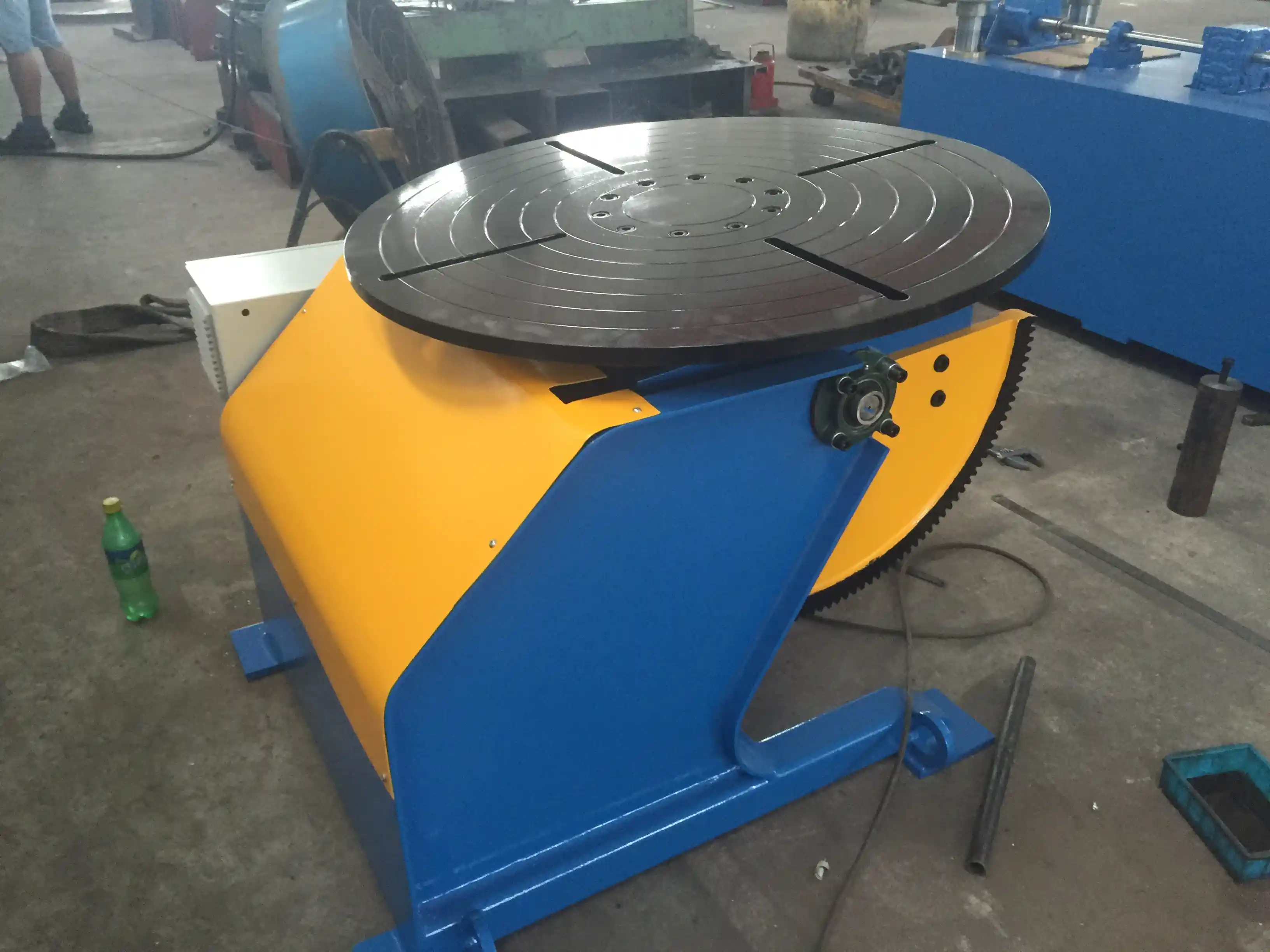
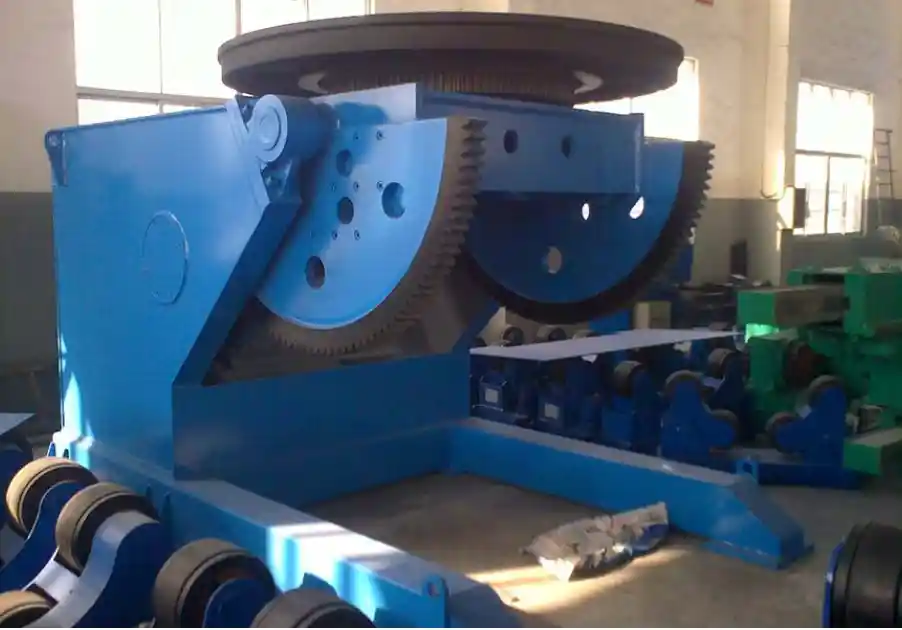
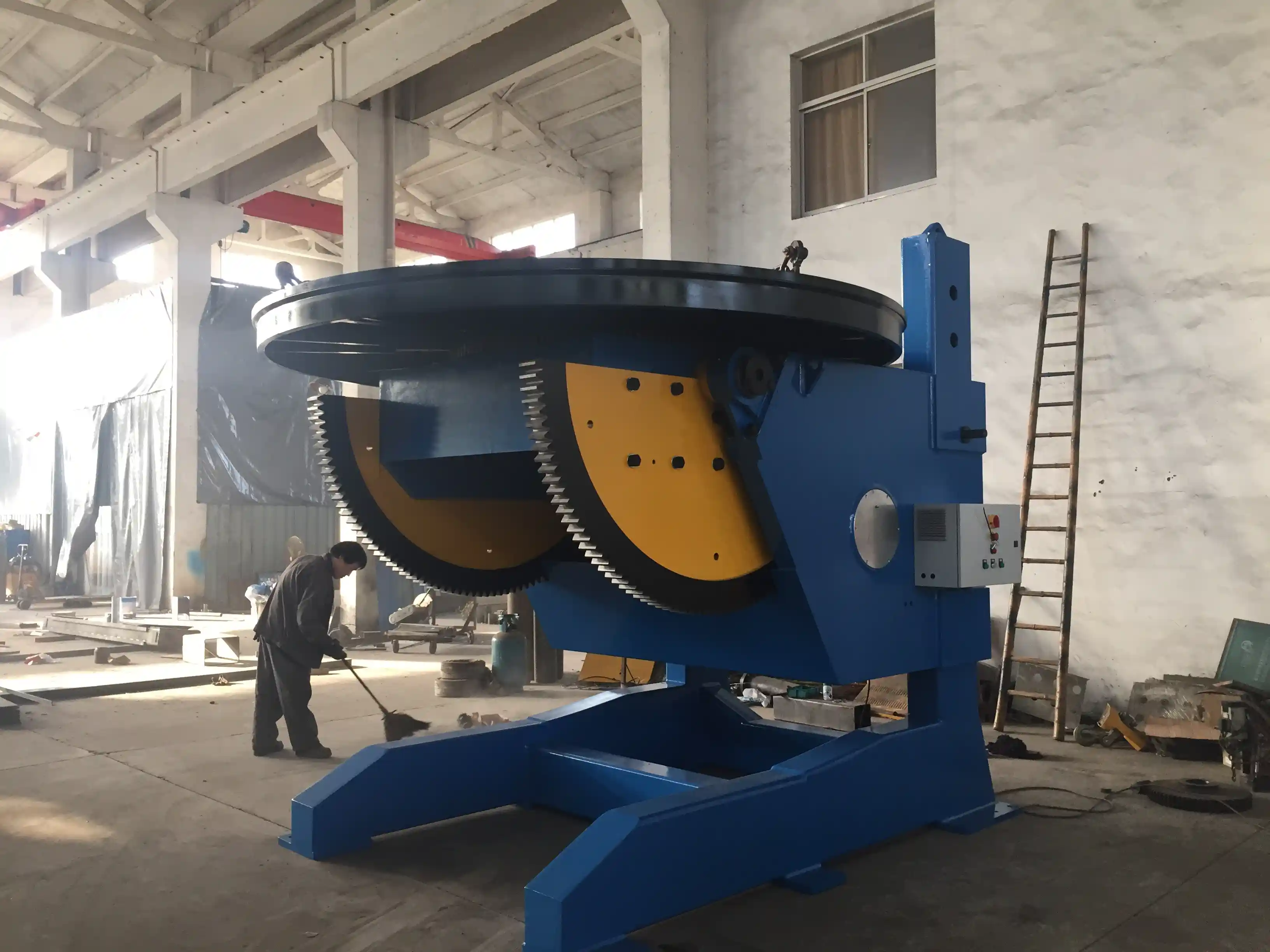
Welding positioners form the backbone for rotating heavy fabrications during welding. A 3‑axis positioner rated for 5 tons with ±0.05 mm positioning accuracy and 360° continuous rotation, such as the ABK 5‑Ton 3‑Axis Welding Positioner, provides the motion control necessary for welding pressure vessel segments or vehicle frames under a consistent parameter set. The servo‑driven axes and SEW reducers in this class allow parameter records to be tied directly to the motion sequence, which simplifies audit preparation.
Manipulador de soldaduras are required when long seams must be welded with uniform quality. A manipulator with a boom travel of 8000 mm and vertical reach of 8000 mm, combined with 360‑degree column rotation, permits continuous longitudinal and circumferential welding on large diameter vessels without repositioning the workpiece. In defense work, this directly improves weld integrity by reducing stops and starts, which are the most frequent initiation points for defects.
CNC cutting equipment introduces different demands. A CNC plasma or laser cutting machine that can hold ±0.1 mm per meter linear accuracy and automatically log cut parameters becomes far more valuable than one that cuts fast but leaves no digital record. When cutting armor plate or high‑strength steel for defense projects, the kerf quality and heat‑affected zone must be controlled tightly to avoid post‑cut machining operations that add cost and risk of dimensional drift.
Welding rotators and fit‑up systems round out the core set. These machines handle cylindrical sections and pipe assemblies, and in defense shipbuilding or vehicle fabrication, they must maintain alignment within 0.5 mm during rotation to prevent weld misalignment. The ABK 60‑Ton Adjustable Height Welding Rotator, with its dual‑motor drive and anti‑creep mechanism, is representative of the heavy‑capacity rotators used in such environments.
Equipment Specifications That Actually Prove Compliance
Meeting defense standards is not a matter of claiming a specification—it is a matter of proving it under audit conditions. Over the years, I have observed that procurement teams initially focus on load capacity and speed, but the specifications that cause the most trouble during certification are exactly those that prevent downstream problems: positional repeatability, motion stability under dynamic load, and data logging completeness.
Repeatability is the first gate. A welding positioner that claims 0.5° rotation accuracy might still produce scattered results if its mechanical backlash allows cumulative error. In a defense fabrication line, that error translates into weld placement that drifts over a batch of identical parts, which will show up in non‑destructive testing. The better‑built machines use zero‑backlash worm gear transmissions or servo‑driven planetary reducers to eliminate this. For very large assemblies, a rotator’s anti‑creep function—the ability to hold a position without drifting—matters more than the top rotation speed.
Stability under dynamic load separates heavy‑duty equipment from units rated only for static load. When a 10‑ton pressure vessel head is rotated at 0.5 RPM, the real‑world deflection and vibration must be contained within the machine’s accuracy specification. Equipment with cast bases, stress‑relieved steel frames, and THK linear guideways tends to maintain path accuracy where lighter fabrications do not.
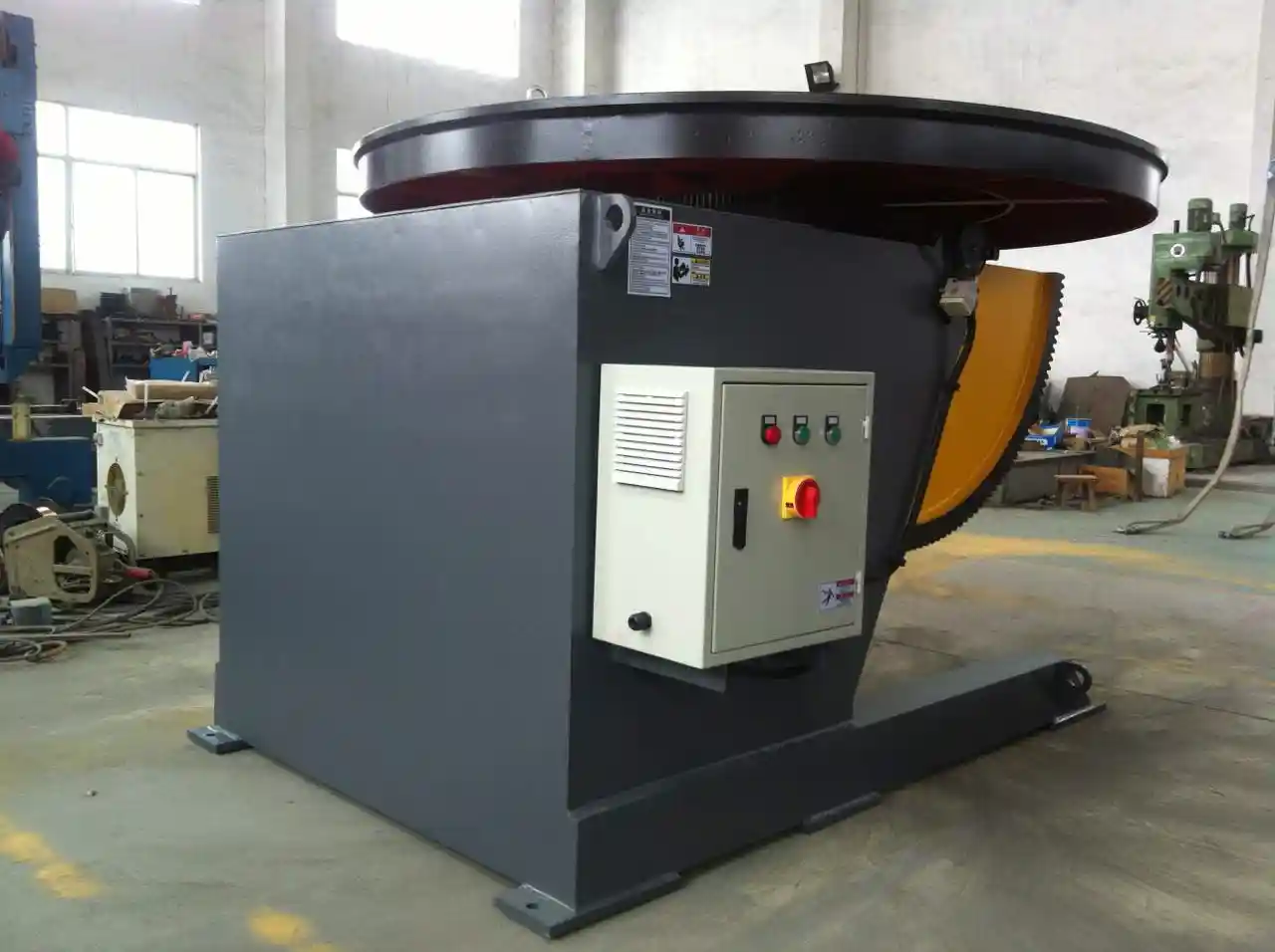
Data logging capability has moved from a nice‑to‑have to a requirement in many defense programs. Machines with PLC‑based controls and HMI touchscreens can record weld parameters, rotation angles, and travel speeds per workpiece. The ABK product line commonly integrates Siemens PLCs with program storage and optional parameter export, which directly supports the documentation demanded by defense quality audits.
The table below summarizes the specification range to look for when comparing equipment families for defense work.
| Equipment Type | Key Specifications | Typical Defense Requirement |
|---|---|---|
| Posicionador de soldadura | Load capacity, repeatability, tilt range | 3–30 ton load, ±0.05–0.5° repeatability, 360° rotation |
| Manipulador de soldadura | Boom reach, column rotation, speed regulation | 3–8 m boom, ±180° rotation, stepless speed control |
| CNC Cutting Machine | Linear accuracy, kerf control, data logging | ±0.1 mm/m accuracy, automatic logging, material library |
| Rotador de soldadura | Load capacity, anti‑creep, diameter range | 20–100+ ton, anti‑creep <0.5 mm, vessel diameter up to 5 m |
Evaluating Equipment for Defense Projects: A Practical Checklist
Procurement engineers who buy fabrication equipment for defense applications typically need to answer one question while standing in front of a machine: “Can this machine be documented well enough that an auditor will accept it?” That question drives a different evaluation sequence than a commercial purchase.
Start with the control system. If the machine cannot digitally record welding parameters, cutting paths, and motion data without manual transcription, then the cost of adding documentation labor and the risk of transcription errors will erode whatever upfront savings exist. Look for PLC‑based systems that allow export of process logs. In many of the successful defense installations I have participated in, customers have directly linked the equipment PLCs to the plant MES system, allowing real‑time traceability.
Next, verify load ratings under the conditions you will actually use. A positioner rated for 5 tons may hold a 5‑ton workpiece without dropping it, but if the center of gravity sits 300 mm above the table, the effective moment load can significantly reduce usable capacity. Always request the manufacturer’s moment load charts and, if possible, witness a test under a representative load before accepting the equipment.
Third, assess the maintenance and calibration support. Defense fabrication lines operate under tight schedules with little tolerance for unplanned downtime. Equipment that requires frequent recalibration or has limited access to spare parts will disrupt production. The manufacturers that maintain a strong technical support team and offer annual recalibration services—rather than selling equipment and disappearing—add measurable value in defense work. Our after‑sales support team has routinely assisted defense contractors with on‑site calibration verification and documentation for their annual ISO and MIL‑SPEC recertification.
Do not overlook the utility of a pre‑delivery inspection. Many defense contractors now require a factory acceptance test where the equipment runs a mock production cycle with simulated loads. This tests not only the mechanical performance but also the data capture system end‑to‑end. If your program involves components that must meet a specific MIL‑STD, it is worth confirming the equipment’s documentation format before finalizing your BOM—reach out at jay@weldc.com.
Integration and Long-Term Support for Defense Fabrication Lines
The way a fabrication shop integrates its core welding and cutting machines determines whether it can scale to handle multiple defense programs simultaneously. A standalone 3‑axis positioner that cannot share positioning data with a welding manipulator on the same workpiece creates manual coordination steps that are both slow and error‑prone. In practice, the most efficient defense production cells I have seen have the positioner, manipulator, and rotator all controlled from a central PLC architecture, allowing coordinated movement and synchronized data capture.
This level of integration does not require proprietary proprietary technology; it requires open communication protocols and a systematic approach to system layout. When configuring a new line, the first decision is whether the line will operate as a flexible, multi‑purpose cell or as a dedicated production line for a single defense component type. The equipment footprint, floor loading requirements, and overhead crane access must be defined before any machine order is placed.
Long‑term support is a critical factor that some buyers underestimate. Defense programs often run for 10 years or more, and the equipment must remain serviceable throughout that period. A supplier with in‑house engineering and a consistent spare parts inventory can substantially reduce the risk of extended downtime. The availability of detailed maintenance documentation—specifying lubrication intervals, bolt torque checks, and calibration procedures—is a direct contributor to equipment uptime. In my experience, machines that ship with a comprehensive maintenance manual and a recommended annual service program experience visibly fewer unexpected failures over their first five years than those that arrive with only an operator’s manual.
Common Questions About Military Spec Fabrication Equipment
What is the difference between standard and defense‑ready fabrication equipment?
The difference lies primarily in documentation capability and precision verification. Defense‑ready equipment typically integrates a PLC that logs process parameters per workpiece, enabling traceability from raw material to finished assembly. Mechanical construction often uses cast bases and high‑grade linear guides to maintain accuracy under heavy loads, with calibration records that can be presented during audits. Standard equipment may match the load capacity but lacks the data logging and repeatability proof required in a defense quality system.
Can a standard welding positioner be upgraded to meet defense standards?
In some cases, yes, but the upgrade path is limited by the original control architecture. If the positioner uses an older relay‑based or simple inverter control system, adding digital data logging may require a complete control retrofit, which is often cost‑prohibitive relative to purchasing a new PLC‑controlled unit. Mechanical upgrades such as adding higher‑precision reducers or anti‑creep features are possible but require engineering resources. A more reliable approach is to select equipment with the necessary control system from the outset.
How important is speed regulation in defense fabrication?
Very important. Stepless speed regulation allows the welding process to be tuned precisely for different material thicknesses and joint configurations, but in defense work its value is consistency. Once a qualified welding procedure specification is established, the equipment must replicate the travel speed and rotation rate identically on every part. Frequency‑driven motors with encoder feedback provide this consistency far more reliably than stepped‑gear or mechanical variator systems.
What type of maintenance schedule keeps equipment audit‑ready?
A written prevention schedule with documented daily, monthly, and annual tasks. Daily maintenance covers cleaning welding spatter, checking lubrication points, and visual inspection of electrical connections. Monthly tasks include torque‑checking mounting bolts and verifying safety interlock function. Annually, replacement of worn bearings, re‑greasing of moving components, and full calibration verification should be performed and documented. This documented maintenance record is often requested by defense quality auditors and can be the difference between a clean surveillance and a finding.
Do manufacturers provide calibration certification for defense work?
Many do, but the depth of documentation varies. Reliable manufacturers provide a factory calibration certificate with the equipment and offer periodic re‑calibration services either on‑site or at the factory. For defense contractors, requesting a calibration protocol and a sample certificate before purchase is a practical safeguard. The equipment should be capable of being integrated into the facility’s ISO or MIL‑SPEC calibration system. Share your calibration requirements with our team at jay@weldc.com or call +86-510-83555592, and we can confirm the documentation package that matches your program’s needs.
Si te interesa, echa un vistazo a estos artículos relacionados:
Un valor de aplicación excepcional: cómo los posicionadores de soldadura de altura fija impulsan los avances en la fabricación en el sector offshore y de la construcción naval (Parte 2)
Desafíos de la soldadura de torres eólicas: Cómo los sistemas avanzados de elevación hidráulica aumentan la producción por 40%
El pilar central de la fabricación pesada: El extraordinario rendimiento de los soportes de rodillos en procesos clave
 English
  Español
  Français
  Deutsch
  Português
  Русский