
Working with H-beam welding lines for over a decade, I’ve watched shops struggle with the same problems repeatedly. The frustrating part is that most productivity losses aren’t dramatic failures—they’re small inefficiencies that compound into serious delays. A conveyor that runs slightly too slow, a positioning system that needs constant adjustment, operators waiting for material that should already be staged. These add up. When I see estimates claiming inefficient welding causes 20% production delays, that actually matches what I’ve observed across dozens of fabrication facilities. The good news is that most of these problems have solutions, and they’re more accessible than many manufacturers realize.
Where H-Beam Welding Lines Actually Lose Time
Before throwing money at new equipment, it helps to understand where time actually disappears in H-beam welding operations. The obvious culprits—slow welding speeds, equipment breakdowns—get plenty of attention. But the hidden time thieves often cause more damage.
Material handling stands out as the biggest offender. Moving heavy H-beams manually or with poorly coordinated crane systems can eat up 30% of total production time. That’s not welding time—that’s waiting, repositioning, and maneuvering steel into place. The welding arc might run at optimal speed, but if beams sit idle between stations, overall throughput suffers.
The Material Flow Problem Most Shops Ignore
Here’s what happens in a typical underperforming H-beam welding line: a beam finishes one operation, then waits. Maybe the crane operator is busy. Maybe the next station isn’t ready. Maybe someone needs to flip the beam manually because the positioning equipment can’t handle the rotation. Each pause seems minor—five minutes here, ten minutes there. Multiply that across hundreds of beams per week, and you’ve lost significant capacity.
Automated material handling changes this equation. Conveyor systems keep beams moving at consistent speeds. Integrated crane systems coordinate with welding stations. The result isn’t just faster movement—it’s predictable movement, which allows better scheduling and reduces operator idle time.
Welding Technology That Actually Delivers Speed Gains
Automation in H-beam welding isn’t about replacing skilled welders—it’s about letting them focus on tasks that require judgment while machines handle repetitive operations. The speed difference is substantial. Automated welding systems typically run 2-5 times faster than manual methods, and they maintain that pace consistently across shifts.
The specific process matters. Submerged Arc Welding handles the deep penetration requirements of heavy structural work. Flux-Cored Arc Welding offers flexibility for varying joint configurations. Gas Metal Arc Welding provides speed for lighter sections. Most productive H-beam welding lines use multiple processes, matched to specific joint types and beam sizes.
What Automated Systems Actually Contribute
The productivity gains from automated welding come from several sources working together. Consistent travel speed eliminates the natural variation in manual welding. Precise parameter control maintains optimal heat input throughout long seams. Continuous operation removes the fatigue factor that slows manual welders toward the end of shifts.
A Manipulador de soldadura handles longitudinal and circumferential seams with positioning accuracy around ±0.1 mm/m. That precision matters because it eliminates the constant adjustments that slow production. Similarly, a Posicionador de soldadura de 3 ejes synchronizes turning, rotating, and tilting movements with ±0.05 mm positioning accuracy and 0.02 mm repeatability. These specifications translate directly into reduced setup time and fewer quality issues.
Preventing Defects Before They Become Expensive Problems
Weld quality problems in H-beam fabrication don’t just affect the immediate piece—they ripple through the entire production schedule. Rework requires repositioning, re-welding, and re-inspection. The 15-25% cost increase from poor weld quality that industry studies cite reflects both direct repair costs and the disruption to planned production.
Defect prevention starts with understanding what causes problems in automated H-beam welding. The equipment itself is rarely the issue. More often, defects trace back to inconsistent parameters, inadequate joint preparation, or environmental factors like contamination or insufficient shielding gas coverage.
Breaking Down Common Defect Causes
| Defect Type | Common Causes | Prevention Strategy |
|---|---|---|
| Porosity | Inadequate shielding gas, contaminated base metal | Optimize gas flow, clean materials thoroughly |
| Lack of Fusion | Insufficient heat input, improper joint design | Adjust welding parameters, ensure proper joint preparation |
| Cracking | High residual stress, improper cooling rate | Implement pre-heating/post-heating, control cooling |
| Distorsión | Uneven heat distribution, inadequate fixturing | Use balanced welding sequences, robust clamping |
| Undercut | Excessive arc voltage, fast travel speed | Adjust voltage, reduce travel speed |
The pattern here is clear: most defects result from process control issues, not equipment limitations. Proper parameter settings, consistent material preparation, and appropriate thermal management prevent the majority of quality problems.
Making Operations Leaner Without Cutting Corners
Lean manufacturing principles apply directly to H-beam welding lines, though implementation requires understanding welding-specific constraints. The 10-15% waste reduction that lean practices typically achieve comes from multiple sources: material waste, energy consumption, labor utilization, and unplanned downtime.
Preventive maintenance deserves special attention. Welding equipment operates under demanding conditions—high currents, thermal cycling, mechanical stress from positioning movements. A maintenance schedule that anticipates wear patterns prevents the unplanned breakdowns that devastate production schedules.
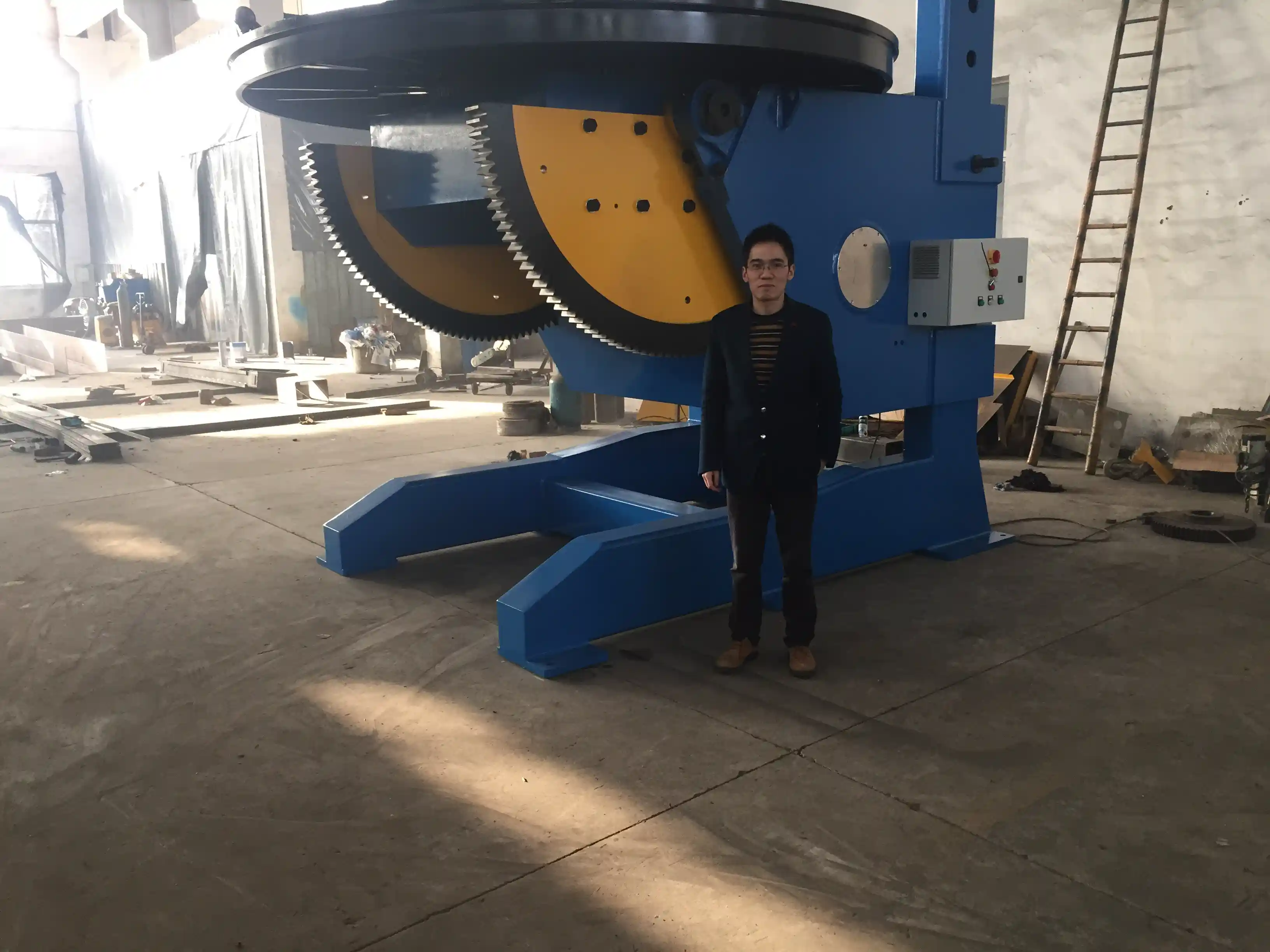
The WUXI ABK 5-Ton 3-Axis Welding Positioner illustrates how equipment design supports operational efficiency. Servo-driven axes with ±0.05 mm positioning accuracy and 0.02 mm repeatability mean less time spent on adjustments and fewer quality issues from positioning errors. The casting base provides stability for demanding applications like pressure vessel welding and structural steel assembly. Equipment that performs consistently reduces the firefighting that consumes supervisors’ time.
Preparing for What’s Coming in H-Beam Welding
Industry 4.0 technologies are moving from pilot projects to production reality in welding operations. The 10-30% productivity gains that smart factory implementations report come from better information, not just better equipment.
IoT sensors on welding equipment generate continuous data streams. Analyzed properly, this data reveals patterns invisible to human observation—gradual parameter drift, developing mechanical issues, subtle quality trends. Predictive maintenance uses these patterns to schedule repairs before failures occur.
Digital twin technology creates virtual models of welding processes, allowing engineers to test parameter changes and process modifications without risking production time or material. This simulation capability accelerates optimization and reduces the trial-and-error that traditionally accompanies process improvement.
Bringing It Together
Optimizing H-beam welding lines isn’t about any single improvement—it’s about addressing the interconnected factors that determine overall productivity. Material handling efficiency, welding technology selection, quality control systems, and operational practices all contribute. Equipment like a Manipulador de soldadura o Posicionador de 3 ejes provides the precision foundation, but realizing their full potential requires attention to the entire production system.
The manufacturers who thrive in structural steel fabrication will be those who treat their H-beam welding lines as integrated systems rather than collections of individual machines. That perspective opens opportunities for improvement that piecemeal approaches miss.
Partner with WUXI ABK MACHINERY CO., LTD
WUXI ABK MACHINERY CO., LTD offers decades of specialized experience in welding equipment and CNC cutting machines. Our expert team is ready to design and implement custom H-beam welding line solutions tailored to your unique production needs, ensuring optimal productivity and quality. Contact us today for a comprehensive consultation to transform your manufacturing efficiency. Email: jay@weldc.com | Phone: +86-510-83555592.
Frequently Asked Questions About H-Beam Welding Line Optimization
What is the typical ROI for investing in an automated H-beam welding line?
Most facilities see payback within 12 to 36 months, depending on their starting point and production volume. The returns come from several directions simultaneously: labor costs drop because fewer operators handle more output, production speed increases because automated systems maintain consistent pace, weld quality improves because parameters stay controlled, and material waste decreases because precision reduces errors. Shops running high volumes or struggling with quality issues often hit the shorter end of that payback range.
How does WUXI ABK MACHINERY ensure the quality of its H-beam welding solutions?
Quality assurance starts in the design phase, where engineering teams apply principles proven across thousands of installations. Manufacturing uses high-grade materials and precision machining to meet tight tolerances. Each system undergoes extensive testing before shipment. The equipment itself incorporates features that support consistent results—precise parameter control, robust fixture design, and compatibility with inspection systems. This approach addresses quality at every stage rather than relying solely on final inspection.
What safety considerations are paramount in H-beam welding line operations?
Welding fume extraction ranks high because respiratory hazards accumulate over time. Personal protective equipment requirements cover arc flash, heat exposure, and mechanical hazards. Machine guarding prevents contact with moving components during operation. Emergency stop systems provide immediate shutdown capability throughout the line. Operator training ensures personnel understand both equipment operation and hazard recognition. WUXI ABK MACHINERY designs integrated safety features into its systems, but facility-level safety programs remain essential for protecting workers.
 English
  Español
  Français
  Deutsch
  Português
  Русский