Managing welding distortion in large tank fabrication sits at the intersection of metallurgical science and practical shop-floor reality. When distortion goes unchecked, the consequences ripple outward—rework costs climb, schedules slip, and structural integrity comes into question. The dimensional accuracy problems and residual stress patterns that emerge from poorly controlled welds represent genuine tank fabrication challenges that affect both immediate welding quality and long-term operational performance.
How Thermal Cycles Drive Tank Welding Distortion
Welding distortion originates from the uneven heating and cooling cycles that define the welding process itself. As weld metal and surrounding base material absorb heat, they expand. During cooling, they contract. When this expansion and contraction occurs unevenly across a structure, internal stresses develop and manifest as visible distortion.
The relationship between material properties, heat input, and joint design determines how severely distortion affects a given weldment. Different welding processes distribute heat differently across the work zone. Higher heat input processes generally produce greater distortion because they create steeper thermal gradients and larger volumes of affected material.
What are the primary causes of welding distortion in storage tanks?
Uneven heating and cooling cycles create thermal gradients that drive welding distortion in storage tanks. These gradients cause differential expansion and contraction across the material thickness and along the weld length.
Restraint conditions during welding significantly influence outcomes. Inadequate fixturing permits greater movement during thermal cycling, allowing distortion to develop more freely. Welding speed, joint geometry, and material thickness each contribute to the final distortion pattern. One documented case study traced significant distortion failure in a large storage tank project directly to inadequate joint design that concentrated thermal stresses rather than distributing them.
Proactive Approaches to Minimizing Tank Welding Distortion
Minimizing tank welding distortion demands attention to pre-weld preparation and precise process control. Optimizing the welding procedure specification serves as the foundation for everything that follows.
Careful selection of welding parameters—current, voltage, and travel speed—enables effective heat input control. Strategic welding sequence optimization through techniques like back-step or skip welding distributes thermal stresses more evenly across the structure. Effective fixture design and robust restraint methods prevent material movement during thermal cycles.
Achieving high fit-up accuracy before welding reduces the volume of weld metal required, which directly lowers overall heat input. Multi-pass welding techniques, when properly executed, distribute heat across several smaller passes rather than concentrating it in fewer, larger passes.
How does preheating influence distortion control in heavy-gauge tank welding?
Preheating reduces the thermal gradient between the weld zone and base material in heavy-gauge tank welding. This smaller temperature differential minimizes differential expansion and contraction, which leads to meaningful residual stress reduction.
Preheating also slows the cooling rate. This slower cooling proves crucial for preventing hydrogen cracking in heavy section welding of certain steel grades. Recommended preheat temperatures vary based on material properties and thickness, but the goal remains consistent: controlled cooling and improved metallurgical integrity.
Correction Methods for Distorted Tank Welds
When distortion occurs despite preventative measures, correction becomes necessary. The choice of post-weld distortion correction technique depends on distortion type, severity, and material properties.
| Method | Type of Distortion Addressed | Primary Mechanism | Ventajas | Desventajas |
|---|---|---|---|---|
| Flame Straightening | Angular, buckling, bowing | Localized heating/cooling | Cost-effective, portable | Requires skilled operator, localized stress |
| Mechanical Stress Relief | Angular, longitudinal, transverse | Plastic deformation | Fast, no heat-affected zone | Limited to accessible areas, potential damage |
| Post-Weld Heat Treatment | Residual stress | Uniform heating/cooling | Reduces overall stress | High energy cost, size limitations |
| Shot Peening | Surface distortion, fatigue life | Compressive surface stress | Improves fatigue resistance | Surface finish alteration, limited depth |
| Vibratory Stress Relief | Residual stress | Vibration-induced relaxation | Non-thermal, low energy | Effectiveness varies, not for severe distortion |
Mechanical stress relief methods, including peening techniques, often deliver efficiency gains over thermal methods when localized correction suffices. Peening can reduce distortion variability by 20-30% compared to unpeened welds in appropriate applications.
Advanced Technologies for Distortion Monitoring and Prediction
Numerical simulation and finite element analysis allow engineers to anticipate welding distortion before fabrication begins. This predictive modeling capability enables optimization of welding sequences and joint designs based on calculated thermal behavior rather than trial and error.
Real-time monitoring systems incorporating laser scanning and other non-destructive testing methods provide immediate feedback on dimensional accuracy during welding. This data integrates into digital twin technology, creating virtual replicas of tanks that track and manage distortion throughout the fabrication lifecycle. FEA simulation implementation has demonstrated up to 40% reduction in distortion-related rework for complex structures.
Automation’s Role in Precision Tank Welding and Distortion Control
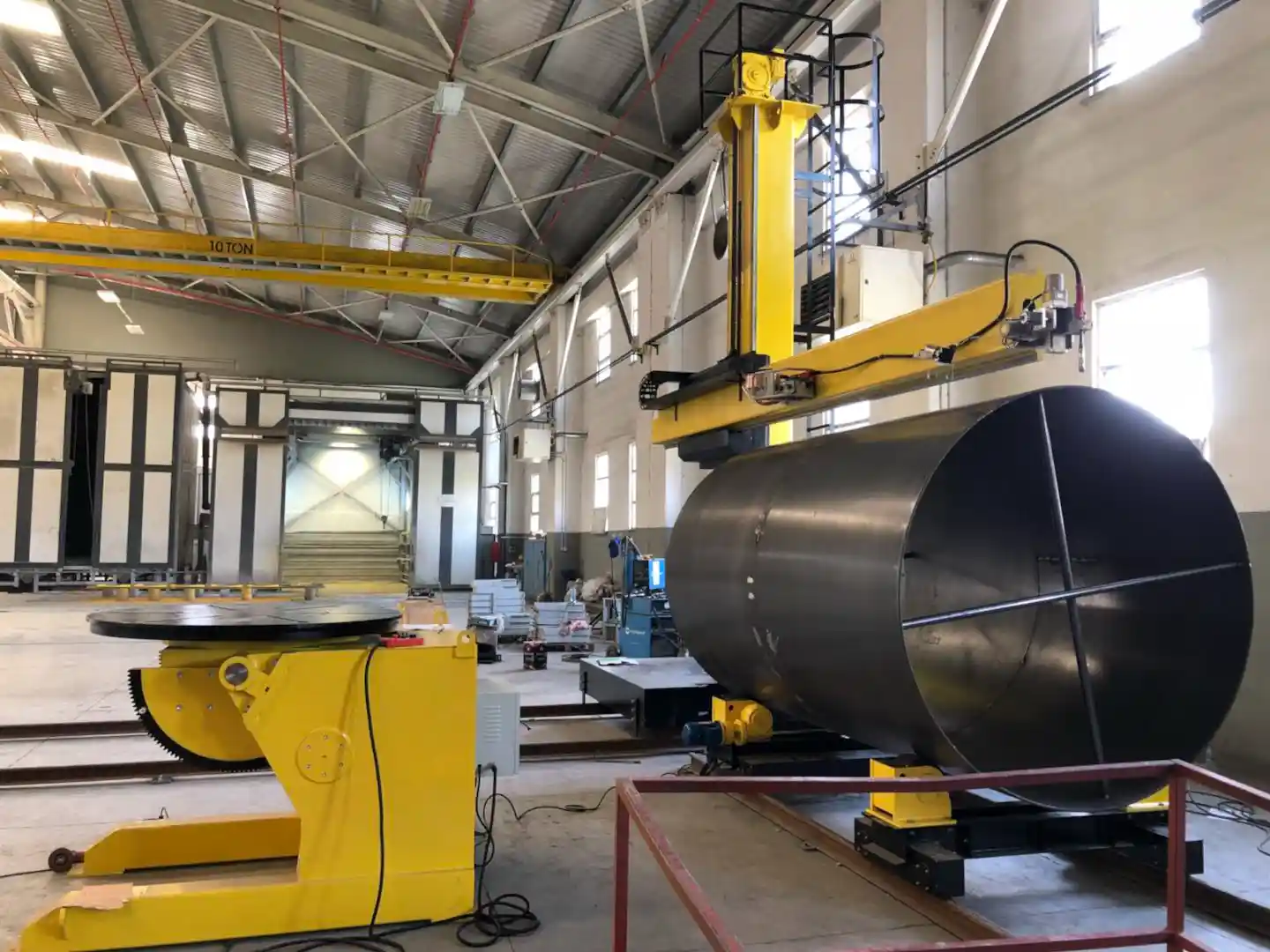
Automated welding systems enhance consistency and significantly reduce human error in tank manufacturing. Manipulador de soldaduras like the WUXI ABK LH series achieve positioning accuracy of ±0.1 mm/m, ensuring stable operation for precise longitudinal and circumferential seam welding.
Posicionador de soldadura de 3 ejess and Posicionador de triple ejes provide synchronized turning, rotating, and tilting with ±0.05 mm positioning accuracy and 0.02 mm repeatability. These specifications matter for heavy-duty robotic welding where consistent heat input and travel speed directly mitigate distortion causes. Robotic welding in large structures often reduces distortion variability by 50% compared to manual processes.
For further insights into optimizing your welding processes, consider reading our article on 《Mejora de la calidad y la eficacia en la fabricación de depósitos y recipientes a presión: El principal valor de aplicación de los posicionadores》.
Can robotic welding systems reduce distortion in tank manufacturing?
Robotic welding systems significantly reduce distortion in tank manufacturing through their ability to maintain consistent weld parameters. Robotic precision ensures uniform arc length, travel speed, and heat input, minimizing the thermal fluctuations that cause distortion.
Automated heat management contributes further by precisely controlling interpass temperatures. This process repeatability eliminates the inconsistencies inherent in manual welding and removes operator fatigue as a variable. Data indicates robotic systems achieve 25-40% reduction in distortion variability compared to manual welding.
Quality and Compliance Requirements in Tank Fabrication
Effective distortion control directly supports quality and compliance in tank fabrication. Industry standards from organizations like API and ASME mandate strict dimensional accuracy. Excessive distortion leads to non-compliance, triggering costly rework procedures, project delays, and potential safety regulations violations.
Robust quality control measures—rigorous inspection methods and thorough documentation—verify structural integrity and long-term performance. A comprehensive checklist of key quality checks for tank distortion ensures all parameters meet specification requirements.
Partner with WUXI ABK for Superior Tank Fabrication Standards
For over two decades, WUXI ABK MACHINERY CO., LTD has developed welding equipment that enables industries to achieve precision and structural integrity in large-scale fabrication. Our Manipulador de soldaduras, Soluciones de mesas giratorias de soldadura, and automated lines deliver the consistent control and efficiency required for minimizing welding distortion in tanks. Contact our team to discuss solutions tailored to your specific project demands. Email us at jay@weldc.com or call +86-13815101750.
Frequently Asked Questions About Tank Welding Distortion
What are the most common types of welding distortion observed in large storage tanks?
Angular distortion, longitudinal shrinkage, transverse shrinkage, and buckling distortion appear most frequently. Angular distortion typically develops at fillet welds where the thermal contraction pulls the joined members toward each other. Longitudinal and transverse shrinkage result from overall weld metal contraction along and across the weld axis. Buckling occurs in thin plates when compressive stresses exceed the material’s stability threshold, particularly in large flat panels.
How can welding sequence optimization significantly reduce distortion in tank construction?
Strategic planning of weld pass order and section sequencing balances thermal stresses across the structure. Back-step welding, skip welding, and symmetrical welding patterns distribute heat more evenly throughout the assembly. This distribution minimizes cumulative shrinkage and prevents the localized stress buildup that causes distortion. Effective distortion control through sequence optimization enhances dimensional accuracy throughout the fabrication process.
Are there specific welding equipment features that aid in better distortion control for tank fabrication?
Precisión Manipulador de soldaduras and Posicionador de soldadura ajustables from WUXI ABK MACHINERY CO., LTD enable optimal workpiece positioning, consistent travel speed, and stable arc control. These capabilities ensure uniform heat input and improved weld access. Minimizing thermal gradients and achieving consistent weld quality through proper equipment selection directly contributes to superior distortion control in tank fabrication.
 English
  Español
  Français
  Deutsch
  Português
  Русский