Precision and stability are the two most important requirements in a welding positioner supplier evaluation. Precision means the table repeats the same weld position after every rotation, tilt, or index. Stability means the workpiece does not creep, sag, or shift when the drive stops and the weld arc is running. In heavy fabrication, a supplier can quote an impressive load rating and still deliver a machine that moves too much under eccentric load. This guide explains the technical checks that help verify both claims.
A supplier should be able to document how the frame, bearing, gear reducer, drive motor, and control system work together under real load conditions, not only with a centered test block. When comparing sources, look beyond table diameter and nominal tonnage. Ask for the load envelope, positioning accuracy, repeatability, and the required maintenance that keeps those values stable over time.
What Precision Means for a Welding Positioner
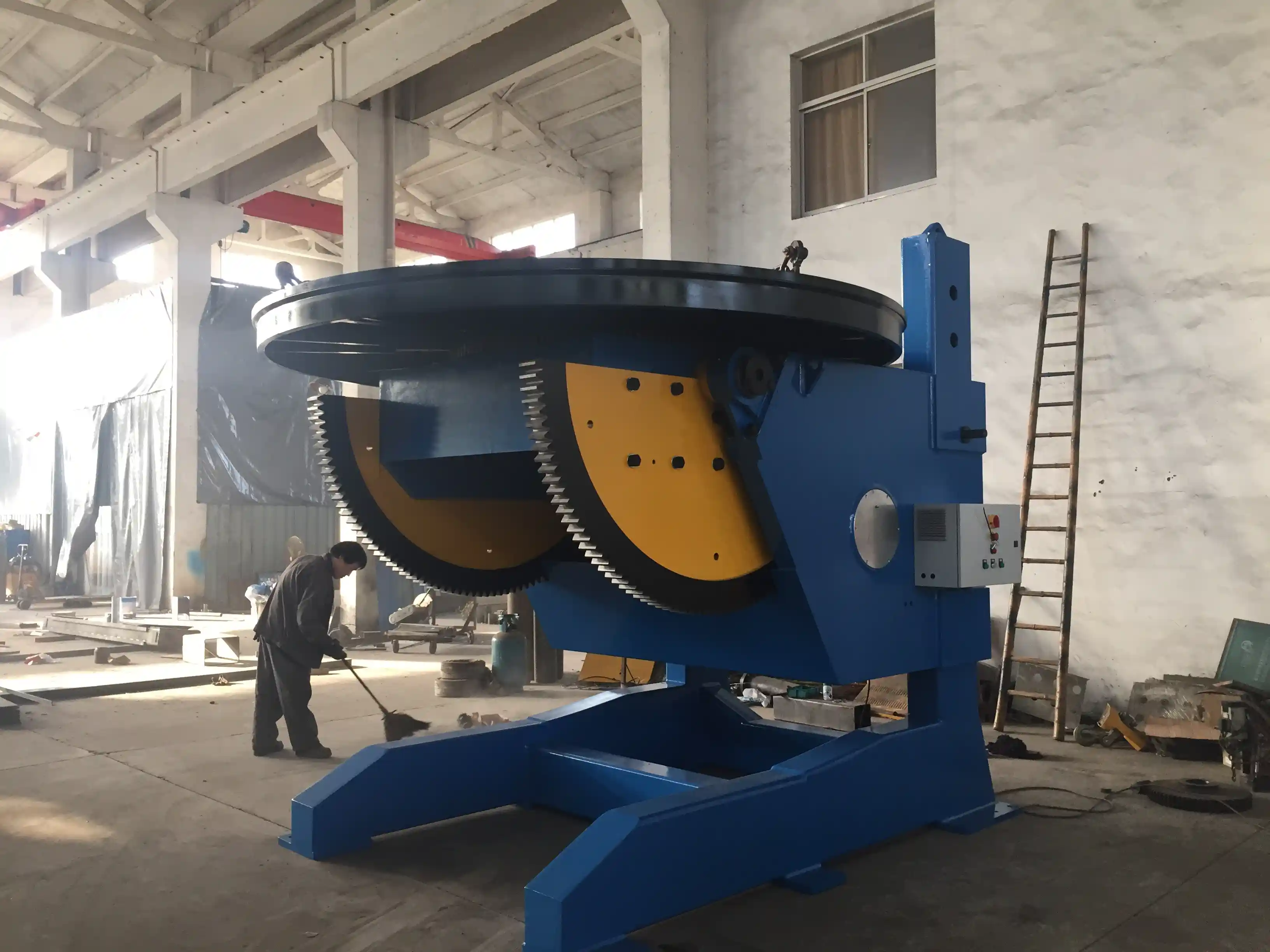
Precision is not a single number. It is the combined result of gear backlash, slewing-bearing runout, table flatness, control resolution, and speed consistency. A positioner that rotates smoothly but cannot hold a preset angle will still cause weld defects on circumferential seams.
In practice, precision is evaluated by two measurements: positioning accuracy and repeatability. Positioning accuracy is how closely the machine reaches a commanded angle or position. Repeatability is how consistently it returns to the same point over multiple cycles. Test methods based on ISO 230-1 provide a common way to compare machine-tool geometric accuracy, and the same discipline should be applied to welding positioners [1].
For standard fixed-height positioners, a typical rotation accuracy may be specified at ±0.5°. For robotic 3-axis models, the specification is usually tighter. WUXI ABK lists its 1-ton 3-axis positioner at ±0.05 mm positioning accuracy and 0.02 mm repeatability using a servo-driven structure with linear guides and precision reducers [1]. Those values matter when a weld seam must align with a robot path or a machined feature.
A useful supplier questionnaire should ask:
- Is the stated accuracy measured at the table, at the workpiece center, or under a specific test load?
- Does the control system use open-loop frequency control or closed-loop feedback?
- What is the gear backlash after running-in?
- How does the supplier define repeatability: unidirectional or bidirectional?
- Is the machine re-verified after installation or only before shipment?
Precision claims are only meaningful when the test condition is defined. Without a reference to the measurement point and load state, a ±0.05 mm statement cannot be compared across suppliers.
Stability Starts with Load Distribution and Center of Gravity
Stability depends on how the workpiece load is distributed across the table, bearing, and base. A positioner can have a 5,000 kg nominal rating and still be unstable if the center of gravity is too high or too far from the table center.
The critical supplier data points are maximum eccentric distance and maximum center-of-gravity distance. These values define the safe envelope for an off-center load. For example, WUXI ABK fixed-height welding positioners list the following product specifications:
| Modell | Load capacity | Table diameter | Max eccentric distance | Max center-of-gravity distance | Positioning accuracy |
|---|---|---|---|---|---|
| HBJ-10 | 1,000 kg | 1,200 mm | 150 mm | 200 mm | ±0,5° |
| HBJ-20 | 2,000 kg | 1,200 mm | 200 mm | 300 mm | ±0,5° |
| HBJ-30 | 3,000 kg | 1,400 mm | 200 mm | 400 mm | ±0,5° |
| HBJ-50 | 5,000 kg | 1,500 mm | 200 mm | 300 mm | ±0,5° |
These are product specifications, not universal market ratings. They show why nominal load capacity is insufficient for a purchase decision. A lightweight but highly eccentric part can generate more overturning moment than a heavy centered part. Before accepting a quote, the supplier should confirm that the worst-case part geometry stays inside the allowed envelope.
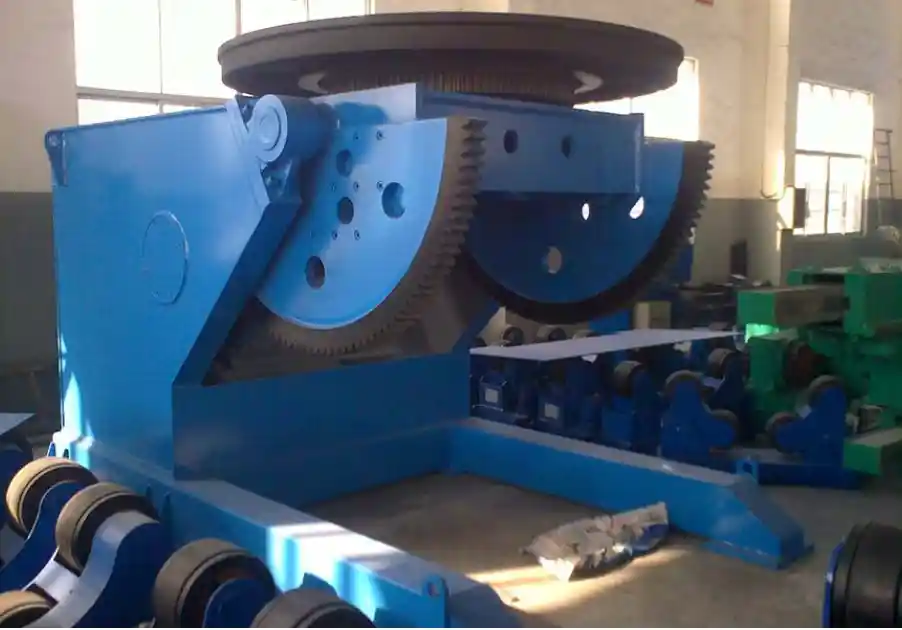
A stable positioner also requires a rigid base. Fixed-height models in the HBJ series use a heavy-duty Q235-A steel box-type base. That construction supports the slewing bearing and reducer, but it must also resist twist when the table reaches the tilt limit. If the base flexes, the positioner may still rotate, but the root gap changes as the weld proceeds.
Quick Check for Your Workpiece
Before comparing quotes, prepare a simple load summary: part weight, center-of-gravity height, distance from the table center, required rotation speed, and required tilt angle. Email this data to jay@weldc.com so a supplier engineer can verify the overturning moment against the selected frame instead of quoting by tonnage alone.
Evaluating Drives, Bearings, and Positioning Accuracy
The drive system determines whether a positioner moves smoothly at welding speed and stops without drift. Standard fixed-height positioners often use an AC frequency drive with stepless speed regulation. WUXI ABK HBJ models list rotation speed from 0.05 to 0.5 RPM with AC frequency control and a cycloidal-worm dual-stage reducer for tilt. This is suitable for manual and semi-automatic welding where the operator controls the seam.
Robotic applications need a different level of control. The 3-Achsen-Schweißpositionierer uses servo-driven axes, THK linear guides, and SEW reducers. The servo loop lets the positioner receive motion commands from ABB, KUKA, FANUC, or Yaskawa controllers while maintaining tighter positioning accuracy.
Bearing quality directly affects stability. A slewing bearing with excessive runout will translate into uneven joint fit-up, especially on long vessels. Supplier drawings should identify the bearing type, load rating, and lubricated wear points. Electrical control equipment should also comply with IEC 60204-1, and safety-related control systems should be assessed according to ISO 13849-1 [5][6].
Misalignment in pipeline welding is often traced to positioner drift after indexing. When the table settles after a command, the seam can move enough to reduce pass rates.
Misalignment in pipeline welding often comes from positioner movement after indexing. <Übermäßige Fehlausrichtung beim Schweißen von Rohrleitungen: Präzisionspositionierungslösung mit dem Schweißdrehtisch von Wuxi ABK> covers how precision turntable positioning helps maintain oil pipeline pass rates.
The same concern appears in pressure vessel fabrication, where the table must rotate at low speed while the weld torch stays on the seam. A positioner that hesitates or overshoots creates abrupt travel speed changes, which may require weld repair.
Tank and pressure vessel shops need repeatable rotation without shifting the joint. <Verbesserung von Qualität und Effizienz bei der Herstellung von Tanks und Druckbehältern: Der zentrale Anwendungswert von Positionierern> covers how positioner accuracy supports vessel pass rates and production consistency.
Supplier Capability Checklist for Precision and Stability
A supplier can claim precision, but a serious evaluation should confirm the claim through documentation, testing, and field reference. Use the following checklist when shortlisting suppliers:
- Load envelope data: documented maximum eccentric distance and center-of-gravity distance.
- Accuracy test method: reference to ISO 230-1 or an equivalent measurement standard.
- Drive configuration: AC frequency drive for manual work or servo drive for robotic integration.
- Bearing and reducer data: bearing type, backlash, and rated service life.
- Frame construction: stress-relieved steel or cast structure with specified deformation resistance.
- Control system: PLC or touchscreen interface with programmable weld positions.
- Safety functions: emergency stop, overload shutdown, and protection rating such as IP54.
- Certifications: CE marking for the machine and ISO 9001 for quality management.
- Welding process documentation: compatibility with qualified welding procedure requirements.
- Factory acceptance test: actual measurement of repeatability before release.
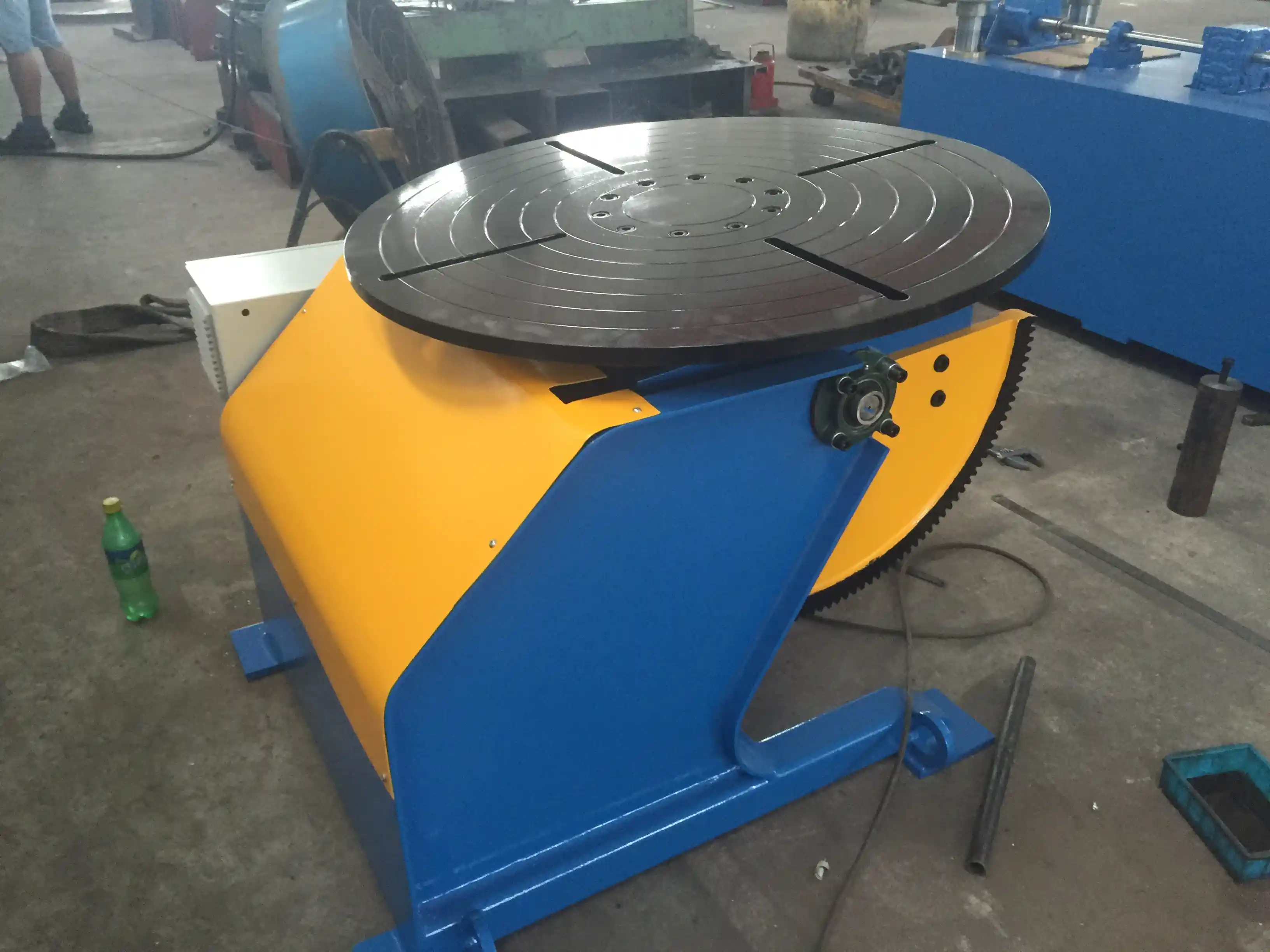
A fabricator should also confirm that the supplier understands welding coordination. EN ISO 14731 defines the responsibilities for welding-related planning and supervision [4]. A supplier that understands these requirements can align the positioner’s speed and positioning behavior with the welding procedure, rather than treating the machine as an isolated rotary table.
For example, a wind tower flange requires continuous rotation while a Schweißmanipulator tracks the joint. The positioner should hold the set rotation speed while the manipulator maintains the arc position. This is an equipment-integration issue, not simply a positioner capacity issue.
Application Matching: Fixed, Adjustable, and Multi-Axis Positioners
The right positioner type depends on workpiece geometry and weld accessibility.
| Workpiece type | Recommended positioner type | Key requirement |
|---|---|---|
| Small flanges, pipes, and brackets | Fixed-height welding turntable | Center the load within eccentric limits |
| Pressure vessels and tanks | Adjustable-height positioner or rotator | Height adjustment and larger tilt range |
| Wind tower sections | Heavy adjustable-height positioner | High load capacity and stable rotation |
| Long shafts and beams | Head-tail positioner | Synchronized rotation at both ends |
| Schweißroboterzellen | 3-axis servo positioner | ±0.05 mm positioning and 0.02 mm repeatability |
Fixed-height models are simpler and suitable for parts with a consistent center of gravity. Adjustable-height models, such as the WUXI ABK LHBJ series, add hydraulic height adjustment and a larger work envelope. They are frequently used in pressure vessel, wind tower, and structural steel applications.
Die adjustable-height welding positioner provides a 5-ton capacity with 0.05–0.5 RPM rotation and 0–360° continuous rotation. For taller vessels, the table height can be adjusted hydraulically, which allows the operator or robot to access the seam without repositioning the whole part.
For multi-position work, a 3-axis model adds turning and tilting synchronized with rotation. This is a better fit when a part must be presented in several orientations to a robot. The choice should be driven by weld sequence, not by an assumption that more axes are automatically better.
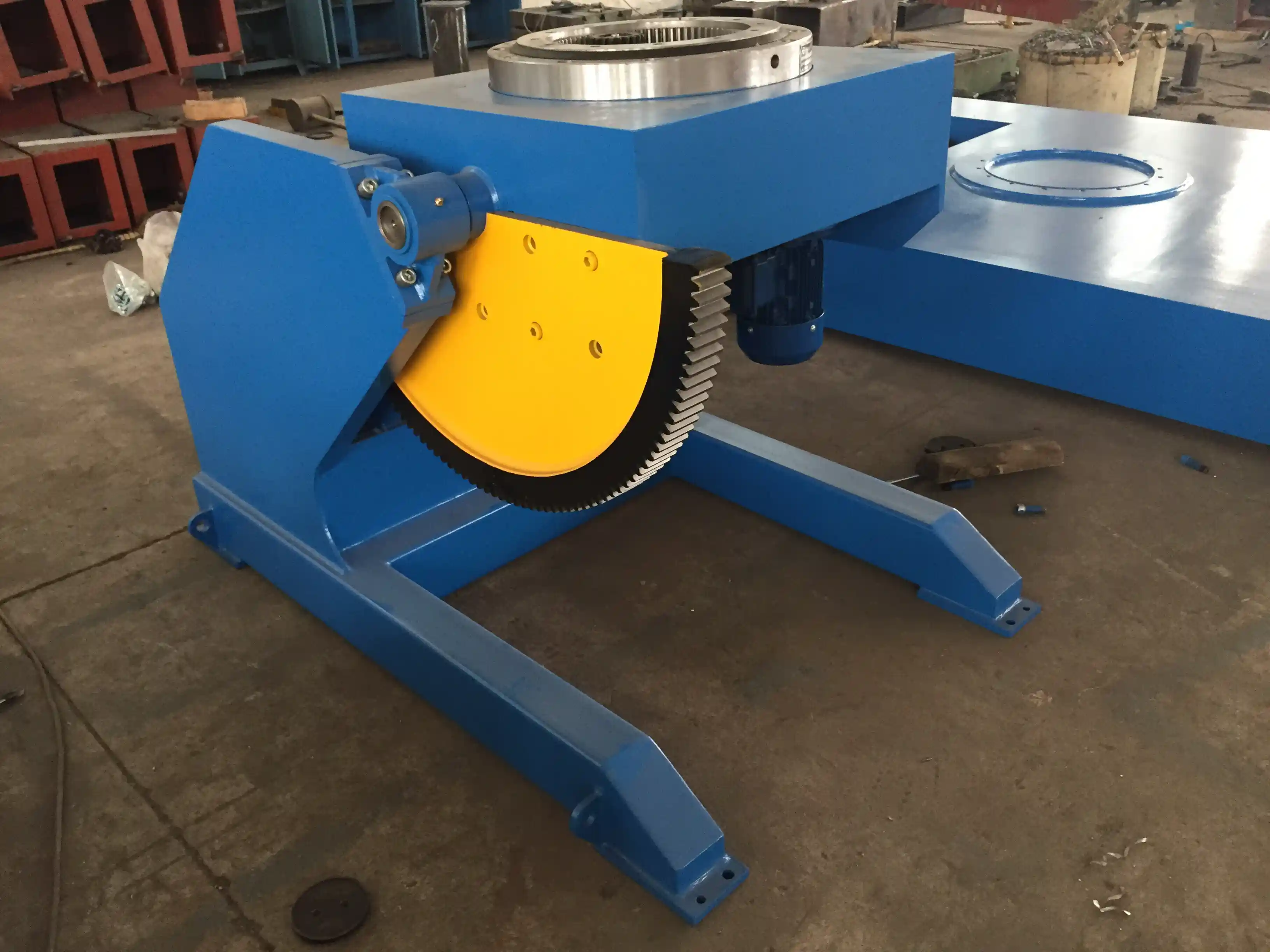
Wind power and shipbuilding fabricators must control positioner deflection across long, heavy sections. In these applications, stability is stressed by repeated indexing, high eccentric loads, and long weld cycles.
Wind power and shipbuilding fabricators must control positioner deflection across long, heavy sections. <Kernprobleme und hochpräzise Lösungen für Schweißpositionierer in der Windkraft- und Schiffbauindustrie: Umfassende technische Analyse> covers the high-precision positioner requirements in both industries.
Build a Stable Welding Positioner Specification
The final step in supplier evaluation is to convert the application requirement into a technical inquiry. A useful inquiry should include:
- Part weight and maximum diameter.
- Center-of-gravity height and distance from table center.
- Required rotation speed and tilt range.
- Manual, semi-automatic, or robotic welding.
- Available power supply and voltage.
- Required certifications: CE, ISO 9001, or project-specific codes.
- Robot interface, if the station will be automated.
- Floor space and installation height constraints.
Request a written specification that confirms the load envelope, positioning accuracy, repeatability, drive configuration, and safety functions. If a supplier cannot provide these data, precision and stability are only assertions.
For positioner selection supported by engineering review, contact WUXI ABK Machinery Co., Ltd. at jay@weldc.com, call +86-13815101750, or call +86-510-83555592. The team can compare fixed-height, adjustable-height, and multi-axis configurations against your workpiece data and provide a CE/ISO-compliant specification for the selected model.
Häufig gestellte Fragen
What positioning accuracy should a welding positioner have?
The required accuracy depends on the weld joint and automation level. Standard fixed-height positioners may specify ±0.5° rotation accuracy, while servo-driven 3-axis models may specify ±0.05 mm positioning accuracy and 0.02 mm repeatability. Ask the supplier how the value is measured and whether it is verified at the table under load [1].
How do I know whether a positioner is stable enough for an eccentric workpiece?
Review the maximum eccentric distance and center-of-gravity distance in the supplier data. Compare those values with your worst-case part geometry. Also check the base design, bearing type, reducer backlash, and tilt structure. If the supplier cannot provide a load envelope, request a test report or engineering review before purchase.
What is the difference between a welding positioner and a welding rotator?
A welding positioner typically provides both rotation and tilt, allowing the operator to bring a weld seam into a favorable position. A welding rotator generally supports cylindrical workpieces on rollers and provides rotation only. Some fixed-height positioners combine rotation with a tilt range, so the selection depends on whether the part must be tilted or only turned.
Should welding positioners be CE and ISO certified?
CE marking indicates that the machine is designed to meet the applicable European machinery directive requirements. ISO 9001 certification supports a supplier’s quality management system. For fabrication shops working to code, the positioner documentation should also support the welding coordination requirements in EN ISO 14731 and the applicable weld quality levels such as ISO 5817 [2][3][4][8].
References
[1] ISO 230-1:2012, Test code for machine tools — Part 1: Geometric accuracy of machines operating under no-load or quasi-static conditions.
[2] ISO 5817:2014, Welding — fusion-welded joints in steel, nickel, titanium and their alloys — quality levels for imperfections.
[3] AWS D1.1/D1.1M:2020, Structural Welding Code — Steel.
[4] EN ISO 14731:2019, Welding coordination — Tasks and responsibilities.
[5] IEC 60204-1:2016, Safety of machinery — Electrical equipment of machines — Part 1: General requirements.
[6] ISO 13849-1:2015, Safety of machinery — Safety-related parts of control systems — Part 1: General principles for design.
[7] ASME BPVC Section IX, Qualification Standard for Welding, Brazing, and Fusing Procedures.
[8] ISO 9001:2015, Quality management systems — Requirements.
Falls Sie daran interessiert sind, lesen Sie doch diese verwandten Artikel:
Die Schwerindustrie meistern: Wie kletternde Rollenböcke zum Grundstein für effizientes Schweißen werden
Erneut Probleme beim Schweißen von Windkrafttürmen: Wie intelligente Rotatoren für Fertigungslinien die Produktivität steigern – von 50%
Verbesserung von Qualität und Effizienz bei der Herstellung von Tanks und Druckbehältern: Der zentrale Anwendungswert von Positionierern
Außergewöhnlicher Anwendungsnutzen: Wie Schweißpositionierer mit fester Höhe den Fortschritt in der Offshore- und Schiffbauindustrie vorantreiben (Teil 2)
 English
  Español
  Français
  Deutsch
  Português
  Русский