Tank welding equipment cost is not a single purchase price. It is the sum of load capacity, rotation accuracy, foundation work, power supply, automation level, and the production volume you expect to reach. I have reviewed tank fabrication budgets where the rotator and positioner line looked reasonable on paper, but the installed cost shifted after site preparation and control integration were added. The more useful starting point is the vessel diameter and weight range. Those two numbers determine whether the equipment can handle the work, and they shape the largest share of the investment before you add a single optional feature.
Main Drivers of Tank Welding Equipment Cost
The largest cost driver is usually the rotating support, not the welding power source. A tank shell must be turned at a controlled speed while the weld head stays on the seam. The rotator’s load rating, roller diameter, and wheel width determine how much vessel weight it can carry without excessive deformation or creep. A 5 ton standard rotator covers vessel diameters from 250 mm to 2300 mm. A 100 ton adjustable rotator moves into the 800 mm to 5000 mm range, and a 300 ton unit reaches 1000 mm to 6000 mm. The frame, gearbox, and drive system all scale with that range.
The table below separates the main cost drivers from the specification checks that protect the investment.
| Cost driver | What it changes | What to check |
|---|---|---|
| Load capacity | Frame, drive, roller size | Vessel weight plus tooling and dynamic factor |
| Diameter range | Roller spacing and frame geometry | Smallest and largest tank diameter in the program |
| Rotation accuracy | Gearbox, bearing, and control quality | Fit-up tolerance and repeatability requirement |
| Automation level | PLC, servo drives, seam tracking | Cycle time, labor availability, pass rate target |
| Power and controls | Electrical cabinet, voltage, protection | Site supply, IP rating, integration with robot |
| Certification and documentation | CE, ISO, inspection records | Market access and customer audit requirements |
Automation is the second major driver. A basic rotator with pendant control costs less than a system with Siemens PLC, touchscreen interface, and anti-creep feedback. The added control is not a luxury when tank girth welds run for long continuous passes. If the rotation speed drifts, the weld bead width and penetration change with it. For shops that run submerged arc welding on large storage tanks, the anti-creep system is often the difference between a pass rate that holds and one that creates repair work.
Tank Diameter and Load Capacity Considerations
Tank diameter drives more than the rotator size. It also affects the fit-up method, the roller spacing, and whether you need a height-adjustable frame. A vessel with a small diameter and long shell length behaves differently from a short, wide storage tank. The first question I ask is the full rolling weight, including shell plate, stiffeners, fit-up tools, and any temporary attachments. A rotator rated for 10 tons is not automatically appropriate for a 10 ton vessel, because dynamic load and eccentricity reduce the usable rating.
What is the difference between a positioner and a rotator for tank work?
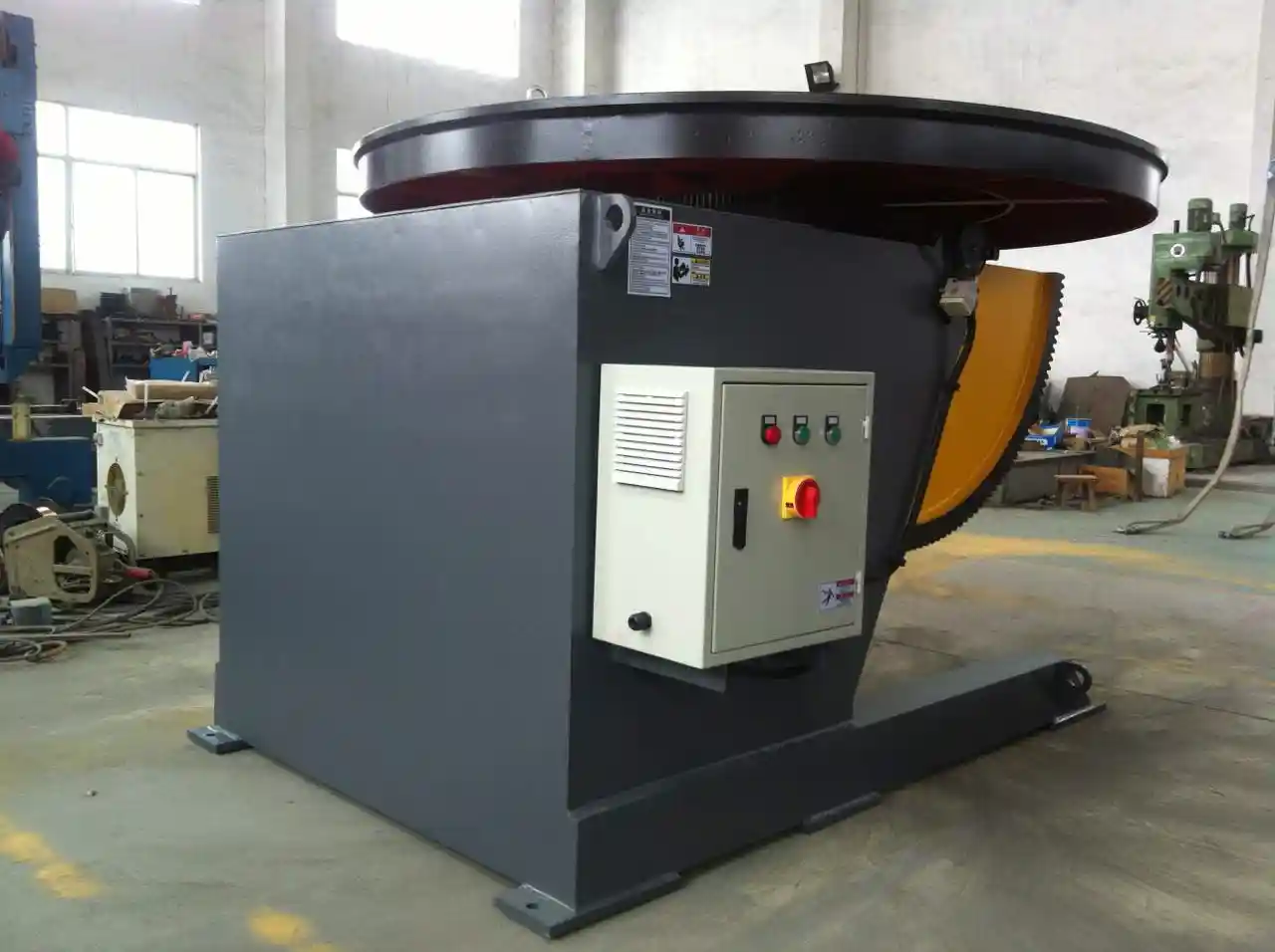
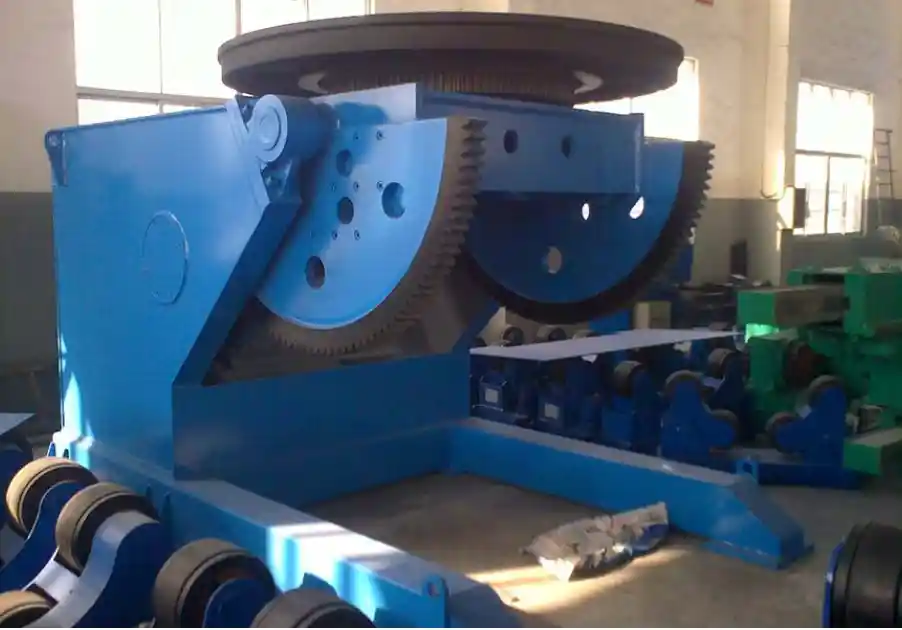
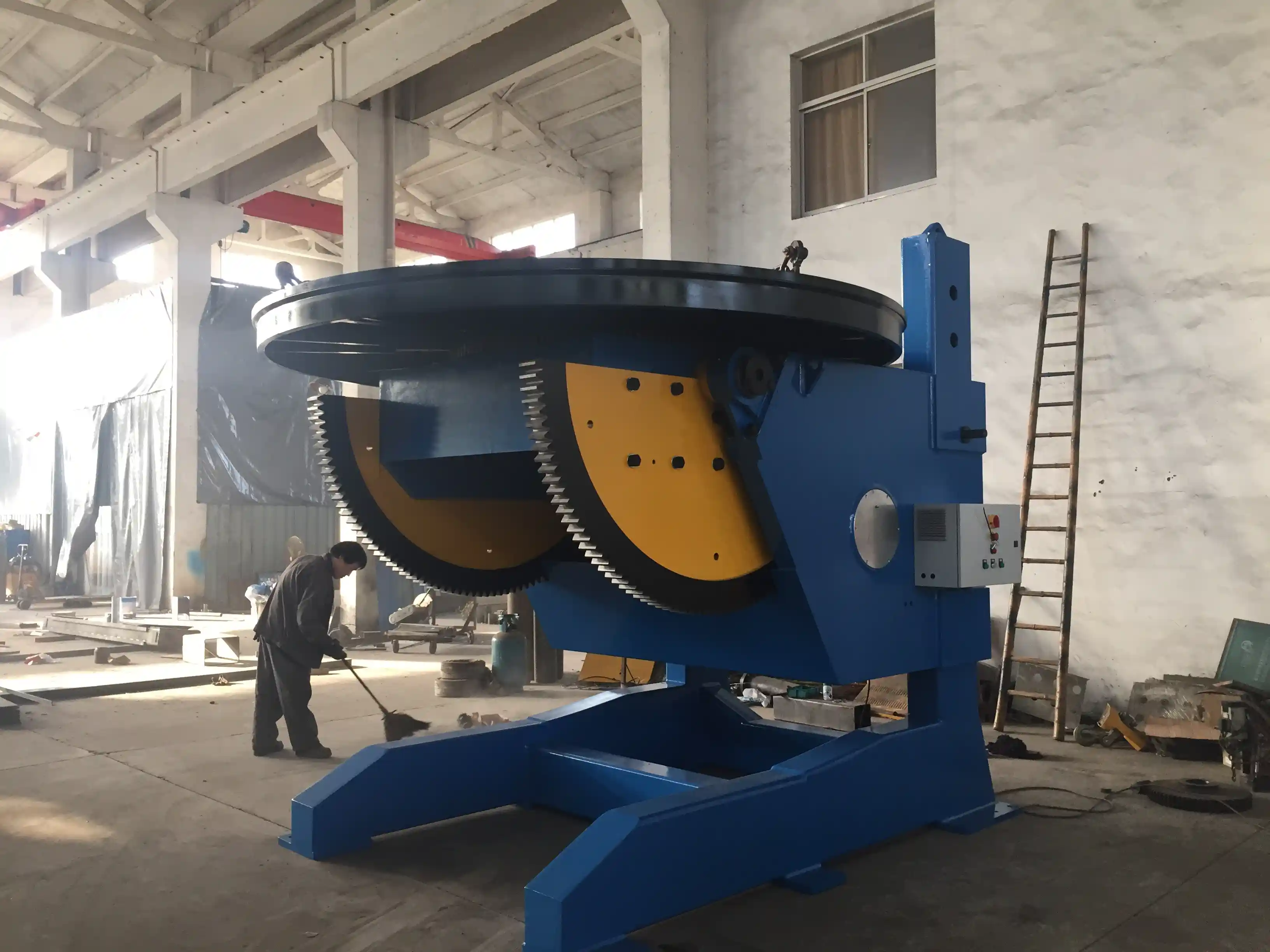
A rotator turns the cylindrical shell around its axis for girth and longitudinal seam welding. A positioner tilts or rotates a head, flange, or subassembly into the flat or horizontal position. Tank fabrication usually requires both. The rotator handles the shell courses, and a positioner handles heads, nozzles, and flanges. A 1 ton fixed height positioner covers small head assemblies; a 30 ton adjustable height positioner supports larger vessel sections.
Rotator selection often starts with the shell weight, but the rolling diameter changes the required roller spacing and frame stiffness. <Innovative Einsatzmöglichkeiten von 10-Tonnen-CNC-Schweißdrehvorrichtungen im Druckbehälterbau> covers how CNC control improves rotation consistency and fit-up accuracy on pressure vessel shells.
Product specifications give the working diameter range, not just the load. A standard 5 ton rotator handles 250 to 2300 mm. A 100 ton adjustable unit handles 800 to 5000 mm. If your tank diameter sits near the upper edge of the range, the roller contact stress increases and the frame must be checked more carefully.
Manual Versus Automated Tank Welding Investment
Manual tank welding has a lower initial equipment cost, but it buys labor hours and weld consistency risk. Automated tank welding combines a rotator with a Schweißmanipulator or a submerged arc welding tractor. The capital cost is higher because the system includes the boom, travel rail, controls, and integration. The operating cost changes at the same time. A mechanized setup runs longer continuous passes with less operator fatigue and fewer stops.
Is automated tank welding worth the higher upfront cost?
The answer depends on monthly output and repeatability requirements. If the shop produces two or three large tanks per month, the automation payback may be slow. If it produces pressure vessels or storage tanks every week with similar joint details, the reduced cycle time and rework can recover the additional cost. The evaluation is not only purchase price; it is cost per good meter of weld, including repair hours and inspection delays.
A welding manipulator adds positioning flexibility. The boom moves the torch along the seam while the rotator turns the shell. Larger LH series models offer horizontal travel up to 8000 mm and vertical travel up to 8000 mm. That reach matters when you move from small vessels to long tank courses. The cost changes with travel length and whether the column rotates, but those dimensions are set by the tank size, not by preference.
If your program involves tanks over 5 meters in diameter or long shell courses, it is worth confirming rotator anti-creep control and manipulator travel before finalizing the equipment list. Send your vessel diameter, wall thickness, and weld length to jay@weldmc.com.
Tank and pressure vessel shops often separate the rotator budget from the positioner budget, but the two interact on the shop floor. <Verbesserung von Qualität und Effizienz bei der Herstellung von Tanks und Druckbehältern: Der zentrale Anwendungswert von Positionierern> covers how positioner selection affects fit-up, weld access, and downstream repair rates.
Installed Cost and Site Preparation Requirements
Purchase price is only part of the installed cost. Heavy rotators and positioners require a concrete foundation with adequate thickness and flatness. A 20 ton turntable needs foundation reinforcement. Larger systems are often paired with an overhead crane of 25 tons or higher. If the shop does not have that lifting capacity, the investment plan must include a crane or an alternative handling method.
Most WUXI ABK equipment runs on 380 V 50 Hz three-phase power. If the site supply differs, a transformer or voltage conversion adds cost. Electrical supply, compressed air, and crane access sit outside the welding equipment quote, but they affect startup. A rotator that arrives on site but cannot be powered or lifted is not an asset. I have seen projects delay because the foundation curing time or the control cabinet location was not included in the schedule. The budget should carry a site preparation line that covers foundation, power connection, lifting, and rail installation where a welding manipulator travels.
Site requirements are easy to undercount when the quote focuses on the machine itself. <Wuxi ABK Professionelle Rotationsschweißgeräte: Präzisionsschweißlösung für den Druckbehälterbau> covers how rotary equipment is matched to vessel programs and where precision requirements affect the total production setup.
Building a Defensible Tank Welding Equipment Budget
A defensible budget does not start with a price list. It starts with the vessel diameter, material, wall thickness, weld length, monthly output target, and available power supply. Those inputs define the rotator class, the positioner type, the automation level, and the site work. When we support tank welding equipment projects, the first step is to match the equipment to those numbers and then test the total against the plant layout and lifting capacity.
WUXI ABK Machinery has engineering support in house for this evaluation. If you share your vessel diameter, wall thickness, weld length, and monthly output target, we can confirm the rotator capacity, positioner type, and automation level that fit the program. Send those details to jay@weldmc.com or call +86 510 83555592 / mobile +86 138 1510 1750. Use the subject line “Tank Welding Equipment Cost” and include your available power supply and crane capacity.
Common Questions About Tank Welding Equipment Costs
How much does tank welding equipment cost?
There is no fixed price for tank welding equipment because the system is configured around vessel diameter, load, and automation level. A basic small-diameter rotator and manual welding setup sits at a different budget level than a heavy rotator with a CNC control system and a welding manipulator. Instead of asking for a single number, build the budget from rolling weight, diameter range, weld length per vessel, and monthly output. Those four inputs determine the equipment class. Any price quoted before those inputs are defined is a placeholder, not an investment figure.
Should I buy a positioner or a rotator for tank fabrication?
It depends on which part of the tank you are welding. A rotator is the primary machine for shell courses because it turns the cylinder under the weld torch. A positioner handles heads, flanges, nozzles, and smaller assemblies that need tilting or rotation. Most tank programs need both, but the rotator usually consumes the larger share of the budget because it carries the full vessel weight. If your shop only manufactures heads or repairs tank components, start with a positioner. If you build complete tanks, size the rotator first and add the positioner around the head fit-up and nozzle work.
Is automation worth the higher capital cost for a small tank shop?
Many smaller shops assume automation is only for high volume plants. The real question is whether manual weld quality and labor availability are limiting output. A mechanized rotator and manipulator system does not require a full robotic cell. Even a basic motorized rotator with stable speed control removes much of the operator dependence in long girth welds. If the shop loses time to rework, inconsistent travel speed, or difficulty finding skilled welders, automation can pay back through first-pass quality rather than volume alone. The investment case should compare cost per acceptable meter, not equipment price alone.
What information should I prepare before requesting a tank welding equipment quote?
The request is more useful when it is narrowed to the actual tank envelope. Prepare the vessel diameter range, maximum shell weight, wall thickness, material grade, weld length per course, monthly production target, available power supply, and crane capacity. Also list the weld processes you plan to use, such as submerged arc welding or MIG. Those details let the supplier confirm rotator capacity, positioner type, and automation level. Share your requirements at jay@weldmc.com and we will confirm the equipment configuration that fits the program.
Falls Sie daran interessiert sind, lesen Sie doch diese verwandten Artikel:
Eine Revolution im Schiffbau: Wie Schweißpositionierer Qualität und Effizienz verbessern
Kernprobleme und hochpräzise Lösungen für Schweißpositionierer in der Windkraft- und Schiffbauindustrie: Umfassende technische Analyse
Perfekte Schweißnähte an Rohren mit großem Durchmesser mit professionellen Walzgeräten
Probleme mit Ausrichtungsfehlern beim Schweißen von Rohren: Wie intelligente Schweißrohrrotatoren die Durchlaufraten von Ölpipelines erhöhen
 English
  Español
  Français
  Deutsch
  Português
  Русский