
Offshore platform fabrication puts long welds on heavy, round, and often out-of-round components, so the deciding factor is not just weld procedure but how the assembly is held, aligned, and rotated during every pass. A heavy-duty welding package earns its place when it reduces crane lifts, keeps a joint within tolerance while welding proceeds, and lets the welder stay in the correct position. That requires matching positioners, manipulators, rotators, and fitup equipment to the actual component weight, diameter, center of gravity, and access path, not selecting equipment from a single tonnage label.
Begin With Fitup and Load Control
In offshore fabrication, the most expensive weld problem is often created before welding starts. A can-to-can joint with mismatched edges, uneven root opening, or localized contact stress may require repeated crane lifts and manual correction. Heavy-duty fitup rotators and adjustable roller beds should first bring the two edges into a stable position, hold the root opening, and preserve that condition during tacking. This is where hydraulic alignment, laser or dial verification, and anti-creep control become more useful than added rotational speed. When the support is wrong, the joint closes on one side and opens on the other once rotation starts.
For larger jacket legs, conductor pipes, and pile sections, the support line must be checked against the actual diameter and expected out-of-round condition. A rotator or positioner may be sized by vessel weight, but roller spacing and wheel diameter decide whether the load stays centered. Companies should request the wheel diameter, vessel diameter range, roller contact width, and anti-creep tolerance before accepting a quotation.
Once a shell can is rolled, it still needs support at the correct centerline before the first weld is made. <Die tragende Säule der Schwerindustrie: Die herausragende Leistung von Walzgerüsten in Schlüsselprozessen> covers how roller stands keep heavy work stable through welding and fitup.
Match Rotator Capacity to the Real Support Condition
A rotator is not a simple weight rating. It supports a cylindrical section on two roller lines, and the load on each roller frame changes with diameter, wheel spacing, and center distance. Oversized vessels on narrow wheel centers create high contact stress; undersized vessels can become unstable. In offshore work, operators should not compare only tons or diameter range. They need the maximum allowable load per frame, the vessel diameter range, the wheel velocity, the rotation speed, and the anti-creep or axial displacement limit. Power requirements also shift when the center of gravity is not centered or when tacked assemblies include temporarily attached lifting lugs and sea fastening details.
| Fabrication requirement | Equipment class | Key sizing input | Typical catalog range |
|---|---|---|---|
| Large-diameter tubular girth welds | Adjustable welding rotator | Weight per support and vessel diameter | 100 to 300 tons; 800 to 6000 mm |
| Small and medium can rotation | Standard-Schweißrotator | Diameter range and duty cycle | 10 to 80 tons; 320 to 5000 mm |
| Segment fitup before welding | Fitup rotator | Root opening, gap, lineup tolerance | 10 to 60 tons; hydraulic adjustment |
| Node and brace positioning | Adjustable-height positioner | Overturning moment and tilt angle | 30 to 100 tons; height and tilt adjustment |
| Longitudinal seam welding | Manipulator zum Schweißen | Seam length and vertical reach | 3 to 8 m boom travel; ±0.1 mm/m accuracy |
Once the correct rotator is chosen, the next practical check is whether it can turn without axial creep. This is especially important on offshore cans that are long and have residual straightness or circularity variation. Anti-creep rollers, guide wheels, and regular roller condition checks are more valuable than chasing higher rotation speed. The goal is repeatable, slow, steady travel for submerged arc or gas-shielded welding.
Pair Positioners With Manipulators for Node Welding
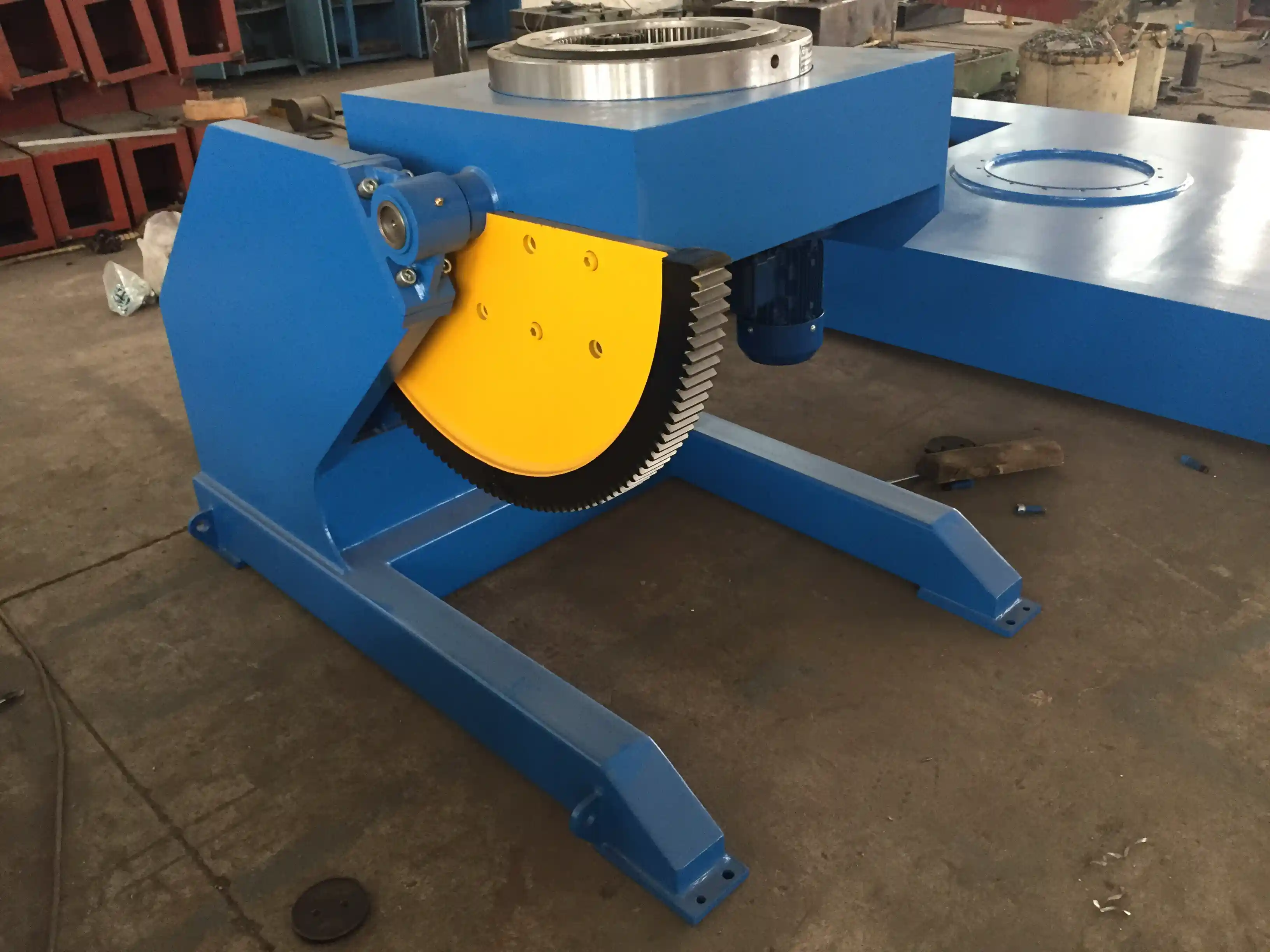
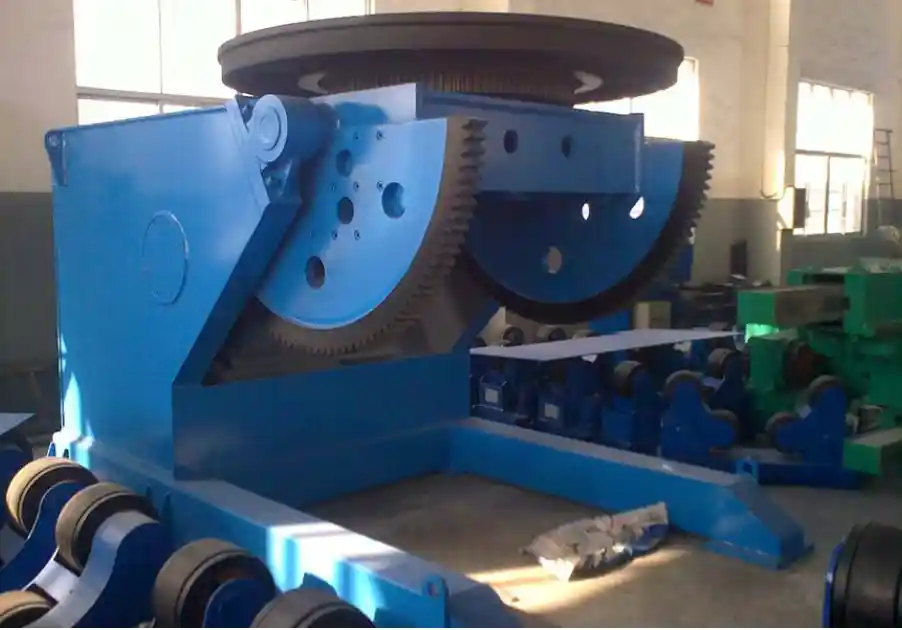
Offshore nodes, braces, and pile sleeves rarely present a simple horizontal butt joint. They require rotating a heavy component into an accessible position while the welding head stays on the joint. A positioner carries the workpiece; a manipulator positions the torch. They should be specified together, not as independent purchases. The manipulator must reach the full seam length after the node is on the worktable, and the positioner must maintain speed and position under the off-center load.
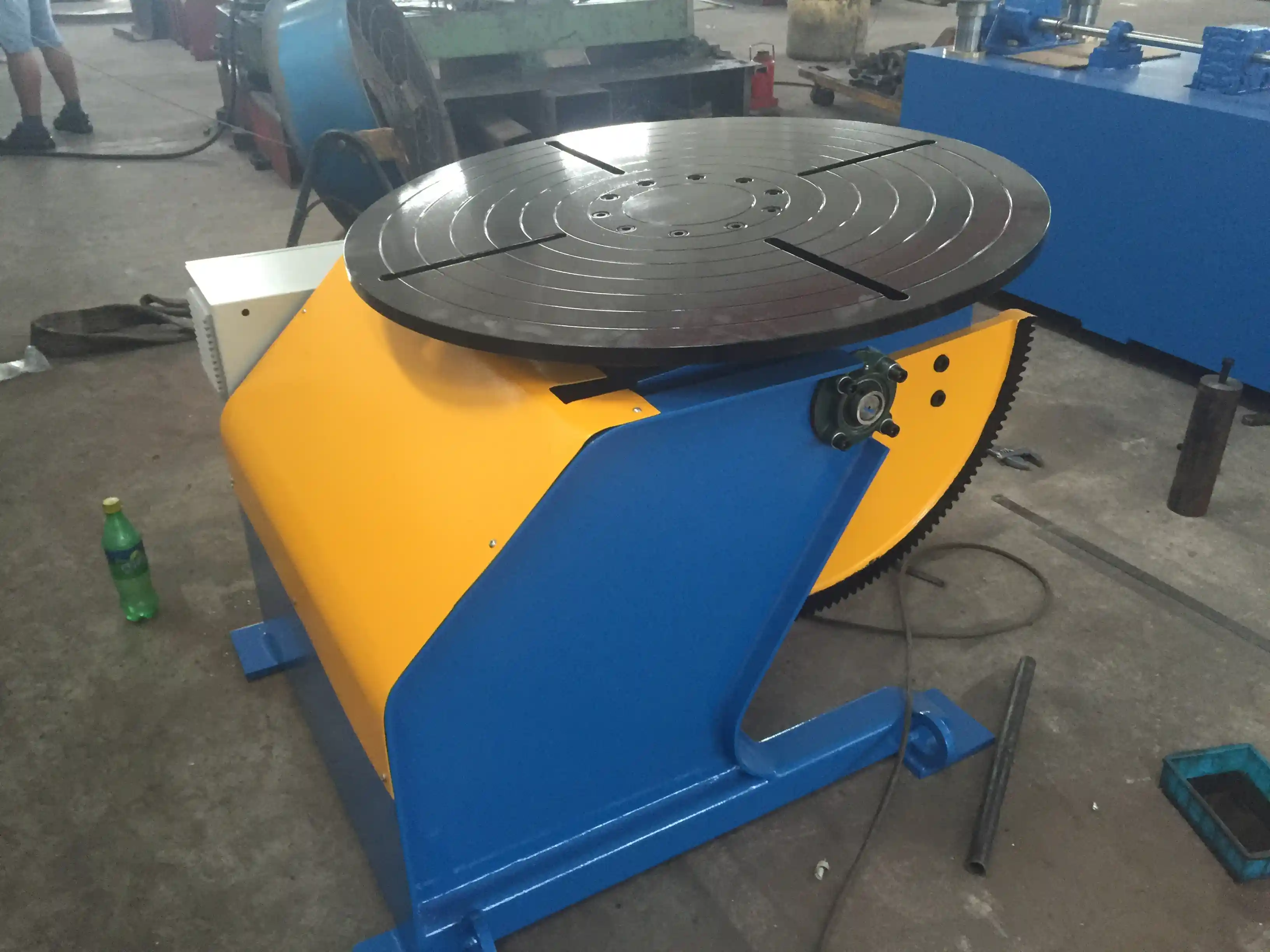
For medium node components, a 3-axis positioner can provide continuous rotation, tilt, and turning with servo repeatability. For heavier tubular sections, an adjustable-height positioner or head-tail system keeps the component at a workable elevation and turns it through the planned sequence. The purchase order should state the load, center-of-gravity distance, maximum eccentric distance, tilt range, and whether the positioner must share control signals with the manipulator or robot.
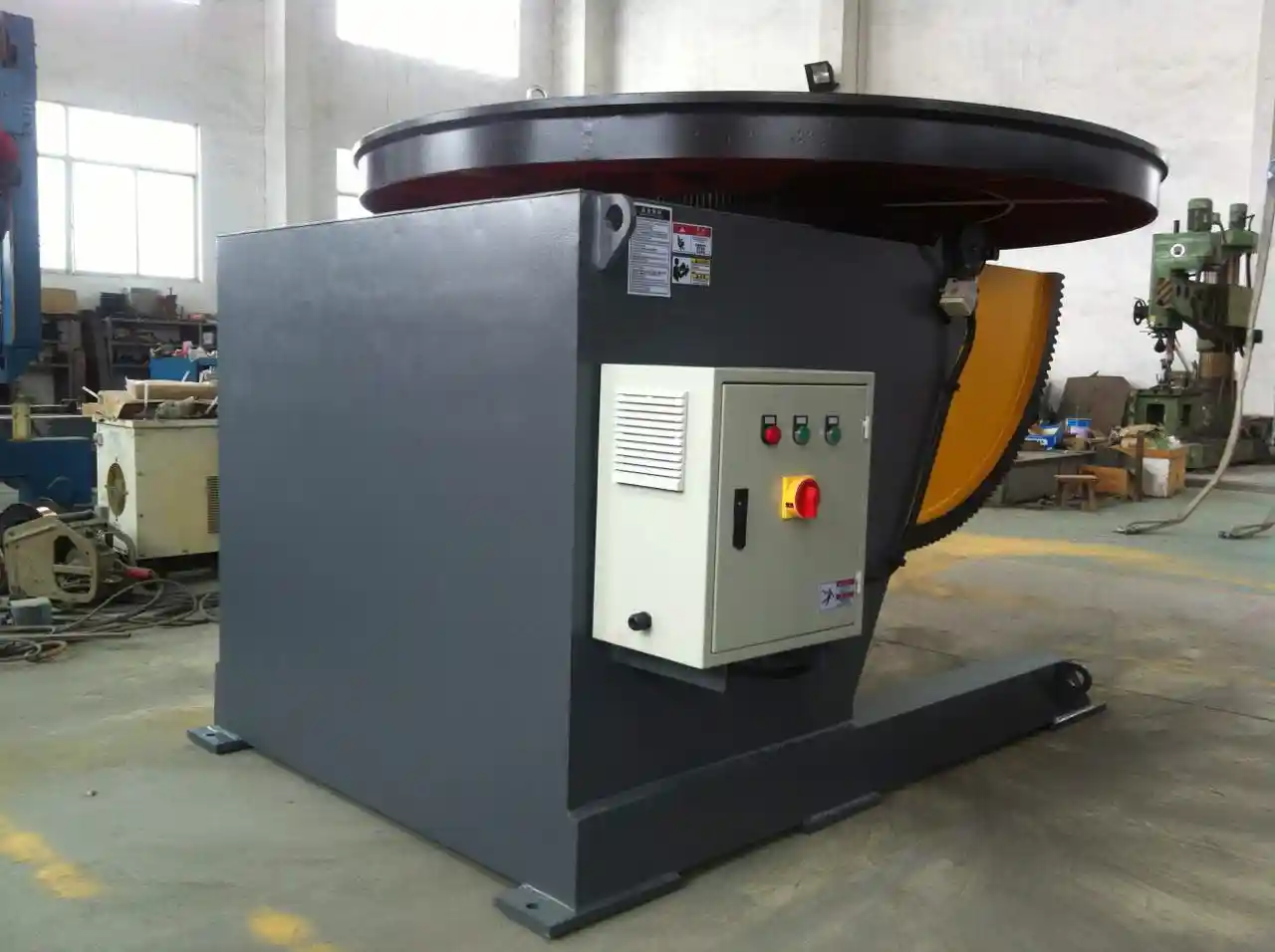
A heavy offshore node may have its center of gravity far from the table center, so the rated tonnage alone is not enough to establish safe use. <Kernprobleme und hochpräzise Lösungen für Schweißpositionierer in der Windkraft- und Schiffbauindustrie: Umfassende technische Analyse> covers the load distribution and accuracy checks that keep positioner selection realistic in wind power and shipbuilding fabrication.
A column and boom manipulator is often the better choice for very long deck seams and pile longitudinal seams because it can travel along the joint while the rotator turns the work. The boom should be sized so the operator does not need to re-rig the weld head at every section, and vertical travel should cover the top and bottom of the largest assembly without overloading the rail or foundation.
Offshore longitudinal seams can be too long for a fixed boom to track accurately when the workpiece is not aligned with the rail centerline. <Schweißmanipulatoren für die Fertigung von Windtürmen: Revolutionierung der Produktionseffizienz> covers how column-boom manipulators improve seam access and production efficiency in large cylindrical fabrication.
Plan Welding Sequence Around Distortion Control
Offshore structures use thick, high-strength plate and tubular sections, and distortion is controlled as much by sequence as by weld procedure. A heavy-duty work positioner helps because it can turn the assembly after each pass, allowing balanced welding from opposite sides and systematic back-step sequencing. The objective is not to weld as fast as possible on the first side; it is to keep the joint from pulling out of line before final acceptance.
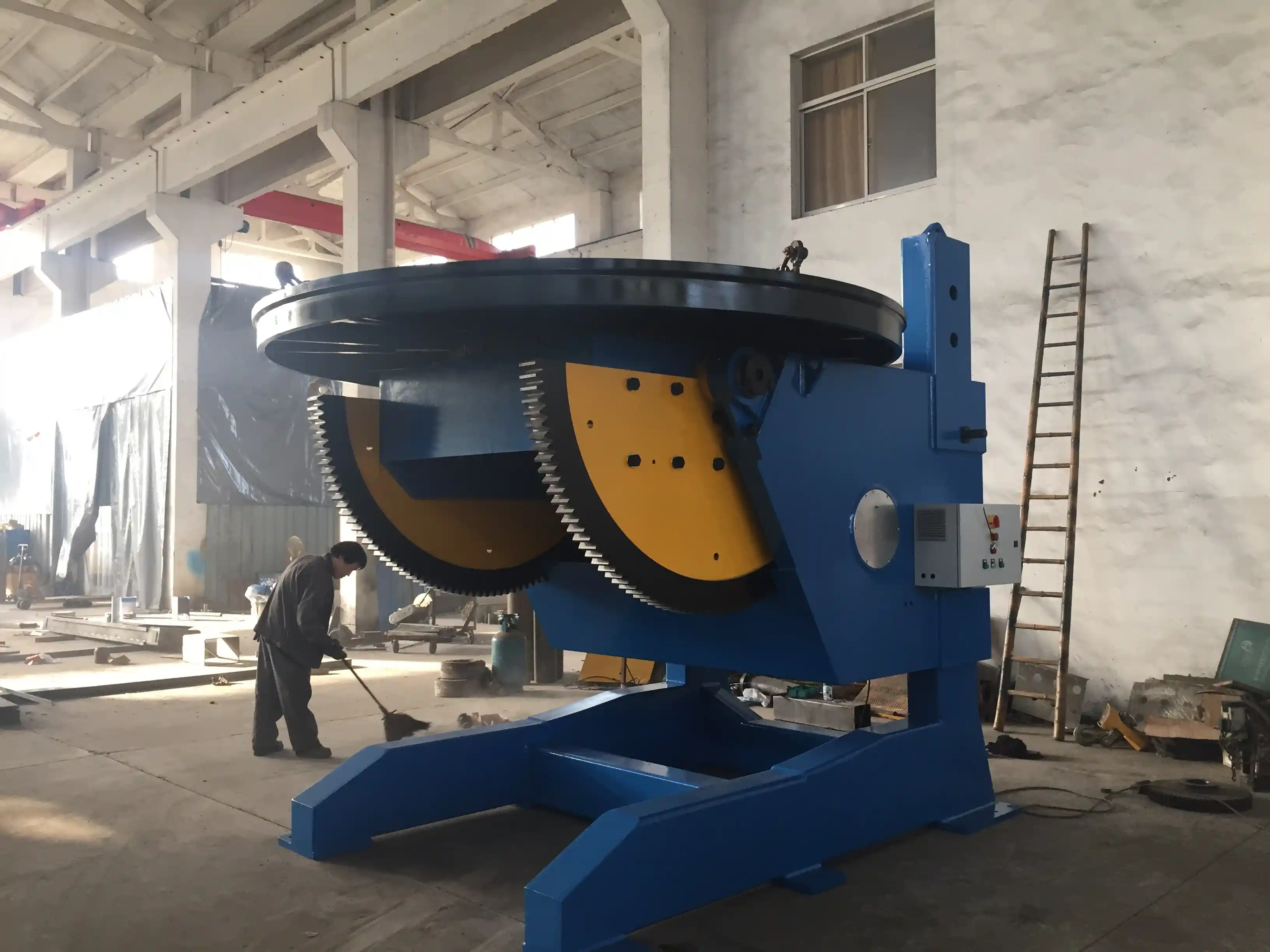
Before releasing a section, the team should record its baseline alignment on the positioner, measure the root gap and joint angle after tacking, and recheck after the first passes. Heavy welding fixtures and variable-height supports are used when a node must be held in a pre-set shape during welding. The pass sequence should be written down and followed. Changing it to save time can create distortion that is more expensive to repair than the weld itself.
Specify Marine-Grade Protection From the Start
Offshore yards and seaside workshops expose equipment to salt mist, humidity, and abrasive weld spatter. The mechanical design may be heavy enough, but the electrical system also has to survive. For positioners and rotators, an IP54 rated housing is often a minimum for the motors and mechanical areas, while control cabinets that sit near the welding station may need IP65 and sealed cable entry. Stainless or coated surfaces, sealed bearings, and plug-connected cables reduce the hidden costs of unplanned downtime in a coastal environment.
Specify the protection class for the control panel, the motor cooling method, the cable glands, and the coating before the machine is built. Retrofit covers and seal kits are less reliable than a factory-built marine package. The same applies to the manipulator boom, wire feeders, and any exposed linear guides. If the unit will be used near blasting or painting areas, confirm whether the electrical cabinet must be purged or remotely located.
Use a Trial Fitup to Freeze the Setup
Before production starts, the most useful verification is a trial fitup on the actual equipment with the heaviest or most offset assembly. This trial should prove that the rollers or positioner can hold alignment after rotation, that the manipulator can follow the seam without repositioning, and that the root gap stays within the qualified range. It also shows whether crane access, braces, or temporary attachments interfere with rotation.
Document the acceptable positions, the number of completed passes before a position change, the speed settings, and the pause points for inspection. These settings then become the baseline used by each shift, so a different operator does not change the setup based on feel. If the trial exposes a limitation, adjust the equipment arrangement before the first production weld rather than after a nonconformance is found.
Define the Heavy-Duty Welding Package Before It Leaves the Shop
Send the largest component diameters, assembled weights, seam lengths, node geometry, and the site crane or hall constraints. WUXI ABK can review the rotator capacity, positioner tilt and turn range, manipulator reach, and the sequence that fits your offshore fabrication yard. Contact Zhang Jian at jay@weldc.com or +86-13815101750.
FAQ: Offshore Heavy-Duty Welding Equipment
How is a rotator load rating calculated?
The load rating includes the workpiece weight distributed across driven and idler frames, with dynamic effects during rotation. Vessel diameter and roller spacing determine contact angle and load distribution. Check the manufacturer’s maximum load per frame, diameter range, and wheel velocity for the actual wall thickness and any temporary attachments.
What is the difference between a welding positioner and a welding manipulator?
The positioner holds and moves the workpiece through rotation, tilt, or turning. The manipulator carries the weld head along a seam and keeps it aligned while the work is moved. In offshore fabrication, the two usually work together. The positioner turns the node while the manipulator tracks the seam and maintains appropriate travel speed.
Can offshore equipment operate in salty coastal environments?
Equipment intended for seaside yards should be ordered with marine-grade protection rather than retrofitted later. Important items include corrosion-resistant coatings, sealed bearings, protected cable glands, and an IP54 or IP65 control cabinet depending on location. Confirm whether motors and linear guides need washdown or purge protection.
What should a fabricator verify before production welding?
Run a trial with the largest or most eccentric assembly on the selected equipment. Record baseline alignment, root gap after tacking, pass sequence, travel speed, and inspection pauses. The trial should confirm the assembly remains stable after rotation and that the manipulator reaches both ends of the seam without re-rigging.
Falls Sie daran interessiert sind, lesen Sie doch diese verwandten Artikel:
Präzisionsautomatisierung mit Schweißrotatoren für die industrielle Fertigung: Ein Leitfaden mit Fragen und Antworten von Experten
Kernprobleme und hochpräzise Lösungen für Schweißpositionierer in der Windkraft- und Schiffbauindustrie: Umfassende technische Analyse
Schweißmanipulatoren für die Fertigung von Windtürmen: Revolutionierung der Produktionseffizienz
Verbesserung von Qualität und Effizienz bei der Herstellung von Windkraftanlagen: Die Schlüsselrolle von Positionierern beim Schweißen von Turmsektionen
 English
 Español
 Français
 Deutsch
 Português
 Русский