
Welding positioner rotation speed and tilting capacity look like simple catalog values until a workpiece is mounted off center. A table rated for 5,000 kg may still struggle with a 1,500 kg assembly if the center of gravity sits too far above the faceplate, and a rotation speed of 0.5 RPM only becomes meaningful when it is converted into weld travel speed at the seam radius. This article explains how to read those two specifications together before you specify a positioner for pipe, pressure vessel, wind tower, or structural welding.
Why Does Rotation Speed Matter More Than RPM Alone?
Rotation speed on a welding positioner is not a line speed. Convert it with this relationship: weld travel speed in millimetres per minute equals table rotation speed in revolutions per minute multiplied by 2π multiplied by the weld radius. At 0.2 RPM on a 300 mm radius tube, the weld travel speed is about 377 mm/min. At the same 0.2 RPM on a vessel seam with a 750 mm radius, the weld travel speed is about 942 mm/min. If the qualified procedure calls for 350 mm/min with a given wire and gas combination, a 0.5 RPM catalog figure says very little until the joint radius is known.
WUXI ABK fixed height and L type positioners operate from 0.05 to 0.5 RPM stepless. That span covers most submerged arc, MIG, and TIG work on diameters from roughly 200 mm up to several metres. The low end matters for root passes and heavy sections where the puddle can outrun the torch. The high end matters for high volume circumferential seams on small to medium parts. Before asking whether a positioner is fast enough, check the weld diameter and the qualified travel speed.
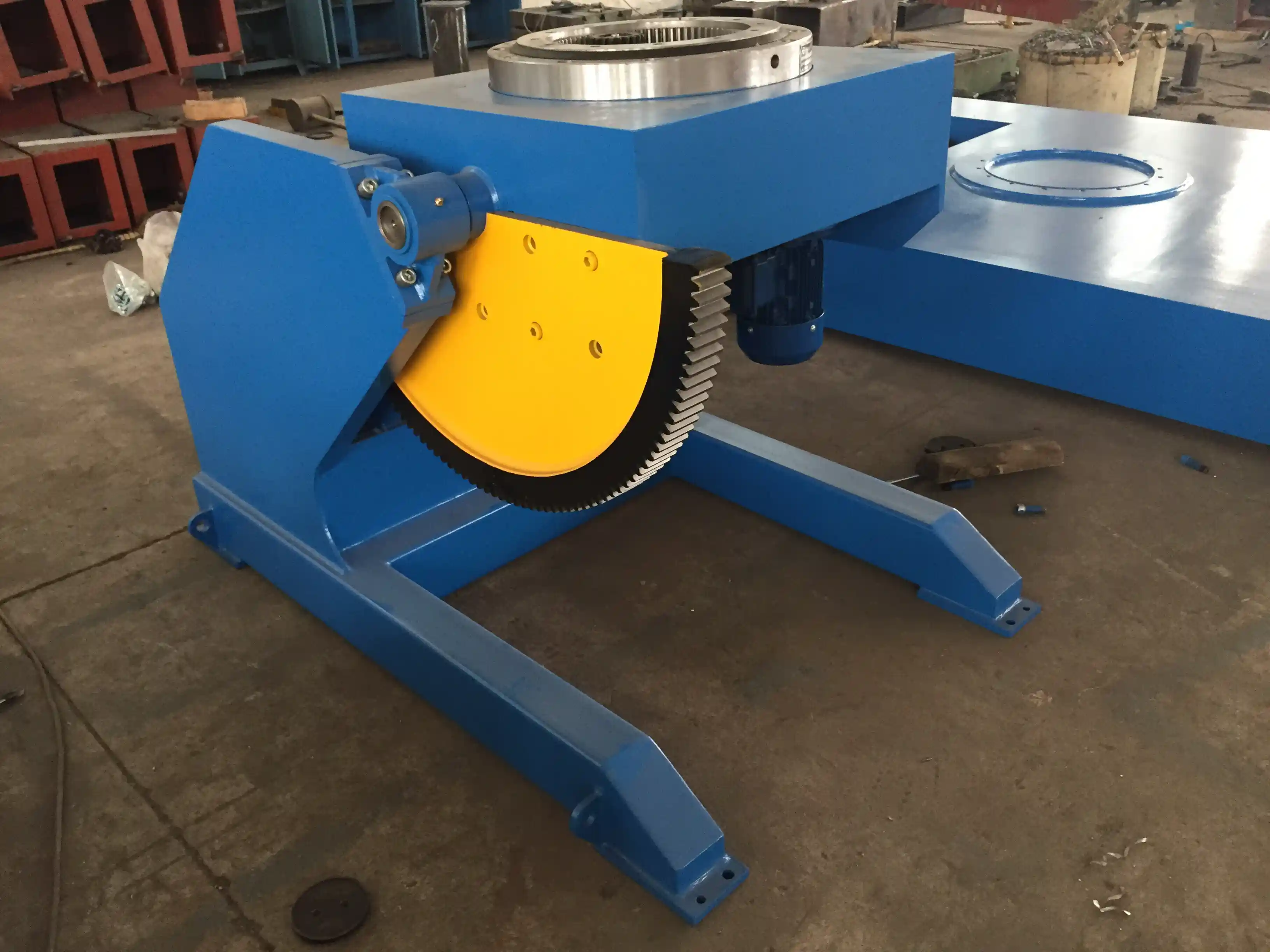
Rotation speed on the table is only part of the picture when a fixed torch follows a rotating pipe joint. <Verbesserung der Qualität beim Schweißen von Rohren durch einen Hochpräzisions-Schweißpositionierer> covers how stable low-speed rotation and table accuracy keep bead width consistent without the operator constantly correcting travel angle.
How Does Tilting Capacity Depend on Load Center of Gravity?
Tilting capacity is not the same as table load capacity. A positioner may rotate a given mass flat, but once the table tilts, the moment around the trunnion and base changes. Two catalog values must be checked together: maximum eccentric distance and maximum center-of-gravity distance.
The HBJ-10 is rated for 1,000 kg, but that rating applies at a maximum center-of-gravity distance of 200 mm and a maximum eccentric distance of 150 mm. A tall part with its mass concentrated 500 mm above the worktable produces far more overturning moment than the flat-position rating suggests. At 400 mm COG height, the moment is roughly double the 200 mm value. The correction is not always a larger machine. Sometimes it is a different fixture, a lower mounting point, or a two-point support layout.
For long cylindrical sections, L type and head tail machines carry the part at two locations, so the component is not cantilevered from a single faceplate. That changes the calculation and often makes it possible to use a different rating because the moment is shared.
| Modell | Tragfähigkeit | Rotationsgeschwindigkeit | Umsatzgeschwindigkeit | Umschlagswinkel | Maximum COG Distance |
|---|---|---|---|---|---|
| HBJ-10 | 1,000 kg | 0.05 to 0.5 RPM | 0.67 RPM | 0 to 90 degrees | 200 mm |
| HBJ-20 | 2,000 kg | 0.05 to 0.5 RPM | 0.67 RPM | 0 to 120 degrees | 300 mm |
| HBJ-30 | 3,000 kg | 0.05 to 0.5 RPM | 0.23 RPM | 0 to 90 degrees | 400 mm |
| HBJ-50 | 5,000 kg | 0.05 to 0.5 RPM | 0.20 RPM | 0 to 120 degrees | 300 mm |
Which Positioner Specifications Fit Common Fabrication Tasks?
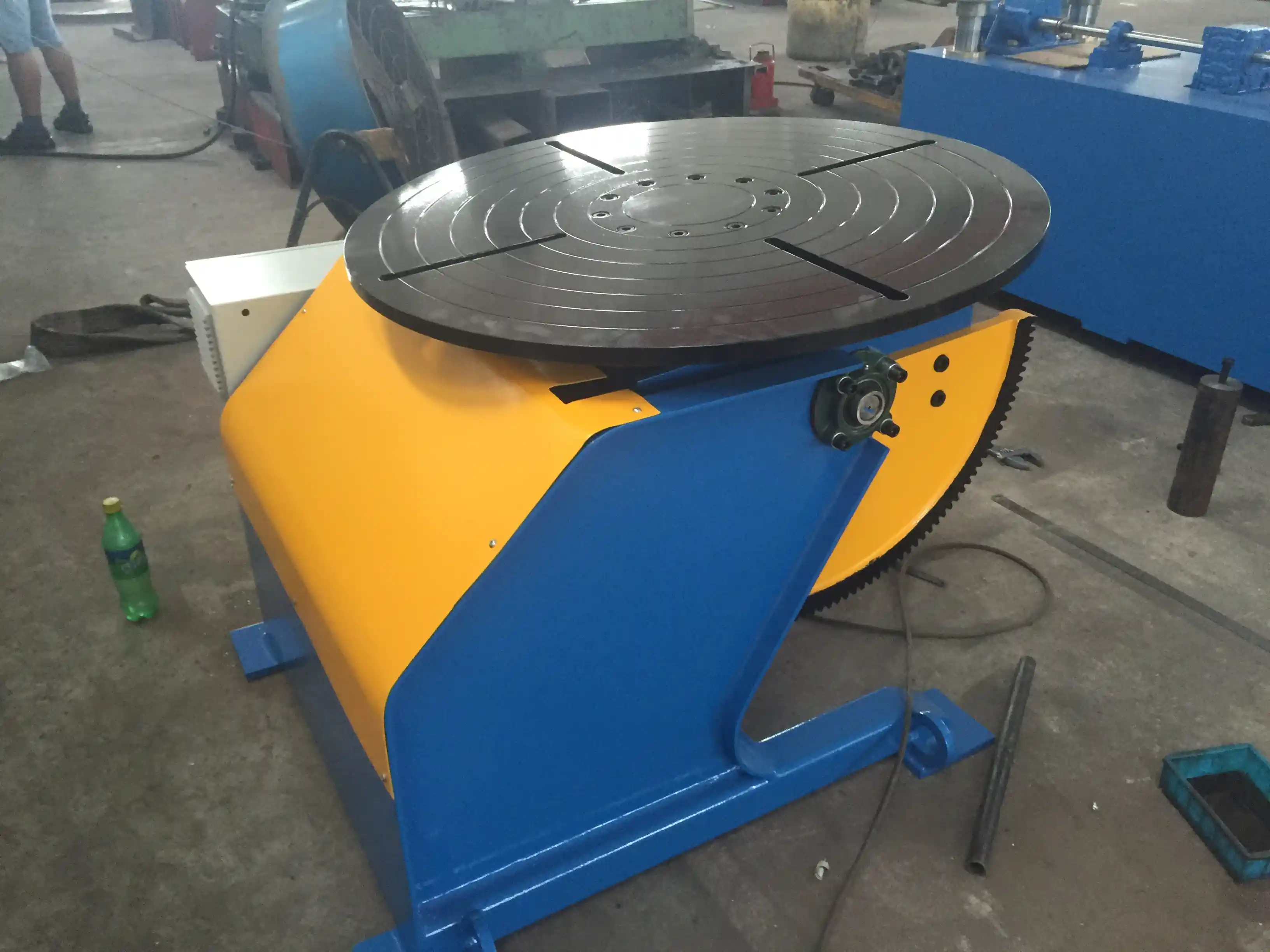
Fixed height machines in the 1 to 5 ton range fit circular seams on flanges, bearings, small pressure vessel sections, and rail components where the weld sits close to the table surface. A 1,200 mm table on the HBJ-10 and HBJ-20 works for parts that can be fixtured central to the rotation axis. For heavy weldments that need taller reach or more room, L type and adjustable height machines take over.
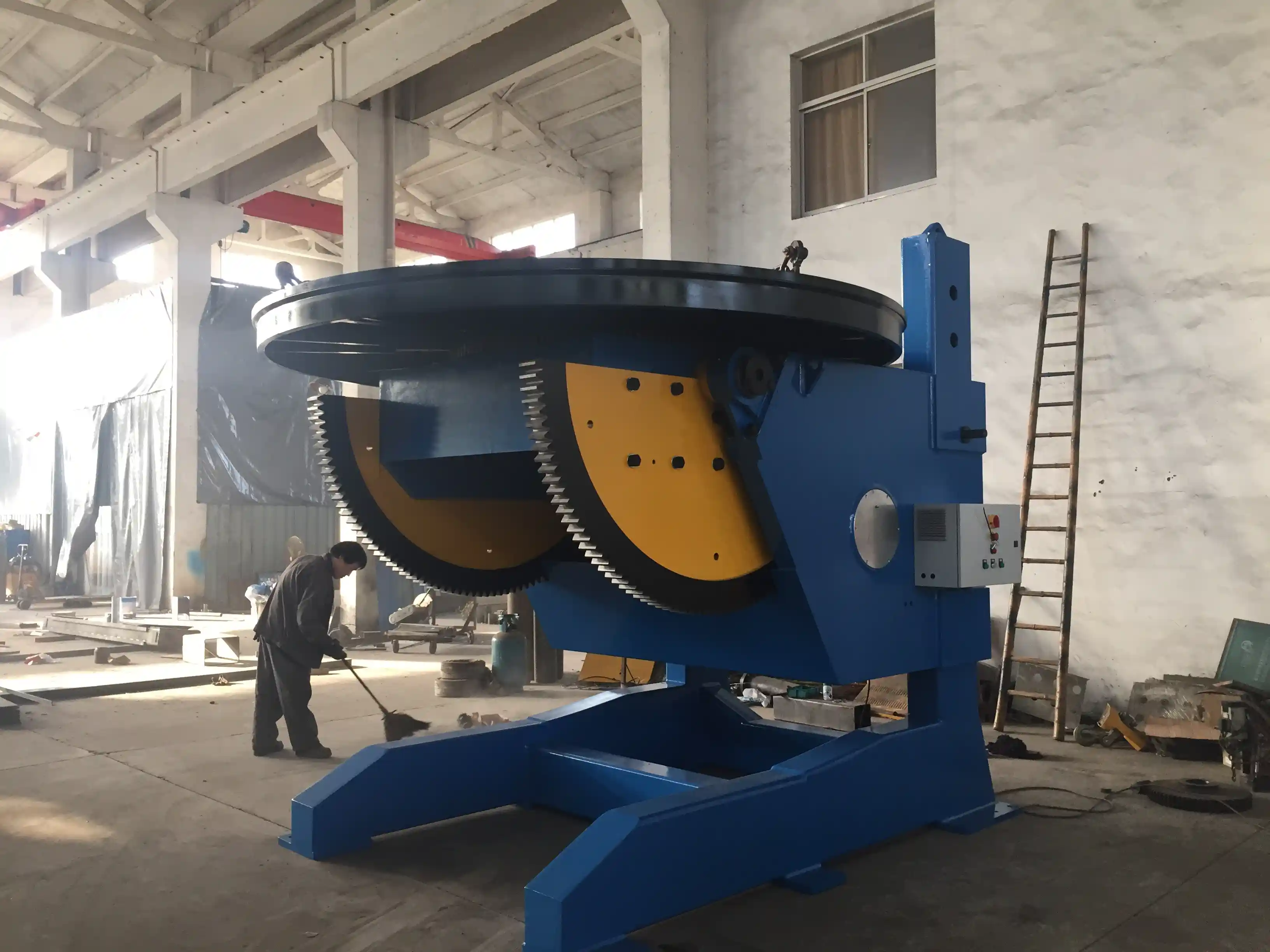
Pressure vessel and tank work usually needs 0 to 120 degrees of turnover or 0 to 135 degrees of tilt rather than only 0 to 90 degrees, because the operator has to reach the inside throat of the shell and reposition the part for out of position sealing passes. WUXI ABK L type models LHBJ-30 and LHBJ-50 cover 3,000 kg and 5,000 kg with L support lengths of 800 mm and 1,200 mm. Wind tower and heavy structural sections move toward 30 to 100 ton machines with height adjustment and continuous 360 degree table rotation.
If your program involves off center tooling, a tilt position below 15 degrees, or a weldment that overhangs the faceplate, do not settle for a tonnage rating alone. Confirm the moment limit and the speed range against your qualified weld procedure. Send your part drawing, weight, COG distance, and qualified weld travel speed to jay@weldmc.com and we will check the positioner envelope against your setup.
What Goes Wrong When Positioner Specs Are Read Too Narrowly?
One common failure is buying by load capacity and ignoring the low speed torque requirement. A machine may offer a higher maximum RPM, but if the drive cannot start smoothly under an eccentric load, the motor faults and the weld starts with a hesitation at the 6 o’clock position. That hesitation can create lack of fusion or a lumpy root pass.
Another failure is treating turnover angle as a check box. A 0 to 90 degree table cannot get a heavy part into the same working positions as a 0 to 135 degree unit with a cycloidal worm dual stage reducer. For pressure vessel end caps and pipe nozzles, that extra tilt is what exposes the joint to the torch without forcing the operator to weld overhead.
I recall a 3 ton positioner that was selected only by part weight. The part had a 0.35 m overhang from the table centerline, and the resulting moment was well above what the drive could start smoothly at low speed. The table would rotate once moving, but it faulted during start. We solved it by moving the fixture closer to the faceplate and lowering the COG, not by changing the motor.
A pressure vessel shell can pass a weight check and still misbehave when the load is not centered. <Revolutionäre Lösung für das Schweißen von Druckbehältern: Technische Analyse von 360-Grad-Rotationsschweißpositionierern> covers how continuous rotation and controlled tilt keep the seam accessible on large cylindrical parts, and why the drive train must be matched to the moment rather than the mass.
Which Positioner Specification Should You Confirm Before Ordering?
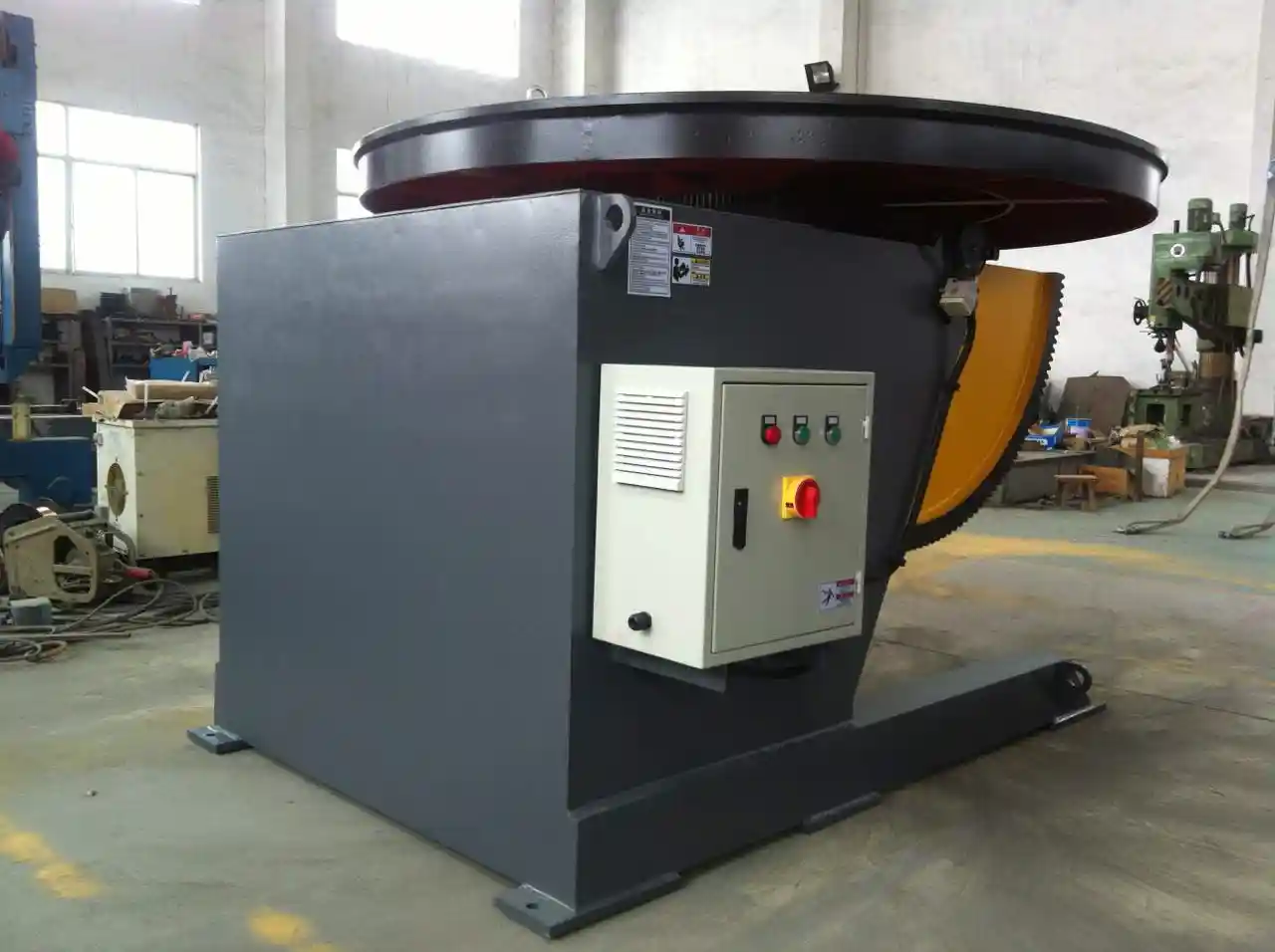
If a previous positioner faulted under load or could not hold a 45 degree tilt, the cause usually sits in the load center of gravity, the seam radius, or the specified turnover angle. Before issuing a purchase order, confirm three things: the speed range expressed as weld travel speed at your joint radius, the maximum COG distance at full load, and the tilt or turnover range your procedure actually needs.
WUXI ABK manufactures fixed height, L type, adjustable height, and multi axis positioners from 1 ton to 100 tons and larger, with CE and ISO certified designs. Send your workpiece weight, COG distance, drawing if available, and target weld speed to jay@weldmc.com or call +86-13815101750. We will confirm the correct table diameter, rotation speed, and tilt capacity for your process, not just the tonnage.
What Questions Should You Ask About Speed and Tilt Specs?
Does a higher rotation speed improve welding productivity?
Only when the qualified weld procedure can run at that speed. If the procedure is limited to 300 mm/min and the joint radius is 500 mm, the required table speed is roughly 0.1 RPM, no matter how high the catalog maximum goes. Higher maximum speed becomes useful on smaller diameters and for rapid repositioning between passes, but it does not shorten weld time unless the wire, gas, and power settings can handle faster travel.
What tilt angle do we need for pressure vessel end caps?
A common assumption is that 90 degrees covers every pressure vessel setup, but that breaks down on stems, nozzles, and transitions that need the joint rotated beyond flat and horizontal. In practice, 0 to 120 degrees or 0 to 135 degrees gives the operator better access to the inside and outside of the cap without repeatedly re-fixturing. The exact range depends on the nozzle position and the sequence of fill passes.
Can a positioner rotate continuously at full load without overheating?
On installations we have handled, continuous rotation at full rated load is feasible within a defined work cycle, but the limiting factor is normally the motor and reducer temperature rise, not the table strength. IP54 cabinets, conductive slip rings, and stepless frequency control handle the electrical side. For continuous multi-shift vessel work, specify the duty cycle and ambient temperature because a machine selected for intermittent fitting will not necessarily carry the same thermal margin in continuous production.
What should we send to get an accurate positioner specification?
The best request is not “I need a 5 ton positioner.” It is a short set of operating conditions: part weight, COG distance, seam diameter, tilt or turnover position, qualified weld travel speed, and daily duty cycle. Those six values define the moment, speed, and thermal envelope better than a tonnage class. Send those six values to jay@weldmc.com and we will confirm the correct table diameter, drive, and tilt range before commercial terms.
Falls Sie daran interessiert sind, lesen Sie doch diese verwandten Artikel:
Außergewöhnlicher Anwendungsnutzen: Wie Schweißpositionierer mit fester Höhe den Fortschritt in der Offshore- und Schiffbauindustrie vorantreiben (Teil 2)
Revolutionäre Lösung für das Schweißen von Druckbehältern: Technische Analyse von 360-Grad-Rotationsschweißpositionierern
Präzisionsautomatisierung mit Schweißrotatoren für die industrielle Fertigung: Ein Leitfaden mit Fragen und Antworten von Experten
 English
  Español
  Français
  Deutsch
  Português
  Русский