Welding storage tanks with diameters over 20 meters pushes standard fabrication equipment beyond its design limits. A 20‑meter shell section can weigh over 30 tons, and rotating it smoothly while maintaining sub‑millimeter positioning accuracy requires purpose‑built machinery, not general‑purpose rotators. As a welding automation engineer who has spent two decades designing and integrating these systems at WUXI ABK Machinery, I know that the difference between a successful weld campaign and a plagued one often comes down to three things: load distribution, anti‑creep control, and rotational precision. This article breaks down the equipment capabilities that make super‑large tank welding practical and productive.
Why 20m+ Diameter Tank Welding Demands Specialized Equipment
A tank shell 20 meters across is not simply a bigger pipe. The bending moment on the roller frames, the ovality tolerance stack‑up from plate rolling, and the sheer torque required to start rotation all scale non‑linearly with diameter. Standard rotators rated for 20 tons may handle a 5‑meter vessel, but the same rating on a 20‑meter section is meaningless if the load distribution centers over a single roller set.
In large storage tank projects, shell courses are often assembled from rolled plates with longitudinal seams welded first, then the complete course is rotated for circumferential submerged arc welding (SAW). Any lateral drift, or creep, during rotation shifts the weld seam out of position and can ruin a multi‑hour SAW pass. Our experience shows that with vessels above 15 meters, the margin between a good weld and a costly repair narrows dramatically unless the rotator system compensates for real‑time axial forces.
Choosing Welding Rotators for Super‑Large Tank Shells
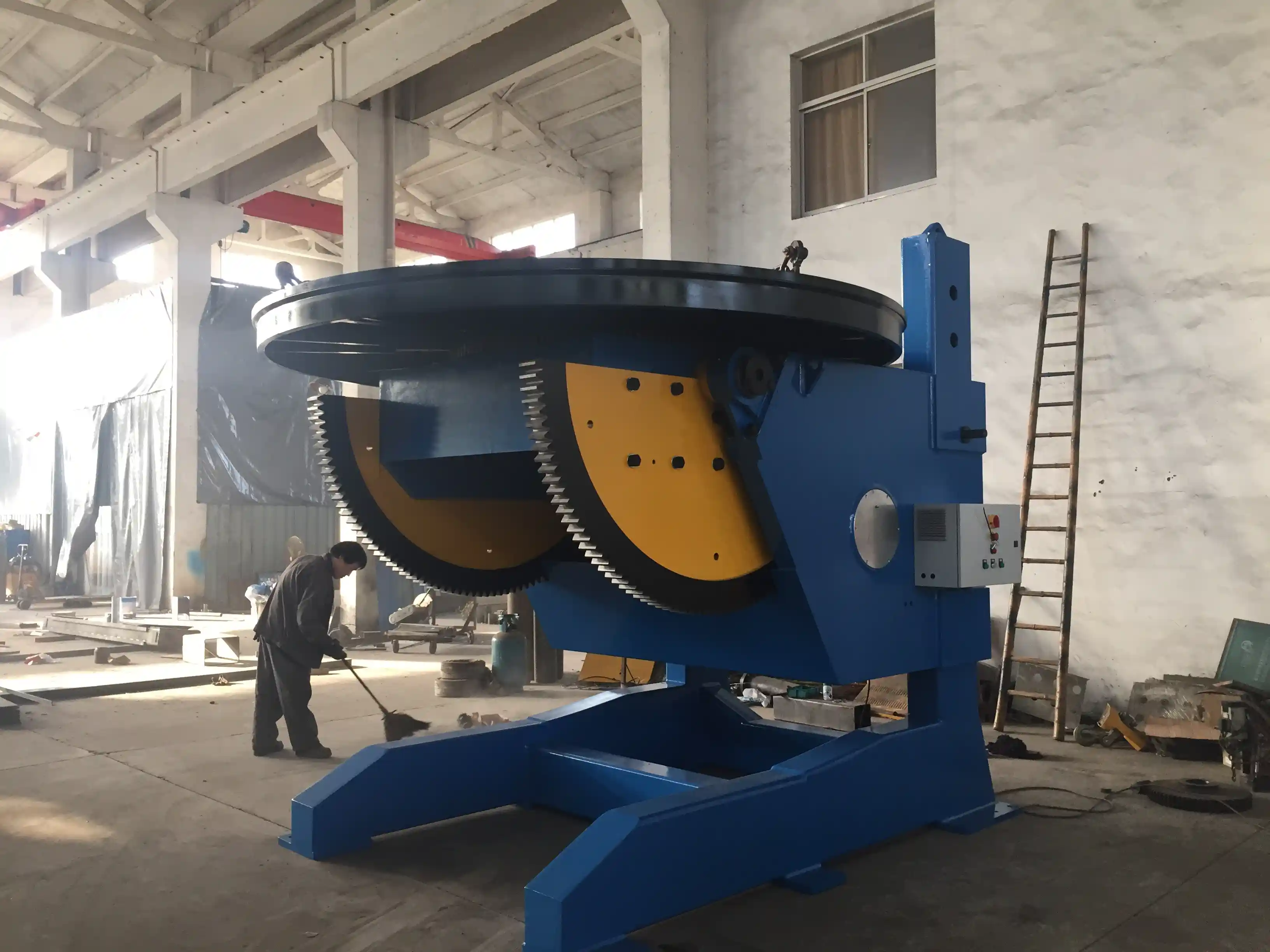
Rotator selection for super‑large tanks centers on three parameters: static load capacity, dynamic load capacity, and the vessel diameter range. The static rating must cover the weight of the shell course plus any temporary stiffening rings. The dynamic rating, typically 30‑40% higher in our designs, accounts for the inertia and vibration during rotation.
Our HGZ heavy‑duty series, engineered for large cylindrical fabrication, provides a clear capacity ladder for tank work. The models below represent the core range for 20m+ projects.
| Modell | Static Load | Dynamische Belastung | Diameter Range | Anti‑Creep Technology |
|---|---|---|---|---|
| HGZ‑60 | 60 Tonnen | 80 tons | 750–4800 mm | <0.1 mm runout, Siemens PLC |
| HGZ‑80 | 80 tons | 100 Tonnen | 850–5000 mm | <0.5 mm drift, hydraulic anti‑creep |
| HGZ‑100 | 100 Tonnen | 130 tons | 1000–5000 mm | Laser‑calibrated, ±0.1 mm/m |
| HGK‑200 | 200 Tonnen | 260 tons | 800–5000 mm | Hydraulic elevation, NOVO sensors |
| HGK‑300 | 300 Tonnen | 390 tons | 1000–6000 mm | 3‑axis hydraulic, ±0.5° accuracy |
For tanks exceeding 6 meters in diameter, multiple rotator sets synchronize through a central PLC to share the load. We configure the roller bed geometry so that each drive unit never exceeds 70% of its dynamic rating, leaving headroom for process fluctuations.
If your program involves shell thicknesses above 30 mm and multi‑layer SAW fill passes, the rotator torque demand can double in the first seconds of arc initiation. It is worth confirming the drive motor sizing and startup torque profile before freezing your equipment list. Send your plate specifications and vessel weights to jay@weldc.com for a load calculation.
Precision Positioning and Anti‑Creep Control
Creep, the slow axial movement of a workpiece along the roller axis, is the most underestimated failure mode in large tank welding. A half‑millimeter drift per revolution becomes a 20 mm offset after 40 rotations, completely misaligning the SAW head.
Our anti‑creep architecture combines self‑aligning roller frames with real‑time feedback. On the HGK‑200 and HGK‑300 models, German NOVO displacement sensors measure lateral position with 0.01 mm resolution and feed into a Siemens PLC that adjusts individual roller tilt hydraulically. The closed‑loop control corrects drift before it reaches 0.5 mm, keeping the weld seam aligned even during six‑hour continuous welds.
For the HGZ‑80 and above, we use a mechanical anti‑creep mechanism where the roller axes converge slightly inward, creating a self‑centering force. Combined with frequency‑controlled rotation starting at 0.5 RPM, the system gently settles the vessel into its natural balance point before the arc strikes.
Automation and Turnkey Tank Welding Lines
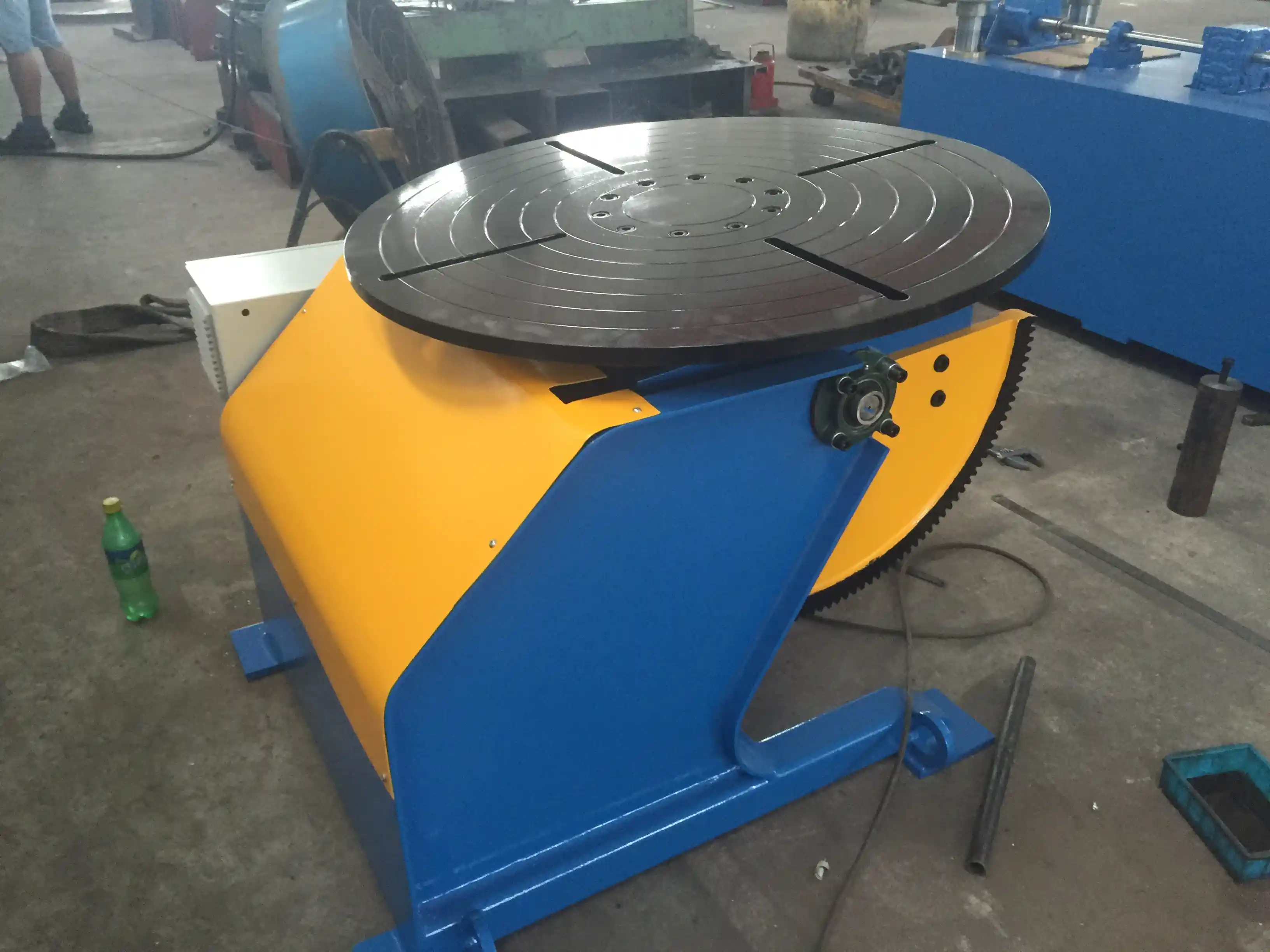
Super‑large tank fabrication rarely stops at rotation. A complete welding line for 20m+ storage tanks typically integrates rotators with a column‑and‑boom manipulator, an automatic submerged arc welding tractor, and a fit‑up rotator for shell alignment before welding.
Unser Schweißmanipulators, such as the LH8080 with 8‑meter horizontal and vertical travel, position the SAW head precisely at any point on a 20‑meter shell circumference without repositioning the base. When paired with the HGZ rotators, the system coordinates boom travel speed with rotator RPM to maintain constant welding travel speed throughout the circumference, compensating for the linear speed variation across segmented rollers.
For large‑scale ammonia or LNG tank farms where dozens of courses are welded daily, we supply integrated lines with automated flux recovery, seam tracking cameras, and remote diagnostic dashboards. The goal is a production rhythm where one station completes fit‑up, the next runs longitudinal welds, and the rotator station feeds the girth welding operation without idle time.
Equipment Customization That Matches Your Vessel Specifications
Not every super‑large tank project fits within a standard catalog. We regularly customize roller diameters, wheelbase widths, and control system protocols to match a client’s existing crane layout and power supply. For customers in seismic zones or floating roof tank markets, we reinforce base frames and add additional leveling jacks to maintain alignment under uneven foundation settlement.
Our engineering team also configures the PLC programs with custom weld sequence parameters. If your procedure calls for a preheat pass rotating at 0.1 RPM followed by a fill pass at 0.8 RPM, the touchscreen interface stores both programs. Once commissioned, the operator selects the sequence and the rotator manages all speed transitions automatically.
What Fabrication Managers Ask About Super‑Large Tank Welding Equipment
What is the largest tank diameter you can support with standard rotators?
Our standard HGZ‑100 and HGK‑200 rotators support vessel diameters up to 5 meters as a single unit. For tank courses exceeding 20 meters in diameter, we configure multiple synchronized rotator sets sharing a common drive signal and anti‑creep correction. The limiting factor is usually the overhead crane capacity and shop floor square footage, not the rotator design. We have supplied systems for oil storage tank projects where each shell course weighed 180 tons and rotated at 100 mm/min with less than 0.8 mm total indicated runout.
How do you prevent the shell from sliding sideways during a long SAW weld?
The combination of self‑aligning rollers and active anti‑creep correction resolves this. The rollers are mounted on spherical bearings that allow a few degrees of angular freedom, so the vessel naturally centers itself under load. The PLC monitors lateral displacement from the NOVO sensors and, if a drift exceeds the 0.5 mm threshold, the control system adjusts the tilt of individual roller units via hydraulic rams. The correction is so gradual that the arc sees a steady seam position, and the finished weld cap remains perfectly centered.
Can your rotators communicate with our existing Lincoln or ESAB SAW systems?
Yes. All our rotators for heavy tank work include PROFINET and Modbus TCP interfaces, and we factory‑configure the I/O mapping for common SAW power source and tractor control systems. The rotator provides encoder feedback pulses corresponding to surface travel speed, and the welding tractor can slave its travel speed or vice versa. Before shipment, we test the communication loop with a simulator matching your system’s protocol to ensure a true plug‑and‑weld experience.
What if our tank diameters vary from project to project, from 15 meters to 25 meters?
Adjustable‑height rotators like the HGK‑200 feature a hydraulic elevation range that accommodates a wide span of shell diameters by changing the center distance between roller sets. For even greater flexibility, we supply quick‑exchange roller wheel assemblies with different diameters and profiles. A single HGK‑300 set can handle 1000 mm to 6000 mm diameter by swapping roller wheels. Send your fleet’s diameter schedule, and we will calculate whether one adjustable setup or a dual‑range carriage is the most economical solution — the cost difference is often surprising.
Falls Sie daran interessiert sind, lesen Sie doch diese verwandten Artikel:
Schweißmanipulatoren für die Fertigung von Windtürmen: Revolutionierung der Produktionseffizienz
Verbesserung von Qualität und Effizienz bei der Herstellung von Windkraftanlagen: Die Schlüsselrolle von Positionierern beim Schweißen von Turmsektionen
Revolutionäre Lösung für das Schweißen von Druckbehältern: Technische Analyse von 360-Grad-Rotationsschweißpositionierern
 English
  Español
  Français
  Deutsch
  Português
  Русский