Large tank welding equipment becomes the decisive factor when tank diameters climb past 10 meters. Without properly matched rotators and positioning gear, keeping multi-ton shell courses aligned while producing consistent weld metal across long seams is a constant fight. I’ve spent over twenty years engineering welding automation for heavy fabrication, and I’ve seen how the right combination of rotators, manipulators, and fit-up systems turns a high-risk project into a stable production line. This article walks through the equipment chain that supports weld quality and throughput for the largest storage tanks, from the workshop floor out to petrochemical sites and tank farm installations.
Why Large Tank Welding Demands Specialized Equipment
Welding a 10-meter-diameter tank is not a scaled-up version of welding a small pressure vessel. The moment a shell plate weighs several tons and stands taller than a building, the dynamics change. Gravity, temperature distortion, and residual stress all pull the structure out of roundness. Standard shop rotators that handle 2- or 3-meter pipe cannot even cradle a 12-meter tank course, let alone rotate it smoothly enough for submerged arc welding.
The challenge is twofold: weight support and rotation precision. A single shell course for a 15-meter-diameter by 7-meter-high crude oil storage tank can weigh more than 20 tonnes. That weight must be carried evenly across multiple roller sets without flat-spotting the rollers or allowing the shell to creep axially. Even 1 mm of axial drift per revolution can stack into a multi-centimeter gap by the time the longitudinal seam is welded. That is why anti-creep technology has become non-negotiable on large tank welding rotators.
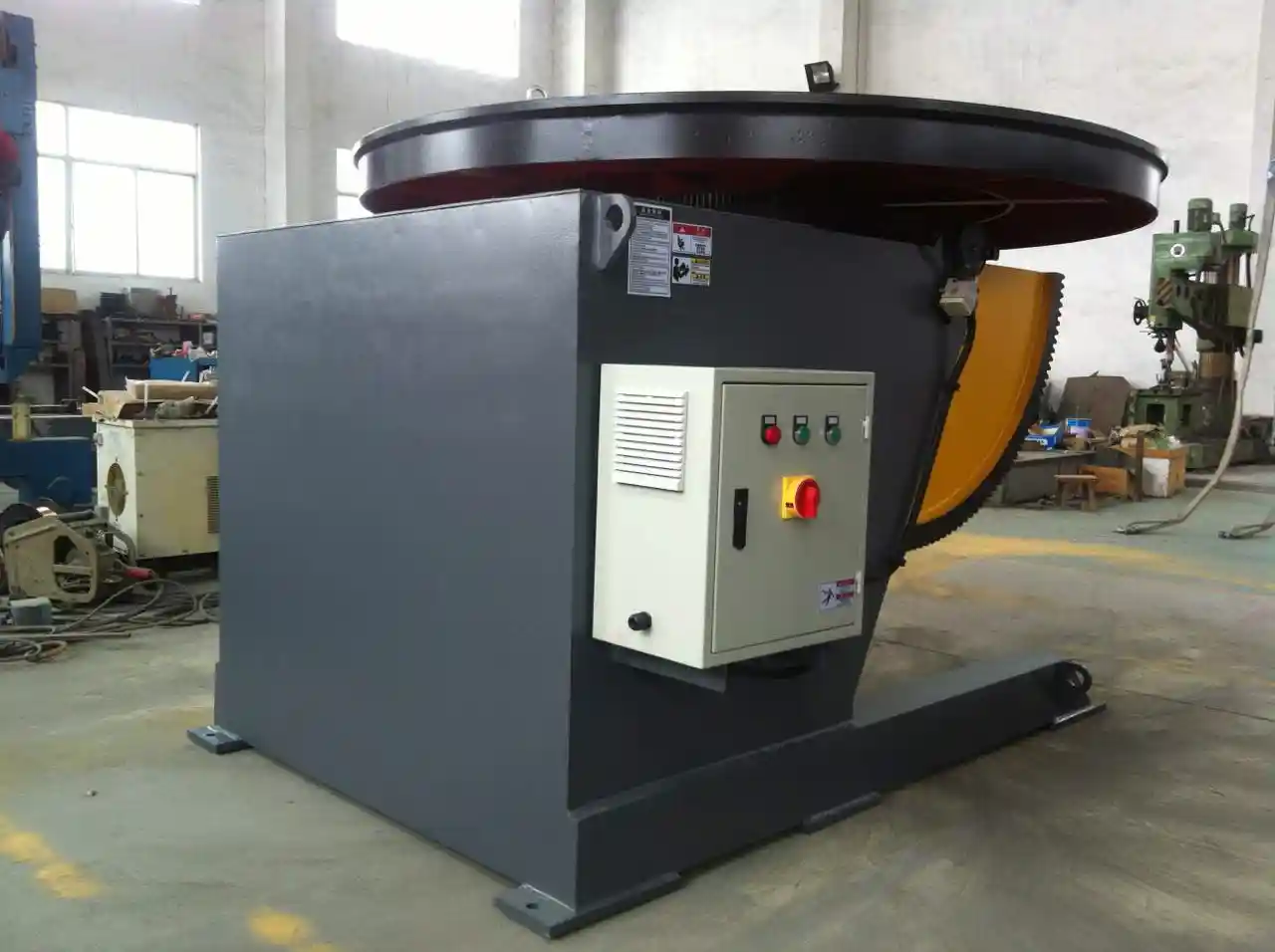
Die Schweißmanipulator must reach high enough to cover the full shell height. For a 10-meter-plus tank, the gun carriage should span at least 7 to 8 meters vertically, with a horizontal reach that allows circumferential welding without repositioning the entire machine. Standard column-and-boom manipulators often need custom boom lengths and reinforced masts to keep the welding head stable at extreme reach.
The Core Equipment Trio for Large Tank Fabrication
Effective large-diameter tank welding always relies on three pieces of equipment working together: a heavy-duty welding rotator set, a high-reach welding manipulator, and a welding positioner for end caps and nozzles. Getting any one of these wrong creates a bottleneck.
Welding rotators are the heart of the system. For tanks 10 to 20 meters in diameter, we generally deploy multiple rotator frames to spread the load. The key specification is not just the tonnage rating but the diameter range the roller frame can accommodate. Our HGZ-80 and HGZ-100 standard rotators, for example, handle vessel diameters from 850 mm up to 5000 mm, but for a 15-meter tank, we custom-configure wider frames with larger rollers to cradle the shell properly. Adjustable-height rotators add another layer of flexibility; the ability to raise or lower the roller center by a few hundred millimeters simplifies aligning shell courses during fit-up and drastically reduces setup time.
Welding manipulators provide the stable travel path for the welding head. A box-beam column and boom design with precision linear guides ensures the gun stays on the seam even at maximum extension. Models like our LH8080 manipulator offer 8 meters of horizontal and 8 meters of vertical travel, enough for most tank courses up to 7 meters high. For taller tanks or when welding the full height in a single pass, custom boom lengths up to 12 meters are available.
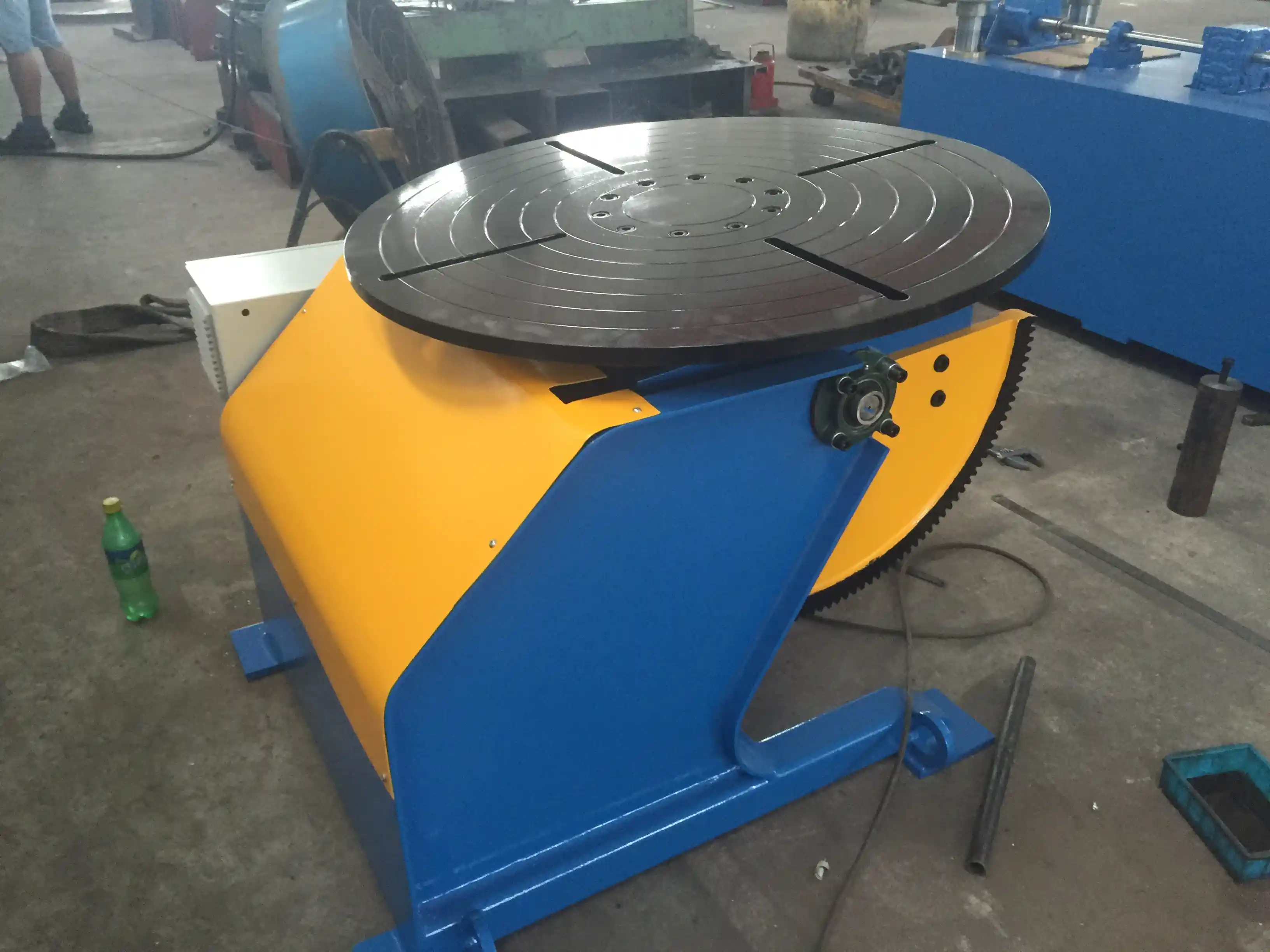
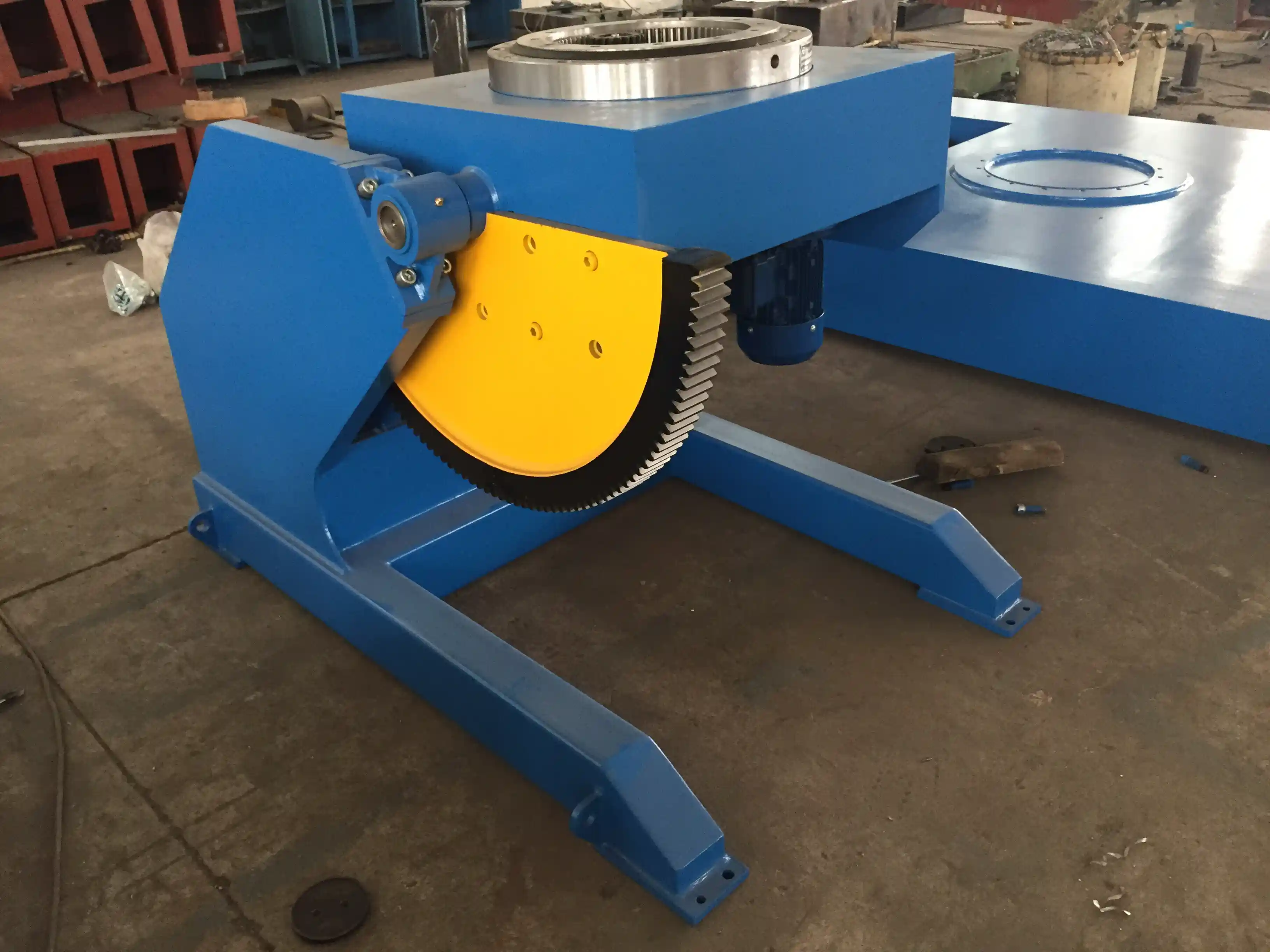
Schweißpositionierer handle the domes, flanges, and nozzle assemblies. A 10-ton or heavier positioner can tilt a tank roof section 0 to 90 degrees while rotating continuously, enabling flat-position welding of all head components. The positioner’s load capacity must be matched to the heaviest sub-assembly, not the average part, because a single overload can damage the slewing bearing and ruin its accuracy.
The following table illustrates how rotator capacity and diameter range relate to typical tank sizes.
| Rotator Model | Tragfähigkeit | Bereich der Gefäßdurchmesser |
|---|---|---|
| HGZ-20 | 20 Tonnen | 500–3500 mm |
| HGZ-50 | 50 tons | 750–4500 mm |
| HGZ-100 | 100 Tonnen | 1000–5000 mm |
| Custom Heavy-Duty | Up to 300+ tons | 2000–8000+ mm (consult factory) |
How to Select a Welding Rotator for Large Diameter Tanks
Choosing the right rotator is not a simple matter of comparing tonnage. The usable vessel diameter range is more important than the raw load number, and the presence of anti-creep control is the single biggest factor separating a dependable system from one that constantly needs operator intervention.
Load capacity versus diameter
A rotator’s tonnage rating indicates the combined weight it can support, but the actual vessel diameter determines whether the shell will sit inside the cradle properly. If the tank diameter is too large for the roller spacing, the shell will contact only the outer edges of the rollers, concentrating the weight and causing rapid wear and inconsistent rotation. As a rule, we specify rotators whose listed maximum diameter exceeds the tank’s design diameter by at least 20 percent to allow for adjustment and out-of-round conditions. For a 12-meter tank, this typically means consulting the factory for a custom frame with an 8000 mm-plus diameter range.
Anti-creep technology
Large shells under their own weight tend to walk sideways as they rotate. Anti-creep systems use hydraulic or mechanical side rollers or automatic alignment controls to detect and correct axial drift in real time. In our factory tests, a 100-ton rotator set running without anti-creep needed manual realignment every 15 minutes on a 3-meter-diameter vessel, while the same shell on an anti-creep-equipped rotator held alignment within 0.5 mm for multiple full rotations. For tanks over 10 meters, creep can easily open the weld joint by several millimeters per meter, making automated anti-creep a necessary investment, not an optional extra.
Fixed versus adjustable height
Fixed-height rotator frames work well when you weld single-diameter tanks in high volume. However, most fabricators handle a range of tank sizes. Adjustable-height rotators allow roller center height changes of several hundred millimeters, which speeds up the changeover from one tank diameter to another. The trade-off is slightly higher initial cost and the need to maintain the hydraulic or screw-lifting mechanism. For job shops that rotate between 8-meter and 16-meter tanks, adjustable-height rotators pay for themselves within the first year through saved setup time.
If your program involves multi-diameter sections or variable wall thicknesses, it is worth confirming the rotator’s anti-creep capability before finalizing your equipment list—reach out at jay@weldc.com.
Integrating Rotators Manipulators and Positioners for Full-Room Welding
Bringing the three equipment types together into one coordinated system is where the real gains appear. I’ve seen fabricators buy excellent individual machines and then struggle with alignment because the rotator centerline does not match the manipulator boom path.
Coordinating axes
The welding manipulator must travel parallel to the tank’s rotational axis. Any angular deviation causes the arc to drift off the joint center as the boom moves vertically. We set up the rotator rails and manipulator rails to share a common reference point, usually a floor-mounted straight edge, and use laser alignment tools to verify parallelism within 0.5 mm per meter. Once the axes are true, the system can weld long longitudinal seams in a single automated pass, stopping only to reposition the manipulator for the next shell course.
Weld seam quality through precision alignment
When a rotator holds the shell stationary and the manipulator moves along the seam, the weld pool behavior is predictable. But when the shell itself rotates under a stationary welding head—the typical setup for girth welding—any variation in rotation speed or axial creep directly disturbs the weld pool. That is why we feed the rotator’s encoder signal into the welding power source control; the system can adjust travel speed in synchronization. Combined with anti-creep, this produces girth welds with consistent penetration and bead profile, even on 12-meter-diameter courses.
Automation add-ons
Seam tracking, flux recovery, and remote monitoring are no longer exotic extras. Laser seam tracking sensors can follow the joint in real time and guide the welding head, compensating for minor misalignment or uneven bevel. Flux recovery systems reclaim unused submerged arc welding flux, cutting waste by up to 60 percent. For remote monitoring, a simple camera feed and PLC data link let supervisors check weld parameters from an office, reducing the need for constant floor presence. These add-ons move the operation closer to a lights-out approach, where one operator oversees multiple stations.
The Economics of High-Capacity Tank Welding Systems
The sticker price of a complete large tank welding system—one heavy-duty rotator set, a high-reach manipulator, and a suitable positioner—can exceed half a million dollars. That upfront number scares off some shops, but the unit economics tell a different story.
Manual welding of a 15-meter-diameter by 20-meter-high storage tank might require four welders working for three weeks, with support crews for fitting and turning the shell sections. With a fully mechanized rotator-manipulator setup, the same tank can be welded by a single operator in one week, with a second person handling fit-up only. Labor savings alone often recover the equipment cost within 18 to 24 months for shops doing two or more large tanks per year.
Beyond labor, there are savings in rework. Automated welding consistently produces fewer defects, reducing the need for radiographic retesting and repairs. On large tanks, a single repair cutout can delay the entire project by days, incurring scaffolding costs, NDT fees, and lost production time. The equipment’s repeatability—±0.5° rotation accuracy and anti-creep holding to under 0.5 mm—directly lowers the rework rate. In my experience, shops moving from manual to mechanized tank welding typically cut their repair rate by 60 to 70 percent.
Maintenance is the final piece. Heavy rotators and manipulators operate in dusty, hot environments. Daily removal of welding slag, periodic bolt torque checks, and annual bearing replacement are non-negotiable. A well-maintained system can serve 15 to 20 years without major component replacement. Including maintenance costs in the payback calculation still leaves a positive return for shops that use the equipment at least 40 percent of available hours.
For shops still evaluating whether to invest, ask for a trial setup on a representative tank diameter before committing. A properly configured rotator-manipulator combination will demonstrate in one day what a spreadsheet cannot—that the weld quality, speed, and operator comfort combined justify the capital outlay.
Common Questions About Large Tank Welding Equipment
How accurate does rotator alignment need to be?
The short answer is within 0.5 mm per meter of travel for both the manipulator and rotator axes. If the rotator frame and the manipulator rail are not parallel, the welding head will wander off the joint as it moves. We use laser trackers to measure alignment during installation. Tanks over 10 meters amplify any angular error, so a 1 mm deviation at the bottom becomes 3 to 4 mm at the top.
Can a single rotator set handle multiple tank diameters?
Yes, if the set includes adjustable-height frames and the roller spacing can be expanded. Our standard adjustable-height rotators can cover a range of several meters, but the maximum and minimum diameters are constrained by the frame design. For shops that weld everything from 5-meter buffer tanks to 12-meter storage tanks, we often configure one heavy-duty set with interchangeable roller sizes and a secondary lighter set for the smaller work.
Should I buy a fixed or adjustable height rotator?
Fixed-height rotators are simpler and have fewer moving parts, which makes them easier to maintain. They make sense if your production is dominated by a single tank size. Adjustable-height rotators become necessary when you frequently switch between different diameters, because the centerline height of the rollers must match the tank axis. The hydraulic lifting systems add cost but cut changeover time by 60 percent or more.
What welding process works best for large tank shells?
Submerged arc welding (SAW) is the standard for longitudinal and girth seams on tanks over 10 mm wall thickness. The high deposition rate and deep penetration suit thick plates, and the granular flux blanket shields the arc without the need for a gas enclosure. For thinner materials or root passes, we sometimes use gas metal arc welding (GMAW) with pulsed transfer to control heat input and reduce distortion.
If your tank program involves diameters beyond standard catalog ranges, we can engineer the rotator and manipulator configuration that matches your shell dimensions and weight. Share your project details with us at jay@weldc.com or call +86-13815101750 for a specific recommendation.
Falls Sie daran interessiert sind, lesen Sie doch diese verwandten Artikel:
Revolutionäre Lösung für das Schweißen von Druckbehältern: Technische Analyse von 360-Grad-Rotationsschweißpositionierern
Verbesserung von Qualität und Effizienz bei der Herstellung von Windkraftanlagen: Die Schlüsselrolle von Positionierern beim Schweißen von Turmsektionen
Herausforderungen beim Schweißen von Windkraftanlagen: Wie moderne hydraulische Hebesysteme die Produktion steigern von 40%
Präzisionsautomatisierung mit Schweißrotatoren für die industrielle Fertigung: Ein Leitfaden mit Fragen und Antworten von Experten
 English
  Español
  Français
  Deutsch
  Português
  Русский