Setting up an industrial steel workshop properly takes more than just buying machines and arranging them on a floor. The equipment choices you make early on determine whether you’ll spend the next decade fighting bottlenecks or running smooth production cycles. Most fabrication shops that struggle with efficiency can trace their problems back to planning decisions made before the first welder was ever plugged in. Getting the foundation right means understanding how welding systems, cutting equipment, and material handling all need to work together as a single production flow.
What Actually Matters When Planning Workshop Layout
Production goals drive everything else in industrial steel workshop setup. Before looking at any equipment catalogs, you need clear answers about what you’re actually making. A shop fabricating structural beams operates completely differently from one producing pressure vessels or pipe assemblies. Output volumes matter too. A facility running three shifts needs different equipment redundancy than one operating single shifts with occasional overtime.
Floor space gets complicated fast. Ceiling height limits what overhead cranes can handle. Power supply capacity determines whether you can run multiple high-amperage welding stations simultaneously. Ventilation requirements for welding fumes affect where you can position workstations. These constraints interact with each other in ways that aren’t obvious until you start mapping out actual material flow.
The path raw steel takes through your facility should follow a logical progression. Material comes in, gets cut to size, moves to fitting and welding stations, then proceeds to finishing and shipping. Every time material backtracks or crosses its own path, you’re losing time and creating safety hazards. Shops that ignore this end up with forklifts constantly maneuvering around each other and workers walking excessive distances between operations.
Safety compliance isn’t optional, but it also shouldn’t be an afterthought bolted onto an existing layout. Building safety into the initial design costs less and works better than retrofitting it later. This includes proper spacing between workstations, clear emergency egress paths, and adequate ventilation capacity.
Planning for growth sounds like a luxury when you’re trying to get a new facility operational, but equipment that can’t scale becomes a bottleneck within a few years. Choosing modular systems and leaving expansion room in your layout costs little upfront and saves major headaches later.
Welding and Cutting Equipment That Actually Performs
The machines doing your welding and cutting determine what quality levels you can consistently achieve. This isn’t about buying the most expensive equipment available. It’s about matching capabilities to your actual production requirements.
For structural steel work involving H beams and similar heavy sections, automated submerged arc welding systems deliver the deep penetration and high deposition rates these applications demand. The process handles thick materials efficiently and produces strong welds with minimal cleanup. Wind tower fabrication and similar large-diameter work requires specialized equipment designed for those specific geometries.
Cutting precision affects everything downstream. Parts that come off the cutting table with accurate dimensions and clean edges require less fitting time and produce better welds. A CNC Plasma Cutter handles most steel thicknesses with good accuracy and reasonable operating costs. For thicker materials or applications requiring tighter tolerances, plasma cutting may need supplementation with other processes.
Matching Welding Processes to Your Work
Different welding processes exist because different applications have different requirements. Submerged arc welding makes sense for long, straight seams on heavy plate where you can automate the process. MIG welding offers good productivity across a range of materials and thicknesses, with moderate skill requirements. TIG welding produces the highest quality results on thin materials and exotic alloys, but runs slower and demands more operator skill.
The table below summarizes how these processes compare across key factors:
| Merkmal | Arc Welding | MIG Welding | TIG Welding |
|---|---|---|---|
| Complexity | Niedrig | Mittel | Hoch |
| Speed | Mittel | Hoch | Niedrig |
| Präzision | Mittel | Hoch | Very High |
| Material | Thick Metals | Various Metals | Thin/Exotic Metals |
| Cost | Niedrig | Mittel | Hoch |
| Skill Level | Mittel | Mittel | Hoch |
Most shops need multiple welding capabilities rather than trying to do everything with one process. The mix depends on your product range and production volumes.
If you’re interested in specific applications, check 《Innovative Einsatzmöglichkeiten von 10-Tonnen-CNC-Schweißdrehvorrichtungen im Druckbehälterbau》.
How Manipulators and Positioners Change Production Economics
Welding manipulators and positioners often get overlooked in favor of the welding power sources themselves, but these positioning systems frequently have more impact on actual productivity. A welder can only work as fast as they can access the joint in a comfortable position. Poor access means slower travel speeds, more repositioning, and inconsistent quality.
Welding manipulators carry the welding head along the workpiece, maintaining consistent torch position and travel speed. For longitudinal seams on tanks, vessels, or structural members, a manipulator turns a physically demanding manual operation into a controlled automated process. The LH series manipulators provide horizontal travel up to 8000 mm and vertical travel up to 8000 mm, with positioning accuracy of ±0.1 mm/m. That precision matters for applications like boiler fabrication and pressure vessel work where weld quality requirements are stringent.
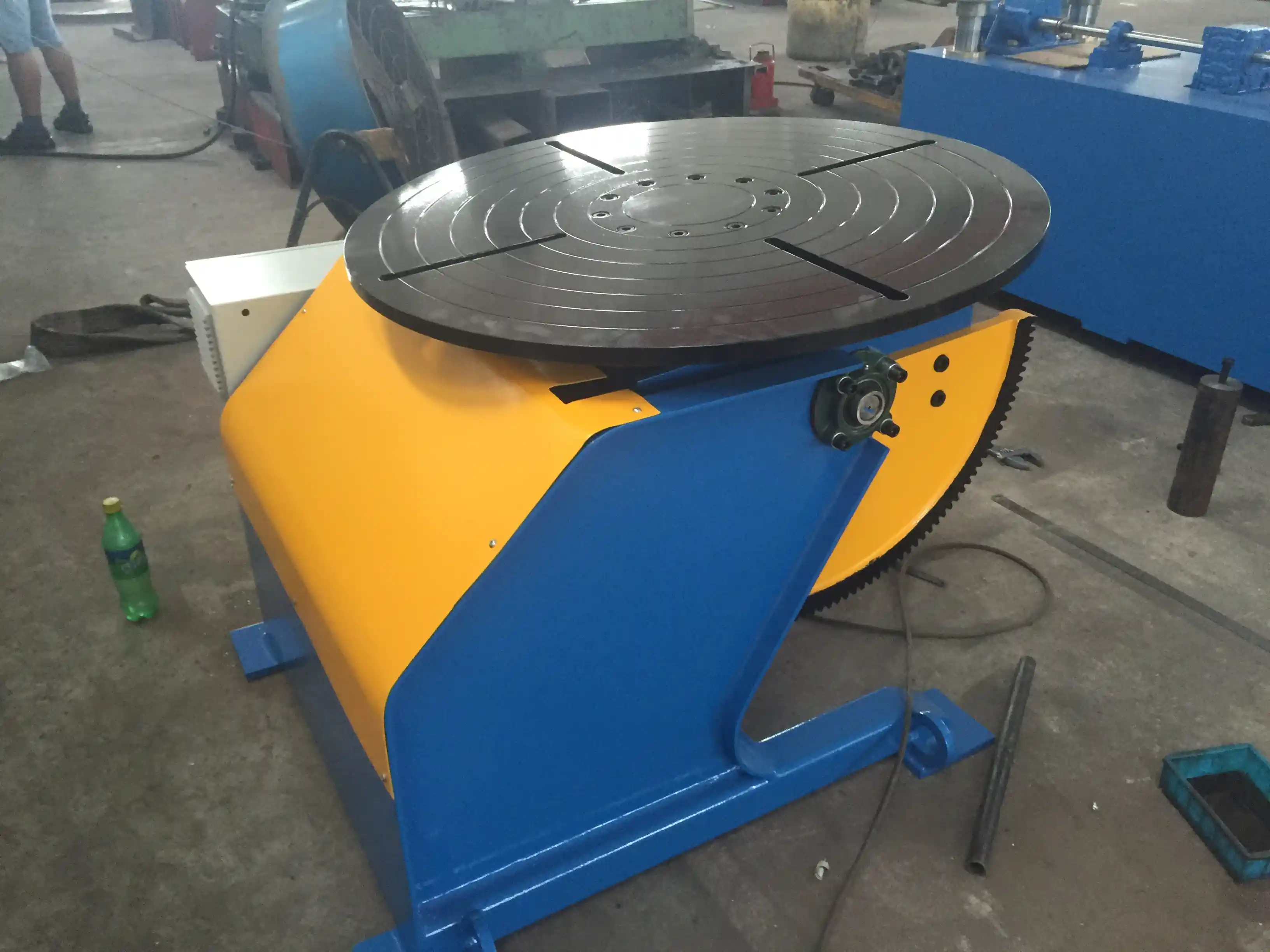
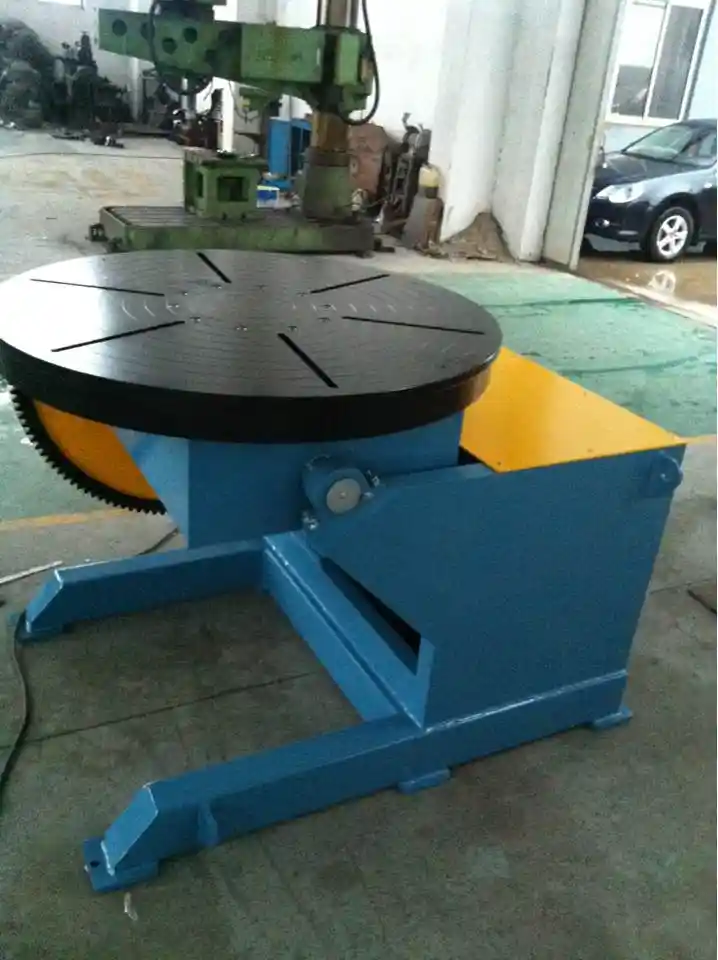
Positioners rotate and tilt the workpiece to present joints in the optimal orientation for welding. A 3 Axis Positioner can orient parts so welders always work in flat or horizontal positions rather than struggling with vertical or overhead welds. This improves both quality and speed while reducing welder fatigue.
The combination of manipulators and positioners enables automation levels that simply aren’t possible with manual positioning. Robotic welding cells depend on precise, repeatable workpiece positioning to function effectively.
What Makes Positioning Equipment Worth the Investment
WUXI ABK Machinery builds manipulators and positioners with high-strength box-beam structures and linear guideways that maintain accuracy over years of production use. The Triple Axis Positioner models, including the 5-Ton 3-Axis Positioner, achieve ±0.05 mm positioning accuracy with 0.02 mm repeatability. These specifications matter for robotic welding integration where the robot expects the workpiece to be exactly where it’s programmed to be.
The practical benefits show up in reduced labor requirements, lower scrap rates from positioning errors, and consistent weld quality that doesn’t depend on individual operator skill levels. Shops that invest in proper positioning equipment typically see payback within one to two years through productivity gains alone.
Keeping Equipment Running Across Decades
Industrial welding and cutting equipment represents substantial capital investment. Protecting that investment requires systematic maintenance rather than running equipment until it fails. The difference between a 15-year service life and a 25-year service life often comes down to maintenance discipline.
Daily checks catch problems before they become expensive. Looking for welding slag accumulation, checking fluid levels, and listening for unusual sounds takes minutes but prevents major failures. Monthly inspections should include torque checks on critical fasteners and examination of wear items. Annual maintenance typically involves bearing inspection or replacement, recalibration of positioning systems, and thorough cleaning of areas that accumulate debris.
The 1-Ton Fixed Height Welding Positioner (Model HBJ-10) illustrates this approach. Daily slag removal, monthly bolt torque verification, and annual bearing replacement maintain the ±0.5° rotation accuracy specification and extend service life by over 30% compared to reactive maintenance approaches.
Realistic Expectations for Equipment Longevity
Quality industrial welding and cutting machines last 15 to 25 years with proper maintenance. Some equipment runs even longer, but performance typically degrades gradually as wear accumulates. The maintenance investment required to keep equipment in specification increases as machines age, eventually reaching a point where replacement makes more economic sense than continued maintenance.
Positioners and manipulators benefit from annual re-lubrication and recalibration to maintain their accuracy specifications. Skipping these maintenance items doesn’t cause immediate failure, but accuracy drift accumulates over time and eventually affects production quality.
To delve deeper into equipment longevity, consider reading 《What is the typical lifespan and maintenance requirement for industrial welding and cutting machines?》.
Where Steel Fabrication Technology Is Heading
Automation continues advancing in steel fabrication, driven by labor availability challenges and quality consistency requirements. Robotic welding systems that seemed exotic a decade ago are now standard in many production environments. Real-time monitoring and data collection enable predictive maintenance and quality tracking that wasn’t previously practical.
Digital integration connects equipment across the shop floor, allowing production scheduling systems to coordinate operations and identify bottlenecks. This Industry 4.0 approach requires equipment designed for connectivity, including modern control systems with communication capabilities.
Sustainable manufacturing practices are becoming competitive requirements rather than optional initiatives. Energy efficiency, material utilization optimization, and waste reduction all affect operating costs and increasingly influence customer purchasing decisions.
Equipment designed for integration with advanced control systems, including Siemens PLC and HMI touchscreens, enables programming for automated welding sequences. This forward compatibility matters because retrofitting older equipment for modern automation often costs more than the equipment is worth.
Working with WUXI ABK MACHINERY
WUXI ABK MACHINERY CO., LTD has manufactured welding equipment and CNC cutting machines since 1999. The product range covers wind tower welding lines, H beam welding lines, pipe welders, Welding Manipulator systems, and positioners. This breadth means equipment from a single supplier can be designed to work together rather than requiring integration of disparate systems.
The registered capital of $1.4 million reflects the manufacturing capacity needed to produce heavy industrial equipment. Decades of experience in this specific market segment translate into practical knowledge about what actually works in production environments.
Common Questions About Industrial Fabrication Equipment
What drives success in industrial steel workshop planning?
Equipment selection matters, but layout and workflow design often have equal or greater impact on long-term productivity. The type of products you’ll fabricate, required production volumes, available space, and power infrastructure all constrain your options. Integrating welding systems, CNC cutting equipment, and material handling into a coherent flow requires understanding how these systems interact. Safety compliance and future expansion capability should be designed in from the start rather than addressed later.
How does proper equipment selection affect welding productivity?
Welding manipulators, positioners, and CNC cutting machines reduce manual labor and improve consistency compared to purely manual operations. Manipulators maintain precise torch positioning and travel speed across long seams. Positioners orient workpieces so welders always work in optimal positions. CNC cutting produces accurate parts that fit together properly and weld cleanly. Together, these capabilities reduce rework, minimize material waste, and enable faster production cycles.
What maintenance approach maximizes equipment service life?
Preventive maintenance based on manufacturer recommendations consistently outperforms reactive maintenance in both equipment longevity and total cost. Daily inspections catch developing problems early. Monthly and annual maintenance addresses wear items before they cause failures. Quality industrial equipment typically lasts 15 to 25 years with proper maintenance, but skipping maintenance accelerates wear and degrades performance. The maintenance investment required increases as equipment ages, but remains worthwhile until replacement becomes more economical.
Why does CNC cutting capability matter for fabrication shops?
CNC Plasma Cutter systems produce parts with consistent accuracy that manual cutting cannot match. Precise parts require less fitting time, produce better welds, and reduce scrap from dimensional errors. The ability to cut complex shapes efficiently expands what a shop can produce. For production volumes above a few pieces, CNC cutting typically pays for itself through labor savings and material utilization improvements.
Start Your Equipment Conversation
WUXI ABK MACHINERY CO., LTD has built welding and cutting equipment since 1999, with a registered capital of $1.4 million backing our manufacturing operations. Our product range includes wind tower welding lines, H beam welding lines, pipe welders, welding manipulators, and positioners designed for industrial steel workshop applications. Contact Jay at +86-13815101750 or jay@weldc.com to discuss how our complete fabrication equipment can address your specific production requirements.
 English
  Español
  Français
  Deutsch
  Português
  Русский