
Steel structure shops live or die by their H-beam lines. Get the workflow wrong, and you’re burning money on rework, idle machines, and missed deadlines. Get it right, and the same crew pushes out more tonnage with fewer headaches.
That’s the reality we’ve watched play out across dozens of fabrication floors. A properly configured production line doesn’t just cut costs—it makes quality repeatable. The difference between a shop that struggles and one that prints money often comes down to how well their equipment talks to each other.
Why H-Beam Fabrication Efficiency Actually Matters
Steel construction keeps demanding more H-beams, faster, with tighter tolerances. The shops meeting those demands aren’t working harder—they’re working smarter.
Integrated production lines handle everything from raw plate to finished beam without the stop-and-start chaos of disconnected equipment. Material flows through cutting, assembly, welding, straightening, and surface prep in a logical sequence. Waste drops. Throughput climbs. And the beams coming off the line look the same whether it’s Monday morning or Friday afternoon.
The competitive edge here isn’t subtle. Shops running optimized lines quote jobs their competitors can’t touch.
The Equipment That Makes It Work
Every H-beam line depends on specialized machines working together. Miss one piece, and the whole system bottlenecks.
What Equipment Does a Complete H-Beam Line Actually Need?
A functional H-beam production line requires cutting machines, assembly machines, gantry welding machines, flange straightening machines, and shot blasting equipment. Each handles a specific stage of fabrication.
CNC cutting equipment shapes the raw plates with programmed precision. The assembly machine positions web and flange components exactly where they need to be—this step determines whether your welds go smoothly or fight you the whole way. Gantry welding machines lay down consistent submerged arc welds at production speeds. Straightening machines correct the distortion that welding inevitably causes. Shot blasting cleans everything up for coating.
| Gerätetyp | Primary Function | Hauptmerkmal |
|---|---|---|
| CNC Cutting Machine | Material preparation | High precision, automated programming |
| H-Beam Assembly Machine | Component alignment | Accurate web/flange positioning |
| Gantry-Schweißmaschine | Automated welding | High deposition rate, consistent welds |
| Flange Straightening Machine | Distortion correction | Hydraulic or mechanical straightening |
| Kugelstrahlmaschine | Surface preparation | Rust and scale removal |
Welding Technology That Changes the Game
The welding station is where H-beam production either shines or falls apart. Automated systems with proper positioning equipment make the difference between structural-grade welds and expensive scrap.
Submerged arc welding dominates H-beam production for good reason. The deposition rates are high, penetration runs deep, and the welds hold up under inspection. But SAW only performs when the torch stays where it belongs relative to the joint.
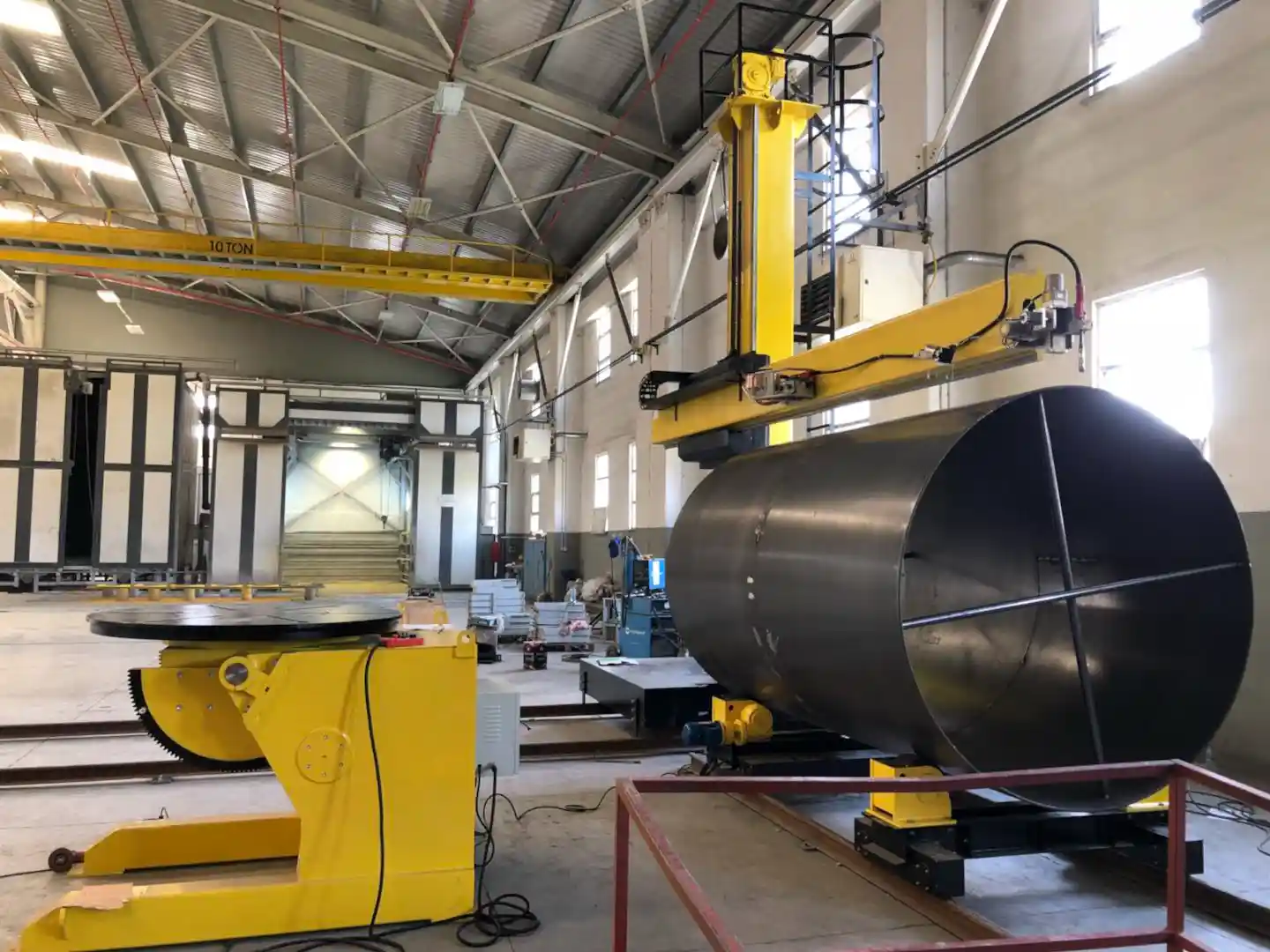
Welding manipulators solve that problem. The WUXI ABK LH series, for example, moves the torch through 8000 mm of horizontal and vertical travel on the LH8080 model. Positioning accuracy hits ±0.1 mm/m, which means the arc stays in the groove instead of wandering onto base metal.
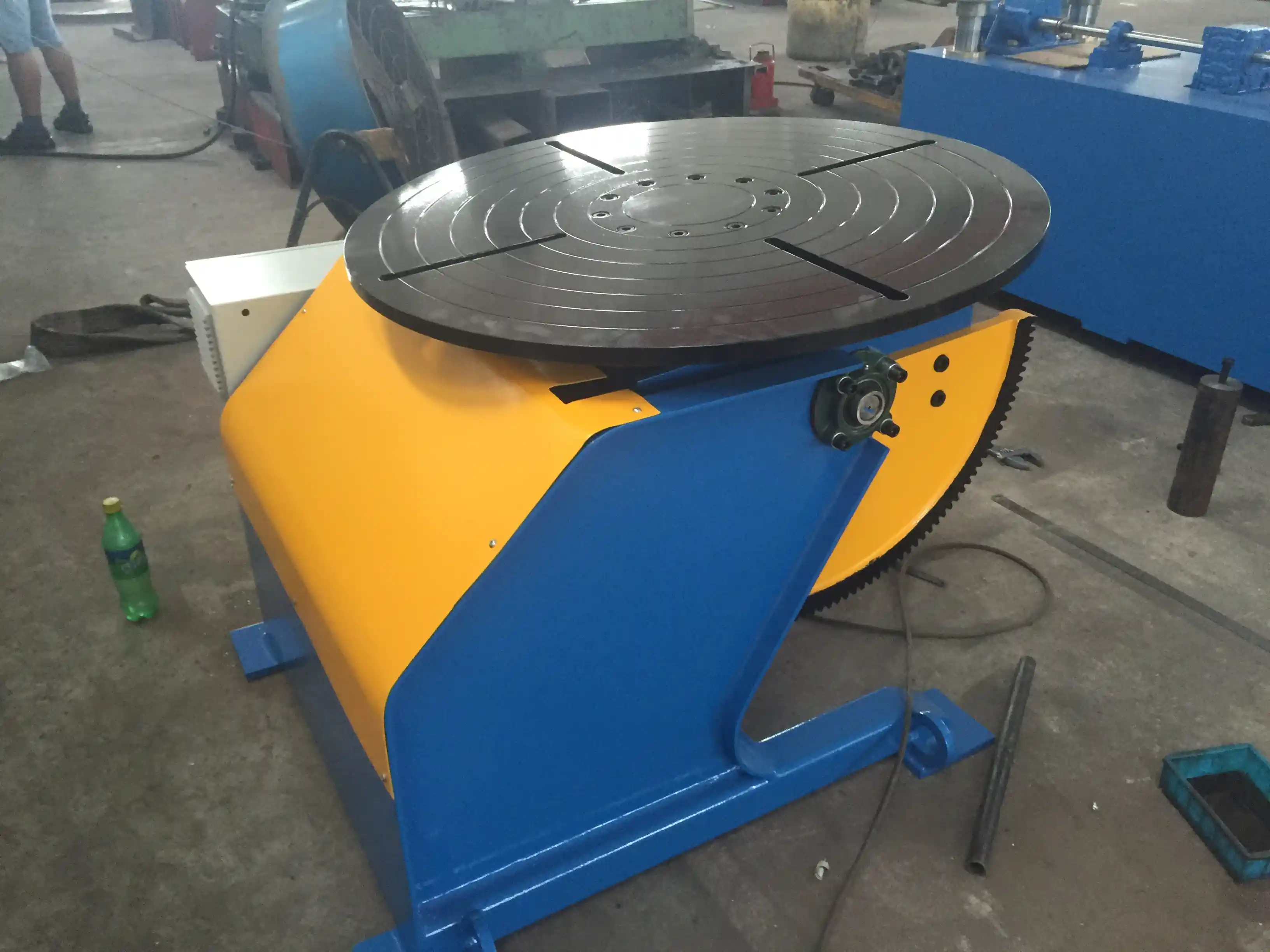
Positioners handle the workpiece side of the equation. The WUXI ABK 3-Axis Welding Positioner rated for 3 tons rotates continuously through 360 degrees and tilts from 0 to 90 degrees. Positioning accuracy runs ±0.05 mm. That kind of control lets welders—or robots—access every joint angle without awkward repositioning.
The combination cuts labor hours and produces welds that pass inspection the first time.
!Säulen- und Auslegermanipulator
 ## Getting Material Through the Shop Without Chaos
Workflow optimization sounds like consultant-speak until you’ve watched a shop lose half its capacity to poor material flow.
The goal is simple: keep steel moving forward without backtracking, double-handling, or machines waiting on upstream operations. Lean manufacturing principles apply directly here. Setup times shrink when equipment is arranged logically. Communication between stations—whether through operators or automated systems—prevents the pileups that kill productivity.
Bottlenecks hide in obvious places once you look for them. The cutting station that can’t keep up with welding. The straightening machine that sits idle because assembly runs slow. Finding and fixing these constraints pays back fast.
Article Recommendation: If you are looking for ways to improve your fabrication process, consider reading about 《Eine Revolution im Schiffbau: Wie Schweißpositionierer Qualität und Effizienz verbessern》.
Picking Equipment That Fits Your Operation
Buying H-beam production equipment isn’t like ordering commodity steel. The wrong choices create problems that last for years.
What Should Drive Equipment Selection Decisions?
Equipment selection should account for budget constraints, required production capacity, and how much automation makes sense for your operation. Technical specifications matter—load capacity, positioning precision, operating speed. But so does the supplier relationship.
A machine that breaks down needs parts and service. A supplier who disappears after the sale leaves you stranded. Energy consumption and maintenance costs add up over the equipment’s life, sometimes exceeding the purchase price.
Custom-configured lines often outperform off-the-shelf packages because they match actual production requirements instead of forcing compromises.
Here’s how different positioner capacities line up against typical applications:
| Modell | Tragfähigkeit | Positionierungsgenauigkeit | Drehung | Anwendungen |
|---|---|---|---|---|
| 1 Tonne 3-Achsen-Positionierer | 1 Tonne | ±0,05 mm | 360° kontinuierlich | Automotive, aerospace, pressure vessels |
| 3-Achsen-Schweißpositionierer 3 Tonnen | 3 Tonnen | ±0,05 mm | 360° kontinuierlich | Robotic welding, metal structure assembly |
| Dreifach-Achsen-Positioniertisch 5 Tonnen | 5 Tonnen | ±0,05 mm | 360° kontinuierlich | Pressure vessels, structural steel, shipbuilding |
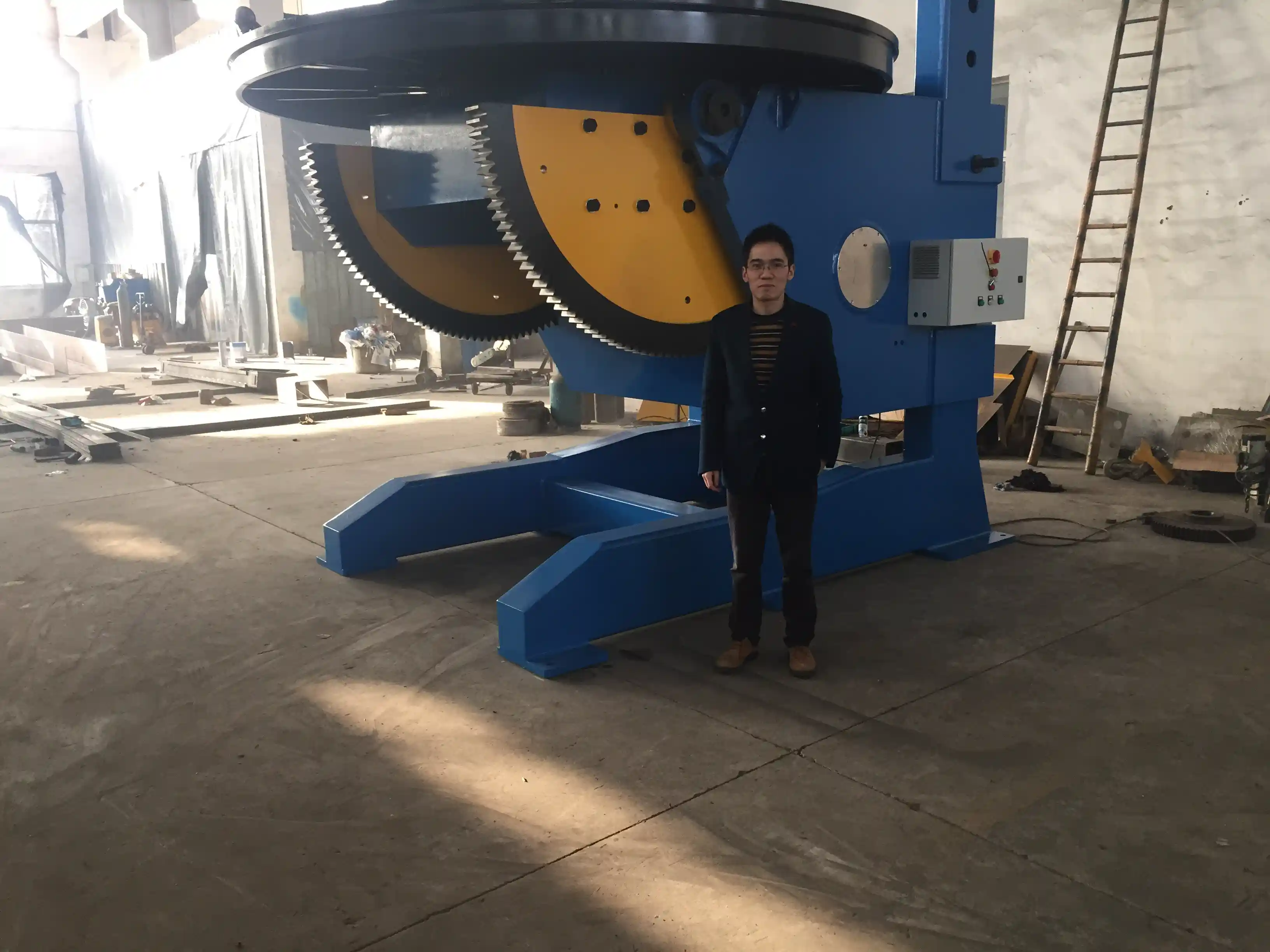
| 30 Tons Adjustable Height Positioner | 30 Tonnen | K.A. | 0-360° | Structural steel, wind tower sections |
| 100 Tons Adjustable Height Positioner | 100 Tonnen | K.A. | 0-135° | Wind tower fabrication, heavy steel structures |
!Heavy Duty Positioner
 ## Quality That Holds Up When It Matters
H-beams carry loads. The welds holding them together can’t fail. Quality control isn’t paperwork—it’s the difference between structures that stand and structures that don’t.
Inspection protocols catch defects before they leave the shop. But the real quality gains come from equipment that produces consistent results in the first place.
Welding manipulators and positioners contribute directly here. When the torch maintains proper stick-out and travel speed, when the workpiece holds position without shifting, welds come out right. The WUXI ABK L-Type Welding Positioners hold 0.5-degree accuracy with construction robust enough for production environments. Components stay where they belong during welding, which means less distortion and fewer repairs.
Calibration and maintenance prevent the gradual drift that degrades quality over time. A positioner that’s off by a degree today will be off by two degrees next month.
Where H-Beam Production Is Heading
The shops investing in automation now are positioning themselves for the next decade. Robotics integration keeps advancing. Industry 4.0 concepts—real-time monitoring, predictive maintenance, connected equipment—are moving from trade show demos to production floors.
Sustainability pressures are real too. Energy-efficient equipment and processes that minimize material waste aren’t just good PR. They affect operating costs and increasingly influence contract awards.
The fabricators who adapt will thrive. The ones who don’t will find themselves competing on price alone, which rarely ends well.
!Industrielle Stellungsreglereinheit
 ## Partner with WUXI ABK MACHINERY for Your H-Beam Production Needs
As a trusted leader in welding equipment and CNC cutting machines since 1999, WUXI ABK MACHINERY CO., LTD. offers comprehensive, high-performance solutions for your complete H-beam production line. Our expertise ensures optimal efficiency, superior quality, and robust support for your manufacturing goals. Contact us today to discuss your project requirements and discover how our advanced H-beam welding lines and cutting-edge equipment can elevate your operations. Reach out to jay@weldc.com or call +86-13815101750 for a personalized consultation.
Frequently Asked Questions About H-Beam Production Lines
How can I optimize the efficiency and quality of H-beam welding processes?
Optimizing H-beam welding efficiency and quality involves integrating advanced automated welding systems, such as gantry type submerged arc welding machines, and utilizing Manipulator zum Schweißen und 3-Achsen-Schweißpositionierer for precise control. Regular maintenance, skilled operators, and adherence to quality control protocols are also crucial for superior H-beam production.
What is the typical lifespan and maintenance requirement for H-beam production equipment?
The typical lifespan of well-maintained H-beam production equipment can exceed 15-20 years. Regular preventative maintenance, including calibration, lubrication, and timely replacement of wear parts, is essential. WUXI ABK MACHINERY provides comprehensive after-sales support and spare parts to ensure the longevity and optimal performance of your H-beam welding line and associated machinery.
Can WUXI ABK MACHINERY provide custom H-beam production line solutions?
Yes, WUXI ABK MACHINERY specializes in designing and manufacturing custom H-beam production line solutions tailored to specific client requirements. Our engineering team works closely with you to understand your production volume, H-beam dimensions, and automation needs, ensuring a complete equipment package that perfectly fits your operational demands for efficient H-beam fabrication.
 English
  Español
  Français
  Deutsch
  Português
  Русский