CE-certified welding equipment procurement requires more than a sticker: specific EN standards, technical documentation, and manufacturer verification are essential for European market compliance. I have spent over twenty years in welding automation and CNC cutting machine manufacturing, and I have seen too many procurement teams accept a CE mark at face value without checking the underlying technical file. That approach leads to customs delays, rework costs, and equipment that does not meet safety expectations. For fabrication shops and project engineers sourcing welding positioners, rotators, manipulators, or CNC cutting machines, understanding the applicable EN standards and the full compliance chain is a practical necessity. This article breaks down the core standards, the compliance pathway a legitimate manufacturer follows, and the documentation you need to verify before a machine reaches your factory floor.
What EN Standards Apply to Welding and Cutting Equipment?
European machinery placed on the market must conform to the Machinery Directive 2006/42/EC. That directive pulls in a range of harmonized EN standards that provide a presumption of conformity when correctly applied. For welding and cutting equipment, the standards stack depends on the machine type and its safety functions, but a few are consistently relevant.
EN ISO 3834 is the quality requirements standard for fusion welding. If your welding positioner or manipulator is part of a production line where weld quality must be documented, the equipment supplier should demonstrate that the machine supports welding in accordance with EN ISO 3834-2 or -3. EN 60204-1 covers the electrical safety of machinery. Every CNC cutting machine, welding rotator, and panel bending system I have worked on must satisfy EN 60204-1 for control panel design, emergency stop circuitry, and protective bonding. EN 13849-1 addresses safety-related parts of control systems, specifying performance levels for functions such as rotation speed limitation or automatic shutdown on a welding positioner.
Additional standards enter depending on the equipment scope. EN 1090 applies if the fabricated output is structural steel, but the manufacturing equipment itself falls under different machinery standards. EN 619 for continuous handling equipment and EN 60974 for arc welding power sources may also appear in a machine’s technical file when those subsystems are integrated. The takeaway for a buyer is that no single EN standard covers “welding equipment”; a well-prepared manufacturer identifies every applicable standard and documents compliance for each.
How Does a Welding Positioner or Rotator Achieve CE Marking?
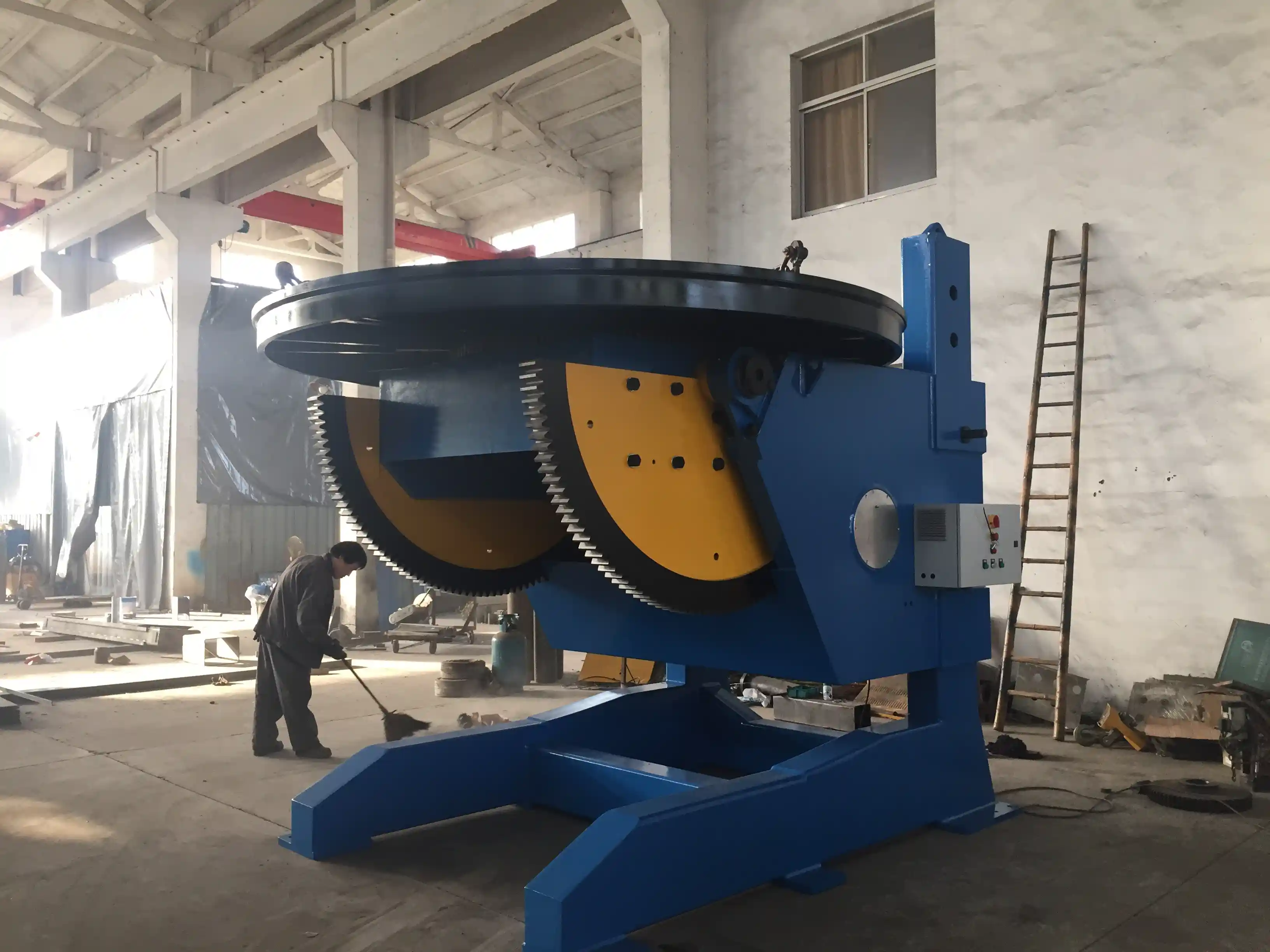
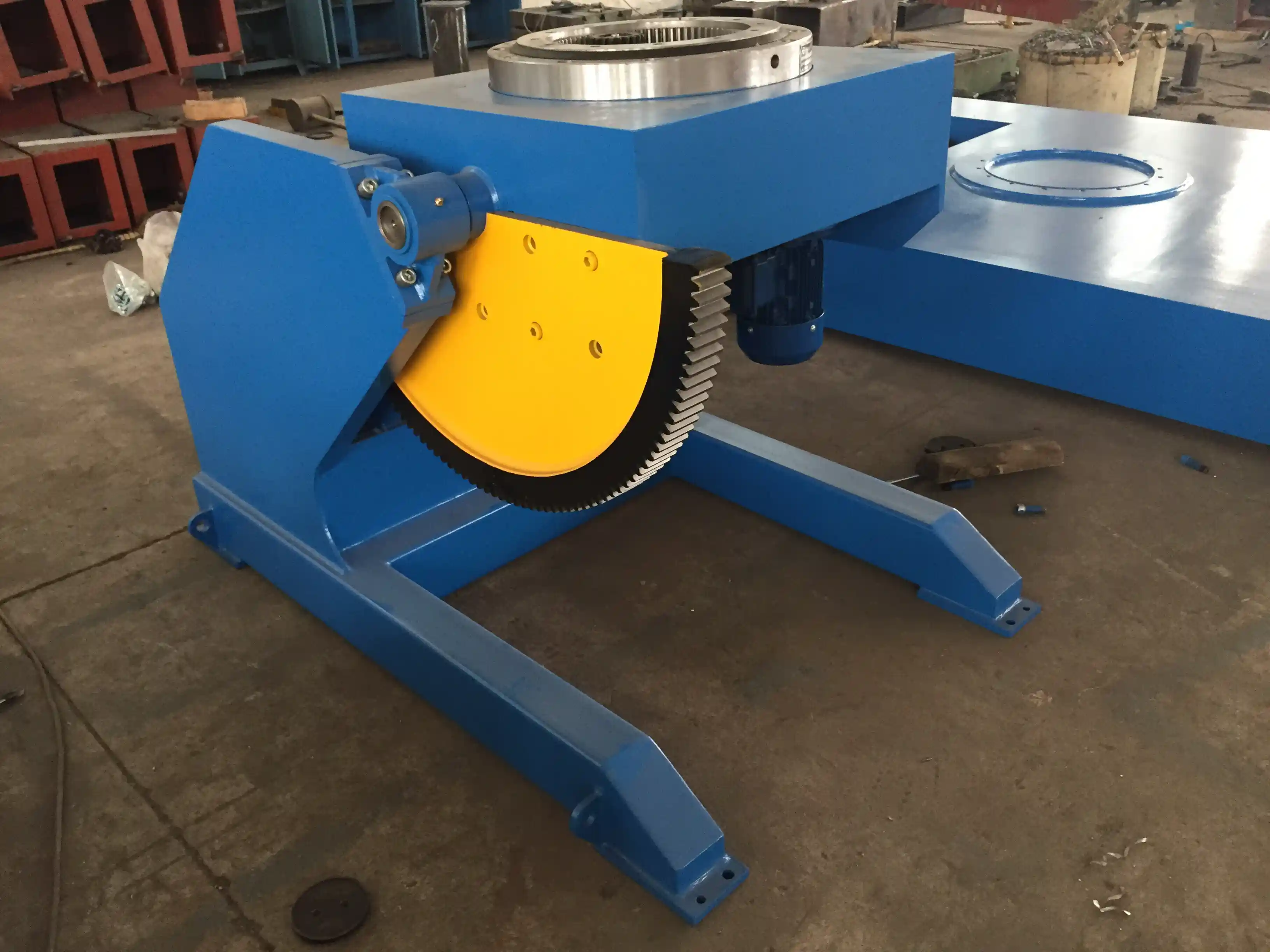
A legitimate CE marking process begins with a risk assessment and ends with a signed Declaration of Conformity. In between, the manufacturer follows a conformity assessment route appropriate to the equipment category. Most standard welding positioners and rotators, including our models at Wuxi ABK, follow the self-declaration route under Annex VIII of the Machinery Directive. That means the manufacturer carries out the full assessment internally, compiles a technical file, and issues the declaration without mandatory Notified Body intervention.
For machines with integrated safety functions that fall under a higher risk category, such as robotic welding cells with collaborative operation or explosion-protected equipment for ATEX zones, a Notified Body may need to be involved. Our explosion-proof option for certain positioners, for instance, requires separate ATEX assessment under Directive 2014/34/EU in addition to the Machinery Directive.
The technical file is the backbone of compliance. It contains the risk assessment, the list of applied standards, design calculations, test reports, electrical schematics, and the instruction manual. I have compiled these files for equipment from 1‑ton welding turntables to 100‑ton adjustable‑height positioners, and each file runs to several hundred pages. A machine that reaches the buyer with a CE plate but without a corresponding technical file is not compliant, regardless of what the supplier claims.
What Documentation Must a Manufacturer Provide for CE Compliance?
When a fabrication shop orders a CNC cutting machine or a welding rotator from outside the EU, the minimum documentation that should accompany the shipment includes the Declaration of Conformity, the installation and operation manual in the user’s language, and evidence of the standards applied. The Declaration of Conformity must reference the specific directive, the product model, the manufacturer’s authorised representative within the EU (if the manufacturer is outside the EU), and the harmonized standards used. A generic declaration that says “complies with EU directives” without listing standard references is insufficient.
Beyond the declaration, I always advise buyers to request the standards compliance matrix from the manufacturer. This is a spreadsheet that maps each relevant clause of each EN standard to the machine’s design feature or test result. It shows exactly how the machine meets EN 60204-1 for protective earth continuity or EN 13849-1 for safety circuit performance level. Not every manufacturer prepares this, but those who take compliance seriously will have it. If the supplier cannot produce one, you are left trusting a statement without evidence.
How Can Buyers Verify a Supplier’s CE Certification?
Verification starts with the Declaration of Conformity but does not end there. I suggest a three-step check that procurement engineers can perform before finalizing an order. First, verify that the declaration correctly identifies the manufacturer and its EU authorised representative, if required. If the manufacturer is outside the EU and does not have an authorised representative, the importer becomes responsible for compliance, which shifts the legal burden onto your company. Second, cross-check the listed harmonized standards against the latest Official Journal of the European Union to ensure the versions are current. Standards are updated periodically; a declaration citing an obsolete version is a red flag. Third, request a sample page from the technical file, such as the risk assessment for the rotation drive or the electrical safety test report. A compliant manufacturer will have no issue sharing these.
Factory audits provide the highest level of confidence. In my experience, a supplier that has gone through ISO 9001 certification audits and maintains a CE compliance folder per product series is far more likely to deliver equipment that passes an importer’s inspection. When I conduct internal audits at Wuxi ABK, I trace each welding positioner model’s technical file back to the original design review and test records. Buyers who visit our factory can observe that traceability directly, and I recommend that procurement teams incorporate a documentation review into any pre-shipment inspection.
What Are Common Compliance Gaps When Sourcing from Non-EU Manufacturers?
I have encountered three recurring gaps that delay or block CE‑certified welding equipment at European ports. The first is an incomplete or generic Declaration of Conformity. Some suppliers issue a one-page document that does not reference any harmonized standard or lists only the Machinery Directive without technical detail. Customs authorities and market surveillance bodies in the EU will reject that. The second gap is the absence of a risk assessment that covers all operational modes, including maintenance and fault conditions. A positioner or rotator that holds a heavy workpiece during welding presents different risks during an emergency stop or a power failure, and the manufacturer must document how those risks are controlled. The third gap is electrical documentation. I have seen machines where the control panel wiring did not meet EN 60204-1 color coding or protective conductor requirements, and no test report was available to prove conformity.
The solution for buyers is straightforward: make the documentation a contractual requirement and verify a sample before shipment. Do not rely on the CE plate alone. If a supplier hesitates to share the technical file, consider that a warning. A compliant manufacturer invests in the compliance infrastructure and is proud to show it.
Documentation Checklist for Sourcing CE-Certified Equipment
| Document | What to Look For |
|---|---|
| Declaration of Conformity | Specific model, directive references, standards list with version dates, EU‑authorised representative |
| Technical File Index | List of all sections: risk assessment, standards compliance matrix, test reports, schematics |
| Risk Assessment (sample page) | Hazards identified for normal operation, maintenance, and emergency scenarios |
| Electrical Test Report | Insulation resistance, protective earth continuity, functional test results per EN 60204-1 |
| Instruction Manual | Language of the destination country, comprehensive safety and installation instructions |
Common Questions About CE and EN Compliance for Fabrication Equipment
How do I know if a Chinese manufacturer’s CE claim is genuine?
Start by asking for the Declaration of Conformity and the technical file index. A genuine CE‑certified machine will have a detailed file that refers to specific EN standards and test results. If the manufacturer cannot produce those within 48 hours, treat the claim as unverified. I have compiled these files for every positioner and rotator series we export to Europe, so the information is always accessible.
What if the equipment I buy is later found non-compliant by EU authorities?
The importer or the EU‑based distributor is liable, which means your company could face fines, forced product recall, or a stop-sale order. Having a full documentation package from the manufacturer allows you to demonstrate due diligence. Without it, the legal exposure is entirely yours.
Are the EN standards the same for a manipulador de soldadura and a CNC plasma cutter?
There is overlap but not identity. Both must comply with EN 60204-1 for electrical safety and the Machinery Directive’s essential health and safety requirements. However, a welding manipulator will also reference welding-specific standards such as EN ISO 3834, while a Cortador a plasma CNC will reference cutting machine standards and possibly EMC requirements under EN 61000‑6‑4. A proper CE file for each machine lists the distinct standard set, not a single generic list.
Should I expect to pay more for equipment that is genuinely CE compliant?
The compliance process adds engineering and documentation cost, so the price is typically higher than for uncertified equipment. However, that cost is negligible compared to the expense of rejected shipments, retrofitting, or legal issues after installation. In my experience, the incremental cost of proper CE compliance for a standard welding positioner is in the low single‑digit percentage range and pays for itself in reduced customs friction and faster project commissioning.
If your procurement involves multiple machine types or you are building a new fabrication line for the European market, share your equipment list and we will confirm which specific EN standards apply to each machine before you finalize your purchase. Reach our team at jay@weldc.com or call +86‑510‑83555592.
Se estiver interessado, consulte estes artigos relacionados:
Problemas de soldadura de torres eólicas novamente: Como os rotadores inteligentes da linha de crescimento aumentam a produtividade por 50%
Principais pontos problemáticos e soluções de alta precisão dos posicionadores de soldadura nas indústrias da energia eólica e da construção naval: Análise técnica exaustiva
Problemas de desalinhamento na soldadura de tubos: como os rotadores inteligentes para soldadura de tubos aumentam as taxas de aprovação dos oleodutos
 English
  Español
  Français
  Deutsch
  Português
  Русский