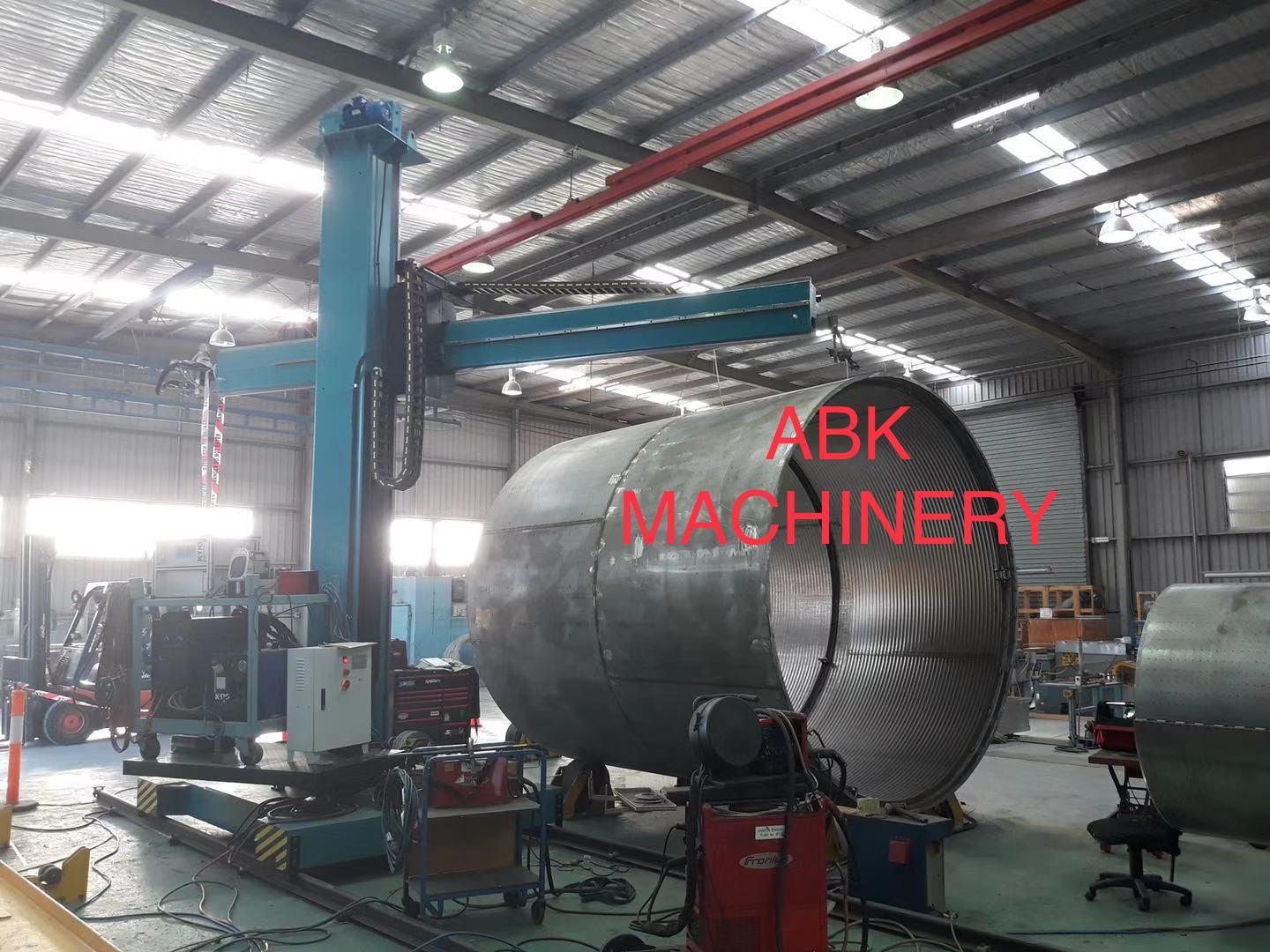
In wind tower manufacturing plants, an impressive scene is becoming commonplace: tower sections weighing tens of tons rotate smoothly on heavy-duty rotating equipmentmientras que los sopletes montados en large column and boom manipulators follow pre-programmed paths for precise welding. This seemingly simple combination is fundamentally transforming the efficiency and quality standards of wind equipment manufacturing. As the global wind industry advances toward larger capacities and higher efficiency, tower dimensions continue to increase, and manufacturing complexity grows exponentially. Traditional welding methods can no longer meet the stringent requirements for weld quality and production efficiency in modern wind tower fabrication.
La aparición de automated welding positioners provides wind manufacturers with an ideal solution. The collaboration between welding manipulators and turning rolls creates an optimal welding environment: the workpiece rotates at a uniform speed, while the welding torch maintains precise positioning. This setup not only ensures process stability but also guarantees that every weld is completed in the best possible position. For thick-walled towers requiring multi-layer, multi-pass welding, this stability ensures perfect fusion of each weld layer, resulting in a dense and uniform weld structure.
Welding Challenges and Solutions in Wind Tower Manufacturing
As the critical structure supporting the entire wind turbine generator, the welding quality of wind towers directly impacts the equipment’s service life of over 20 years. Modern wind towers now exceed 100 meters in height, with diameters reaching 4-5 meters, and individual section weights often surpassing 50 tons. Such massive components present numerous challenges during welding: continuity in circumferential seams, straightness in longitudinal seams, uniformity of heat input, and most critically, operator safety.
Heavy-duty roller beds provide an ideal rotating platform for tower welding through their robust load-bearing capacity and precise speed control. Combined with the accurate positioning of column boom welding equipment, this enables precise control of the welding torch in three-dimensional space. This combination addresses the most challenging issue in traditional welding: how to maintain large workpieces in the optimal position throughout the welding process. In practical applications, this automated system can increase welding efficiency by 3-5 times while improving first-pass weld qualification rates to over 99.5%.
Technical Essentials for Achieving Perfect Circumferential Welds
In wind tower manufacturing, the quality of circumferential welds is crucial. The success of tower section welding depende de dos factores clave: una velocidad de rotación estable y un posicionamiento preciso de la antorcha. Precision rotating systems achieve stepless speed regulation within the 0.1-120 rpm range through frequency control systems, ensuring absolute stability in welding speed. This stability directly affects heat input uniformity, which is key to avoiding welding defects.
Simultáneamente, wind tower manipulators maintain optimal distance and angle between the torch and workpiece through their sturdy column structure and precise servo control systems. Even for longitudinal seams spanning tens of meters, they ensure full-length straightness and uniform weld formation. This precision control is vital for maintaining tower straightness and roundness, directly impacting subsequent section assembly accuracy and the operational stability of the entire wind turbine.

Specific Applications of Automated Welding Systems in Wind Manufacturing
In modern wind tower manufacturing plants, the combination of welding manipulators and turning rolls has formed standardized production units. A typical configuration includes one heavy-duty turning roll systems y una manipuladores de grandes columnas, with the option to add a second driven turning roll for extra-long tower sections. This setup can accommodate welding requirements for tower sections with diameters of 3-6 meters, lengths up to 30 meters, and weights reaching 100 tons.
The system demonstrates exceptional adaptability for welds in different positions. For internal and external circumferential seams, the turning rolls rotate the workpiece while the manipulator’s torch remains fixed, achieving perfect flat position welding. During longitudinal seam welding, the turning rolls secure the workpiece while the manipulator moves the torch along the guide rail to complete vertical welding. This flexibility allows one system to handle most of the tower’s welding tasks, significantly improving equipment utilization.
Tapered Tower Welding Solutions
With advancements in wind turbine technology, tapered towers are becoming increasingly popular due to their superior structural performance and wind load distribution. However, this design introduces new welding challenges: traditional methods struggle to maintain constant welding parameters due to continuously changing diameters. Sistemas de soldadura inteligentes conseguir un ajuste dinámico de los parámetros durante la soldadura mediante un control coordinado.
When welding tapered towers, adjustable roller systems automatically adjust rotation speed based on the tower’s taper, compensating for the effect of diameter changes on linear speed. Meanwhile, automated positioning equipment continuously adjust torch height and angle to maintain optimal welding position throughout the process. This intelligent coordinated control ensures consistent welding quality across every cross-section of tapered towers, providing reliable assurance for wind equipment safety.
Selecting Suitable Welding Equipment for Wind Manufacturing
Choosing appropriate welding equipment for wind tower manufacturing requires comprehensive consideration of multiple factors. First, equipment specifications must meet production requirements. The load capacity of heavy-duty welding machinery should exceed the maximum workpiece weight by at least 30% to ensure operational stability and safety. The speed range of turning rolls must cover all possible welding process requirements, while the manipulator’s travel and precision must meet the welding needs of the largest workpieces.
Second is equipment reliability and durability. Wind tower welding involves high intensity and long durations, requiring equipment capable of withstanding continuous operation. Selecting reputable fabricantes de equipos de soldadura es crucial, ya que suelen utilizar componentes de alta calidad y ofrecen una asistencia técnica completa y garantías de servicio. Además, el nivel de inteligencia de los equipos es un factor importante. automated welding machinery deben contar con funciones de recopilación de datos, diagnóstico de averías y supervisión a distancia.
Technical Considerations for Equipment Configuration
When configuring welding systems, several technical details require special attention. The drive method of turning rolls directly affects speed stability, with servo drive systems offering better control precision than traditional frequency conversion drives. The structural rigidity of manipulators determines welding stability, with double-column structures providing better anti-deformation capability than single-column designs. For extra-long tower welding, synchronized control of multiple turning rolls must also be considered.
Professional welding suppliers suelen ofrecer soluciones completas que incluyen la selección de equipos, la planificación del emplazamiento, la puesta en marcha de la instalación y la formación de los operarios. También ofrecen el desarrollo de funciones personalizadas basadas en las necesidades específicas del cliente, como paquetes de procedimientos de soldadura para materiales concretos o interfaces de datos para la integración de sistemas MES de fábrica. Estos servicios de valor añadido ayudan a las empresas a obtener más rápidamente las ventajas de la soldadura automatizada.
Future Development Trends and Intelligent Upgrades
With the deepening application of Industry 4.0 technologies, the combination of welding manipulators and turning rolls is evolving toward comprehensive intelligence. Next-generation soluciones de soldadura inteligentes integrará más sensores y algoritmos de control avanzados para lograr la optimización autónoma y la predicción de la calidad del proceso de soldadura. Gracias a la tecnología de aprendizaje automático, los sistemas pueden aprender los parámetros óptimos de soldadura a partir de datos históricos y realizar ajustes dinámicos en función de las condiciones de trabajo en tiempo real.
The application of digital twin technology will bring revolutionary changes to wind manufacturing. Digital production lines constructed in virtual space can real-time map the operating status of physical equipment for process optimization and fault prediction. Operators can remotely manage multiple welding workstations through intelligent monitoring platforms, significantly improving management efficiency and production flexibility.
Technological Innovation Under Sustainable Development
In the context of carbon neutrality, wind manufacturing faces higher requirements for energy conservation and environmental protection. New-generation welding equipment is developing toward greater energy efficiency and environmental friendliness. Sistemas de soldadura de alta eficacia incorporan tecnología de energía regenerativa para devolver la energía de frenado a la red, reduciendo los costes de funcionamiento. Las funciones inteligentes de gestión de la energía pueden optimizar la eficiencia del uso de la energía en tiempo real en función de los requisitos del proceso de soldadura.
Mientras tanto, los fabricantes de equipos prestan cada vez más atención a la reciclabilidad de los materiales y al rendimiento medioambiental de todo el ciclo de vida de los equipos. A través del diseño modular, modern welding equipment becomes easier to upgrade and refurbish, extending equipment service life and reducing resource waste. These innovations not only lower operating costs for manufacturing enterprises but also contribute to the sustainable development of the entire wind industry.
The perfect combination of welding manipulators and turning rolls has established new quality standards and efficiency benchmarks for wind tower manufacturing. This automated welding packages not only solves the technical challenges of large component welding but also brings significant competitive advantages to wind manufacturers. As wind technology continues to advance and market competition intensifies, investing in advanced welding equipment has become an inevitable choice for wind manufacturing enterprises.
Selección de los welding machinery partners and establishing long-term strategic cooperation relationships can ensure continuous support for technology updates and equipment maintenance. In the future, with deeper application of intelligent technologies, the collaboration between welding manipulators and turning rolls will become even closer, providing more efficient and reliable manufacturing solutions for the wind industry and supporting the development of global clean energy.
welding machinery partner:
welding equipment manufacturers:
adjustable roller systems:
heavy-duty turning roll systems:
wind tower manipulators:
https://www.weldmc.com/product/wind-tower-welding-line/
column boom welding equipment:
https://www.weldmc.com/product/welding-manipulator/
 English
  Español
  Français
  Deutsch
  Português
  Русский