
You know, it’s funny how often the simplest things can trip us up, especially when we’re striving for perfection in something as intricate as welding. We pour so much effort into getting the right arc, the perfect penetration, the cleanest bead, but sometimes we overlook a foundational element: how that workpiece is actually sitting on the positioner. It might seem like a minor detail, but trust me, getting the load distribution right isn’t just about making the machine happy; it’s absolutely critical for everything from the stability of your setup to the quality of your final weld and, let’s be honest, how long your expensive equipment is going to last. We’ve seen firsthand how these seemingly small issues can snowball into major headaches, impacting productivity and even the lifespan of our gear. So, understanding and tackling these load distribution challenges head-on isn’t just a good idea—it’s essential for any fabrication shop that truly wants to excel.
Understanding How Load Distribution Affects Welding Positioner Performance
1. The Critical Role of Proper Load Distribution in Welding
Think of it like this: if you’re trying to carry a heavy, awkward package, you naturally adjust it until it feels balanced, right? You want that weight distributed evenly so you don’t strain your back or drop the whole thing. A welding positioner is no different. Getting the load distribution right is absolutely fundamental to keeping that machine stable and accurate. When the weight is spread out properly, all those gears, bearings, and motors are working within their happy place, not grunting under undue stress. That means less wear and tear, fewer breakdowns, and a longer life for your equipment. Plus, a balanced load translates directly to smooth, consistent rotation and tilting, which, in turn, gives you those beautiful, uniform weld beads and minimizes distortion. Honestly, even the fanciest welding gear in the world can’t perform its best if it’s constantly fighting an unbalanced load.
2. Common Causes of Uneven Load Distribution in Positioners
So, why do loads get all wonky in the first place? Well, there are a few usual suspects. First off, you’ve got those oddly shaped workpieces – the ones that just look unbalanced. Their center of gravity is naturally going to be off-kilter from the positioner’s spinning axis. Then there’s the human element: sometimes we just don’t clamp things down quite right, or our fixturing isn’t as precise as it should be. Even with a perfectly symmetrical piece, sloppy setup can throw everything out of whack. And let’s not forget all the extra bits we attach – welding torches, cameras, sensors – if you don’t counterbalance them, they’re going to shift the weight around. Oh, and here’s a subtle one: over time, little bits of welding spatter or debris can build up on the table, slowly, subtly altering the weight distribution. It’s like finding a penny in your perfectly balanced pocket – small, but it adds up.
3. The Negative Consequences of Imbalanced Loads on Welding Quality and Equipment Life
When your load is out of balance, it’s like a domino effect of bad news. Operationally, you’ll see jerky movements, annoying vibrations, and your positioning won’t be nearly as accurate. What does that mean for your weld? Inconsistent bead profiles, more spatter than you’d like, and generally a less-than-stellar finish. Mechanically, it’s even worse. That uneven stress is a killer for drive components – gear reducers, slewing bearings – they just wear out so much faster. Suddenly, your expensive equipment has a significantly shorter lifespan. And then there’s the risk of a sudden, catastrophic failure, which means costly downtime, repairs, and potentially even safety hazards. In the long run, you’re looking at more frequent repairs, more money spent on replacements, and a big hit to your overall productivity. Nobody wants that.
Identifying Specific Load Distribution Challenges in Welding Operations
1. Analyzing Eccentricity and Center of Gravity Issues in Complex Workpieces
When you’re dealing with a really complex workpiece, two things immediately jump out: eccentricity and the center of gravity. Eccentricity is basically how far off-center the workpiece’s center of gravity is from where the positioner wants to spin it. If that distance is large, you’re creating a massive “overturning moment” – essentially, the workpiece is trying to tip the positioner over. This really tests the positioner’s guts, from its structural integrity to its drive system. For those weirdly shaped components, figuring out the exact center of gravity isn’t just a good idea; it’s absolutely crucial for managing the load safely and precisely. Sometimes you need fancy calculations, sometimes a bit of trial and error, but you have to know where that weight is concentrated.
2. Recognizing the Dangers of Overloading and Dynamic Forces on Positioner Stability
Look, pushing a welding positioner beyond its rated capacity is just asking for trouble. It’s not just about damaging the machine; it’s a serious safety risk. We’re talking immediate structural failure, major equipment damage, and a very real chance of injuring someone. And then there are dynamic forces – those sneaky forces that pop up when you accelerate, decelerate, or quickly change the tilt angle. These can amplify the risks even if your static load is technically within limits. Think about it: when you slam on the brakes in your car, everything lurches forward, right? That’s inertia, and it applies here too. The positioner’s drive system and structure have to actively manage these forces. If you ignore them, you’re looking at instability, loss of control, and potentially a very expensive, very dramatic equipment failure.
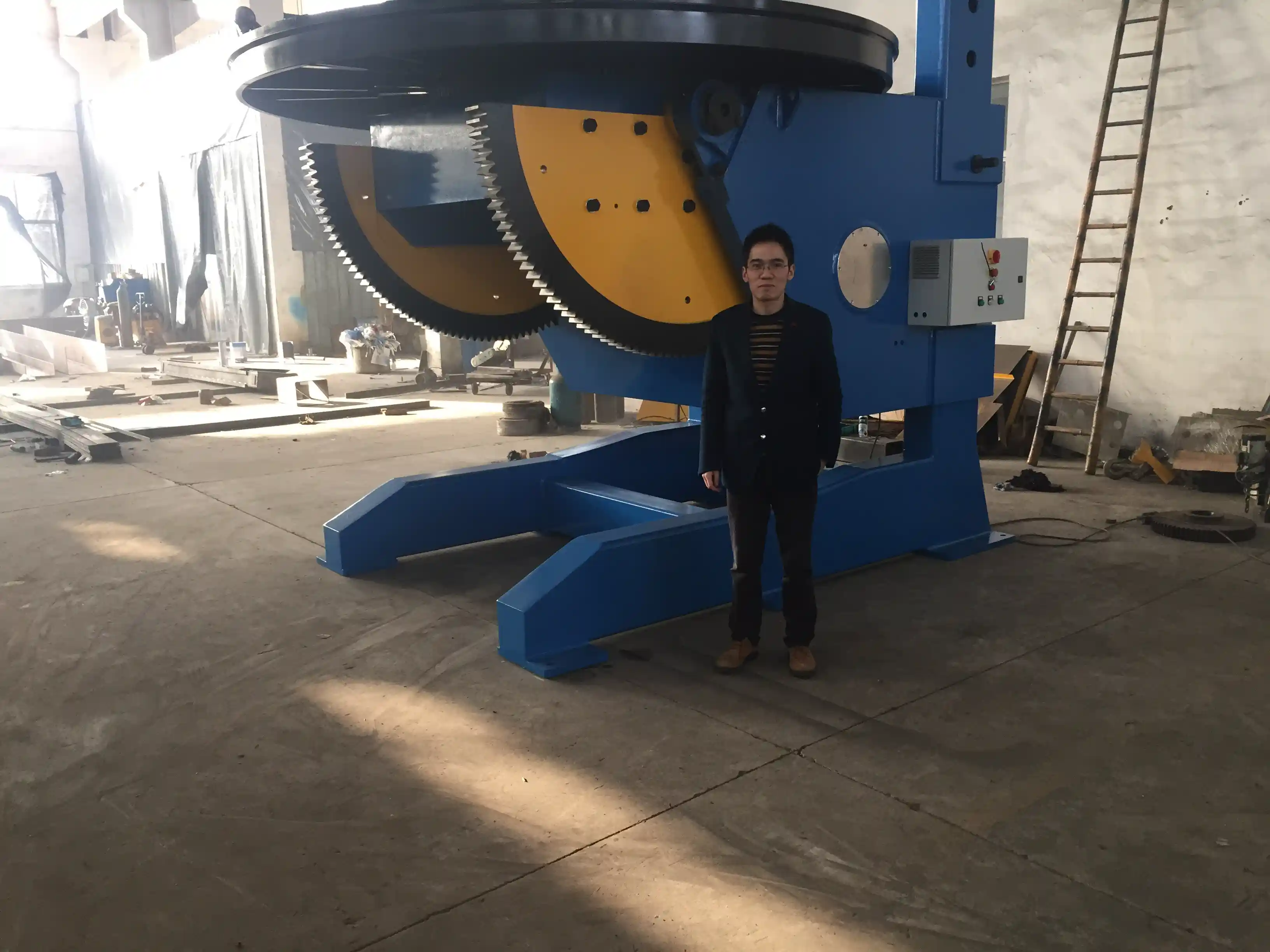
3. Evaluating the Impact of Workpiece Geometry on Positioner Stress Points
It’s not just about how much something weighs; it’s also about its shape. A big, bulky item will put stress on the positioner in a completely different way than a long, skinny one, even if they both tip the scales at the same weight. Understanding how a workpiece’s geometry affects leverage, bending moments, and torsional forces is key to identifying where the positioner might be getting overstressed – whether it’s the table, the frame, or the drive mechanisms. Engineers really have to consider these geometric effects to prevent localized damage and ensure the positioner holds up over the long haul.
Wenn Sie interessiert sind, schauen Sie unter 《Revolutionäre Lösung für das Schweißen von Druckbehältern Technische Analyse von um 360 Grad drehbaren Schweißpositionierern》.
Advanced Solutions for Mitigating Load Distribution Problems
1. Implementing Design Features for Enhanced Stability and Load Bearing
Thankfully, modern welding positioners aren’t just bigger versions of old ones; they’re designed smarter. We’re talking about robust, heavy-duty frames made from high-strength steel, often with reinforced bases that can really take a beating from both static and dynamic loads. Then there are those oversized slewing bearings – they add a ton of rigidity and cut down on deflection, especially when you’ve got an eccentric load trying to twist things. And let’s not forget the precision-machined components and top-notch gear reducers that ensure everything moves smoothly, without any annoying backlash. That’s absolutely vital for maintaining accuracy, even with the most challenging workpieces.
2. Utilizing Counterbalance Mechanisms and Adjustable Supports for Optimal Balance
Sometimes, you just can’t avoid an unbalanced load, so you have to fight fire with fire – or rather, weight with weight. That’s where intelligent counterbalance mechanisms and adjustable supports come in. You can add counterweights, either fixed or adjustable, to offset those eccentric loads, effectively pulling the combined center of gravity back closer to where the positioner wants it. And for those really long or oddly shaped pieces, auxiliary stands or outriggers provide extra points of contact and stability. These features give operators the flexibility to fine-tune the setup, reducing stress on the positioner and making the whole welding process much more stable.
3. Leveraging Smart Control Systems for Dynamic Load Management
Here’s where the real magic happens: smart control systems. These aren’t just glorified on/off switches; they’re integrated PLCs and HMI touchscreens that are constantly monitoring load conditions in real-time. They can actually adjust motor speeds and torques on the fly to compensate for shifts in the center of gravity as the workpiece moves. And with servo-driven axes, you get incredibly precise control over acceleration and deceleration, which means no sudden jolts that could destabilize your workpiece. Some of the really advanced systems even use predictive algorithms to anticipate load changes, ensuring everything runs smoothly and consistently throughout the entire welding cycle. This level of automation isn’t just cool; it makes things safer and much more precise.
Operational Best Practices for Preventing Load Distribution Failures
1. Establishing Proper Workpiece Setup and Fixturing Techniques
Honestly, a lot of problems can be avoided right at the start with good old-fashioned planning. Operators need to meticulously plan where they’re mounting the workpiece to spread that weight as evenly as possible across the positioner’s table. Using the right clamps, jigs, and fixtures isn’t just about holding the piece; it’s about making sure it stays absolutely secure, no matter how much it rotates or tilts. And for goodness sake, double-check that all fasteners are tightened to the correct torque specs. A quick visual inspection before you hit that start button can save you a world of hurt.
2. Adhering to Manufacturer Specifications for Load Capacity and Eccentricity Limits
This one is non-negotiable, full stop. Every single welding positioner comes with clearly defined limits for its maximum load capacity, how far off-center a load can be (eccentric distance), and the center of gravity distance. If you go over these limits, even by a little bit, you’re compromising the equipment’s structural integrity and putting everyone at risk. Always, always, always consult the machine’s manual and do the necessary calculations to make sure your workpiece fits within those parameters. Prioritizing these guidelines isn’t just about avoiding costly damage; it’s about ensuring safe operation.
3. Regular Maintenance and Inspection to Ensure Positioner Integrity
Think of your welding positioner like a high-performance car; it needs regular check-ups to stay in top shape. That means daily checks for anything loose, signs of excessive wear on gears and bearings, or any hints of structural fatigue. Lubricate those moving parts exactly when the manufacturer says to – it cuts down on friction and prevents premature wear. And don’t skip those periodic professional inspections! They can spot those subtle issues long before they blow up into major problems, ultimately extending the positioner’s lifespan and keeping it performing at its best.
WUXI ABK Welding Positioners Offer Superior Load Management Capabilities
1. Precision Engineering in WUXI ABK 3-Axis Positioners for Balanced Operations
At WUXI ABK, we’ve really put our heads together to engineer our 3-axis positioners for balanced operations, even with the most complex workpieces you can throw at them. Take our 3 Axis Positioner and 3 Axis Welding Positioner models, for instance. They boast robust servo-driven structures, complete with THK linear guides and SEW reducers. What does that mean for you? Incredibly precise and synchronized movement across all three axes, which is key to minimizing those nasty dynamic load imbalances. With positioning accuracy down to ±0.05 mm and repeatability of 0.02 mm, our positioners maintain rock-solid stability throughout the entire welding process. This kind of precision engineering isn’t just a fancy spec; it directly translates to superior weld quality and a longer, healthier life for your equipment.

2. Robust Construction of WUXI ABK Adjustable Height Positioners for Heavy Loads
When it comes to handling the really big, challenging loads, our adjustable height positioners are built like tanks. Whether it’s our Adjustable Welding Positioner (30 Tons) or the Heavy Duty Pipe Rotator (a whopping 100 Tons), they feature heavy-duty Q235-A steel box-type bases and reinforced frames that give them exceptional structural rigidity. And with hydraulic lifting systems, you get precise height adjustments, so you can perfectly accommodate various workpiece sizes while always maintaining optimal load distribution. These are the workhorses designed for demanding applications like pressure vessel welding and wind tower sections, where stability under extreme loads isn’t just a feature, it’s an absolute necessity.
Wenn Sie interessiert sind, schauen Sie unter 《Empowering Giant Projects How Heavy Duty Welding Rotators Became The Core Pillar Of Offshore Wind And Heavy Steel Structure Manufacturing》.
3. Integrated Control Systems in WUXI ABK Fixed Height Positioners for Enhanced Stability
Even our fixed height positioners, like the Fixed Height Positioner and Fixed Height Welding Positioner, come packed with advanced control systems for enhanced stability. We’re talking Siemens PLCs and HMI touchscreens that offer incredibly precise speed regulation and let you program complex welding sequences. These systems are smart enough to monitor and manage dynamic forces as the workpiece rotates and tilts, ensuring smooth, controlled movements. This sophisticated control minimizes vibrations and keeps your positioning consistent, which ultimately leads to high-quality welds and, frankly, a less fatigued operator.

Call to Action
Don’t let load distribution challenges hold your welding operations back from achieving peak precision and safety. Reach out to WUXI ABK MACHINERY CO., LTD. today – seriously, drop us a line! We’d love to show you how our cutting-edge welding positioners can truly revolutionize and optimize your fabrication processes. For any questions or if you need a bit of technical guidance, you can always hit me up at jay@weldc.com or just give me a ring at +86-13815101750.
Über den Autor
Jay Li, Direktor für Forschung und Entwicklung
Hey there, I’m Jay Li. I’ve been knee-deep in welding automation for over two decades now, specializing in all sorts of advanced equipment – think wind tower welding lines, H-beam lines, and all kinds of pipe welding solutions. My passion really lies in helping companies like yours boost their production quality and efficiency through innovative automation. It’s what gets me up in the morning!
FAQs
1. What is the most common cause of load distribution problems in welding positioners?
From what I’ve seen, it almost always boils down to an improperly placed or just plain oddly shaped workpiece. When the center of gravity doesn’t line up with the positioner’s rotational axis, you’ve got an eccentric load, and that creates a ton of stress on the machine’s components.
2. How can I calculate the center of gravity for an irregularly shaped workpiece?
For those tricky, irregular shapes, you typically break the object down into simpler geometric pieces, figure out the center of gravity for each one, and then use a weighted average formula to get the overall center of gravity. Honestly, CAD software usually makes this a breeze these days.
3. What are the risks of operating a welding positioner with an unevenly distributed load?
Oh, the risks are plenty! You’re looking at potential equipment damage, definitely a drop in weld quality, and some serious safety hazards. It can really chew up bearings and gears, lead to unstable movements, and in a worst-case scenario, the workpiece could even come flying off the positioner. Not good.
4. Can older welding positioners be retrofitted to improve load distribution?
Absolutely, many older positioners can get a new lease on life with retrofits. We’re talking about adding external counterweights, upgrading to smoother control systems, or even just implementing better fixturing solutions. That said, you’ll definitely want a thorough engineering assessment first to make sure it’s actually feasible and will be effective.
5. How do WUXI ABK welding positioners address dynamic load challenges during rotation and tilting?
At WUXI ABK, we tackle dynamic loads head-on with servo-driven axes and advanced PLC control systems. These systems give us incredibly precise control over acceleration and deceleration, actively compensating for those dynamic load shifts as the workpiece rotates and tilts. The result? Super smooth operation and enhanced stability, every time.
 English
  Español
  Français
  Deutsch
  Português
  Русский