In the production area of modern pipeline prefabrication plants, an impressive scene of industrial automation is becoming commonplace: twelve-meter-long giant pipe sections rotate steadily and uniformly on Schwerlast-Wenderollenwährend Schweißbrenner, die auf Schweißpositioniereinrichtungen trace perfect welding paths along the pipeline circumference. This seemingly simple yet technically sophisticated equipment combination is profoundly changing the quality standards and production efficiency of the traditional pipeline welding industry. As large-scale projects such as global energy pipelines, chemical pipelines, and municipal water supply networks continue to expand, requirements for pipeline welding quality and construction efficiency are constantly increasing. Traditional semi-automatic and manual welding methods can no longer meet the stringent demands of modern pipeline engineering for welding quality consistency and production speed.
The technological innovation of automated pipe welding systems has brought revolutionary solutions to pipeline manufacturing enterprises. The precise coordination between welding positioners and turning rolls creates an almost ideal welding environment: pipe sections maintain stable rotation while achieving precise torch positioning. This innovative equipment combination not only ensures the stability of the entire welding process but, more importantly, guarantees that every circumferential weld can be completed in the optimal welding position. For thick-walled pipelines requiring multi-layer, multi-pass welding, this stability means each weld layer can achieve ideal fusion, ultimately forming a dense and uniform weld microstructure, thereby ensuring the overall quality and service life of the pipeline.
Technical Challenges and Innovative Solutions in Pipeline Welding Manufacturing
The development of modern pipeline engineering presents higher requirements for welding technology. Current large-scale pipeline projects typically feature diameters exceeding two meters, wall thicknesses reaching fifty millimeters, with single pipe sections usually twelve meters long and weighing over ten tons. These oversized pipe components face numerous special challenges during welding: continuity and consistency of circumferential welds, uniformity of groove filling, effective control of welding deformation, and most critically, stability of welding quality. These challenges not only affect production efficiency but are directly related to the safe operation of the pipeline system.
Pipeline rotating rollers provide an ideal rotating platform for pipeline welding through their precise speed control systems. This equipment ensures stable rotation speed during the welding process, laying the foundation for welding quality stability. Combined with the precise control of column boom manipulators, accurate tracking and positioning of welding torches on pipeline circumferential welds is achieved. This innovative equipment combination effectively solves the core technical challenge in pipeline welding—how to maintain stable welding position and process parameters during prolonged welding operations. According to actual application data statistics, this automated welding system can improve welding efficiency by 4-6 times while increasing the first-pass weld qualification rate to over 99.9%, leading the industry.
Core Technical Elements for Ensuring Pipeline Welding Quality
In the pipeline welding manufacturing process, the quality of circumferential welding is a key factor determining the reliability of the entire pipeline system. The successful implementation of pipe circumferential welding mainly depends on three core elements: stable rotation speed control, precise torch positioning system, and reliable equipment structural rigidity. Precision turning roll systems achieve stepless speed regulation within the 0.1-150rpm range through advanced frequency control technology, ensuring speed stability under various welding process requirements. This precise speed control directly determines the uniformity of welding heat input and is the primary condition for avoiding welding defects.Simultaneously, welding manipulator systems maintain the optimal relative position between the torch and pipeline groove through their robust mechanical structure and precise transmission system. Even during continuous welding operations lasting several hours, it ensures the torch continuously and accurately tracks the weld trajectory. This precise control capability is decisive for guaranteeing pipeline circumferential weld quality, directly affecting the service life and safe operation performance of the pipeline system. Modern welding equipment is also equipped with real-time monitoring systems that can continuously monitor and record various parameters during the welding process, providing complete data support for quality traceability.
Practical Application of Automated Welding Systems in Pipeline Manufacturing
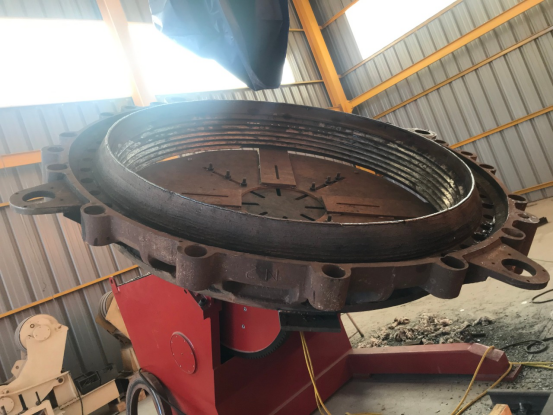
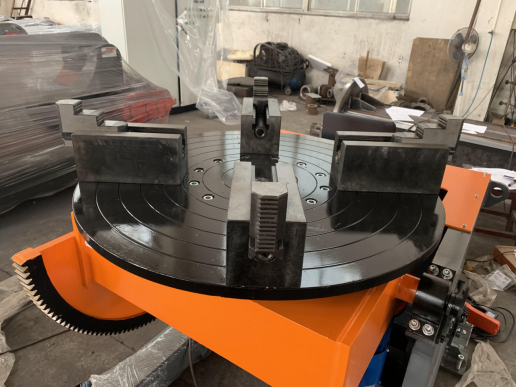
In the production system of modern pipeline prefabrication plants, the collaborative operation of welding positioners and turning rolls has formed a standardized production mode. Typical equipment configuration includes a set of heavy roller systems und eine pipe welding positioner. Depending on specific pipe diameter dimensions and length requirements, multiple sets of turning rolls can be configured for collaborative work. This flexible configuration scheme can adapt to welding requirements for various specifications of pipelines with diameters of 0.5-3 meters, lengths of 12 meters, and weights up to 20 tons, demonstrating excellent equipment adaptability and versatility.
For pipelines of different specifications and materials, this welding system demonstrates excellent adaptability. During circumferential welding of standard pipelines, the turning rolls drive the pipe section to maintain uniform rotation while the positioner’s torch remains fixed, achieving ideal flat position welding. When welding large-diameter thin-walled pipelines, the system can configure multiple sets of turning rolls for synchronous drive, ensuring excellent stability and straightness of extra-long pipe sections during rotation. This flexible configuration scheme enables one system to meet the welding requirements of various specification pipelines, significantly improving equipment utilization and return on investment. Additionally, the system can adjust welding parameters and rotation speed according to different welding process requirements, ensuring optimal welding quality for each type of pipeline.
Advanced Welding Processes for Special Pipeline Materials
With the diversified development of pipeline materials, welding of special materials such as high-strength steel, low-temperature steel, and corrosion-resistant alloys places higher demands on equipment. These special materials often have extremely strict requirements for heat input control and interpass temperature management, where any parameter deviation may lead to welding quality issues. Intelligente Schweißsysteme achieve precise management and optimization of various process parameters during welding through digital collaborative control technology.
When welding special material pipelines, verstellbare Wendewalzen can precisely control rotation speed according to specific welding process requirements, ensuring each weld layer is completed within the optimal heat input range. Meanwhile, automatic positioning equipment monitor and adjust welding parameters in real-time, ensuring the optimal welding thermal cycle is maintained throughout the welding process. This intelligent collaborative control system effectively guarantees the performance consistency of special material pipeline welded joints, providing reliable technical support for the safe operation of pipeline systems. The system is also equipped with a comprehensive process database that can store and call welding parameters for different materials, greatly improving production standardization.
Scientific Selection Points for Professional Pipeline Welding Equipment
Selecting suitable pipeline welding equipment requires comprehensive consideration of multiple technical and economic factors. First, equipment performance parameters must fully meet production requirements. The load capacity of industrial welding equipment needs to fully consider the weight distribution characteristics and rotational inertia of the pipeline, ensuring excellent stability and safety during equipment operation. The speed range of turning rolls must comprehensively cover all pipeline welding process requirements, while the operating accuracy of positioners must meet the special needs of pipeline circumferential welding—these are key technical indicators to consider during selection.
Second is equipment reliability and environmental adaptability. Pipeline welding operations typically require continuous uninterrupted operation for several hours, and the equipment must withstand the severe test of long-term continuous work. Choosing professional Hersteller von Schweißmaschinen is crucial. These experienced manufacturers typically use high-quality components and rigorous manufacturing processes, providing complete technical support and service guarantees. Additionally, the intelligence level of equipment is an important modern selection consideration. Advanced automatisierte Schweißmaschinen should possess intelligent functions such as process parameter storage, welding process monitoring, and quality data traceability. These functions are significant for ensuring welding quality and improving production efficiency.
Key Technologies for System Configuration and Process Optimization
When configuring pipeline welding systems, several key technical details require special attention. The driving method of turning rolls directly affects the stability of pipeline rotation. Modern servo direct drive systems have better control accuracy and reliability than traditional chain drives. The material and structural design of rollers largely determine equipment service life and maintenance costs. Polyurethane-coated rollers have better friction performance and pipeline protection effects than traditional steel rollers. For welding large-diameter thin-walled pipelines, special attention must be paid to the synchronization control accuracy of multiple turning roll groups, as any slight non-synchronization may cause pipeline deformation or welding defects.Professional equipment suppliers can usually provide customers with complete process solutions, including equipment selection recommendations, process development support, installation and debugging services, and technical training. They also provide customized function configurations according to customers’ specific production needs. For example, specialized welding process packages for specific pipeline materials, or data interface solutions integrated with factory production management systems. These professional value-added services can help enterprises quickly achieve the technical benefits of automated welding, shorten equipment debugging cycles, and improve return on investment.
Intelligent Development Trends and Technological Innovation Directions
With the rapid development of industrial Internet of Things technology, the combination of welding positioners and turning rolls is evolving toward comprehensive digitalization and intelligence. The next generation of intelligente Schweißlösungen will integrate more sensing devices and more advanced control algorithms to achieve autonomous optimization and intelligent decision-making in the welding process. Through big data analysis and machine learning technology, the system can autonomously learn optimal process parameters from historical welding data and make adaptive parameter adjustments according to real-time working conditions, continuously improving welding quality and efficiency.
The deep application of digital twin technology will bring全新的变革 to pipeline welding manufacturing. Equipment digital models built in virtual space can real-time map the operating status of physical equipment, achieving online optimization of process parameters and predictive maintenance of equipment health. Engineering technicians can real-time manage multiple welding workstations through intelligent monitoring systems, significantly improving the refinement level of production management and operational efficiency. This intelligent management mode not only improves equipment utilization but also reduces labor costs, providing strong support for enterprises’ sustainable development.
Technological Innovation Paths in the Context of Green Manufacturing
In the context of green manufacturing and sustainable development, the pipeline manufacturing industry places higher requirements on energy conservation and environmental protection. New-generation welding equipment is developing toward higher efficiency and environmental friendliness. High efficiency welders use advanced energy feedback technology to convert kinetic energy generated during equipment braking into electrical energy fed back to the grid, significantly reducing operating energy consumption and equipment operating costs. Intelligent energy management systems can optimize equipment energy use efficiency in real-time according to welding process requirements, achieving refined energy management.
Meanwhile, equipment manufacturers are also paying more attention to material environmental friendliness and equipment’s full lifecycle environmental impact. Through ecological design, modern welding machinery is easier for component replacement and system upgrades, effectively extending equipment service life and reducing resource consumption and waste generation. These technological innovations not only help manufacturing enterprises reduce operating costs and improve market competitiveness but also make positive contributions to the sustainable development of the entire pipeline manufacturing industry. Additionally, environmental indicators such as noise control and electromagnetic radiation protection during equipment operation are receiving increasing attention, reflecting enterprises’ social responsibility for environmental protection.
Technological innovation in the pipeline welding field continues to advance, with automatisierte Schweißlösungen bringing significant competitive advantages to manufacturing enterprises. Choosing reliable equipment manufacturing partners and establishing long-term technical cooperation relationships can ensure enterprises receive continuous professional support in equipment updates and technological upgrades. In the future, with the deep application of intelligent technology, the collaboration between welding positioners and turning rolls will become more precise and intelligent, providing more advanced and reliable manufacturing solutions for the pipeline manufacturing industry, promoting the continuous improvement of global pipeline engineering construction levels, and making greater contributions to the development of world energy infrastructure.
automatisierte Schweißlösungen:
https://www.weldmc.com/product-category/welding-automation
smart welding solutions:
https://www.weldmc.com/product-category/welding-automation
adjustable turning rolls:
https://www.weldmc.com/product-category/welding-automation/welding-rotator
pipe welding positioner:
https://www.weldmc.com/product-category/welding-automation/welding-positioner
heavy duty turning rolls:
welding positioning equipment:
https://www.weldmc.com/product-category/welding-automation/welding-positioner
 English
  Español
  Français
  Deutsch
  Português
  Русский