An NBIC‑authorized repair shop cannot substitute a general fabrication setup for the precision and documentation that the National Board Inspection Code demands. Boiler repairs involve heavy sections, tube replacement that requires exact fit‑up, and welds that will be scrutinized under NDE. The right equipment does more than pass inspection; it makes consistent code‑quality work repeatable across shifts and operators. The key machinery includes heavy‑duty welding positioners, manipulators for longitudinal tube‑to‑tube seams, CNC cutting tables for replacement panels, and the integration that ties them to a qualified welding procedure. Without the proper positioning and automation, a shop risks non‑conformance during the first audit or costly rework on in‑service boilers.
What NBIC Authorized Repair Demands from Equipment
An R‑stamp holder is not just a welder with a code book. The equipment itself must support the qualified welding procedures, ensure repeatable positioning, and maintain the alignment tolerances that the authorized inspector will verify. The National Board expects that every repair restores the boiler to its original safety margin, which means the welding machinery must deliver the same consistency that the original equipment manufacturer achieved in production.
Boiler components arrive heavy, often corroded, and awkward to maneuver. Manual handling introduces misalignment, and misalignment produces welds that cannot pass radiography or ultrasonic testing. Automated positioners with controlled tilt and rotation take the guesswork out of setup, while digital speed regulation ensures that the welding travel speed matches the procedure specification exactly. Beyond the mechanics, the machine’s control system should log parameters—voltage, amperage, travel speed, and even preheat temperatures—so that the repair record stands up under audit.
Welding Positioners and Turning Rolls for Heavy Boiler Sections
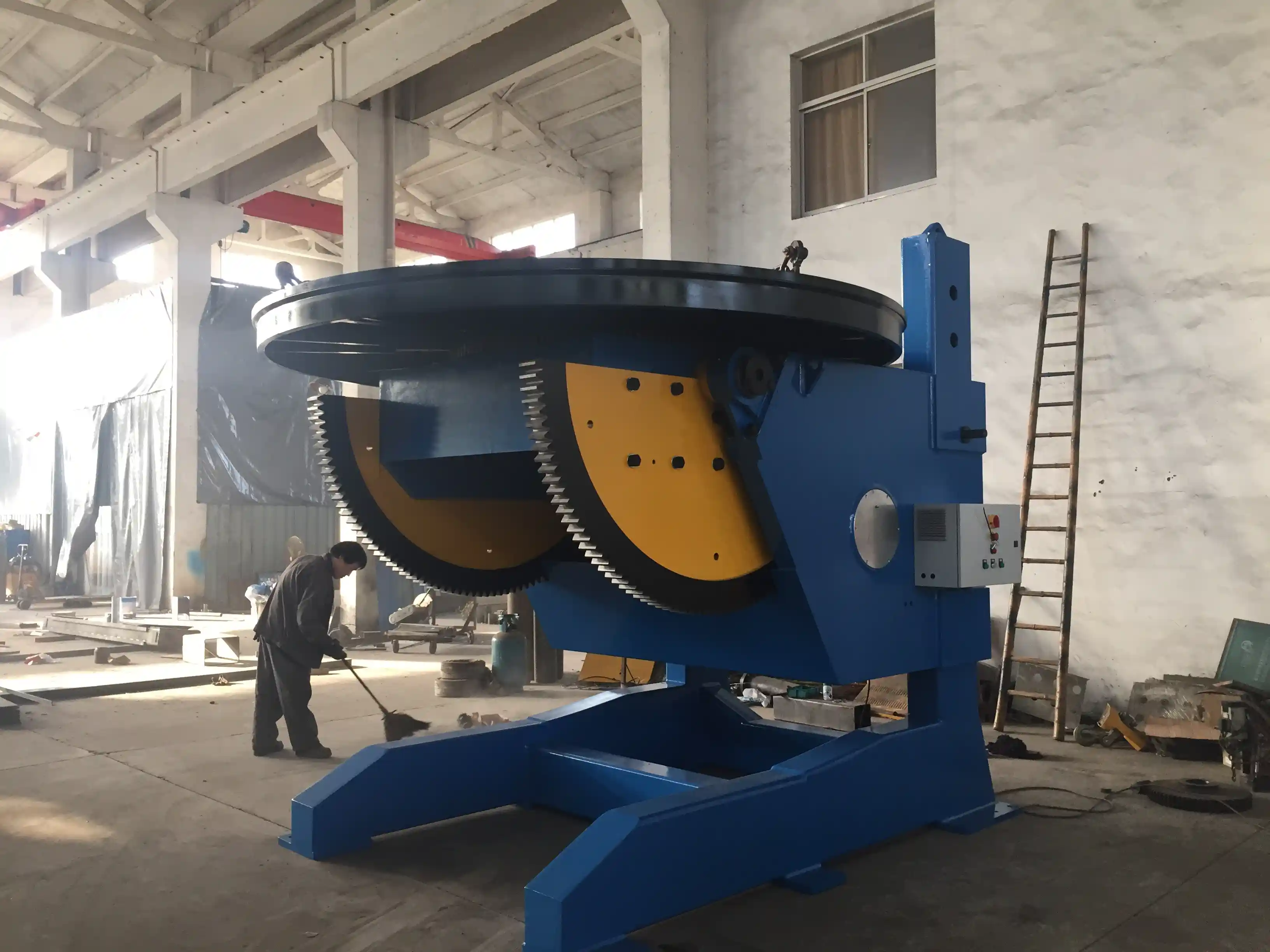
A boiler drum or a large waterwall section needs a positioner that can handle severe eccentric loading. In repair scenarios, the center of gravity often shifts because of uneven corrosion or partial replacement of tubes, so the machine’s dynamic load rating is as important as its static capacity.
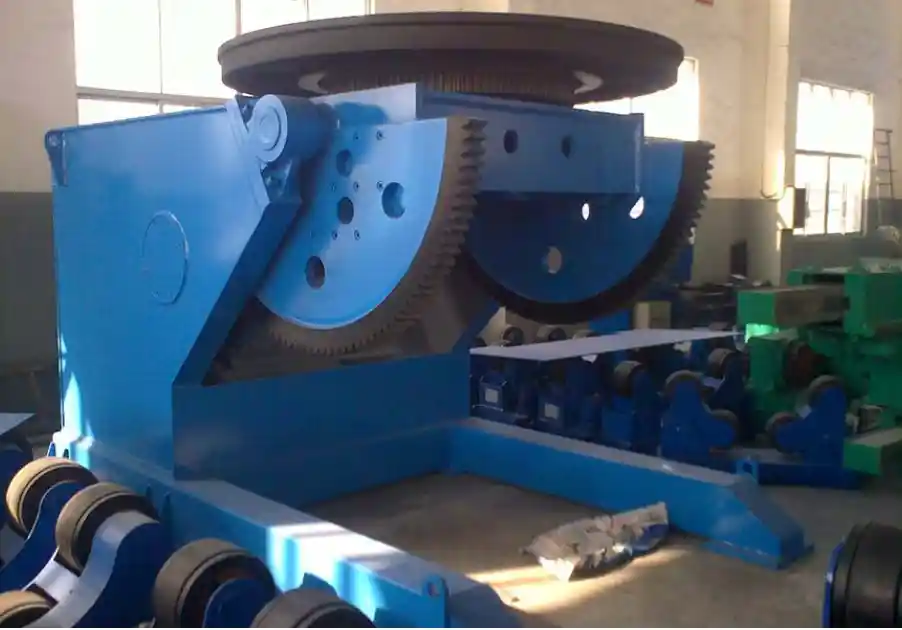
We have seen shops select a 5‑ton positioner for a 3‑ton drum because the corrosion loss was uneven, and then the positioner struggled with overturn torque. For boiler work, a 3‑axis welding positioner with a tilt range of 0‑90° and continuous 360° rotation provides the flexibility to position a damaged section for both longitudinal and girth weld repairs. The Wuxi ABK 3‑Ton 3‑Axis Welding Positioner, for example, uses servo drives and THK linear guides to hold ±0.05 mm positioning accuracy with 0.02 mm repeatability—precision that directly reduces NDE rejections on circumferential seams.
For the long, cylindrical boiler shells or replacement tube bundles, turning rolls replace the positioner. Standard welding rotators from 5 tons to 100 tons can support vessel diameters up to 5 meters, with anti‑creep mechanisms that keep the workpiece from drifting during submerged‑arc welding. The key specification to watch is the wheel velocity range: 6‑60 m/h with stepless frequency control gives the welding engineer the ability to dial in exactly the travel speed required by the WPS.
Welding Manipulators for Tube‑to‑Tube and Membrane Panel Repairs
When replacing individual boiler tubes or repairing membrane wall panels, a welding manipulator turns what would be a series of difficult out‑of‑position welds into consistent, flat‑position automated seams. The column‑and‑boom design moves the welding head to the workpiece, not the other way around, which is critical when the boiler section is immobilized by rigging or scaffolding.
For most industrial boiler repair shops, a manipulator with 4 to 8 meters of horizontal and vertical travel covers the working envelope of a typical tube panel. ABK’s LH series welding manipulators provide linear guideways and cycloidal reducers that keep positioning accuracy to ±0.1 mm per meter, so the arc length remains constant even over long travel distances. Combined with a submerged‑arc or flux‑core head, these manipulators enable the shop to weld dozens of tube‑to‑header joints with identical parameters, producing the uniform penetration profiles that ultrasonics inspection looks for.
If the repair involves replacing an entire waterwall panel, the manipulator can be paired with a CNC‑controlled oscillation carriage to weave the weld across the membrane bar. The result is a consistent tie‑in to the existing tube without the stops and starts that create stress risers. This is one area where specifying a manipulator with PLC program memory pays for itself: the welding engineer can develop the weave parameters on a mock‑up, store them, and then repeat the exact motion on the actual boiler.
CNC Cutting Machines for Repair‑Ready Replacement Parts
Many boiler repairs require cutting out damaged tube sections or header plates and fabricating exact replacements. A CNC plasma or flame cutting machine brings the fit‑up tolerance to within 1 mm, which eliminates the hours of grinding and hand‑fitting that plague manual layout.
We typically recommend a plasma cutting table for thicknesses up to 50 mm and a flame cutting system for heavier carbon‑steel boiler plate up to 200 mm. ABK’s CNC plasma cutting machines include torch height control that automatically compensates for warped plate—a common problem with boiler steel that has been in service. The nesting software also helps a repair shop optimize material usage when the replacement part comes from an odd‑size remnant.
For tube ends, a portable water jet or a tube‑beveling machine avoids the heat‑affected zone that plasma can leave, but the bulk of boiler part fabrication relies on plasma or flame. The important point is that the cut edge must be square and smooth enough for a code‑quality weld prep. An irregular cut creates a gap that forces the welder to over‑compensate, leading to excess reinforcement that will be ground down and re‑inspected.
Matching Equipment Capacity to Your Boiler Repair Scope
Not every authorized repair shop handles large utility boilers. A shop that focuses on package boilers and small fire‑tube units often does well with a 1‑ to 5‑ton capacity positioner and a manipulator in the 3‑meter reach class. Shops that take on industrial water‑tube boilers or economizer repairs need positioners rated for at least 10 tons and rotators capable of 2‑meter diameters.
The decision tree comes down to the heaviest component you will handle, plus a 25% margin for dynamic loading during rotation. If your typical job is replacing a superheater section that weighs 2 tons, select a positioner with at least a 2.5‑ton dynamic capacity. For the manipulator, measure the farthest distance from the column to the weld joint and add one meter of buffer for repositioning.
Another factor that is easy to overlook is the foundation. A 30‑ton welding turntable needs a reinforced concrete pad, while smaller positioners can sit on a level floor with vibration‑dampening pads. Planning the equipment layout early prevents the discovery that the shop floor cannot support the machine that the repair contracts require.
If your program involves replacing economizer headers or large‑bore superheater tubes, it is worth confirming the positioner’s tilt and rotation torque before finalizing the purchase. Send the part geometry and weight to the manufacturer to verify that the machine’s drive system can handle the eccentric load without stalling.
Start Your NBIC‑Compliant Equipment Plan
Stepping into an NBIC audit with equipment that was selected for general fabrication invites non‑conformances. The solution is not to buy the largest machine; it is to match the machinery’s precision and load capacity to the worst‑case repair scenario your shop intends to handle. Wuxi ABK Machinery has supported boiler repair shops with welding positioners, manipulators, and CNC cutting systems that are specifically designed for the heavy, asymmetric, and corrosion‑affected components that boiler work presents. Call us at +86‑510‑83555592 or email jay@weldc.com to discuss your boiler component dimensions and get a capacity‑matched equipment recommendation.
Common Questions About NBIC Boiler Repair Equipment
Does the NBIC require a specific brand of welding positioner for boiler repairs?
No—the NBIC is performance‑based. It requires that the equipment can produce and reproduce welds that meet the qualified welding procedure specification. The authorized inspector will examine the equipment’s ability to hold alignment, control speed, and maintain parameters. The brand does not matter, but the machine’s positioning accuracy and documentation capability do. A positioner that can demonstrate ±0.5° rotation accuracy with a calibration certificate is far more likely to pass scrutiny than an uncalibrated manual turntable.
Can a welding manipulator be used for both tube‑to‑tube and membrane panel welding in the same repair?
Yes, if it has sufficient horizontal and vertical travel to reach all joints without repositioning the boiler section. We often set up a manipulator with a quick‑change carriage so that the same column‑boom system can switch between a single‑wire SAW head for tube‑to‑tube seams and an oscillating carriage for membrane bar welding. The critical specification is the boom’s deflection under load: more than 0.2 mm per meter of deflection will cause arc wander on thin‑wall tubes.
What is more important for an NBIC repair shop: positioner capacity or precision?
Precision. A positioner that can handle 10 tons but drifts under dynamic loading will cause weld defects that NDE will find. A lower‑capacity machine with servo drives and anti‑backlash gearing produces better weld quality on a 3‑ton component than an oversized but sloppy positioner. That said, the capacity must still safely handle the maximum component; the two are not alternatives, but if a budget is tight, prioritize precision and limit the job scope.
Do I need a dedicated CNC cutting machine, or can I use hand‑held plasma for boiler repairs?
For any repair that will be radiographed, hand‑cut edges introduce enough variability that the welder must compensate with extra fill, which creates a heat‑affected zone profile that may not match the PQR. A CNC cutting machine, even a basic gantry‑type plasma table, produces a square, consistent bevel face that can be replicated on the replacement part and the boiler shell. The cost of a CNC plasma table is often recovered within the first six months by eliminating rework on one or two large repair jobs.
How long does equipment integration take before the authorized inspector visit?
Typically four to six weeks for installation, calibration, and procedure qualification if the shop already has qualified welding procedures. That includes setting the positioner up, verifying the speed control with a tachometer, running test plates on the manipulator, and documenting the entire process for the inspector’s review. If new WPS development is needed, add another two weeks. It is far better to present a fully documented setup than to rush and have the inspector witness a parameter drift during the demonstration.
Share your shop’s typical boiler repair scope and component weights with our team, and we will confirm the equipment mix that fits both your code requirements and your floor space.
If you’re interested, check out these related articles:
Exceptional Application Value: How Fixed-Height Welding Positioners Drive Advancements in Offshore and Shipbuilding Manufacturing (Part 2)
Pipe Welding Misalignment Issues: How Intelligent Welding Pipe Rotators Boost Oil Pipeline Pass Rates
How to Improve the Quality of Pipe Welding Through a High-Precision Welding Positioner
Tired of Complex Welding Challenges? How a 3-Axis Positioner Can Boost Productivity by 70%
Wind Tower Welding Challenges: How Advanced Hydraulic Lifting Systems Boost Production by 40%
 English
  Español
  Français
  Deutsch
  Português
  Русский