Achieving superior quality and efficiency in tank welding demands a deep understanding of industry standards and advanced technologies. We recognize the critical role of API 650 compliance in ensuring structural integrity and operational safety for storage tanks. Our experience shows that embracing specialized equipment and automation significantly mitigates traditional welding challenges. This approach leads to enhanced precision, reduced labor costs, and improved overall project timelines.
Understanding the Criticality of API 650 in Tank Welding
1. Why Adherence to API 650 Standards is Paramount for Storage Tanks
API 650 standards govern the design, fabrication, erection, and inspection of welded tanks for oil storage. Adherence to these standards is crucial for several reasons. First, it ensures the structural integrity and long-term reliability of storage tanks. Non-compliance can lead to catastrophic failures, environmental damage, and significant financial losses. Second, API 650 mandates specific material requirements and welding procedures, which guarantee the tank’s ability to withstand operational stresses. Third, regulatory bodies and insurance providers often require API 650 compliance for permitting and coverage, making it a legal and financial necessity. Finally, upholding these standards protects personnel and the public by minimizing risks associated with hazardous material storage.
2. Key API 650 Requirements Impacting Welding Procedures and Quality
API 650 outlines stringent requirements directly impacting welding procedures and overall quality. These include detailed specifications for welding consumables, pre-heating, post-weld heat treatment, and non-destructive testing (NDT). Welders must possess specific qualifications, and welding procedures must be meticulously documented and approved. The standard dictates acceptable weld imperfections and repair procedures, ensuring high-quality joints. Furthermore, API 650 emphasizes fit-up tolerances and alignment, which are critical for achieving sound welds. We consistently implement these requirements to deliver tanks that meet the highest safety and performance benchmarks.
Challenges in Traditional Tank Welding and the Need for Advanced Solutions
1. Common Difficulties in Achieving Consistent Weld Quality and Efficiency
Traditional manual tank welding presents numerous challenges to achieving consistent quality and efficiency. Manual processes are highly susceptible to human error, leading to inconsistent weld beads, porosity, and incomplete fusion. Maintaining precise travel speed and arc length over long seams is difficult for even the most skilled welders. This inconsistency often necessitates extensive rework, increasing project timelines and costs. Furthermore, the physical demands of manual welding contribute to welder fatigue, further impacting quality and productivity. The sheer scale of storage tanks exacerbates these issues, making manual methods impractical for large-scale projects.
2. Addressing Labor Shortages and Safety Concerns in Manual Tank Welding
The welding industry faces a persistent shortage of skilled labor, making it challenging to staff large tank fabrication projects. Manual tank welding also poses significant safety risks, including exposure to fumes, arc flash, and ergonomic injuries from awkward positions. Working at height or in confined spaces adds further hazards. These factors not only increase the risk of accidents but also contribute to higher insurance premiums and worker compensation claims. Advanced solutions are essential to mitigate these risks and create safer working environments.
Selecting Optimal Welding Equipment for API 650 Compliant Tank Fabrication
Selecting the right equipment is critical for achieving API 650 compliance and maximizing efficiency in tank fabrication. We focus on solutions that enhance precision, control, and repeatability.
1. Precision Welding Manipulators for Longitudinal and Circumferential Seams
Welding manipulators are indispensable for achieving high-quality longitudinal and circumferential seams on tanks. These systems provide stable support and precise movement for welding torches. Our Manipulador de soldadura models, such as the LH8080, offer horizontal travel up to 8000 mm and vertical travel up to 8000 mm. They feature linear guideways and cycloidal reducers, ensuring positioning accuracy of ±0.1 mm/m. This precision is vital for maintaining consistent weld parameters and meeting API 650 standards for seam integrity. Optional features like real-time monitoring and seam tracking further enhance weld quality and reduce defects. These manipulators are crucial for large-scale tank production.
2. High-Capacity Welding Positioners for Complex Tank Components
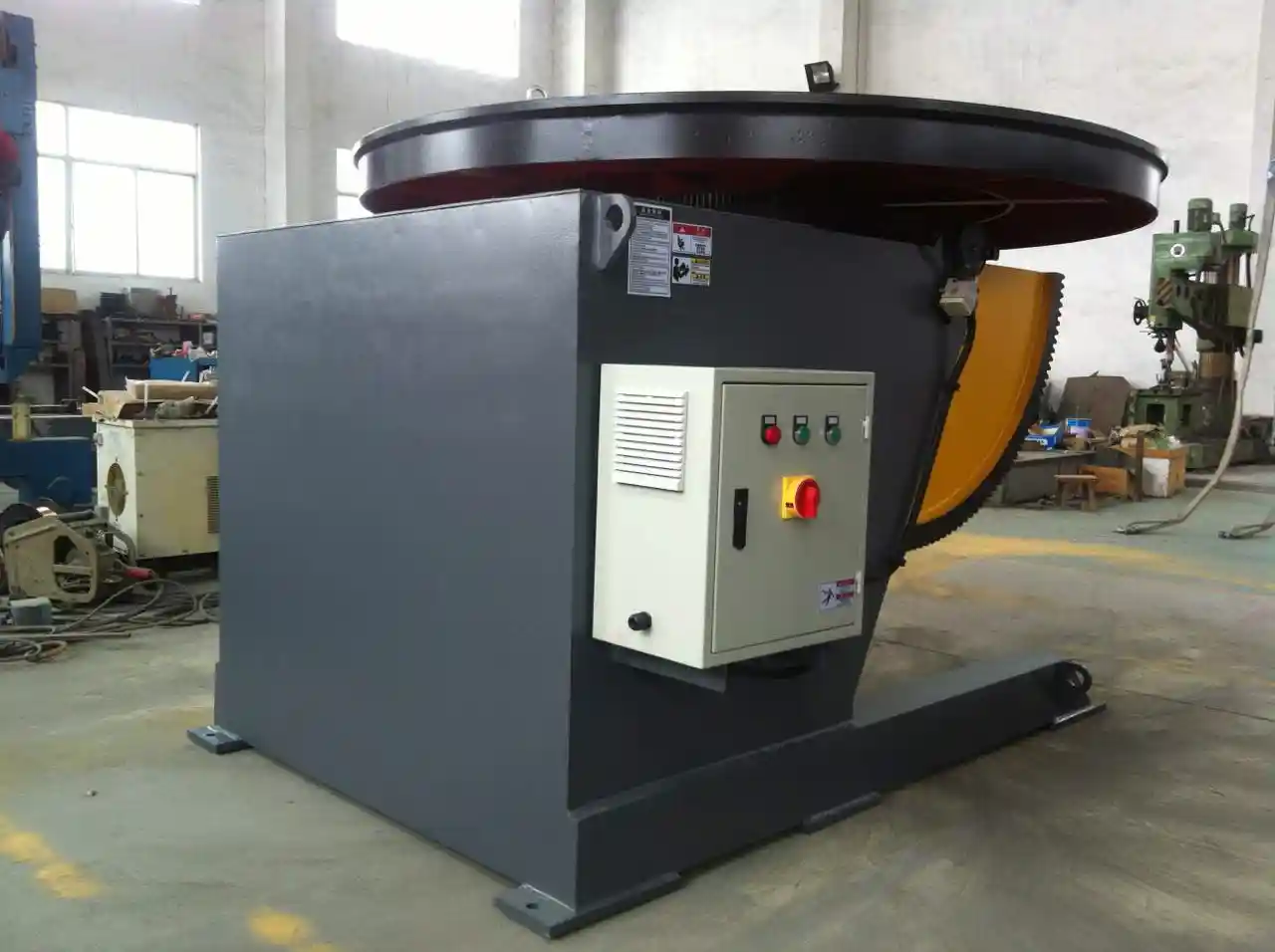
Welding positioners are essential for orienting complex tank components, such as nozzles, manways, and internal structures, into optimal welding positions. This improves welder access and allows for downhand welding, which produces higher quality welds faster. Our range includes Posicionador de 3 eixos e Posicionador de eixo triplo models with capacities up to 5 tons. They provide synchronized turning, rotating, and tilting movements with ±0.05 mm positioning accuracy and 0.02 mm repeatability. These features are critical for maintaining tight tolerances and ensuring proper fit-up before welding. The robust design and PLC control systems ensure stable and precise manipulation of heavy components.
3. Automated Welding Rotators and Fit-Up Systems for Cylindrical Tanks
Automated welding rotators are fundamental for fabricating cylindrical tank sections and shells. They provide controlled rotation, allowing for continuous, uniform circumferential welds. Our Fabricantes de rotores de soldadura offer various models, including Adjustable Rotator Manufacturers e Standard Rotator Suppliers, with load capacities from 5 tons to 300 tons. These rotators feature stepless speed control and anti-creep mechanisms to ensure precise rotation and prevent workpiece slippage. For optimal efficiency and quality in tank manufacturing, consider A New Era in Tank Manufacturing: The Art of Precision Collaboration Between Turning Rolls and Manipulators.
Fit-up rotator systems are equally important for aligning tank shell courses and other cylindrical components. Our Fornecedores de rotadores Fit-Up are designed for precise alignment, minimizing gaps and misalignments before welding. The 20 Ton Automatic Fit-Up Rotator, for example, handles 1-4m diameter workpieces with ±0.8mm positioning accuracy. These systems drastically reduce manual adjustment time and improve overall fabrication accuracy, contributing directly to API 650 compliance.
Revolutionizing Tank Welding Through Automation and Advanced Technologies
Automation is transforming tank welding, addressing historical challenges and setting new benchmarks for quality and efficiency.
1. Enhancing Accuracy and Repeatability with Automated Welding Systems
Automated welding systems significantly enhance accuracy and repeatability, critical factors for API 650 compliance. These systems employ precise control over welding parameters, including travel speed, wire feed speed, voltage, and oscillation patterns. This eliminates human variability, resulting in consistent weld quality across all seams. Automated systems can execute complex weld paths with extreme precision, reducing defects like undercut, overlap, and porosity. The consistent application of heat and filler material minimizes distortion, which is a common issue in large tank fabrication. This level of control ensures that every weld meets the exact specifications required by industry standards.
2. Integrating Smart Control Systems for Optimized Welding Parameters
Smart control systems are at the forefront of welding automation, optimizing parameters in real-time. These systems use sensors and feedback loops to monitor the welding process, adjusting parameters as needed. For example, they can detect changes in joint geometry or material thickness and automatically modify welding current or travel speed. This adaptive control ensures optimal penetration and fusion, even in challenging conditions. Programmable Logic Controllers (PLCs) and Human-Machine Interfaces (HMIs) allow operators to pre-set and recall welding programs, streamlining setup and ensuring consistency across batches. This integration leads to superior weld quality and reduced reliance on manual intervention.
3. The Future of Tank Welding: Robotics and Real-time Monitoring
The future of tank welding increasingly involves advanced robotics and real-time monitoring. Robotic welding systems offer unparalleled speed and precision for repetitive tasks, further boosting productivity. They can operate continuously, reducing cycle times and increasing throughput. Real-time monitoring systems use advanced sensors, cameras, and data analytics to track weld quality, identify potential defects, and provide immediate feedback. This allows for proactive adjustments, preventing costly rework. Integration with artificial intelligence (AI) and machine learning (ML) will enable predictive maintenance and even more sophisticated process optimization. These technologies will continue to drive innovation in the tank manufacturing industry.
WUXI ABK’s Solutions for High-Performance Tank Welding
WUXI ABK is dedicated to providing advanced welding solutions that meet the rigorous demands of tank fabrication. Our equipment is engineered for precision, reliability, and compliance with international standards.
1. How WUXI ABK Equipment Ensures API 650 Compliance and Production Efficiency
WUXI ABK equipment is designed with API 650 compliance as a core principle. Our welding manipulators, positioners, and rotators feature robust construction and precise control systems. These systems ensure consistent weld parameters, critical for achieving the mechanical properties and defect-free welds required by API 650. For example, our Welding Manipulator Manufacturers deliver ±0.1 mm/m positioning accuracy, minimizing misalignment and improving weld quality. The integration of advanced control technologies, such as Siemens PLCs, allows for repeatable processes and reduces human error. This precision directly translates into higher production efficiency, less rework, and faster project completion.
2. Featured Products for Tank Welding: Manipulators, Positioners, and Rotators
We offer a comprehensive range of equipment specifically tailored for tank welding applications.
- Welding Manipulators: Our LH series welding manipulators, including models like LH8080 and LH5060, provide extensive reach and precise control for longitudinal and circumferential seams. They are suitable for various tank sizes and configurations, ensuring consistent weld quality.
- Welding Positioners: O nosso Welding Positioner Suppliers include 3-axis positioners (1-ton, 2-ton, 3-ton, and 5-ton capacities) and adjustable height positioners (up to 100 tons). These provide versatile positioning for complex tank components, enabling optimal welding angles and improved access. For insights into improving quality and efficiency, read Melhorar a Qualidade e a Eficiência no Fabrico de Reservatórios e Recipientes sob Pressão: O principal valor de aplicação dos posicionadores.
- Welding Rotators: We supply a wide array of welding rotators, from standard models (HGZ series) to adjustable height pipe rotators (HGK series) and Fornecedores de rotadores Fit-Up. These systems handle tank diameters from 250mm to 6000mm and loads up to 300 tons, ensuring smooth, controlled rotation for high-quality circumferential welds. Our fit-up rotators, like the 20 Ton Automatic Fit-Up Rotator, provide precise alignment for tank shell courses, enhancing overall fabrication accuracy.
Table: Comparison of WUXI ABK Welding Equipment for Tank Fabrication
| Tipo de equipamento | Exemplo de modelo | Caraterísticas principais | Precisão de posicionamento | Load Capacity (Max) | Primary Application |
|---|---|---|---|---|---|
| Manipulador de soldadura | LH8080 | High-strength box-beam, linear guideways | ±0,1 mm/m | N/A | Longitudinal & Circumferential Seams |
| Posicionador de soldadura | Posicionador de eixo triplo | Synchronized 3-axis movement | ±0,05 mm | 5 toneladas | Complex tank components |
| Posicionador de altura ajustável | 30 Tons Adjustable Height Positioner | Hydraulic lifting, AC frequency control | Precisão de rotação de ±0,5 | 30 tons | Pressure vessels, structural steel |
| Rotador de soldadura | HGZ-100 | Laser calibration, dual servo motor drive | ±0.1mm/m | 100 toneladas | Large cylindrical tank sections |
| Rotador Fit-Up | 20 Ton Automatic Fit-Up Rotator | Servo drives, anti-deflection mechanisms | ±0.8mm | 20 tons (single frame) | Tank shell course alignment |
Partner with WUXI ABK for Your Tank Welding Needs
Achieving excellence in tank welding requires a commitment to quality, compliance, and advanced technology. WUXI ABK MACHINERY CO., LTD offers proven solutions that integrate seamlessly into your fabrication processes, ensuring API 650 adherence and boosting your operational efficiency. We provide expert guidance and robust equipment to meet your most demanding project requirements.
Contact us today to discuss your specific tank welding challenges and discover how our equipment can elevate your production standards.
Correio eletrónico: jay@weldc.com
Phone: +86-510-83555592
About the Author
Jay Li, R&D Director
Jay Li is the R&D Director at WUXI ABK MACHINERY CO., LTD, bringing over 20 years of expertise in welding automation. He specializes in developing innovative solutions for heavy fabrication industries, including wind tower welding lines, H-beam welding lines, and pipe welding equipment. Jay is dedicated to advancing welding technology, improving production efficiency, and ensuring the highest quality standards in automated manufacturing. His extensive experience and commitment to research and development drive WUXI ABK’s leadership in the global welding equipment market.
FAQs
1. What are the primary benefits of using automated welding equipment for tank fabrication?
Automated welding equipment offers numerous benefits, including significantly improved weld quality and consistency by eliminating human error. It increases production speed and efficiency, reduces labor costs, and enhances worker safety by minimizing exposure to hazardous environments. Automation also provides better control over welding parameters, leading to fewer defects and less rework, ultimately lowering overall manufacturing costs.
2. How does WUXI ABK ensure its welding equipment meets API 650 standards?
WUXI ABK designs and manufactures its welding equipment with strict adherence to API 650 standards. We incorporate precision components, advanced control systems (like Siemens PLCs), and robust construction to ensure high accuracy and repeatability. Our equipment undergoes rigorous testing and quality control checks, often including certifications like CE and ISO, to guarantee performance and compliance with industry-specific requirements for tank fabrication.
3. What types of tanks can be welded using WUXI ABK’s automated solutions?
WUXI ABK’s automated solutions are versatile and can weld various types of tanks. These include large oil storage tanks, pressure vessels, chemical reactors, LNG tanks, and other cylindrical containers. Our range of manipulators, positioners, and rotators accommodates diverse tank sizes and configurations, from small components to super-large vessels up to 6000mm in diameter and 300 tons in weight.
4. Can WUXI ABK’s equipment be integrated with existing robotic welding systems?
Yes, many of WUXI ABK’s welding positioners and rotators are designed for seamless integration with existing robotic welding systems. Our 3-axis positioners, for instance, are compatible with leading robot brands like ABB, KUKA, and FANUC. This compatibility allows manufacturers to upgrade their existing setups, leveraging the precision and repeatability of robotics with our robust and reliable material handling equipment.
5. What factors should be considered when selecting welding equipment for large storage tanks?
When selecting welding equipment for large storage tanks, consider the tank’s diameter and length, material type, required weld quality (API 650 compliance), and production volume. Evaluate the load capacity and precision of manipulators, positioners, and rotators. Also, assess the level of automation desired, available workshop space, and the need for features like seam tracking, flux recovery, and real-time monitoring to optimize the welding process.
 English
  Español
  Français
  Deutsch
  Português
  Русский