CWB certified fabrication is not solely about the skill of individual welders. The Canadian Welding Bureau’s requirements for certification examine the entire production system, including the precision and repeatability of the welding equipment used. Shops that rely on manual positioning alone often discover during an audit that inconsistent travel speeds and variable arc lengths undermine their qualification tests. In my twenty years of working with welding automation, I have seen how the right positioner or manipulator can turn a borderline CWB application into a confident pass. This article breaks down the equipment specifications that directly support CWB certified fabrication standards and why precision machinery is a compliance investment, not just a production tool.
What CWB Certified Fabrication Requires
The Canadian Welding Bureau (CWB) administers certification for welding fabricators under standards such as CSA W47.1 for steel. Certification is not a one-time welder test; it requires the shop to demonstrate that its welding procedures, personnel, and quality assurance system consistently produce code-compliant welds. Key aspects include qualified welding procedure specifications (WPS), welder performance qualification testing, and in-house inspection capabilities. The standard CSA W59 provides the acceptance criteria for welded connections, covering discontinuities, porosity, undercut, and incomplete fusion. For a fabricator, achieving CWB certification means proving that every weld, regardless of who performs it or on which shift, meets those acceptance levels. This is where the stability of the welding setup makes all the difference. A skilled welder working with a poorly positioned assembly or an erratic rotator will inevitably produce welds that vary, and variation is the enemy of certification.
Why Welding Equipment Precision Matters for Certification
The Canadian Welding Bureau does not certify welding machines, but the output of those machines must satisfy code requirements rooted in process control. When welding heavy sections—common in structural steel, pressure vessels, and wind tower fabrication—even small inconsistencies in travel speed, arc length, or heat input create defects that fail ultrasonic or radiographic inspection. Manual welding relies on the operator’s steadiness, but with parts weighing several tons and diameters exceeding two meters, maintaining constant travel is physically demanding and nearly impossible to replicate across an entire work week. Precision positioning equipment removes that variable. A welding rotator with stepless speed control and anti-creep stabilization, for example, keeps the weld pool in the optimal position and the travel speed within a narrow band. I have personally witnessed shops that, after upgrading to a ±0.5° accuracy positioner, reduced their rework rate by more than half, directly contributing to a first-time CWB audit success. The consistency that comes from mechanical control is exactly what CWB auditors want to see documented in your quality records.
If your current rotator or positioner lacks fine speed control, the variation could be costing you more than you realize. Send your project details to jay@weldc.com or call +86-510-83555592 to discuss equipment that stabilizes your process and supports CWB certification.
Key Equipment Specifications That Support CWB Code Compliance
To align with CWB requirements, welding equipment should meet certain technical benchmarks. While no specific CWB equipment standard exists, the following parameters have proven indispensable in practice:
| Especificação | Typical Requirement for Code-Quality Welding | How WUXI ABK Equipment Addresses It |
|---|---|---|
| Precisão de posicionamento | ≤ ±1° for heavy sections; tighter for robotic work | WUXI ABK positioners offer ±0.5° accuracy on rotating and tilting axes (model HBJ-50) |
| Rotation Speed Control | Stepless adjustment, 0.05–0.5 RPM for heavy vessels | AC frequency drives provide stepless speed from 0.05 RPM on all adjustable rotators |
| Anti-Creep System | <0.5 mm deviation during welding | HGZ series include anti-creep technology with PLC feedback |
| Control and Documentation | PLC-based with programmable weld parameters, data logging capability | Siemens PLC systems store 100+ programs and can export parameter records |
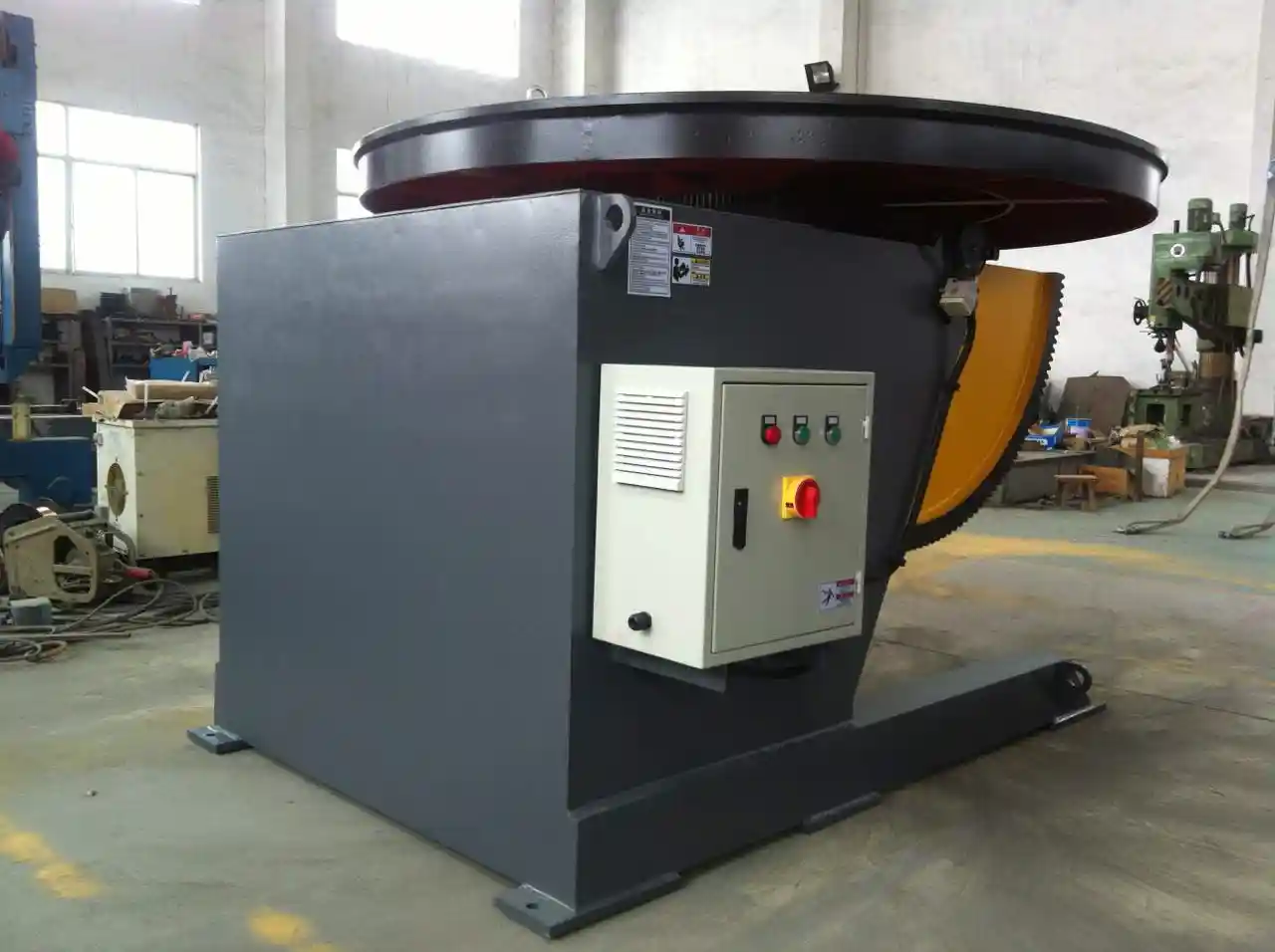
These features make consistent CWB-certified fabrication achievable. For example, the WUXI ABK 5-Ton Fixed Height Welding Positioner (model HBJ-50) incorporates a cycloidal-worm dual-stage reducer that maintains tilt stability under full load, while the conductive slip rings permit continuous rotation without cable entanglement—a practical detail that prevents shutdowns mid-weld and the defects that would follow. Similarly, our manipulador de soldaduras achieve ±0.1 mm/m positioning accuracy on the boom travel, which means the electrode extension remains constant throughout long longitudinal seams, an important factor in avoiding lack-of-fusion flaws in SAW applications.
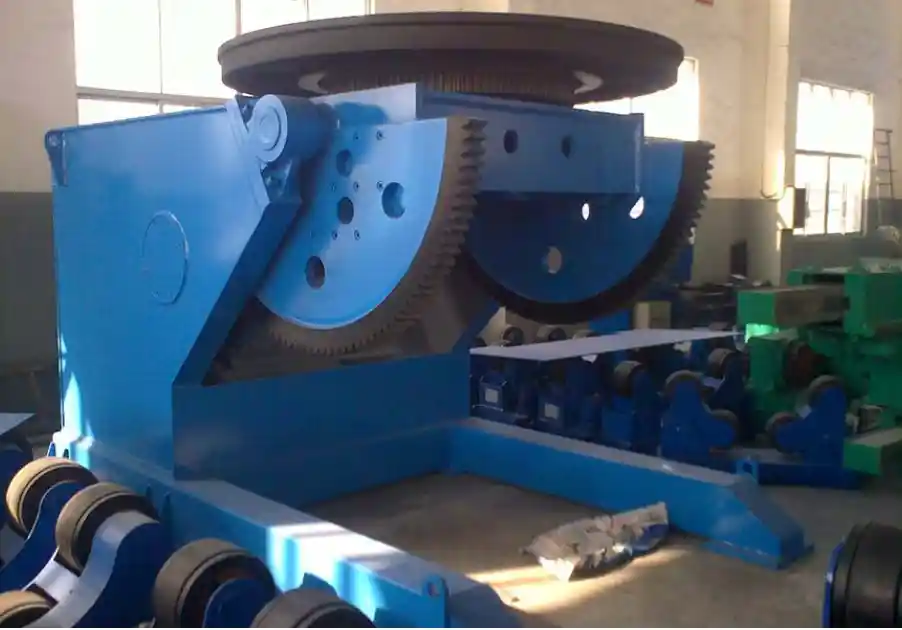
When evaluating equipment for CWB work, do not overlook the gear train and motor response. A backlash-free worm gear set keeps rotation drift-free after the arc strikes. ABK’s use of SEW reducers and THK linear guides in our 3-axis positioners delivers this zero-backlash performance, maintaining the precise position needed for automatic orbital welding on pipes and flanges.
Automating Welding for Consistent Certification Results
Beyond simple rotation, true welding automation through manipulators and integrated turning rolls locks in a repeatable process. Once a weld procedure is qualified, the goal is to reproduce it exactly, time after time. Welding manipulators with motorized vertical and horizontal travel let the operator set the exact head position and travel speed, then let the machine execute the weld. This is far more reliable than relying on a hand-held electrode, especially on long joints. With optional seam tracking and real-time monitoring, the system adjusts for minor misalignments without straying from the qualified procedure range. In my experience, shops that automate their longitudinal and circumferential welding with a manipulator-rotator combination consistently score higher on CWB surveillance audits because the process is documented and repeatable. It also reduces dependence on finding and retaining highly skilled manual welders, an increasing challenge in our industry.
Taking the Next Step Toward CWB Certification
Many fabricators reach out to us because they are unsure whether their existing equipment will hold up under CWB scrutiny. They have the welder certifications and the paperwork, but the actual weld quality varies from one part to the next. This uncertainty can delay certification and limit access to lucrative Canadian and international projects. The solution begins with a realistic assessment of your positioning and automation setup. WUXI ABK has been supplying precision welding equipment for over twenty years, and we understand the connection between machine accuracy and code compliance. I invite you to send your part specifications, material grades, and welding process details to jay@weldc.com. We will review your application and recommend a positioner, rotator, or manipulator configuration that delivers the consistency CWB requires. A call to +86-13815101750 for a technical consultation is also welcome.
Common Questions About Equipment and CWB
Does CWB certification require specialized welding equipment?
CWB does not mandate specific brands or models. The equipment must be capable of producing welds that meet the acceptance criteria in CSA W59 consistently. In practice, this means the welding positioner or rotator must offer sufficient accuracy and repeatability. Shops relying on worn-out manual positioners often struggle with defect rates during certification testing. Upgrading to a precision positioner with documented accuracy specifications simplifies the validation process.
Can I use manual welding techniques for CWB certified fabrication?
Manual welding is permitted; the welder must pass performance qualification tests for each procedure and position. The challenge is maintaining that performance over a full production run. Precision positioning equipment reduces the physical demand on the welder and keeps the joint in the optimal position, directly supporting higher first-pass yield. I have seen many shops pass the initial CWB welder qualification but later face non-conformance due to inconsistent manual welding under production conditions. Automating the positioning is a strategic move to sustain certification.
What rotational accuracy do I need in a rotator for CWB structural fabrication?
For structural steel sections under CSA W59, there is no single accuracy requirement, but as a practical guideline, a rotational accuracy of ±1° or better is recommended for heavy sections to maintain the welding position. For pressure vessels or high-restraint joints, ±0.5° provides a greater margin. ABK’s standard positioners offer ±0.5° rotational accuracy, proven in wind tower and boiler panel fabrication shops targeting CWB certification. For a more detailed discussion on selecting rotators, see our Welding Rotator Precision Automation FAQ Guide.
How does WUXI ABK ensure its equipment can support CWB certification?
We design our welding positioners, manipulators, and rotators with repeatability and control as core principles. Siemens PLC systems allow parameter documentation and traceability, which aligns with CWB’s emphasis on quality records. Additionally, our equipment undergoes CE certification and factory acceptance testing under load before shipment. For a fabricator aiming for CWB certification, this means the equipment arrives with verified performance data, reducing the variables you must validate during your own qualification process. If your shop is in the early stages of CWB certification and you are uncertain about equipment capability, send us your part drawings and current setup details to jay@weldc.com; we can help identify gaps before they become audit findings.
Se estiver interessado, consulte estes artigos relacionados:
Principais pontos problemáticos e soluções de alta precisão dos posicionadores de soldadura nas indústrias da energia eólica e da construção naval: Análise técnica exaustiva
Valor de aplicação excecional: como os posicionadores de soldadura de altura fixa impulsionam os avanços na indústria offshore e na construção naval (Parte 2)
Welding Rotator Precision Automation for Industrial Fabrication: Expert FAQ Guide
Obtenção de soldaduras perfeitas em tubos de grande diâmetro com equipamento de laminagem profissional
Baixa eficiência na soldadura em grupo de tubagens: como os suportes de rolos inteligentes aumentam a produtividade em 50%
 English
  Español
  Français
  Deutsch
  Português
  Русский