
Petrochemical Tank Welding: Where the Real Challenges Are
Welding large petrochemical storage tanks is not simply a scaled-up plate welding job. A tank is built from a bottom, multiple shell courses, nozzles, manways, and often a fixed or floating roof. The shell courses are rolled from plate, erected, tacked, and welded in sequence. Each step has its own tolerance: roundness, verticality, joint fit-up, and weld profile all affect the final vessel. For tanks built to API 650 [1], shell roundness and weld quality are not only productivity concerns but also code-compliance concerns.
The equipment challenge is that a large steel cylinder cannot be moved easily by crane alone. It must be rotated, supported, and positioned while the welding head moves at a controlled speed. If the rotator capacity is undersized, the shell may creep or sag during welding. If the fit-up system cannot hold two courses in alignment, the girth seam will show mismatch and increase rework. This guide covers the main equipment decisions: manipulador de soldaduras, rotators, positioners, fit-up systems, and automatic girth welding.
Codes, Materials, and Quality Requirements
Equipment selection starts with the governing code and material. API 650 [1] covers welded steel tanks for oil storage. API 653 [2] covers inspection, repair, alteration, and reconstruction of existing tanks. When the vessel stores product under pressure or falls under pressure vessel rules, ASME Section VIII [3] may apply. Welding procedure qualification and welder performance qualification often follow AWS D1.1 [4]. A fabrication shop operating under ISO 3834-2 [5] also needs documented welding quality management.
| Code / Standard | Main Scope | Equipment Implication |
|---|---|---|
| API 650 [1] | Welded tanks for oil storage | Rotators and fit-up systems should maintain shell roundness for code-compliant weld profiles. |
| API 653 [2] | Tank inspection, repair, alteration | Field and shop equipment may be used for partial shell replacement and vertical seam access. |
| ASME Section VIII [3] | Pressure vessels | Positioners and turning rolls for pressurised storage should be selected against vessel weight and diameter. |
| AWS D1.1 [4] | Structural welding code—steel | Welding manipulators and tractors must keep travel speed and arc position stable. |
| ISO 3834-2 [5] | Fusion welding quality requirements | Calibration, procedure documentation, and traceable weld data become part of the equipment scope. |
Material also changes the equipment configuration. Carbon steel tanks generally tolerate conventional submerged arc welding. Stainless steel, lined, or low-temperature tanks require cleaner handling, more controlled heat input, and smoother travel speed. A rotator or manipulator with stepless speed control and stable rotation supports both cases.
Core Welding and Positioning Equipment for Storage Tanks
A practical tank line is built around a few machine groups. A welding manipulator positions the submerged arc welding head over longitudinal and circumferential seams. Welding rotators support and rotate the shell courses. Fit-up rotators align adjacent courses before tack welding. Positioners handle smaller assemblies such as nozzles, flanges, and manways.
At WUXI ABK, the Manipulador de soldadura range includes models with horizontal travel from 1,200 mm to 8,000 mm and vertical travel up to 8,000 mm. The larger LH8080 configuration provides 8,000 mm horizontal travel, 8,000 mm vertical travel, and ±180° column rotation for long shell seams.
The table below shows representative equipment configurations from the product library.
| Tipo de equipamento | Representative Configuration | Key Capacity / Range | Typical Tank Application |
|---|---|---|---|
| Column and boom welding manipulator | LH8080 | 8,000 mm horizontal travel; 8,000 mm vertical travel; ±180° rotation | Longitudinal and circumferential submerged arc welding on large shell sections |
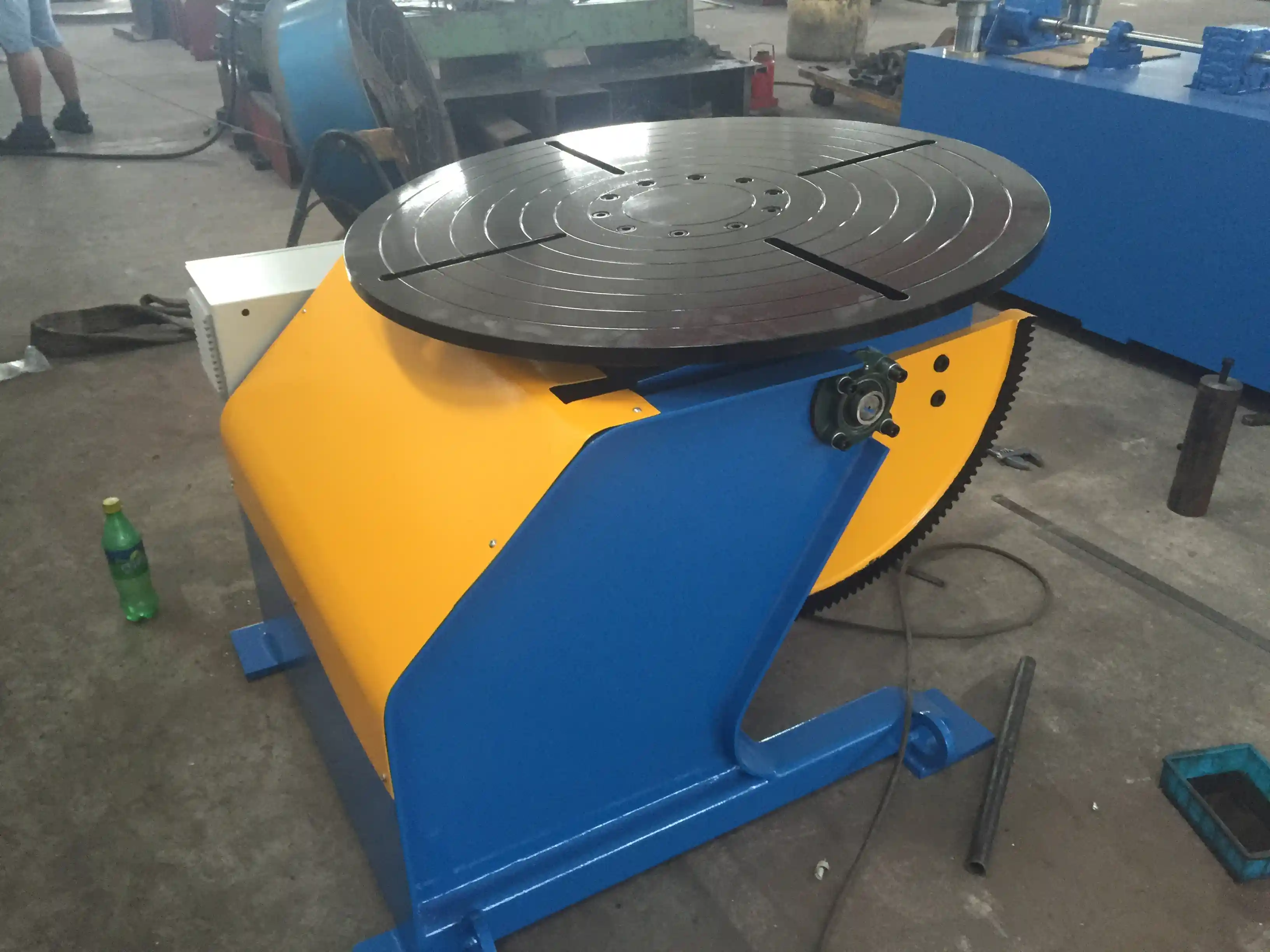
| Adjustable height welding positioner | 100-ton model | 100,000 kg load; 1,800 mm table; 0–135° turnover; 800 mm lifting | Nozzle, manway, and flange positioning |
| Variable height welding roller system | 200-ton model | 800–5,000 mm vessel diameter; 700 mm wheels | Rotating heavy shell courses during girth welding |
| Auto height adjusting welding rotator | 300-ton model | 1,000–6,000 mm vessel diameter; 800 mm wheels | Super-large storage tanks and heavy cylindrical sections |
| Heavy-duty fit-up rotator | 60-ton model | 1.5–6 m workpiece diameter; ±0.5 mm positioning | Course-to-course alignment before welding |
| Pipe fit-up rotator | 40-ton model | 1.5–6 m diameter; 0.1–1.2 m/min stepless speed | Fit-up for pipe, stack, and smaller tank sections |
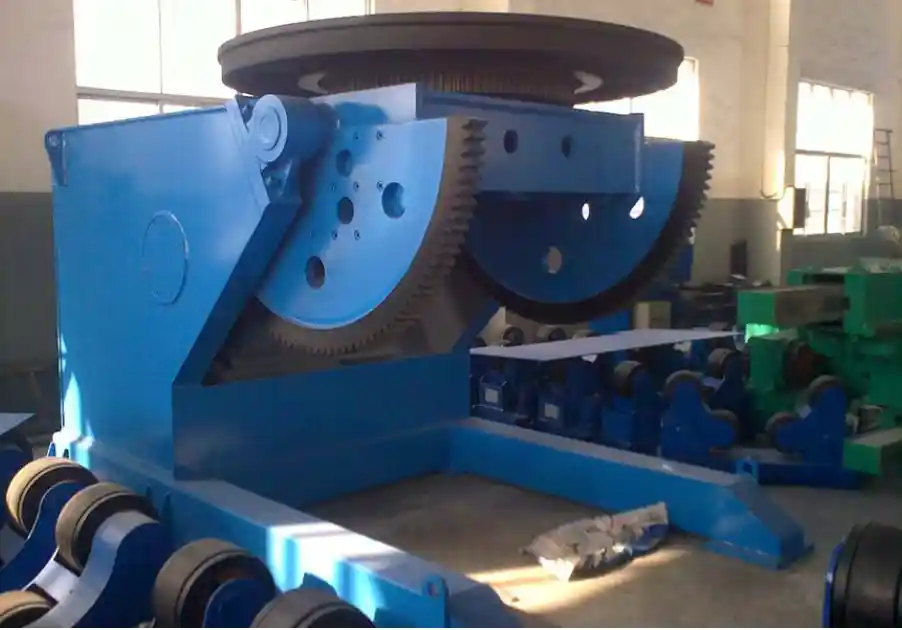
These values are product capabilities, not universal selection limits. The correct configuration depends on the heaviest course, the vessel diameter range, the welding process, and the required rotation speed.
Tank and pressure vessel fabrication often uses the same positioning principles: heavy cylindrical workpieces, limited weld access, and the need for controlled rotation. <Melhorar a Qualidade e a Eficiência no Fabrico de Reservatórios e Recipientes sob Pressão: O principal valor de aplicação dos posicionadores> covers the application value of positioners in this production environment.
Shell Fit-Up, Rotators, and Automatic Girth Welding
Shell construction for large storage tanks normally proceeds course by course. The bottom is welded first, then shell plates are rolled and erected. Vertical seams on each course are often welded with electrogas or vertical submerged arc equipment. Horizontal girth seams are welded with automatic circumferential submerged arc welding. The shell must be kept round and supported during these operations.
For vertical seams, Vertical Electrogas Welding systems provide high-deposition single-pass welding on heavy shell plates. For horizontal seams, Automatic Girth Welding equipment combined with Submerged Arc Welding tractors is common in storage tank fabrication.
The 200-ton variable height roller system supports vessel diameters from 800 mm to 5,000 mm with 700 mm wheels. The 300-ton auto height adjusting rotator extends that range to 6,000 mm. Both use frequency conversion or hydraulic adjustment to maintain centerline alignment. For large tanks, multiple driven and idler sets can be arranged along the shell length.
Rotating shell courses during welding requires controlled speed and low runout, especially when the vessel diameter exceeds several meters. <Rotadores de tubos e rolos de torneamento: Equipamento essencial para o fabrico moderno de condutas> covers turning roll selection and application in cylindrical fabrication.
Fit-up rotators with hydraulic alignment and ±0.5 mm positioning accuracy reduce mismatch before tack welding. The 60-ton fit-up rotator is designed for 1.5–6 m diameter workpieces, while the 40-ton version provides 0.1–1.2 m/min stepless fit-up speed. Precise alignment before welding reduces the weld repair rate and protects the joint from incomplete fusion or excessive reinforcement.
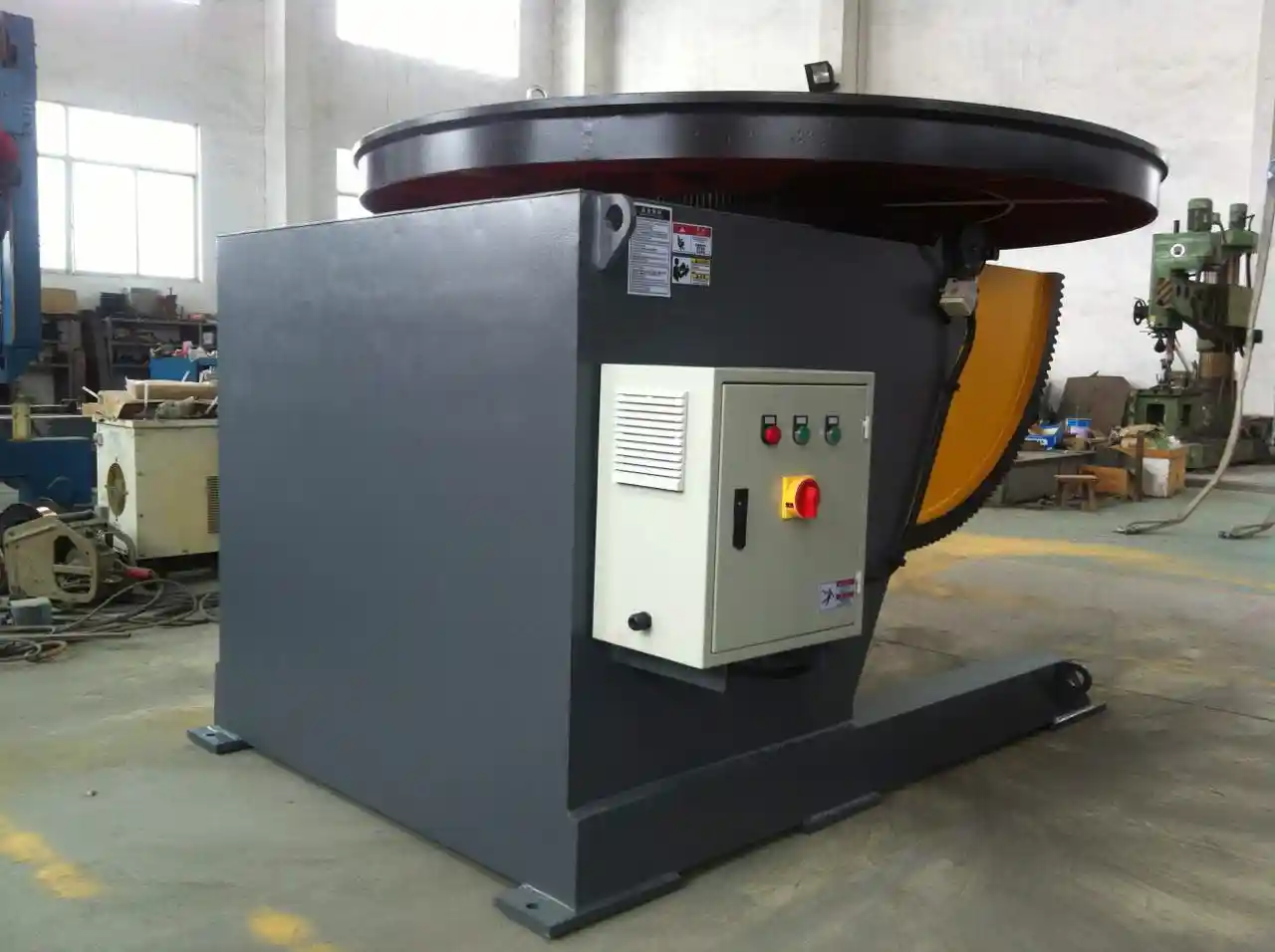
Fit-up accuracy in vessel and pipeline welding has a direct effect on pass rates and rework. <Excessive Misalignment in Pipeline Welding: WUXI ABK Welding Turntable Precision Positioning Solution> covers precision positioning solutions for cylindrical workpieces.
Before moving from equipment selection to full quotation, it helps to define the heaviest shell course and the minimum-maximum diameter range. Send these values to jay@weldc.com and an engineer can check whether the selected rotator and manipulator fit the project envelope.
Equipment Selection Checklist
A focused RFQ should separate the vessel envelope from the weld process. Before requesting a tank welding line quotation, confirm the following values.
| Parâmetro | What to Record |
|---|---|
| Tank diameter range | Minimum and maximum course diameter, including bottom and roof sections |
| Shell course weight | Heaviest assembled course or shell section to be rotated |
| Wall thickness | Thickest plate to be welded, for power and heat input planning |
| Material grade | Carbon steel, stainless steel, or clad; note any PWHT requirement |
| Welding process | SAW, GMAW, FCAW, EGW, or a combination |
| Shop vs field | Whether welding is performed in a workshop or on-site |
| Quality system | ISO 3834, API, ASME, or customer-specific documentation |
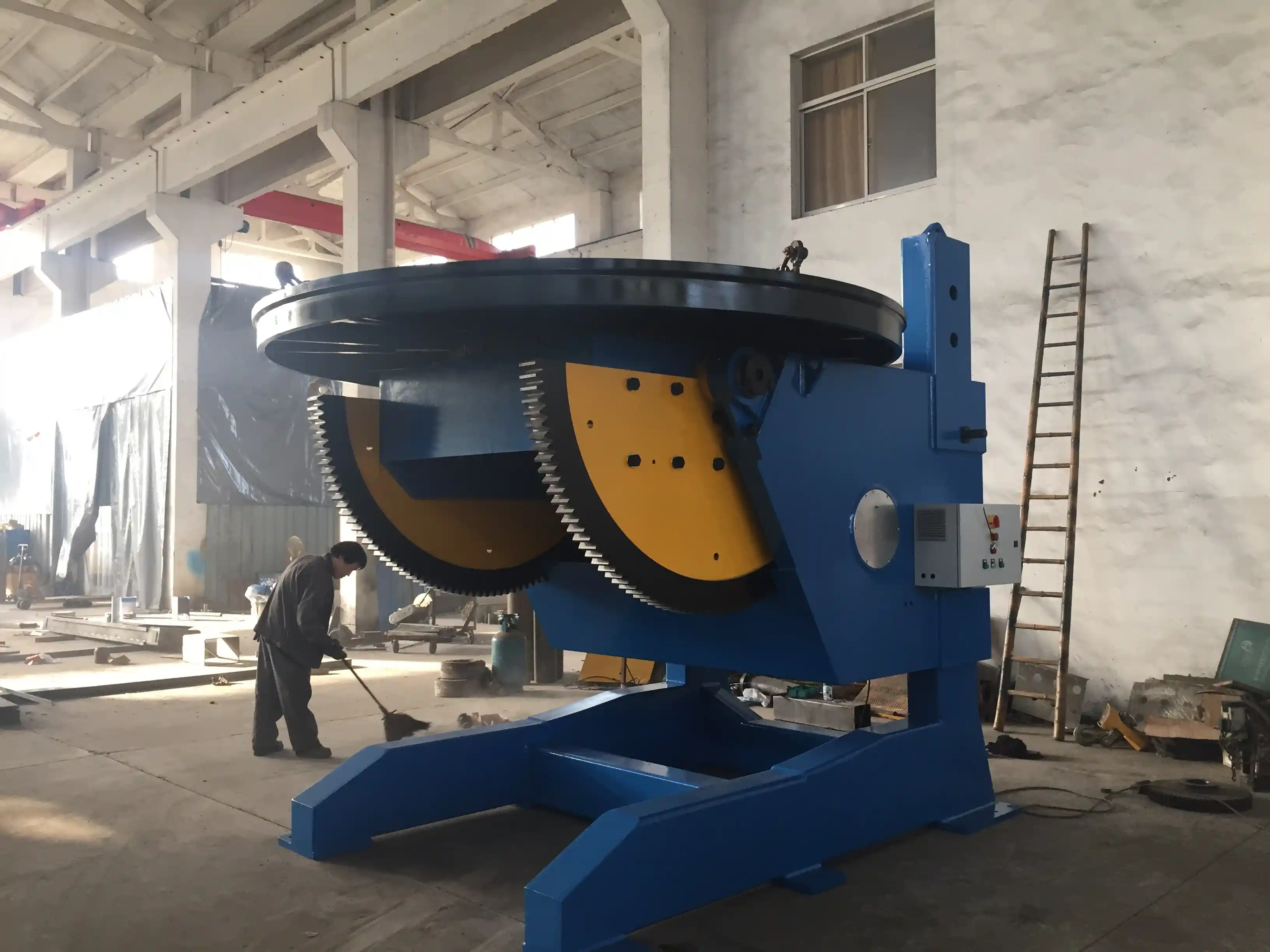
A good equipment proposal starts from these values. The goal is to size the rotator for the heaviest practical load, select the manipulator for the longest reach, and choose fit-up equipment that can hold alignment without excessive crane time.
For project-based shops that build multiple tank sizes, adjustable-height rotators and variable-speed drives offer more flexibility than fixed machines. For high-volume tank farms producing repeated shell diameters, dedicated automatic girth welding stations can reduce cycle time.
Talk to WUXI ABK About Your Tank Welding Line
If you are planning a new petrochemical storage tank line or upgrading an existing shop, send the tank diameter range, shell thickness, material, and required welding process. WUXI ABK can propose a matched combination of rotators, fit-up systems, welding manipulators, and automatic girth welding equipment.
Correio eletrónico: jay@weldc.com
Mobile / WhatsApp: +86-13815101750
Tel: +86-510-83555592
For technical drawings or site layout details, mark the subject line as “Tank Welding Equipment.”
Perguntas mais frequentes
What welding process is most common for petrochemical storage tank girth seams?
Submerged arc welding is widely used for horizontal girth seams because it provides deep penetration and high deposition on carbon steel shell plates. Vertical seams often use electrogas welding or vertical submerged arc welding, depending on shell thickness and project specifications.
How do I choose rotator capacity for a large storage tank?
Size the rotator set for the heaviest individual shell course or assembly, not the complete tank weight. Include a safety margin for fit-up loads, weld metal weight, and temporary attachments. The rotator should also cover the minimum and maximum vessel diameters in the production plan.
Does welding equipment need to be API 650 certified?
API 650 is a tank design and construction code, not an equipment certification scheme. The equipment must be capable of producing welds that meet the code’s tolerances and procedure requirements. CE, ISO 9001, and documented control systems are relevant equipment quality references.
Can the same tank line weld different shell thicknesses?
Yes, if the rotator speed range is stepless and the welding manipulator has sufficient reach and travel. Adjustable-height rotators and multi-program controls allow shops to switch between thin and thick shell courses without rebuilding the station.
What should I send to get an accurate equipment proposal?
Send the tank diameter range, maximum shell course weight, wall thickness, material grade, welding process, and whether the work is shop or field fabrication. A layout drawing or vessel drawing set improves the proposal.
References
- American Petroleum Institute. API 650: Welded Tanks for Oil Storage.
- American Petroleum Institute. API 653: Tank Inspection, Repair, Alteration, and Reconstruction.
- American Society of Mechanical Engineers. ASME Boiler and Pressure Vessel Code, Section VIII, Rules for Construction of Pressure Vessels.
- American Welding Society. AWS D1.1/D1.1M: Structural Welding Code—Steel.
- International Organization for Standardization. ISO 3834-2: Quality requirements for fusion welding of metallic materials.
Se estiver interessado, consulte estes artigos relacionados:
Problemas de escorrimento no revestimento de condutas de navios: como os suportes inteligentes para rolos de pintura aumentam a taxa de aprovação para 98%
Problemas de desalinhamento na soldadura de tubos: como os rotadores inteligentes para soldadura de tubos aumentam as taxas de aprovação dos oleodutos
Manipuladores de soldadura para o fabrico de torres eólicas: Revolucionando a eficiência da produção
Welding Rotator Precision Automation for Industrial Fabrication: Expert FAQ Guide
Como melhorar a qualidade da soldadura de tubos através de um posicionador de soldadura de alta precisão
 English
 Español
 Français
 Deutsch
 Português
 Русский