Running an H-beam welding line day after day teaches you something: the machines tell you when something’s off, but only if you’re paying attention. A slight change in arc sound, a wire feed that hesitates for a fraction of a second, a gas flow gauge that reads just a bit lower than yesterday—these small signals matter. Catching them early keeps production moving and welds clean. Missing them means scrambling later when a minor issue has become a major repair.
Why Daily Inspections Determine Whether Your H-Beam Welding Line Thrives or Struggles
Daily inspections of an H-beam welding line aren’t paperwork exercises. They’re the difference between predictable output and expensive surprises. A worn contact tip that goes unnoticed for a week doesn’t just wear further—it destabilizes the arc, introduces porosity, and forces rework on welds that should have been right the first time. A partially clogged gas nozzle creates shielding gaps that contaminate the weld pool with atmospheric nitrogen and oxygen, weakening the joint at a molecular level.
The financial math is straightforward. Unscheduled downtime on an H-beam welding line typically costs several times more than scheduled maintenance because it disrupts production schedules, delays deliveries, and often requires emergency parts sourcing at premium prices. Early detection through daily inspection procedures converts potential crises into routine maintenance tasks.
Beyond economics, there’s the safety dimension. Malfunctioning equipment creates hazards—electrical faults, gas leaks, unexpected movements from material handling systems. A well-maintained H-beam welding line protects the people operating it while producing consistent, structurally sound H-beams that perform as designed in their final applications.
Complete Daily Inspection Checklist for H-Beam Welding Line Components
A structured checklist prevents the human tendency to skip steps when time pressure builds. Every component in an H-beam welding line has failure modes, and systematic inspection catches problems across all of them.
Pre-Operation Checks for Power, Gas, and Material Feed Systems
Before the first arc strikes, these checks establish baseline readiness:
Electrical connections need visual inspection for tightness and physical damage. Loose connections create resistance, which generates heat and voltage drops that affect weld parameters. Gas lines and regulators require leak checks—a simple soap solution test reveals bubbles at connection points. Confirm supply pressure and flow rates match the welding procedure specifications for the day’s work.
The material handling system deserves particular attention. Conveyors must track straight, and clamping mechanisms need to grip without slipping. Misaligned H-beams produce misaligned welds. Check that the wire feeder operates smoothly by running it briefly without welding—listen for any hesitation or grinding sounds that indicate drive roll wear or liner problems. Examine the welding torch assembly: nozzle, contact tip, and diffuser should be clean and properly seated.
Post-Operation Checks for Cleaning and Wear Assessment
End-of-shift inspections catch wear that developed during production:
Remove all welding slag, spatter, and debris from the machine and work area. Accumulated spatter on the welding torch restricts gas flow and causes arc instability on subsequent shifts. Examine components for wear indicators—abrasions on wire guides, cracks in insulators, deformation of contact tips. Lubricate moving parts following manufacturer specifications; over-lubrication attracts debris while under-lubrication accelerates wear. Verify cooling systems maintain proper flow and adequate coolant levels.
| Componente | Daily Check Item | Potential Issue | Impact on H-Beam Production |
|---|---|---|---|
| Wire Feeder | Wire tension, drive rolls, liner condition | Birdnesting, inconsistent feed | Porosity, lack of fusion, arc instability |
| Welding Torch | Contact tip, nozzle, diffuser, cable integrity | Spatter buildup, wear | Poor gas shielding, erratic arc, poor weld quality |
| Fonte de energia | Cable connections, indicator lights, cooling | Overheating, voltage drops | Inconsistent weld parameters, equipment damage |
| Gas System | Leaks, pressure, flow rate, hose condition | Insufficient shielding | Porosity, atmospheric contamination |
| Material Handling | Clamps, rollers, alignment | Misalignment, jamming | Poor fit-up, structural distortion |
| Fume Extraction | Filter condition, airflow, duct integrity | Reduced suction | Health hazards, poor visibility |
Recognizing Early Warning Signs That Prevent Welding Defects
Equipment rarely fails without warning. The challenge is recognizing what the warnings mean and acting before defects appear in finished welds.
Inconsistent wire feeding usually traces back to a worn liner or incorrect drive roll tension. The liner develops grooves over time that create friction points, causing the wire to hesitate or surge. This shows up as porosity or lack of fusion in the weld because the arc length fluctuates unpredictably. Arc instability can stem from multiple sources: a contact tip that’s worn oval instead of round, gas shielding that’s inadequate due to a kinked hose or low cylinder pressure, or power source fluctuations from loose connections.
Watching the weld pool provides immediate diagnostic information. A pool that’s too fluid suggests excessive heat input; one that’s sluggish indicates insufficient current or contaminated base material. Unusual sounds during welding—popping, crackling, or irregular humming—signal problems that visual inspection alone might miss.
Porosity prevention starts with proper gas flow, but also requires clean base materials and correct electrode selection for the steel grade being welded. Undercutting responds to adjustments in travel speed, voltage, and wire stick-out distance. Systematic troubleshooting based on observed symptoms minimizes the trial-and-error that wastes time and materials.
For deeper insights into refining your welding operations and avoiding common pitfalls, consider reading 《Solução revolucionária para a soldadura de vasos de pressão: Análise técnica de posicionadores de soldadura rotativos de 360 graus》.
Safety Standards and Regulatory Requirements for H-Beam Welding Operations
Safety in H-beam welding operations isn’t optional, and the regulations exist because the hazards are real.
Personal Protective Equipment requirements are non-negotiable: safety glasses, welding helmets with appropriate shade lenses, heat-resistant gloves, and protective footwear. Before inspecting any internal component, lockout/tagout procedures must be implemented completely. A partially locked-out machine can still injure or kill if someone inadvertently energizes it.
Emergency shutdown systems require regular testing to confirm they actually work when needed. Safety interlocks on guards and access panels should prevent operation when panels are open. Compliance with welding quality standards protects workers during production and ensures the structural integrity of fabricated H-beams in their final applications—bridges, buildings, industrial structures where failure has serious consequences.
Safety culture means every team member accepts responsibility for identifying and reporting potential hazards, even when it’s inconvenient or might slow production temporarily.
Calibration Checkpoints That Maintain H-Beam Welding Equipment Precision
Calibration ensures that the numbers on displays match what’s actually happening at the arc. Drift in calibration accumulates gradually, so welds can degrade slowly enough that the change isn’t obvious until quality problems become significant.
Voltage and current sensors directly control arc characteristics and heat input. A sensor reading 5% high means actual heat input is 5% lower than intended, affecting penetration and fusion. Wire feed speed calibration maintains consistent material deposition—critical for achieving specified weld sizes and mechanical properties.
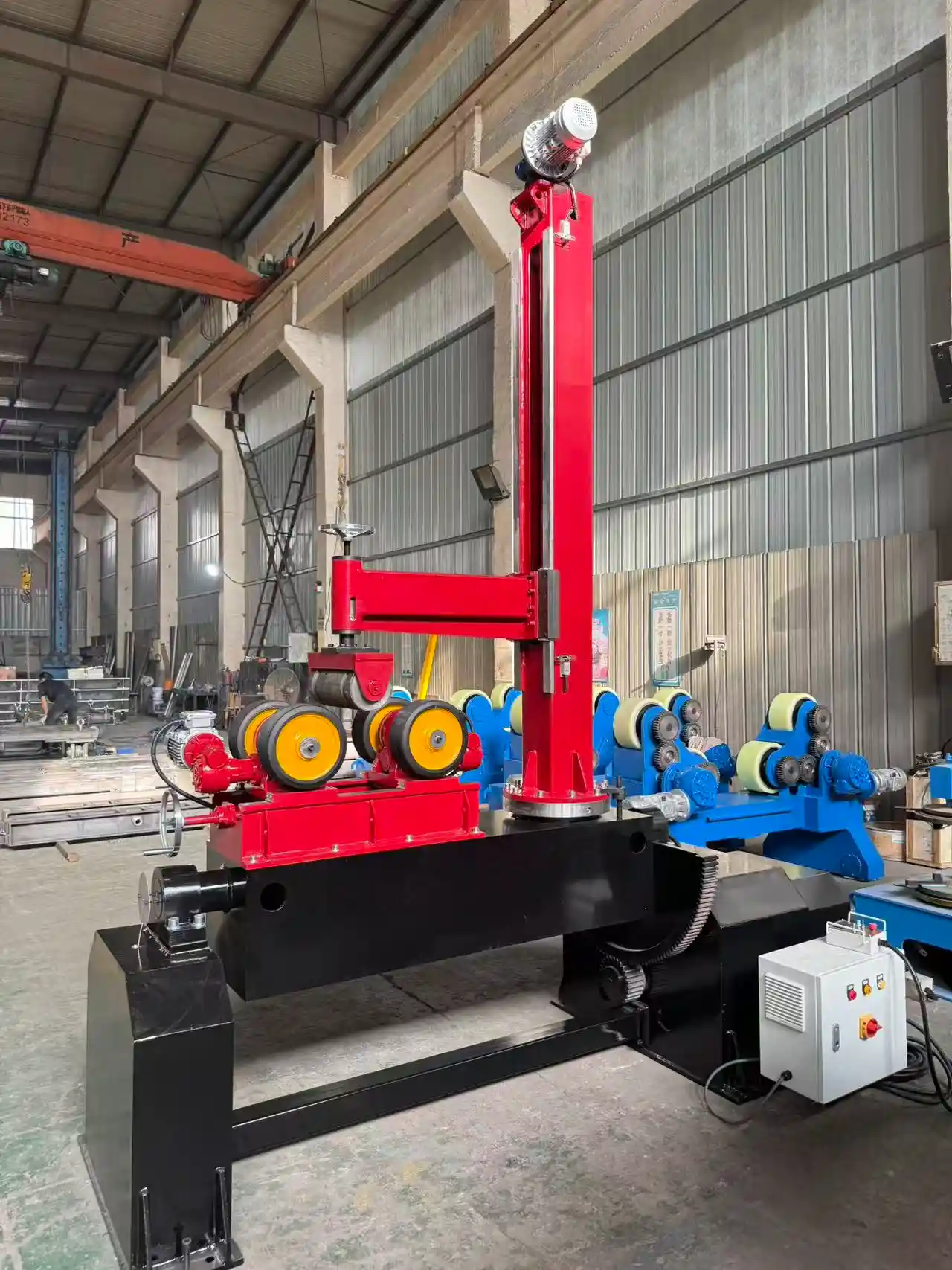
Gas flow meters need calibration to guarantee the shielding gas coverage that prevents porosity. A meter reading correctly at installation may drift over months of use. Robotic welding systems, including those compatible with the WUXI ABK 3-Ton 3-Axis Welding Positioner and Triple Axis Positioner, require precise calibration of motion axes to maintain ±0.05 mm positioning accuracy and 0.02 mm repeatability. Without this precision, weld seams don’t track correctly and joint coverage becomes inconsistent.
| Calibration Point | Parameter Measured | Impacto na qualidade da soldadura | Recommended Frequency |
|---|---|---|---|
| Voltage/Current | Arc voltage, welding current | Penetration, bead profile, spatter control | Trimestral |
| Wire Feed Speed | Wire delivery rate | Deposition rate, fusion, bead consistency | Mensal |
| Gas Flow | Shielding gas volume | Porosity prevention, atmospheric contamination | Weekly |
| Torch Alignment | Tool center point (TCP) | Weld seam tracking accuracy, consistent joint coverage | Bi-weekly |
| Travel Speed | Welding speed | Heat input, penetration, distortion control | Mensal |
| Positional Accuracy | Robotic arm/positioner | Joint fit-up, repeatability, dimensional precision | Trimestral |
How Consistent Daily Inspection Extends Equipment Life and Maximizes Performance
The connection between daily inspection and equipment longevity isn’t theoretical. Tracking maintenance records across installations shows clear patterns: equipment receiving consistent daily inspection procedures typically achieves 30% longer service life compared to equipment maintained only when problems become obvious.
Unplanned downtime reductions of 85% are achievable when daily inspections catch issues early. A bearing that’s starting to wear makes noise before it seizes. A cable with damaged insulation shows visible signs before it shorts. A cooling system with low flow still cools, just not as effectively—until the day it can’t keep up with heat load and the power source shuts down on thermal overload.
Equipment operating at peak efficiency consumes less energy per weld and wastes less material through defects and rework. The return on investment from daily inspection procedures compounds over time, delivering both immediate benefits in consistent production and long-term benefits in reduced capital replacement costs. The 1-Ton Fixed Height Welding Positioner, for example, demonstrates measurably longer service intervals when maintained through systematic daily checks.
We also recommend reviewing 《Valor de aplicação excecional: Como os posicionadores de soldadura de altura fixa impulsionam os avanços no fabrico offshore e de construção naval》 for further insights into optimizing your equipment.
Partner with WUXI ABK MACHINERY CO., LTD for Advanced H-Beam Welding Solutions
Established in 1999, WUXI ABK MACHINERY CO., LTD manufactures high-quality welding equipment and CNC cutting machines, including H-beam welding lines designed for demanding production environments. Our engineering team provides consultation on optimizing welding processes, enhancing equipment performance, and selecting the right solutions for specific fabrication requirements. Contact our specialists to discuss your H-beam welding line needs. Mobile: +86-13815101750 | Email: jay@weldc.com
Frequently Asked Questions About H-Beam Welding Line Inspections
What are the most common failure points in an H-beam welding line?
Wire feed mechanisms fail most frequently because they handle continuous mechanical stress and accumulate debris from the welding environment. The wire liner wears internally, drive rolls develop grooves, and tension springs lose calibration. Welding torches rank second—contact tips erode from arc heat and electrical current, nozzles accumulate spatter that restricts gas flow, and cables flex repeatedly until conductors break internally. Power source issues typically involve cooling system degradation or connection loosening from thermal cycling. Material handling systems fail at clamping mechanisms and alignment guides where repeated loading creates wear.
How often should H-beam welding equipment be calibrated?
Calibration frequency depends on usage intensity and the specific parameter being measured. Gas flow meters benefit from weekly verification because they directly affect weld quality and drift is common. Wire feed speed and torch alignment warrant monthly or bi-weekly checks respectively. Voltage and current sensors, along with positional accuracy for robotic systems, can typically follow quarterly schedules unless production data suggests drift is occurring faster. Manufacturer recommendations provide baseline guidance, but actual calibration needs should be adjusted based on observed weld quality trends and equipment age.
What safety precautions are essential during welding line inspection?
Lockout/tagout procedures are the most critical safety requirement—more inspection injuries result from unexpected equipment energization than any other cause. Complete lockout means all energy sources, not just the main power disconnect. Wear appropriate PPE including safety glasses even when not welding, because inspection often involves cleaning operations that can propel debris. Be aware of stored energy in springs, pneumatic systems, and elevated components. Hot surfaces remain hazardous for extended periods after welding stops. Pinch points exist throughout material handling systems and should be identified before reaching into mechanisms.
 English
  Español
  Français
  Deutsch
  Português
  Русский