
Getting a steel fabrication line to run well takes more than just buying good equipment. The real gains come from how cutting, welding, and assembly work together as a system. Each stage feeds into the next, and problems at one point ripple through everything downstream. When the integration works, you see it in the numbers: less scrap, faster turnaround, and structures that hold up under inspection.
Precision Cutting Technologies in Steel Fabrication
Precision cutting sets the tone for everything that follows. A part cut wrong means rework at the welding station or worse, a fit-up that never quite comes together. The choice of cutting method depends on what you’re working with and what tolerances you need to hit.
CNC plasma cutting handles a wide range of steel thicknesses at speed, leaving clean edges without excessive heat distortion. Laser cutting steel works better for intricate shapes and thinner stock, often producing edges clean enough to skip secondary finishing entirely. Oxy fuel cutting still earns its place for thick plates where the other methods struggle or become cost-prohibitive. Plate processing machinery that combines cutting with drilling and marking in one automated sequence eliminates the handling steps that eat up time and introduce errors.
Automated Material Handling for Cutting Efficiency
Moving material by hand slows everything down and puts people in harm’s way. Automated loading systems and conveyor systems fabrication keep plates flowing to cutting stations and finished parts moving to the next process without waiting for someone to drive a forklift. The result is fewer bottlenecks, steadier throughput, and operators who can focus on running the equipment rather than wrestling with steel.
Software Integration for Optimized Cutting Paths
CAD/CAM software fabrication makes the difference between acceptable material utilization and genuinely good yields. Nesting optimization arranges parts on a sheet to squeeze out every usable square inch, and production planning software keeps the schedule tight by managing inventory and predicting what’s needed before it becomes a problem. The scrap pile tells you how well this is working.
| Cutting Technology | Speed (m/min) | Precision (mm) | Material Range (Thickness) |
|---|---|---|---|
| CNC Plasma Cutting | 1-10 | ±0.5 | 3mm – 50mm |
| Laser Cutting | 5-20 | ±0.1 | 0.5mm – 25mm |
| Oxy Fuel Cutting | 0.1-1 | ±1.0 | 20mm – 300mm |
Advanced Welding Solutions for Structural Integrity
Welding determines whether a structure performs as designed or becomes a liability. The joint quality you achieve depends on matching the right process to the application and maintaining consistency across thousands of welds.
Robotic welding cells remove the variability that comes with fatigue and human inconsistency, producing repeatable results shift after shift. Submerged arc welding (SAW) delivers the deposition rates and penetration needed for heavy plate work. Gas Metal Arc Welding (GMAW) and Flux-Cored Arc Welding (FCAW) cover the middle ground, adapting to various thicknesses and positions. Welding quality control built into the process catches problems before they become expensive.
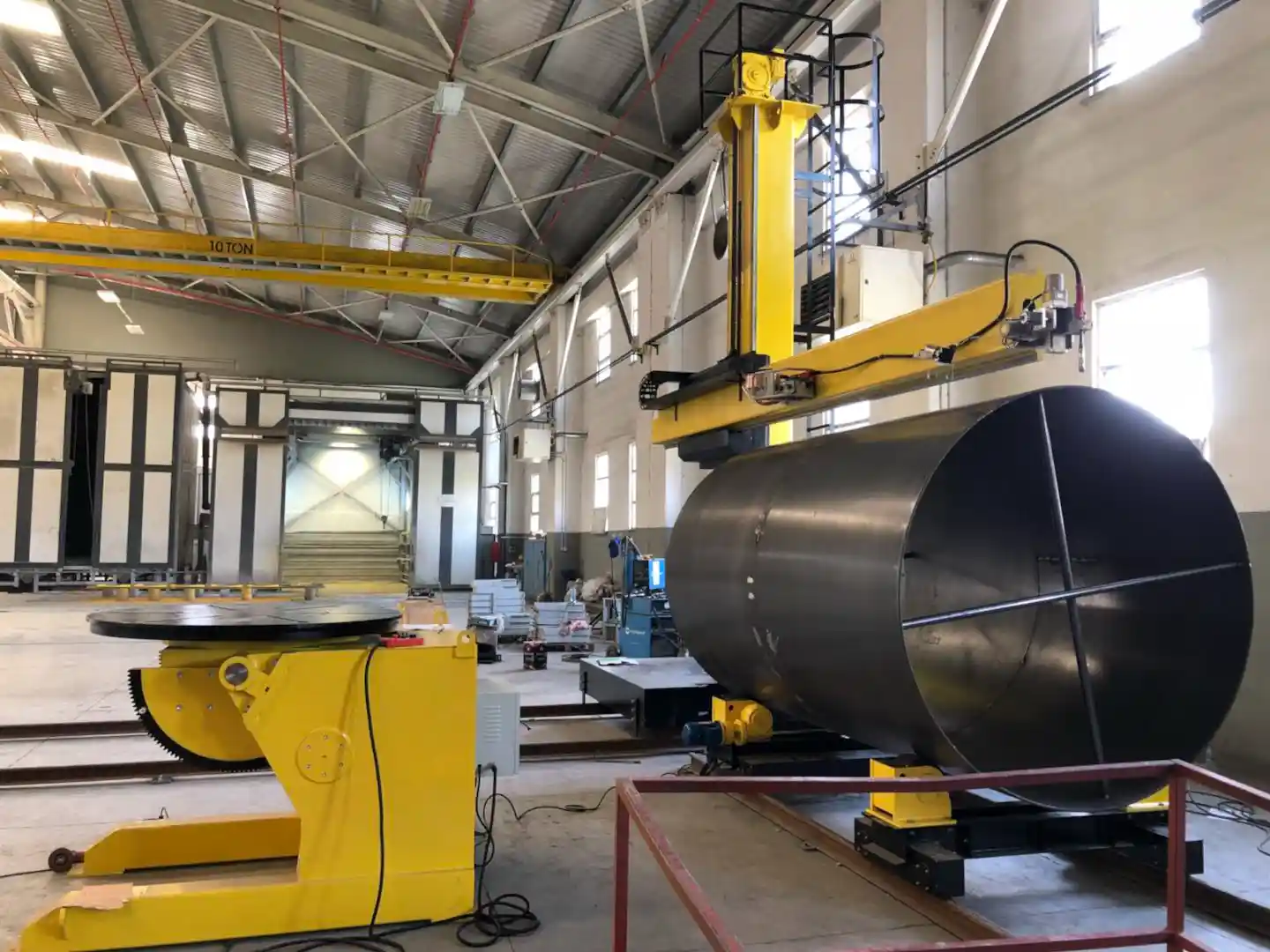
Specialized applications call for specialized equipment. Welding manipulators like the LH8080 model provide 8000mm of horizontal and vertical travel with ±0.1 mm/m positioning accuracy and stepless speed control. This kind of precision matters for boiler fabrication, pressure vessel welding, and wind tower welding where joint quality directly affects service life. Welding positioners such as the 3 Axis Positioner add ±0.05 mm positioning accuracy and 0.02 mm repeatability to automated cells. For related applications, see 《Welding Manipulators for Wind Tower Fabrication: Revolutionizing Production Efficiency》.
Robotic Welding Systems for Enhanced Productivity
Industrial welding robots change the economics of fabrication. Automated welding solutions mean faster cycle times, lower labor costs, and a safer shop floor. The consistency alone justifies the investment for many operations, but the productivity gains compound over time as the system runs without the breaks and slowdowns that human welders need.
Non Destructive Testing in Welding Quality Assurance
NDT welding inspection catches what visual inspection misses. Ultrasonic testing welds reveals internal discontinuities that would otherwise go undetected until something fails. Radiographic inspection provides detailed subsurface imaging for critical joints. These methods cost time and money, but they cost far less than a structural failure.
Streamlined Assembly Processes for Steel Structures
Assembly is where cutting and welding either come together smoothly or expose every upstream shortcoming. Good assembly processes depend on accurate parts and well-designed fixturing.
Modular assembly systems allow pre-assembly of sections in controlled conditions before final erection. This approach reduces on-site labor and compresses project schedules. Fit up stations and jig fixture design maintain dimensional accuracy during assembly, ensuring components align properly before welding locks them in place. Steel structure erection benefits directly from this preparation.
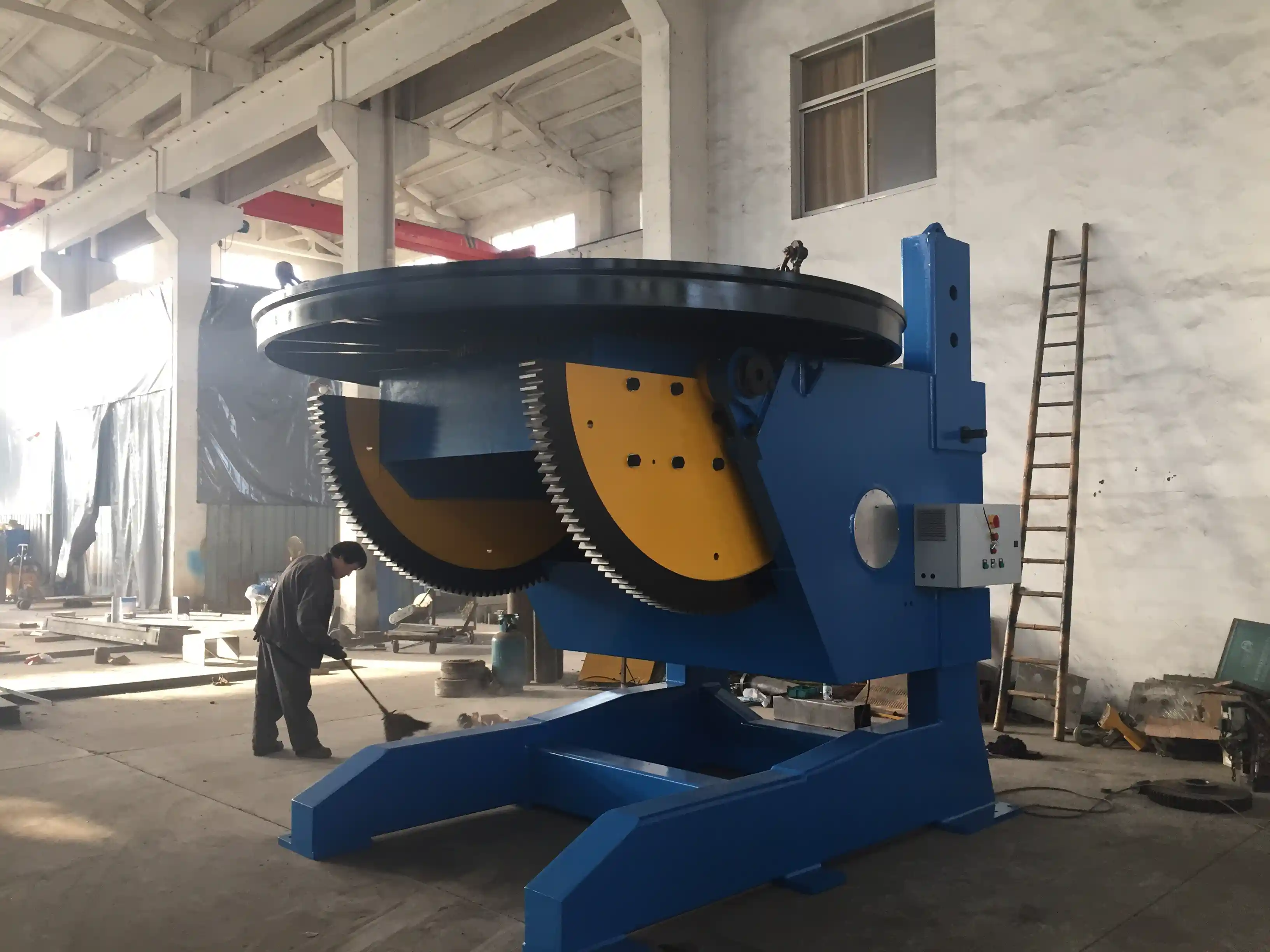
Welding positioners make assembly practical for heavy components. The 1-Ton Fixed Height Welding Positioner (Model HBJ-10) handles 1000 kg loads with ±0.5° rotation accuracy, suitable for excavator booms and wind turbine flanges. The 5-Ton Fixed Height Welding Positioner (Model HBJ-50) manages 5,000 kg with similar precision for pressure vessel fabrication. The WUXI ABK HBT series Head & Tail Welding Positioners provide continuous 360° rotation with ±0.5° accuracy for pipes, shafts, and structural components. For more on positioning applications, see 《Improving Quality and Efficiency in Tank and Pressure Vessel Manufacturing: The Core Application Value of Positioners》.
Modular Construction Techniques in Assembly
Prefabricated steel structures assembled off-site reduce on-site construction time and the logistical headaches that come with field work. Offsite fabrication benefits include better quality control and predictable schedules. The controlled environment of a fabrication shop produces more consistent results than field conditions ever will.
Integrated Quality Control from Cutting to Assembly
Quality control works best when it runs continuously rather than appearing only at the end. In-process inspection catches deviations before they propagate through subsequent operations. Dimensional accuracy checks confirm that parts will fit together as designed. This approach costs less than finding problems during final assembly or, worse, after installation.
Optimizing Fabrication Line Workflow and Automation
Workflow optimization means looking at the entire line as a system rather than a collection of independent stations. Lean manufacturing steel principles help identify where time and material disappear without adding value.
Fabrication process optimization relies on continuous improvement and willingness to change established practices when better methods emerge. Industrial automation solutions reduce manual handling and increase operational speed. The goal is production line efficiency that shows up in output numbers and cost per unit.
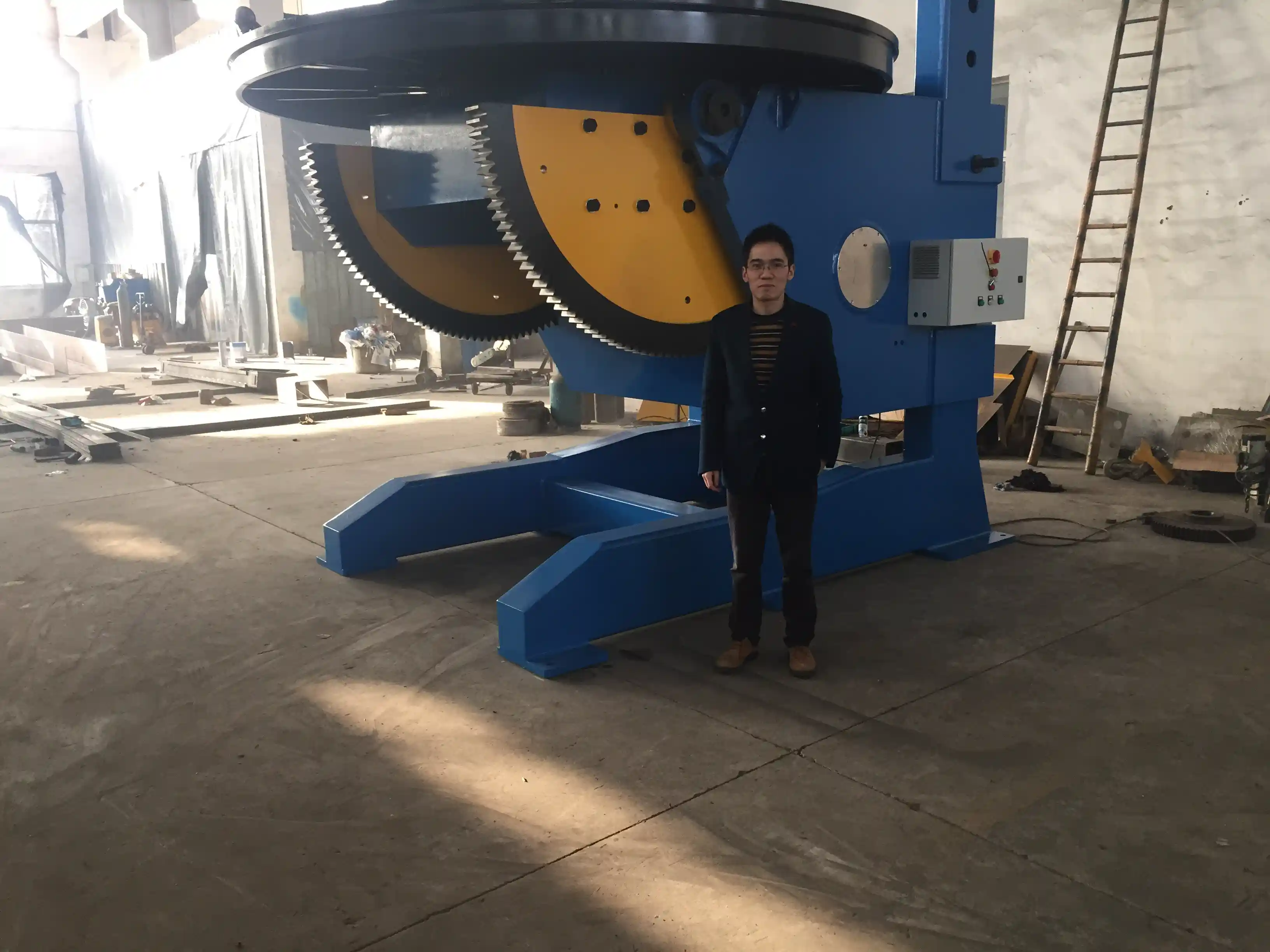
WUXI ABK welding manipulators like the LH8080 model provide the positioning accuracy needed for automated welding of complex joints in heavy steel structures. Welding Turntable Solutions add 360° continuous rotation and precise positioning to automated cells. These technologies contribute measurably to production line efficiency. For related information, see 《Low Efficiency in Pipeline Group Welding: How Intelligent Roller Racks Increase Productivity by 50%》.
Future Trends in Steel Structure Fabrication
The direction of steel fabrication points toward greater integration and smarter systems. The technologies emerging now will reshape what’s possible over the next decade.
Industry 4.0 fabrication connects equipment, sensors, and software into systems that respond to conditions in real time. AI in manufacturing steel enables optimization that would be impractical to achieve manually. Sustainable steel production addresses environmental requirements through energy efficiency and material recycling. Digital twin fabrication creates virtual models that allow simulation and optimization before committing resources to physical production.
| Technology | Impact on Fabrication | Benefits |
|---|---|---|
| Industry 4.0 | Real-time data, predictive maintenance | Increased uptime, optimized resource allocation |
| AI in Manufacturing | Automated decision-making, quality prediction | Reduced errors, improved material yield |
| Sustainable Production | Reduced waste, energy efficiency | Lower environmental footprint, cost savings |
| Digital Twin | Virtual prototyping, performance monitoring | Faster design cycles, proactive problem-solving |
Upgrade Your Fabrication Capabilities
WUXI ABK MACHINERY CO., LTD. provides advanced welding equipment and CNC cutting machines designed to improve your cutting, welding, and assembly processes. We work with fabricators to match equipment to specific production requirements. Contact us at jay@weldc.com or +86-13815101750 to discuss your project needs.
What are the critical stages in a modern steel structure fabrication line?
A modern steel structure fabrication line moves through material preparation (cutting), joining (welding), and component integration (assembly). Each stage requires equipment and processes matched to the work being done. CNC cutting machines and robotic welding systems handle the precision and throughput demands that manual methods struggle to meet consistently.
How do automation and advanced machinery improve fabrication efficiency and precision?
Automation reduces the variability inherent in manual operations. CNC cutting machines produce consistent results regardless of operator fatigue. Robotic welding cells maintain weld quality across production runs. The combined effect is fewer errors, less scrap, and faster completion times. Welding manipulators and positioners extend these benefits to heavy and complex assemblies.
What are the key considerations for selecting cutting, welding, and assembly equipment for steel structures?
Material characteristics, production volume, precision requirements, budget constraints, and integration with existing equipment all factor into equipment selection. The right choice depends on your specific situation rather than general recommendations. We help fabricators evaluate these factors against our welding and cutting machinery capabilities.
 English
  Español
  Français
  Deutsch
  Português
  Русский