The decision to pursue production capacity doubling rarely begins with equipment. It begins with a bottleneck—a welding station that cannot keep pace, a cutting line that finishes shifts early while downstream stations idle, or a sudden contract win that turns a comfortable output target into a daily shortfall. After more than two decades designing welding automation lines for fabricators worldwide, I have learned that the gap between current output and doubled output is never closed by simply ordering a second machine. It is closed by making the right equipment investments in the right sequence, and that sequence almost never matches the purchase list a factory manager drafts on instinct.
What Production Capacity Doubling Requires from Your Equipment
Production capacity doubling forces every piece of equipment to handle double the workpiece flow. A welding manipulator that currently processes four pressure vessel shells per shift may need to handle eight. A CNC plasma cutter that cuts 20 plate sheets per day may need to cut 40. The immediate impulse is to buy faster machines. In practice, the more useful approach is to identify which machines are already running near their mechanical or operator limit and which ones have hidden slack that, when unlocked, can absorb part of the new volume.
For example, our LH8080 welding manipulator with 8000 mm horizontal travel and 0.12–1.2 m/min stepless boom speed can support submerged arc welding at higher deposition rates when paired with a properly sized rotator. If the current rotator is a standard 10-ton unit feeding beveled plates at a constant speed, swapping it for a 20-ton rotator with hydraulic anti-creep control can let the same manipulator weld faster without repositioning delays. That change alone can lift circumferential welding throughput by 30 percent or more without adding a second manipulator. What appears to be a “capacity” problem is often a compatibility problem between adjacent stations.
Matching Welding and Cutting Capacity to Output Targets
When a fabricator tells me they need to go from producing two wind tower sections per day to four, I do not start by recommending specific machines. I start by mapping the work content across every station: the time a workpiece spends on the cutting table, in fit-up, on the positioner, under the welding arc, and in post-weld inspection. Only then does the equipment specification become clear.
| Workpiece Type | Typical Weight | Recommended Positioner | Rotation Accuracy | Key Benefit |
|---|---|---|---|---|
| Wind tower flange | 5–10 tons | 3-Axis Triple Axis Positioner 5T | ±0.05 mm | 360° continuous rotation for full-penetration girth welds |
| H-beam assembly | 2–3 tons | L-Type Positioner LHBJ-30 | ±0.5° | 120° turnover angle for fillet welds without re-rigging |
| Pressure vessel section | 20–60 tons | 30-ton Adjustable Height Positioner | ±0.5° | Hydraulic lift adjusts center of gravity for stable rotation |
| Long pipe spool | 5–10 tons | Head & Tail Positioner HBT-25 | ±0.5° | Supports shafts up to 3000 mm base distance |
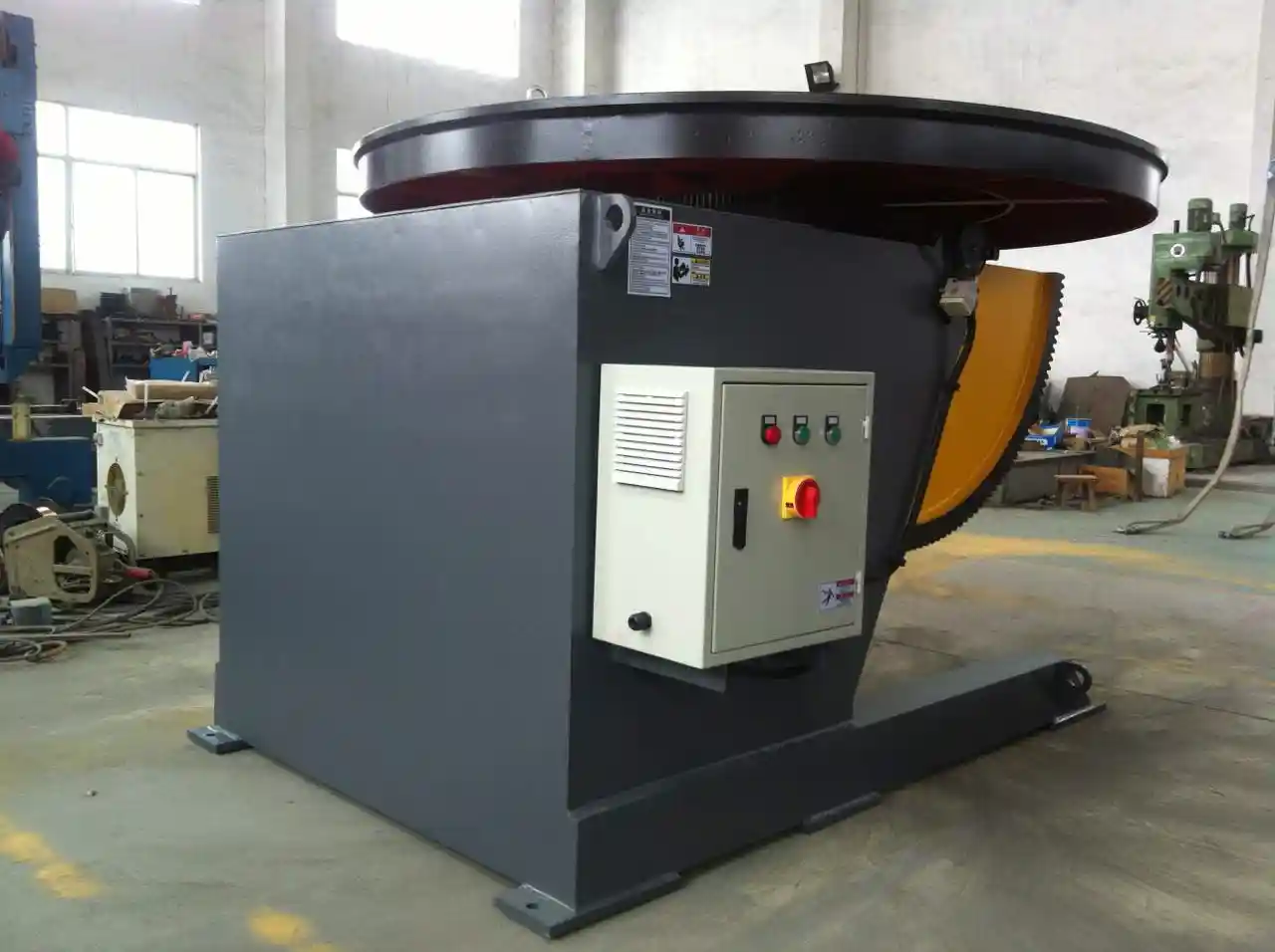
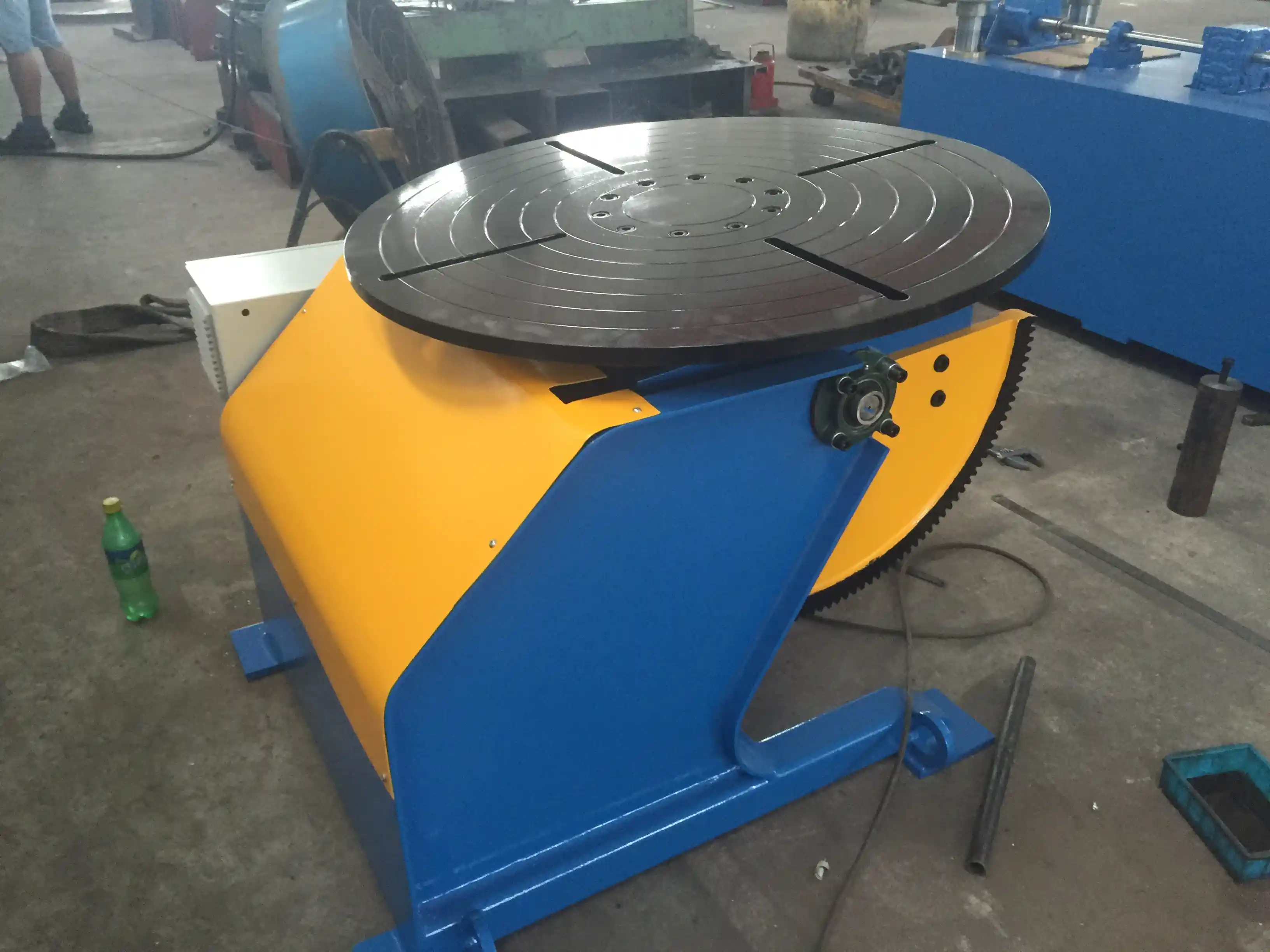
Selecting capacity is not a matter of picking the model with the highest load rating. It is about matching the positioner’s rotational speed range to the welding process speed, ensuring the table diameter accepts the workpiece envelope, and confirming that the turnover angle accommodates the joint geometry. A 5-ton positioner with 0.05–0.5 RPM speed control and ±0.5° accuracy may be sufficient for a 2-ton fabricated frame, but if that frame needs to tilt 135 degrees to reach a hidden bracket weld, a model with only 90 degrees of tilt creates a manual workaround that erases the throughput gain. This is the level of detail that determines whether capacity doubling succeeds or stalls.
The Overlooked Risk: Bottlenecks That Sabotage Doubled Capacity
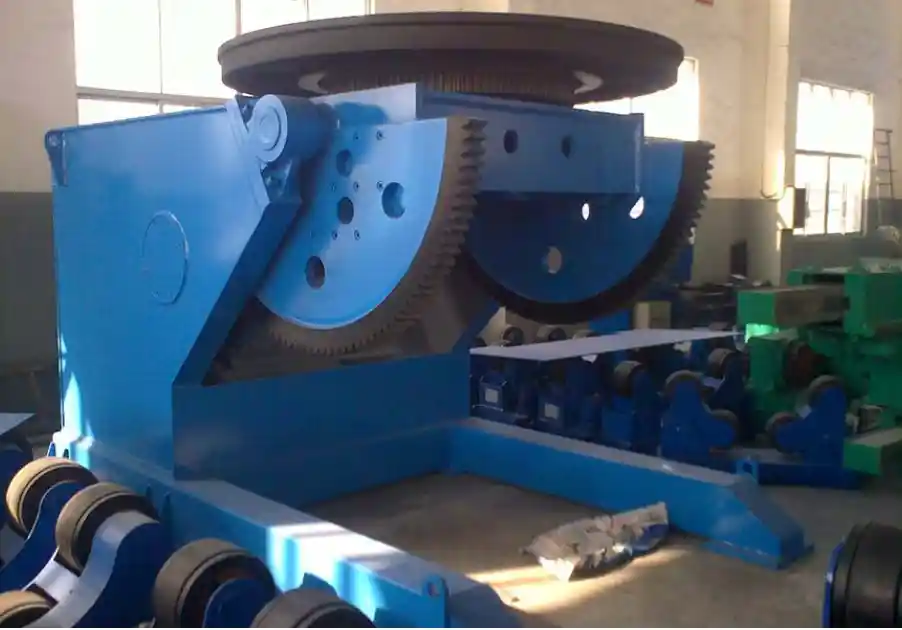
I have walked into fabricator shops where a brand new 20-ton CNC welding rotator sat idle for an hour every shift because the upstream CNC flame cutter could not prep bevels fast enough. The shop had doubled its welding capacity but left its cutting station untouched, and the result was a schedule that repeatedly stopped and started. Doubling production capacity means ensuring that every single operation—cutting, beveling, fitting, welding, inspection—can operate at the increased demand without lagging. If any one of them falls behind, the entire line resets to the speed of the slowest station.
This lesson applies acutely to fabrication lines that mix different machine types. A production line that welds H-beam assemblies with a gantry welding machine and straightens them with a shot blaster and straightening machine must consider whether the straightening process can handle twice the throughput. Often the bottleneck is not welding at all. It is material handling between stations, or the time lost to manual measurement and setup. Integrating a lift fixture or adding a motorized trolley to the welding manipulator can reduce setup time per part from 15 minutes to under five, freeing hours per shift. The investment is modest next to a whole second line, but it removes a hidden constraint that would otherwise cap output at 1.4 times current levels instead of 2.
Customization: Why Off-the-Shelf Machines Rarely Double Output
Production lines are not commodities. The workpiece mix at a pressure vessel shop differs completely from a wind tower plant, even when both need to double capacity. Yet many investment plans start with catalog selections of standard equipment. Over two decades, I have seen the gap between standard machine capability and actual production need grow larger as fabricators serve more varied contracts.
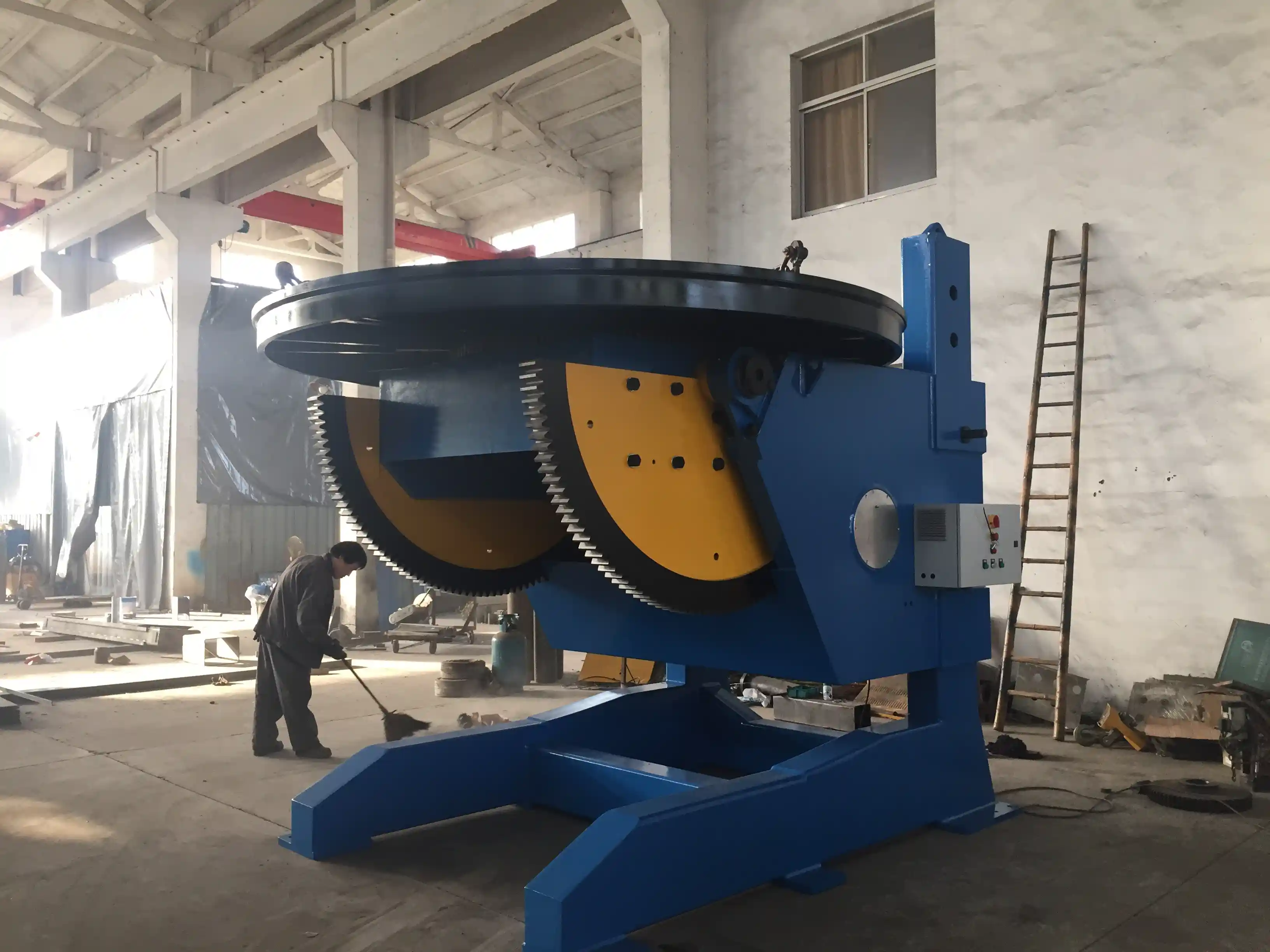
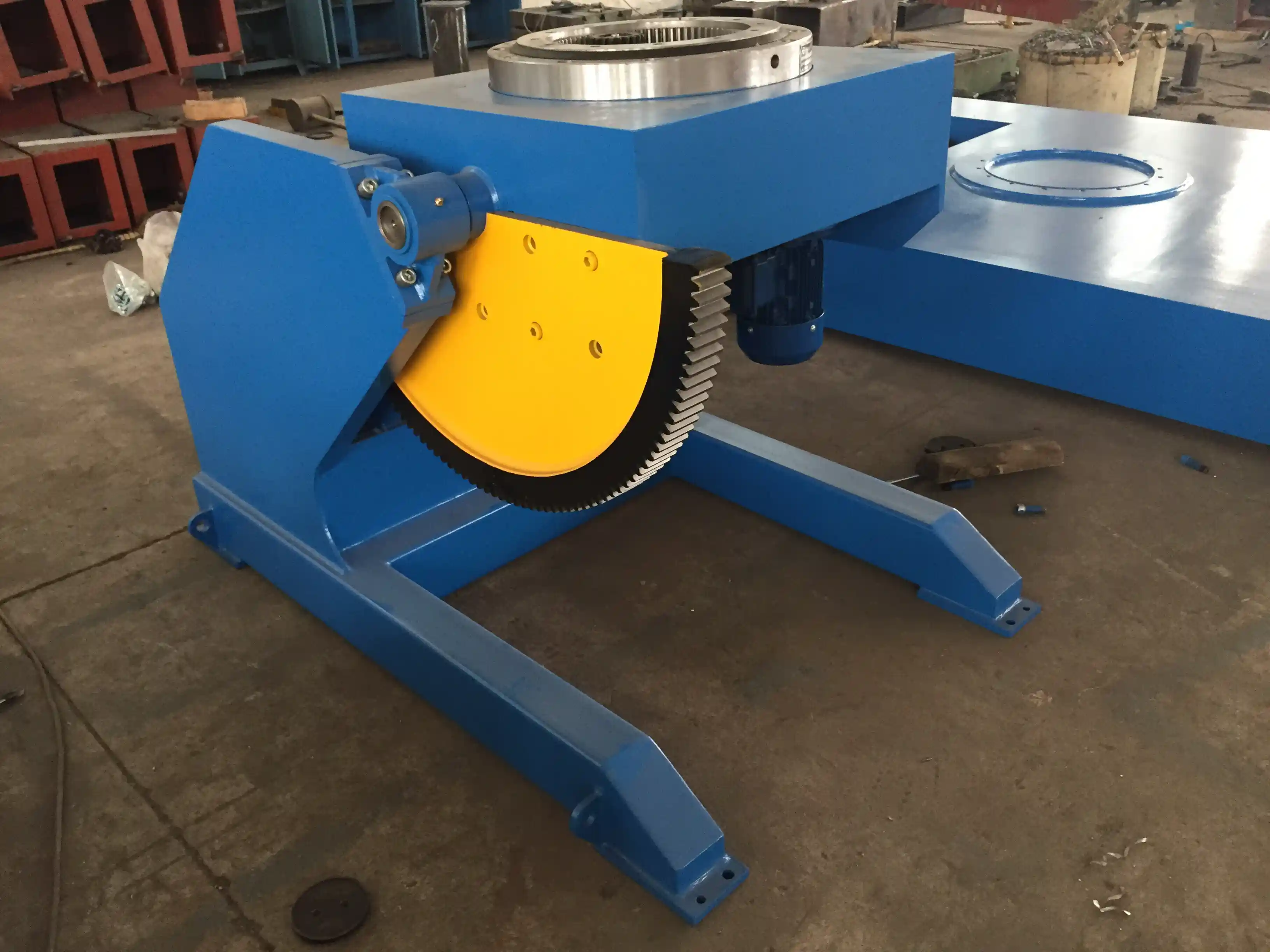
Customization is where the capacity doubling equation balances. A standard 1-ton fixed height positioner might accept a 1200 mm table diameter and turn over 90 degrees, which is fine for batch welding small excavator booms. But if the contract mix includes longer crane segments that require 1500 mm table with 120-degree turnover and an extended L-support, the standard unit cannot physically hold the part. The capacity you gain from a faster welding process is meaningless if the workpiece does not fit.
At our factory, we configure adjustable height positioners from 5 tons to 100 tons, with hydraulic lift ranges of up to 800 mm and table diameters up to 1800 mm. We also set the rotational speed band to match the specific weld procedure specification—using AC frequency drive control with 0.05–0.5 RPM for submerged arc welding thick sections and a slightly higher band for thinner-wall pipe. These adjustments cost little compared to the price of buying a new machine that turns out to be too small after six months of operation, a scenario that repeats far too often in shops that plan equipment investment on headline specifications alone.
Building a Phased Equipment Investment Plan That Works
Production capacity doubling is best approached in phases, because the feedback from each phase sharpens the requirements for the next. A three-phase plan often aligns with a fabricator’s actual order book.
Phase one focuses on the single biggest bottleneck. In many cases that is the welding station with the longest cycle time. Replacing an old fixed-height positioner with an adjustable model that eliminates manual re-positioning can release 10–15 percent more arc-on time immediately. Adding a simple CNC control upgrade to an existing flame cutter can boost plate throughput similarly without a full machine replacement. These targeted moves build both capacity and confidence that further investment will be absorbed efficiently.
Phase two addresses integration: connecting stations with powered trolleys, adding conveyors for beam transfer, and ensuring that the fit-up station can feed the faster welding cell. Our fit-up welding rotators with laser guidance achieve ±0.5 mm alignment accuracy and let one operator prepare twice as many joints compared to manual tack welding methods. This phase often provides the biggest jump in overall line throughput because it converts individual machine gains into system gains.
Phase three introduces scaling: bringing in additional welding manipulators or CNC cutting machines when the phase-one and phase-two gains have been fully harvested. By this point, the factory floor layout, operator training, and material flow have already been proven to handle higher volume, so the new equipment slots in without the disruption that kills the ROI of a big-bang purchase.
Throughout this process, investment decisions need a hard return expectation. When a 5-ton adjustable height positioner reduces repositioning time by 20 minutes per shift and extends arc-on time by one hour, the payback from additional output alone often falls within 18 months of sustained orders—shorter if the freed-up operator time is redirected to other value-adding tasks.
Common Questions About Doubling Capacity Through Equipment Investment
Will doubling capacity require entirely new machines, or can existing equipment be modified?
It depends on the current equipment’s design margin. Many welding manipulators from the last decade were built with sufficient structural stiffness to handle higher amperage processes and faster travel speeds. If the boom’s linear guides and cycloidal reducers remain within their load ratings, upgrading the control system to a Siemens PLC with preset multi-pass programs can lift throughput without replacing the entire column and boom. However, if the workpiece envelope has grown—for example, you now weld longer wind tower sections—the physical reach limitation makes a new manipulator with greater horizontal travel the only viable path. I always recommend checking the manufacturer’s original design margins before assuming replacement is necessary.
How do I handle variation in workpiece sizes when planning for doubled production?
Flexibility must be designed into the load-bearing range, not the table size alone. An adjustable height welding rotator that accepts vessel diameters from 500 mm to 5000 mm, like our HGK-40 with 450 mm ZG45 rollers, lets you process small-diameter pipe sections and large pressure vessel rings on the same frame. Pairing it with a head-and-tail positioner that adjusts center distance gives you a single cell that covers most cylindrical fabrication without re-tooling. The point is to build the flexibility into the equipment from the procurement stage, because retrofitting a larger roller frame later costs more than the initial up-spec.
What if our shop floor cannot accommodate additional equipment?
Space constraints force a different kind of capacity doubling: density instead of footprint. Multi-function machines like the 3-axis positioner that combines rotation, tilting, and turning in one enclosed cell reduce the need for multiple separate fixtures. In one installation, replacing three single-axis turntables with a single 5-ton 3-axis unit freed 40 square meters of floor space while improving weld access from all angles. For beam lines, a welding manipulator with optional 360-degree column rotation can service two workstations from a single rail, effectively doubling output per square meter. Floor space often becomes a justification for higher integration, not a barrier to it.
What after-sales support should I expect when scaling up with complex equipment?
Capacity expansion puts production deadlines on the line. The equipment must be supported with responsive technical service from day one. We provide full electrical documentation, remote diagnostics, and spare parts availability that keeps downtime measured in hours, not days. Our team also supports on-site commissioning to align the equipment with existing line speeds and workpiece schedules, something that a generic machine distributor rarely offers. Before purchasing, verify that the supplier can deliver installation training, control system programming adjustments, and priority service response for the specific models you are installing. This support infrastructure often determines whether the equipment meets production targets within the first quarter of operation.
If we are preparing to double capacity, what information should we share to get an accurate equipment recommendation?
Share your current production layout, typical workpiece range including diameters, lengths, and weights, and your realistic output target per shift. That data plus your available power supply and floor space allow an equipment engineer to recommend a configuration that fits your operation, not a generic catalog. Send your requirements and a sketch of your floor plan to jay@weldc.com or call +86-510-83555592, and we will confirm which machine combinations can hit your throughput number and identify any workflow changes that amplify the investment return.
If you’re interested, check out these related articles:
How to Improve the Quality of Pipe Welding Through a High-Precision Welding Positioner
Pipe Rotators and Turning Rolls: Essential Equipment for Modern Pipeline Fabrication
Revolution in Ship Welding: How Welding Positioners Improve Quality and Efficiency
Excessive Misalignment in Pipeline Welding: Wuxi ABK Welding Turntable Precision Positioning Solution
 English
  Español
  Français
  Deutsch
  Português
  Русский