When a fabrication project requires bending pipe with diameters exceeding 500 millimeters, standard tube bending machines quickly fall short. Large diameter tube bending machines are purpose-built for these heavy wall, large bore applications, such as offshore risers, wind tower internals, and high-pressure piping systems. From my twenty years working with welding automation in heavy fabrication, I have seen how the choice of bending method and equipment directly impacts downstream welding quality and overall project timelines. This article breaks down the key considerations for selecting and integrating large diameter tube bending solutions, with a focus on how bent tube condition affects subsequent automated welding processes.
The Limits of Conventional Tube Bending at Large Diameters
Conventional rotary draw benders and small hydraulic machines operate comfortably below the 200mm range. Push them toward 500mm and beyond, and the physics shifts. The bending moment increases exponentially with diameter, and without sufficient pressure capacity and proper support, you get severe ovality, buckling on the inner radius, and wall thinning that may violate code minimums. I recall a heat exchanger project where a supplier attempted to bend 600mm schedule 80 pipe on an undersized cold bender. The resulting ovality exceeded 8%, and every joint needed an extra hour of fit-up. Large diameter bending equipment must handle high tons of force while maintaining roundness, which means robust frames, multi-axis mandrel support, and often induction heating to soften the material before forming.
Three Methods for Bending 500mm+ Diameter Pipe
There is no single best method. The right choice depends on wall thickness, material grade, and the required bend radius. The three mainstream approaches are summarized below.
| Bending Method | Diameter Range (mm) | Typical Wall Thickness (mm) | Key Applications | Major Advantage |
|---|---|---|---|---|
| Induction bending | 100–1500+ | 10–100 | Pipeline, offshore risers, long-radius bends | Low ovality, tight radii possible |
| Cold roll bending (three-roll) | 200–3000+ | 6–60 | Structural tubes, large vessel piping, wind towers | High capacity, no heating required |
| Rotary draw bending (with mandrel) | 50–500 | 2–25 | Short, precise bends for fittings and elbows | Excellent wall thinning control |
Induction bending dominates when you need a smooth, wrinkle-free bend on thick pipe. Cold roll bending scales to extreme diameters but struggles with tight radii. Rotary draw machines cap out around 500mm, so they sit at the upper edge of the range. In practice, we often see a combination: cold roll for the major bend, then a rotary draw or induction post to refine critical ends.
Critical Specifications for Large Diameter Bending Machines
If your program involves wall thickness over 20mm or bend radii less than 3D, it is worth confirming the machine’s pressure rating and mandrel compatibility before finalizing your BOM. Reach out at jay@weldc.com if you need a second opinion on equipment specs.
When evaluating a large diameter bending machine, four parameters decide whether it will hold tolerance. First, the maximum bending force in tons directly limits the wall thickness and diameter combination. Second, the bend radius range is not just a catalog number; the machine’s arm length and tooling determine the smallest achievable radius without kinking. Third, mandrel support type (ball, plug, or multi-ball) is critical for thin wall pipe; without a mandrel, you cannot control flattening. Fourth, CNC control accuracy, typically within ±0.1°, makes the difference between a good bend and one that needs rework. I have seen a 0.5° angular deviation on a 5-meter bend shift the centerline by over 40mm at the far end, creating a nightmare for the weld fit-up crew.
How Bending Quality Affects Automated Welding
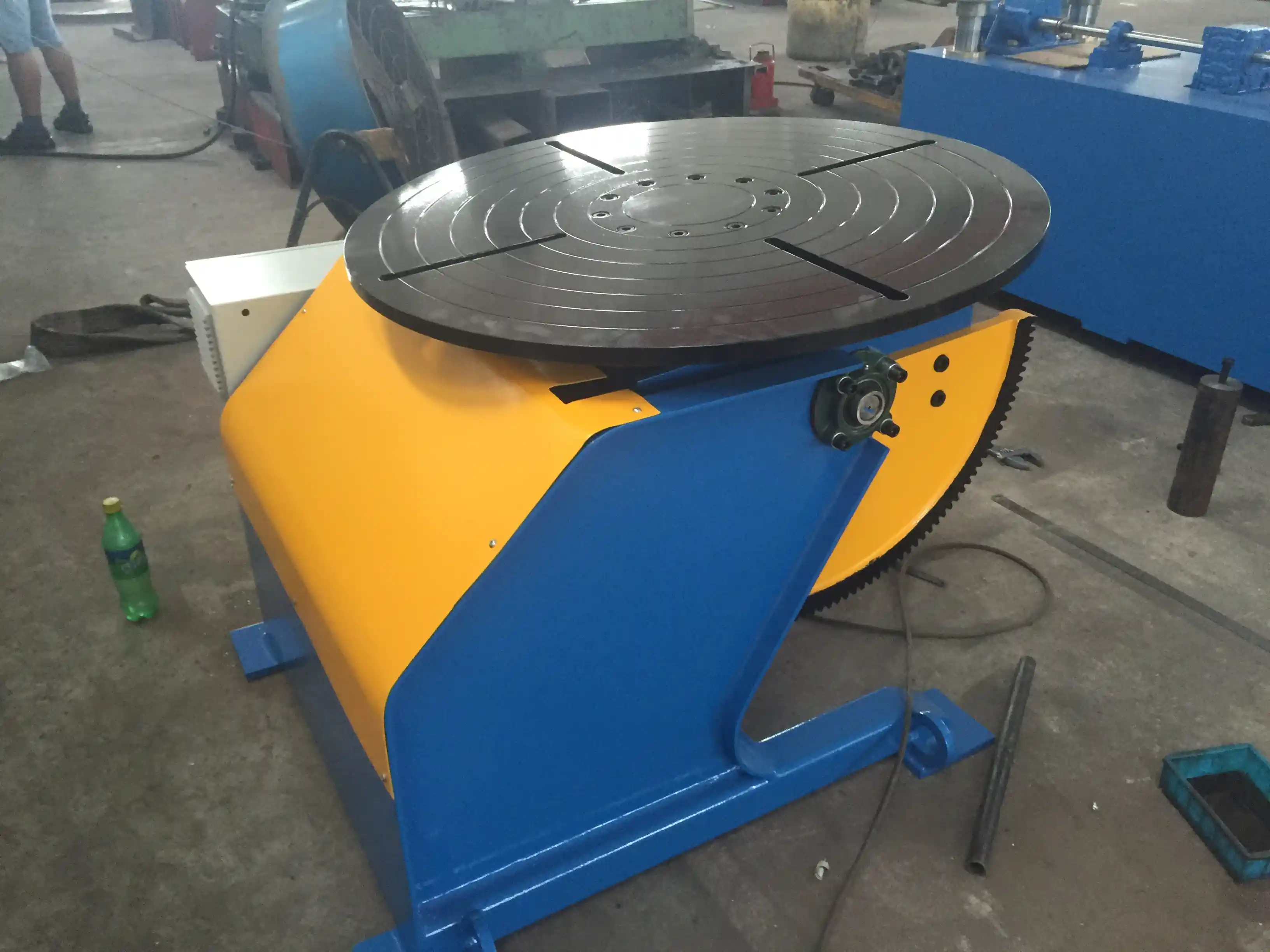
The relationship between bending quality and welding productivity is rarely discussed, but in automated cells it is the single biggest determinant of first-pass yield. When a bent tube arrives at the welding station with ovality above 3% or a wandering centerline, the automated welding positioner must compensate with continuous torch adjustment, slowing the process. Our welding manipulators and 3-axis positioners are designed to handle typical fabrication tolerances, but they perform best when the incoming workpiece geometry is consistent. I recommend fabricators set an incoming ovality limit of 2% and a wall thinning allowance of no more than 12% from nominal. This keeps the automated welding cycle stable and reduces arc-on time lost to re-programming.
Integrating Bending with Your Fabrication Line
A 500mm+ pipe is heavy, often exceeding 100kg per meter, so handling between bending and welding stations must be planned. Overhead cranes and dedicated pipe roller conveyors are standard. The bent pipe’s orientation must also be preserved; rotating a complex multi-bend spool to align the joint for welding can introduce twist. At WUXI ABK, we often configure the welding rotator and fit-up station to receive the pipe in the same orientation as it leaves the bender, so the build sequence is uninterrupted. Another factor is post-bend stress relieving for induction bends, which requires a dedicated furnace or local heating. That step can become a bottleneck if not sized for the production rate. I advise customers to map the entire flow from raw pipe receiving through bending, heat treatment, NDT, and final welding before ordering any one piece of equipment.
What Heavy Fabricators Should Know About Large Pipe Bending Equipment
If your project includes a spec that demands less than 2% ovality on a 700mm diameter 40mm wall pipe, the bending method is not a detail you can delegate. Induction bending with precise temperature control and a post-bend quench can achieve that. When a client asks me whether they should invest in their own large bending cell or subcontract, the decision hinges on volume. For fewer than 50 identical bends, subcontracting to a specialist bender is usually cheaper and faster. For program quantities above 200, an in-house machine pays back through schedule control and reduced logistics. Keep in mind that bending tooling for each diameter and radius set can cost upward of $15,000, so a flexible machine that shares tooling across pipe schedules reduces the capital burden.
To discuss how your bending requirements connect to downstream welding automation, send your part drawings and production targets to jay@weldc.com or call +86-510-83555592. I can help you build a complete workflow from bend to finished weld.
Common Questions About Large Diameter Tube Bending
What is the largest pipe diameter that can be bent without heating?
In most cases, cold bending can handle up to 600mm diameter on thin wall (under 10mm) using a heavy-duty roll bender. Thicker walls force the transition to induction bending at smaller diameters because the force required multiplies. I have seen 800mm schedule 40 pipe cold bent successfully, but the machine had a 600-ton frame and the bend radius was kept above 8D. Without induction, the risk of cracking in the heat-affected zone of the upcoming weld is also higher.
Does a 500mm+ bend always require a mandrel?
Not always. Induction bending often uses no internal mandrel because the heated narrow band creates a plastic hinge that resists ovality naturally. Cold roll bending on thick-walled pipe can also run without a mandrel if the bend radius is large enough (above 5D). However, for rotary draw bending at the upper end of its capacity, a multi-ball mandrel is essential to support the inner radius. The mandrel selection directly impacts the final roundness, and a poorly chosen mandrel can score the inner wall, creating a defect that shows up later in radiographic weld inspection.
How much does a large diameter tube bending machine cost?
It depends on the method and capacity. A dedicated induction bending machine for 500–800mm pipe typically starts around $200,000 and can exceed $1 million with full CNC and automated handling. A heavy cold roll bender for the same range often falls between $150,000 and $400,000, depending on the roll configuration and whether it includes servo-controlled pressure adjustment. Rotary draw machines capable of 500mm bends, if available, are rare and custom-built. The total investment includes foundation work, tooling, and installation, so a realistic budget for a turnkey system is 30 to 50 percent above the machine price alone.
What welding processes follow large diameter bending?
Submerged arc welding (SAW) is the dominant process for joining thick-walled bent pipe sections in spool fabrication because of its deep penetration and high deposition rate. For orbital pipe welding in tight quarters, GMAW with mechanized tractors is common. In our projects, we often pair a welding rotator with a column and boom SAW setup to handle the girth welds. For root passes on critical joints, we sometimes recommend TIG for its lower heat input and better penetration control. If your program requires multiple welding methods and strict traceability, sharing your requirements with us will help ensure the welding equipment matches the bent pipe condition.
If you’re interested, check out these related articles:
Revolutionary Solution for Pressure Vessel Welding: Technical Analysis of 360-Degree Rotating Welding Positioners
Pipe Welding Misalignment Issues: How Intelligent Welding Pipe Rotators Boost Oil Pipeline Pass Rates
 English
  Español
  Français
  Deutsch
  Português
  Русский