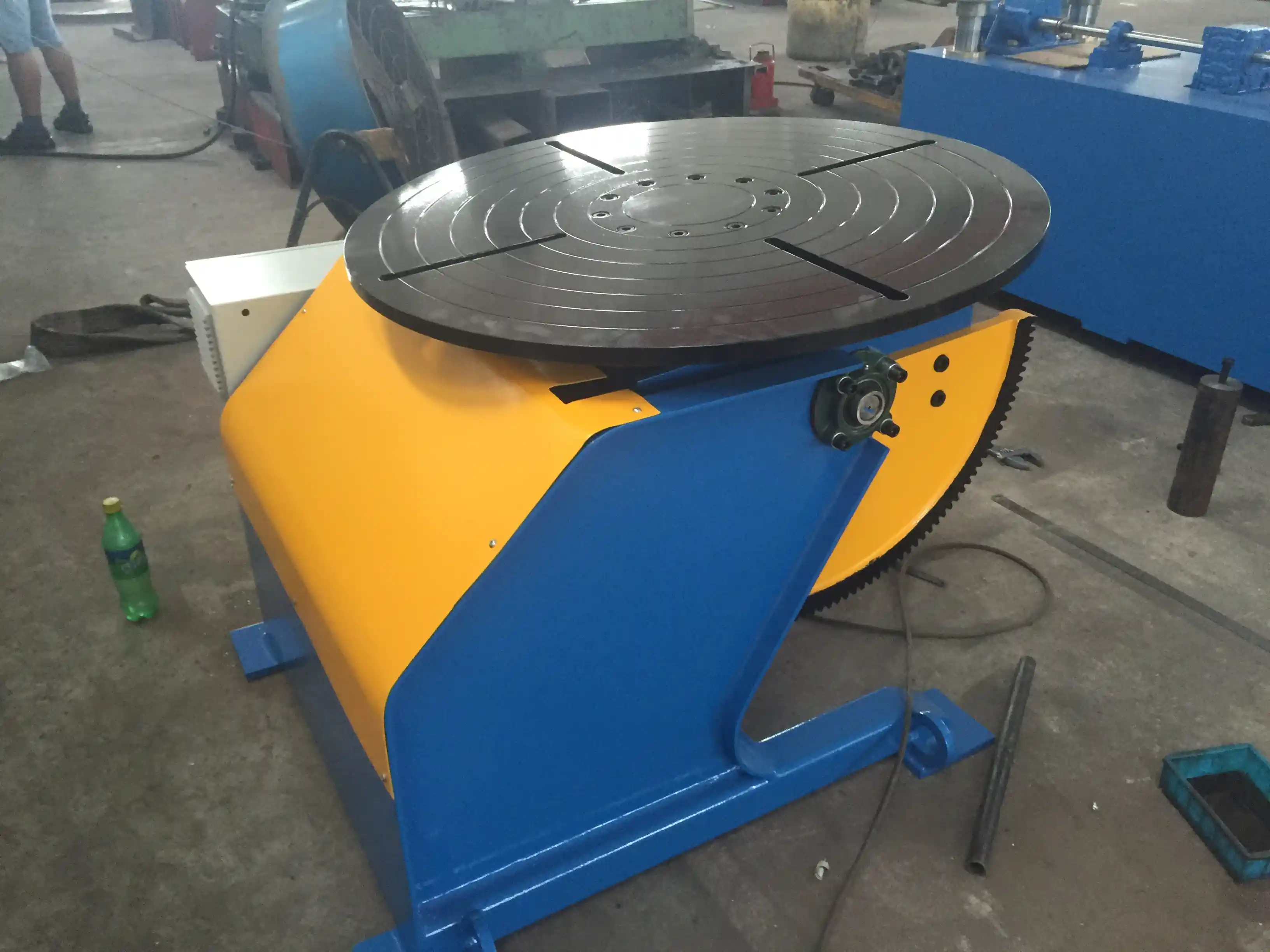
Positioner selection is not a simple catalog decision. The right welding positioner reduces setup time, holds the joint in the most weldable orientation, and removes the stop-start rhythm that erodes deposition rate and first-pass yield. For fabricators working with pressure vessels, tube-to-tube joints, flanges, excavator booms, or wind tower sections, a poorly matched table or tilt axis does more than slow the weld. It creates variable operator technique, uneven root penetration, and costly inspection repairs [1].
How Welding Positioner Selection Affects Fabrication Productivity
A welding positioner earns its floor space because it turns workpiece movement into controlled motion. When a part can be rotated, tilted, or turned into the flat or horizontal position, the welder maintains a shorter arc, a more consistent travel angle, and a steadier weld pool. That consistency directly affects how often a seam passes non-destructive testing on the first attempt.
The productivity case is not only about speed. A positioner that reduces clamping, re-rigging, and manual turning reduces non-arc time. In heavy fabrication, non-arc time frequently consumes more hours than actual welding. A 20-ton vessel shell that must be repositioned manually several times per shift can lose hours to crane movements, fit-up checks, and operator repositioning. A properly sized positioner can remove many of those interruptions.
The key is matching the positioner to the load path, not simply to the part weight. Load capacity, center-of-gravity distance, eccentric loading, and table stiffness all determine whether the positioner holds the workpiece safely while maintaining the intended weld position [1].
Controlled positioning keeps weld parameters repeatable when the workpiece is moved into position. <How to Improve the Quality of Pipe Welding Through a High-Precision Welding Positioner> covers the setup details that turn positioner accuracy into consistent pipe weld quality.
Key Specifications to Verify with Welding Positioner Manufacturers
Before comparing quotes, define the worst-case workpiece condition. A positioner rated for 5,000 kg does not necessarily accept a 5,000 kg part with a large center-of-gravity offset. The table bearing, tilt mechanism, and overturning moment must all be reviewed together.
Important specification points include:
- Load capacity and eccentric distance: Confirm both standard load and maximum center-of-gravity distance.
- Rotation and tilt accuracy: For automated or semi-automated welding, repeatability matters more than maximum speed.
- Table size and T-slot layout: The workpiece must be clamped securely without excessive overhang.
- Protection rating: Welding spatter, grinding dust, and shop humidity demand an enclosure such as IP54.
- Control interface: PLC and HMI storage for preset programs can shorten changeover between product families.
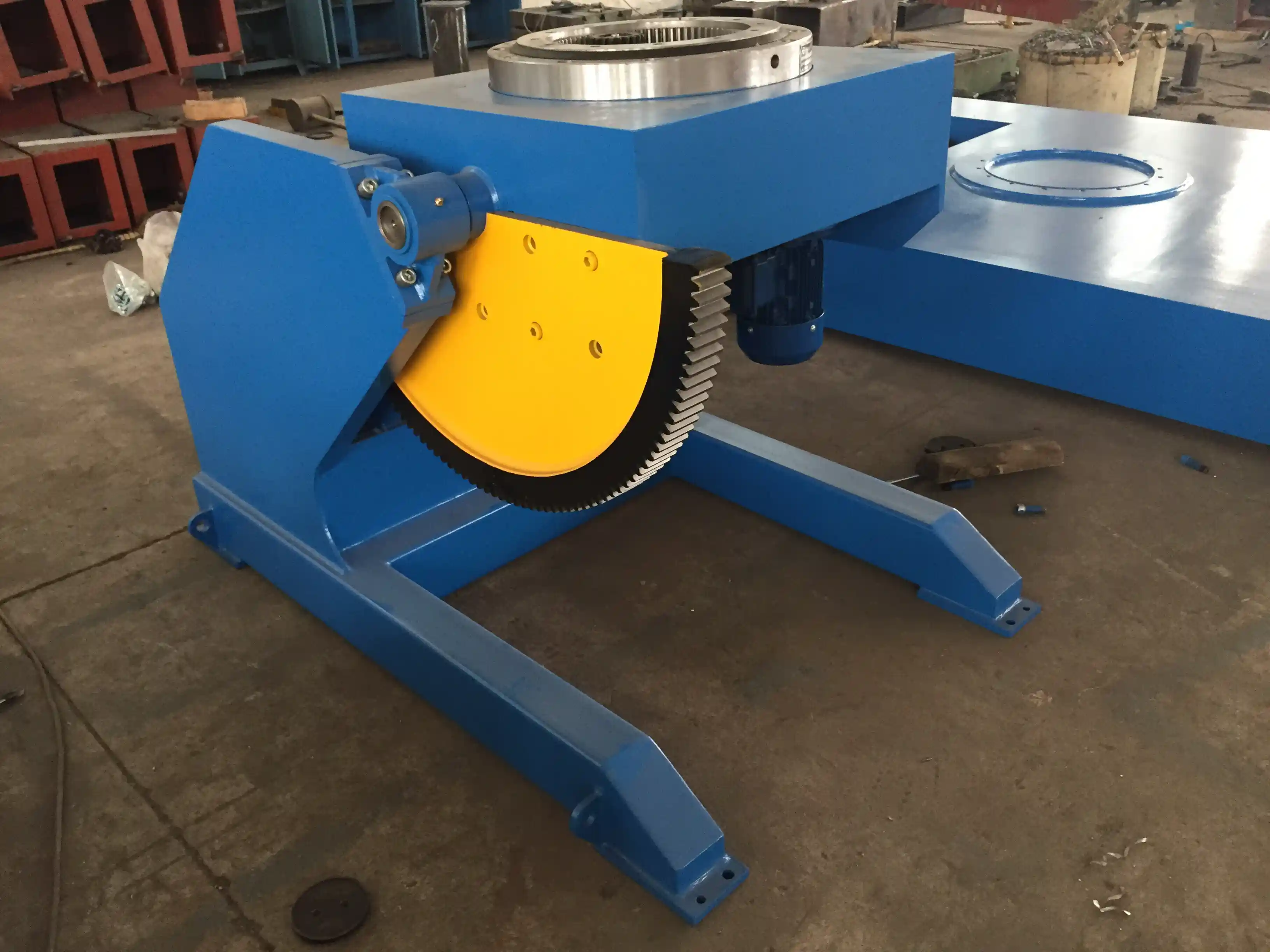
Heavy-duty models such as the WUXI ABK adjustable welding positioner equipment provide rotation, tilt, and height adjustment for vessels and structural sections. Smaller workpieces often fit a welding turntable solution, while long cylindrical parts may require a head-and-tail setup.
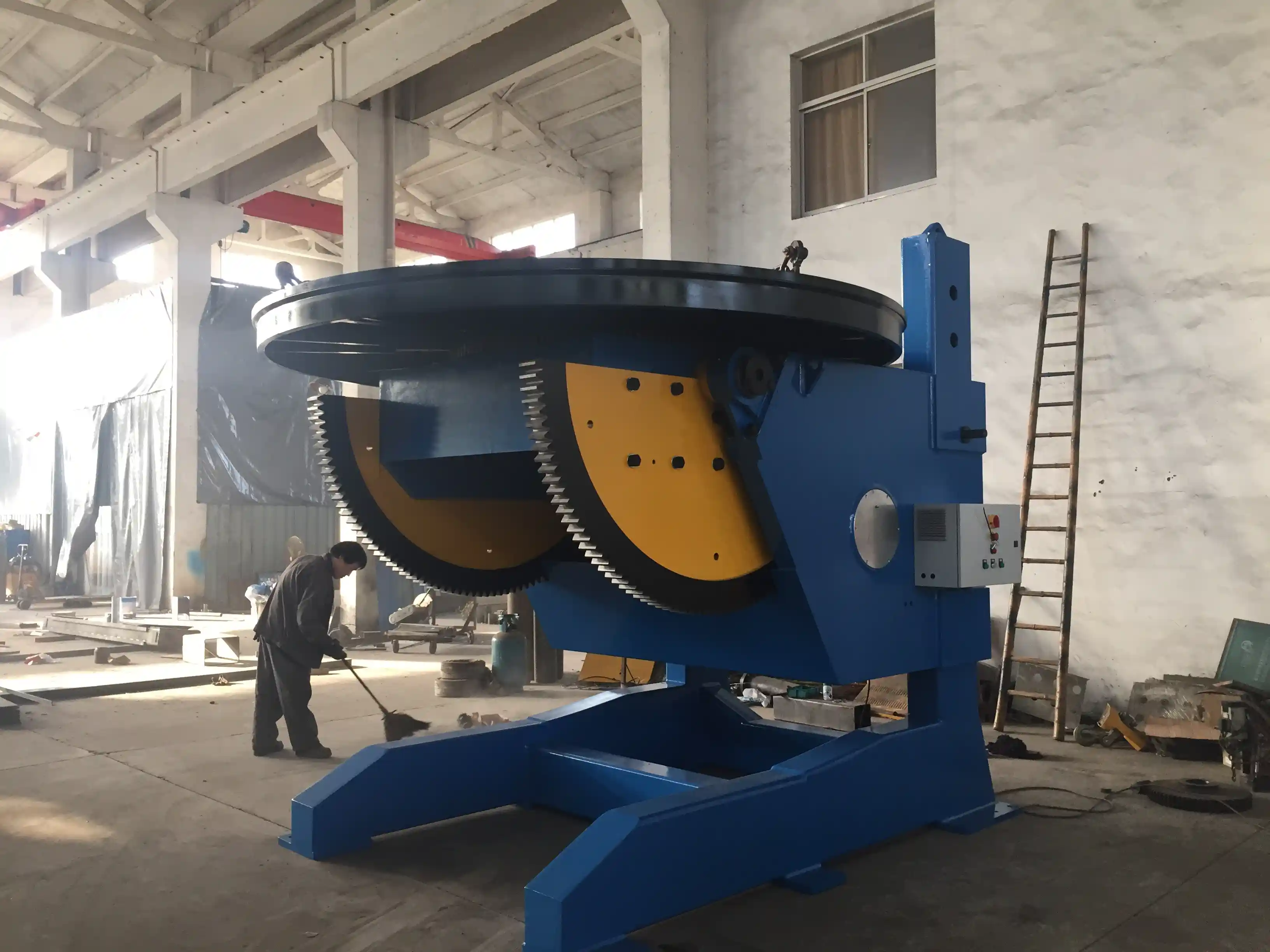
The same prioritization of load distribution and repeatable positioning applies across heavy fabrication. <Core Pain Points and High-Precision Solutions of Welding Positioners in the Wind Power and Shipbuilding Industries: Comprehensive Technical Analysis> covers the load, alignment, and precision issues that most often reach the field.
Matching Positioner Type to the Workpiece
The best welding positioner manufacturers usually offer several configurations because no single machine covers every part family.
Fixed-Height Positioners
Fixed-height machines work well for stable product lines with repeatable part dimensions. They are simpler to install, easier to guard, and often provide a lower total cost of ownership.
Adjustable-Height Positioners
When a shop welds both small flanges and large vessel sections, adjustable-height models provide flexibility. The table can be moved to a comfortable working height, which also supports crane-assisted loading.
L-Type and Head-Tail Positioners
L-type positioners suit parts that need both rotation and tilt. Head-tail configurations are common for long beams, columns, or pipe assemblies because they support the workpiece from both ends.
Three-Axis Positioners
Three-axis equipment combines rotation, tilting, and turning. This is especially useful for robotic cells and complex parts that would otherwise require multiple setup stations. WUXI ABK 3-axis welding positioner models provide servo-controlled accuracy and compatibility with ABB, KUKA, FANUC, and Yaskawa robots.
For joints that are difficult to reach with a standard boom, a welding manipulator can be paired with the positioner to keep the torch in the correct work angle while the part rotates.
Automation-Ready Design and Throughput
If the goal is higher output per operator, the positioner must support automation rather than simply rotate the part. Repeatability and control architecture become central.
A three-axis positioner with ±0.05 mm positioning accuracy and 0.02 mm repeatability is designed for robotic welding because the controller can return to the same programmed position without drift. That reduces the need for manual correction after every cycle. The same logic applies to semi-automatic cells where an operator repeatedly loads and unloads parts.
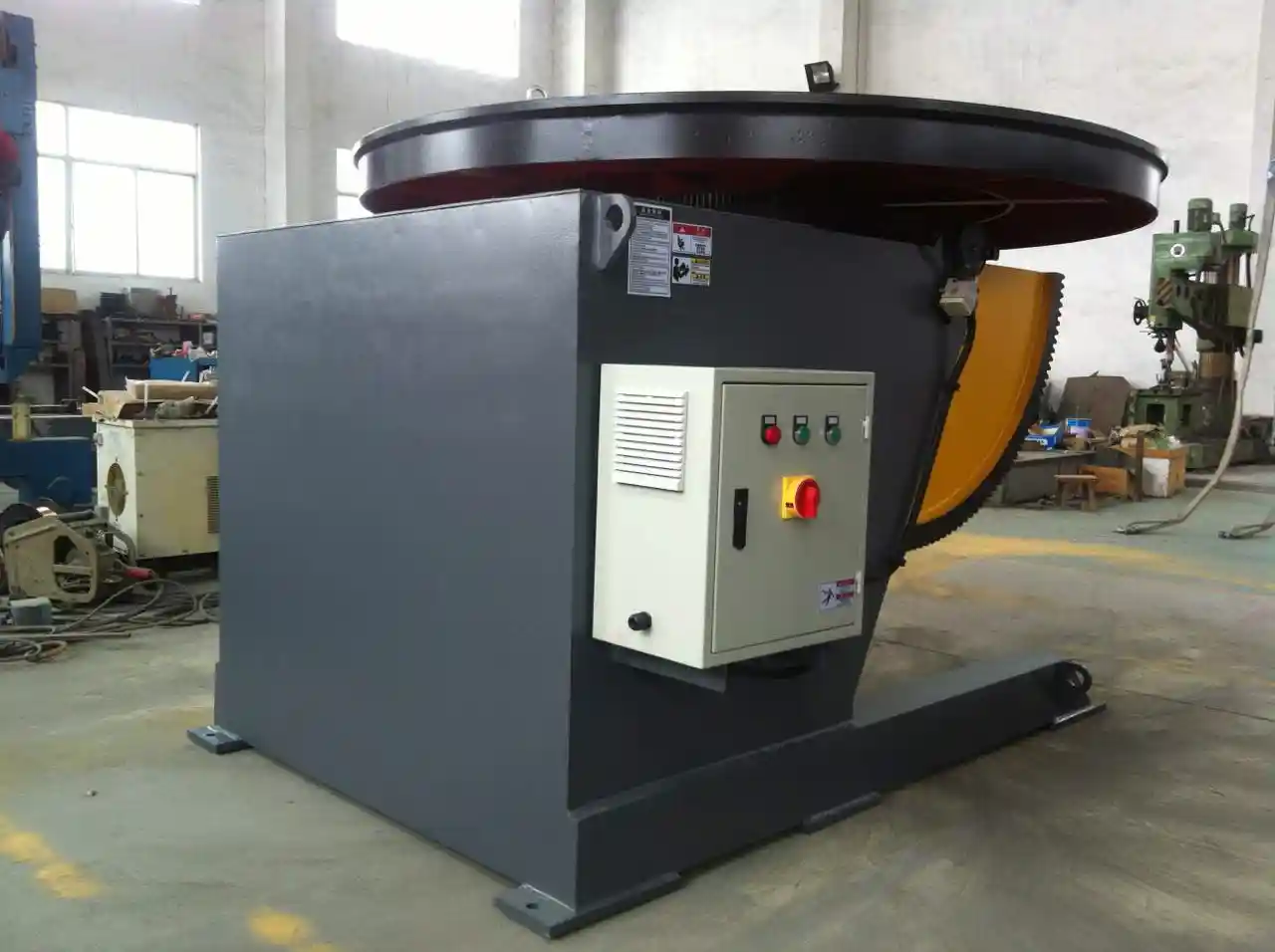
Control features to evaluate include:
- Preset welding programs stored in the PLC or HMI.
- Servo-driven axes with overload shutdown and emergency braking.
- Communication with robot controllers.
- Conductive slip rings for continuous rotation without cable entanglement.
- Remote monitoring inputs for production tracking.
Personnel qualification still matters in automated cells. Operators and weld setters for mechanized and automatic welding must be qualified according to the applicable code [3]. A well-designed positioner reduces variability, but it does not replace welding procedure qualification or operator training.
Multi-axis motion is most valuable when it removes setup steps and lets one cell handle complex parts without manual repositioning. <Tired of Complex Welding Challenges? How a 3-Axis Positioner Can Boost Productivity by 70%> covers the throughput logic behind coordinated rotation, tilt, and turning.
Quick Specification Cross-Check
If you are reviewing a proposal from any welding positioner manufacturer, send the part drawings, loaded weight, center-of-gravity distance, weld orientation, and cycle time target in one package. Ask for a loaded runout test, a tilt-axis deflection calculation, and confirmation of the gear backlash before shipment. For a direct review of your workpiece and positioner combination, contact jay@weldmc.com with the load case and joint details.
Vetting Welding Positioner Manufacturers
The difference between manufacturers often appears after the quotation stage. A reliable supplier asks engineering questions about load distribution, weld sequence, and robot interface before offering a model. A less careful vendor may simply confirm a tonnage rating.
Evaluation should include:
- Documented quality system: ISO 9001 indicates that design, production, and inspection follow a controlled process [2].
- CE compliance: For equipment supplied to European production sites, the Machinery Directive requires design and documentation evidence [6].
- Code awareness: For structural steel, suppliers should understand AWS D1.1 requirements. For pressure-retaining parts, ASME Section IX weld qualification may apply [4][5].
- Test records: Request factory acceptance test documentation, runout measurements, and load-case verification.
- After-sales support: Confirm spare-part lead times, service response, and whether the manufacturer supports robotic integration and commissioning.
Do not rely on a single model number. Ask the manufacturer to recommend a positioner based on the overturning moment and not only the part mass. A heavy part with an off-center mounting can generate a much higher tilting load than its weight suggests.
Plan Your Fabrication Productivity Upgrade
The strongest positioner purchase starts with a clear part-family review. Identify the three workpieces that create the most manual repositioning, rework, or overtime, and use those as the basis for comparison. Once the load case is defined, select the configuration, accuracy class, and control interface that fit both current work and the next automation step.
If you are preparing a specification for a fixed-height, adjustable-height, L-type, head-tail, or three-axis welding positioner, send your worst-case workpiece envelope to jay@weldmc.com or call +86-13815101750. WUXI ABK MACHINERY CO., LTD can support technical selection, robot integration planning, and factory acceptance requirements for heavy fabrication projects.
Frequently Asked Questions
What load capacity should I specify for a welding positioner?
Start with the actual workpiece weight, then add the maximum eccentric load condition. If the center of gravity is offset from the table center, the overturning moment can exceed the simple part weight. Select a machine that covers the worst combination, not only the nominal tonnage.
How does eccentric loading affect positioner selection?
Eccentric loading increases the tilting and bearing loads. A positioner rated for a given weight may deflect or trip under an off-center part. Manufacturers should provide maximum center-of-gravity distance and eccentric load limits, and these should be checked before purchase.
What is the difference between a welding positioner and a welding rotator?
A welding positioner rotates, tilts, or turns the workpiece into the desired welding position. A welding rotator mainly rotates cylindrical workpieces on rollers for circumferential welding. The choice depends on whether the part must be reoriented in multiple axes or simply rotated on its longitudinal axis.
How can I verify positioning accuracy before purchase?
Request a factory acceptance test that includes table runout, repeatability measurement, backlash check, and loaded rotation. For robotic applications, confirm that the positioner can hold the stated repeatability under the maximum expected load.
References
[1] ISO 3834-2:2021, Quality requirements for fusion welding of metallic materials — Part 2: Comprehensive quality requirements.
[2] ISO 9001:2015, Quality management systems — Requirements.
[3] EN ISO 14732:2013, Welding personnel — Qualification testing of welding operators and weld setters for mechanized and automatic welding.
[4] AWS D1.1/D1.1M:2020, Structural Welding Code — Steel.
[5] ASME Boiler and Pressure Vessel Code, Section IX: Welding, Brazing, and Fusing Qualifications.
[6] Directive 2006/42/EC, Machinery Directive.
If you’re interested, check out these related articles:
Wind Tower Welding Challenges: How Advanced Hydraulic Lifting Systems Boost Production by 40%
Ship Pipeline Coating Sagging Issues: How Intelligent Paint Roller Racks Boost Pass Rates to 98%
Improving Quality and Efficiency in Tank and Pressure Vessel Manufacturing: The Core Application Value of Positioners
 English
  Español
  Français
  Deutsch
  Português
  Русский