
Welding positioners do more than rotate a workpiece. The right unit turns difficult out-of-position welds into controlled flat or horizontal passes, which directly affects deposition rate, weld quality, operator strain, and repeatability. Selecting a supplier should therefore focus on mechanical load behavior, motion accuracy, safety architecture, control integration, and support quality — not simply table diameter and kilowatts.
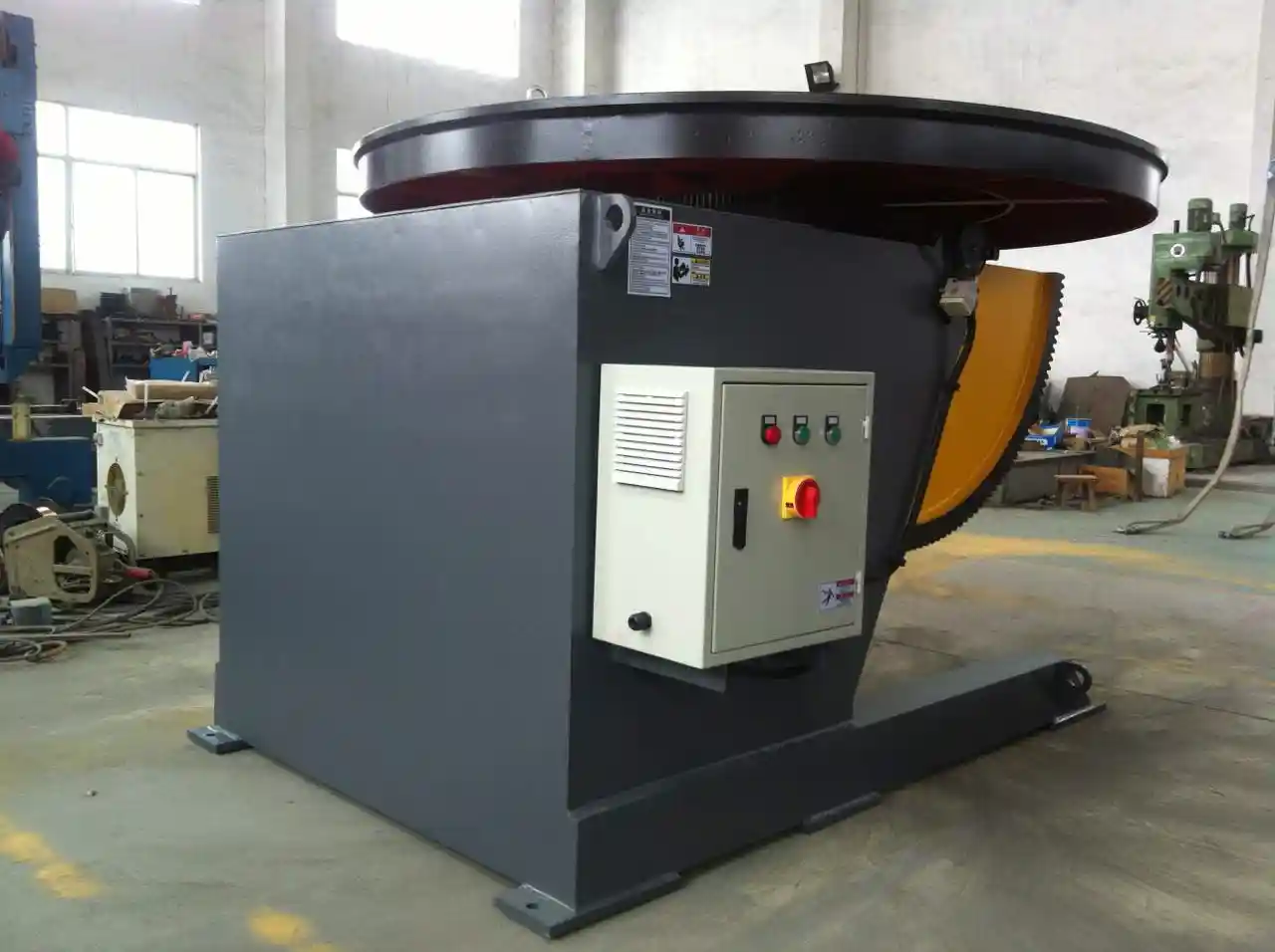
1. Define the Real Load Condition Before Comparing Catalog Numbers
Rated load capacity only tells part of the story. A 5-ton positioner does not safely handle every 5-ton workpiece because the load acts at a distance from the table face. Suppliers should provide three related values: maximum load capacity, allowable center-of-gravity distance, and maximum eccentric distance.
Eccentric loading creates an overturning moment that loads the slewing bearing, reverse gears, and base unevenly. If the center of gravity is too far from the table, the positioner may rotate smoothly during testing but deflect under welding pressure, causing arc wander and lost repeatability.
Before requesting a quote, prepare these values:
- Heaviest workpiece weight, including fixtures and clamping.
- Center-of-gravity distance from the table surface.
- Maximum eccentric offset from the rotation axis.
- Required rotation angle and tilt angle during welding.
- Duty cycle per shift and whether loading is impact-free or assisted by crane.
Ask the supplier whether the quoted load is static or dynamic. Static rating may look attractive, but most welding applications require continuous rotation at low speed and occasional sudden braking. A positioner with insufficient dynamic margin can trip overload protection or accelerate gear wear.
Load distribution failures often begin with an undersized table and an unchecked center-of-gravity distance. <Core Pain Points and High-Precision Solutions of Welding Positioners in the Wind Power and Shipbuilding Industries: Comprehensive Technical Analysis> covers how eccentric loading affects rotation accuracy and how to specify overturning capacity for long or asymmetric components.
2. Verify Rotation Accuracy, Repeatability, and Speed Control Range
Accuracy is not a single number. A supplier may quote 0.05 mm positioning accuracy for a servo-driven 3-axis positioner, while another quotes ±0.5° rotation accuracy for a fixed-height turntable. Both can be valid — but they describe different systems.
For circular seam welding, table runout and repeatability matter more than absolute positioning on a single axis. Check these parameters:
- Rotation accuracy at full load, not only empty-table accuracy.
- Repeatability from one indexed position to the next.
- Runout at the outer edge of the maximum workpiece diameter.
- Speed stability at the low end of the range, commonly 0.05–0.5 RPM for submerged arc or TIG work.
- Whether the drive system is servo, AC frequency-controlled, or open-loop.
A stable low-speed range is especially important for processes that require a consistent travel speed over long weld lengths. If the rotation speed fluctuates, heat input changes and weld penetration can vary. In structural applications governed by AWS D1.1/D1.1M, consistent process parameters support the required weld quality documentation [4].
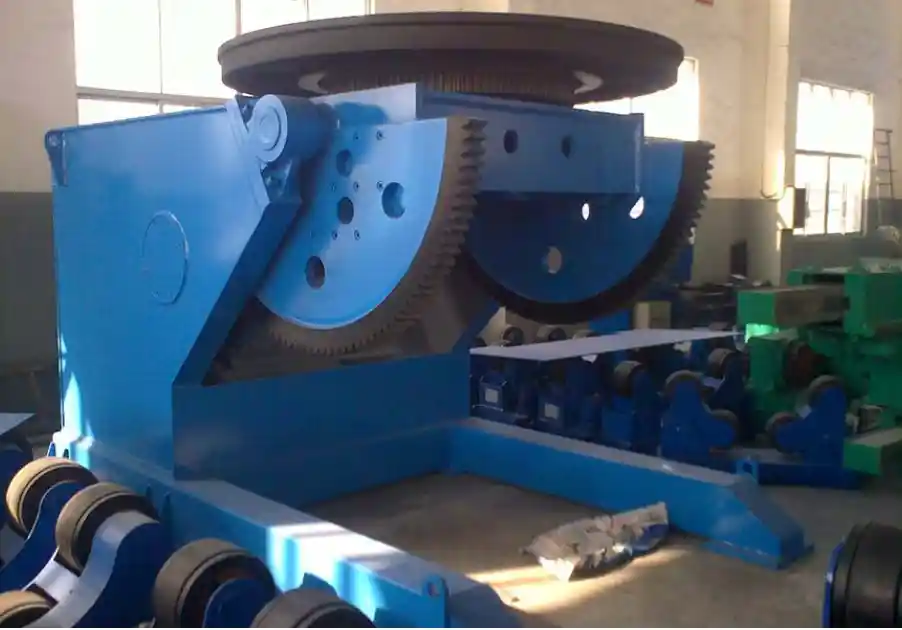
Representative fixed-height positioners often range from 1-ton to 5-ton table capacity with stepless rotation speeds near 0.05–0.5 RPM and turnover angles from 0–90° to 0–135°. Heavier adjustable-height systems extend beyond 100 tons for large vessels, wind tower sections, and offshore fabrications. Rather than selecting the largest available model, match the speed, torque, and moment capacity to the weld procedure.
3. Check Tilt Geometry, Table Clearance, and Workholding Compatibility
Welding positioners should support more than flat rotation. Tilt and turnover functions allow the operator to place the weld seam in the most accessible position, reduce awkward weaving, and improve shielding gas coverage.
When reviewing a supplier’s specification sheet, compare the actual tilt range rather than assuming all machines behave the same. Fixed-height models may offer 0–90°, 0–120°, or 0–135° tilt, while 3-axis systems add synchronized turning, rotation, and tilting for robotic cells. The choice depends on the joint geometry and whether the part must be repositioned during a single sequence.
Workholding is equally important. Look for:
- Number and size of T-slots on the table.
- Conductive slip rings for continuous rotation without cable entanglement.
- Clearance between the table and base for protruding flanges or attachments.
- Optional quick-change fixtures for batch production.
- Compatibility with overhead crane loading.
A larger table does not automatically improve clamping. The table must allow bolts to pass through the table face or include configured slots for standard fixture plates. If you plan to robotically weld small or medium components, confirm the table can accept a precision tooling plate without losing accuracy.
Specification shortcut: if you send the supplier your heaviest workpiece weight, center-of-gravity distance, joined material thickness, and required tilt angle, a qualified welding automation engineer can recommend a suitable positioner configuration before quotation. For direct assistance, email jay@weldc.com or call +86-13815101750.
4. Examine Drive Architecture, Braking, and Safety Systems
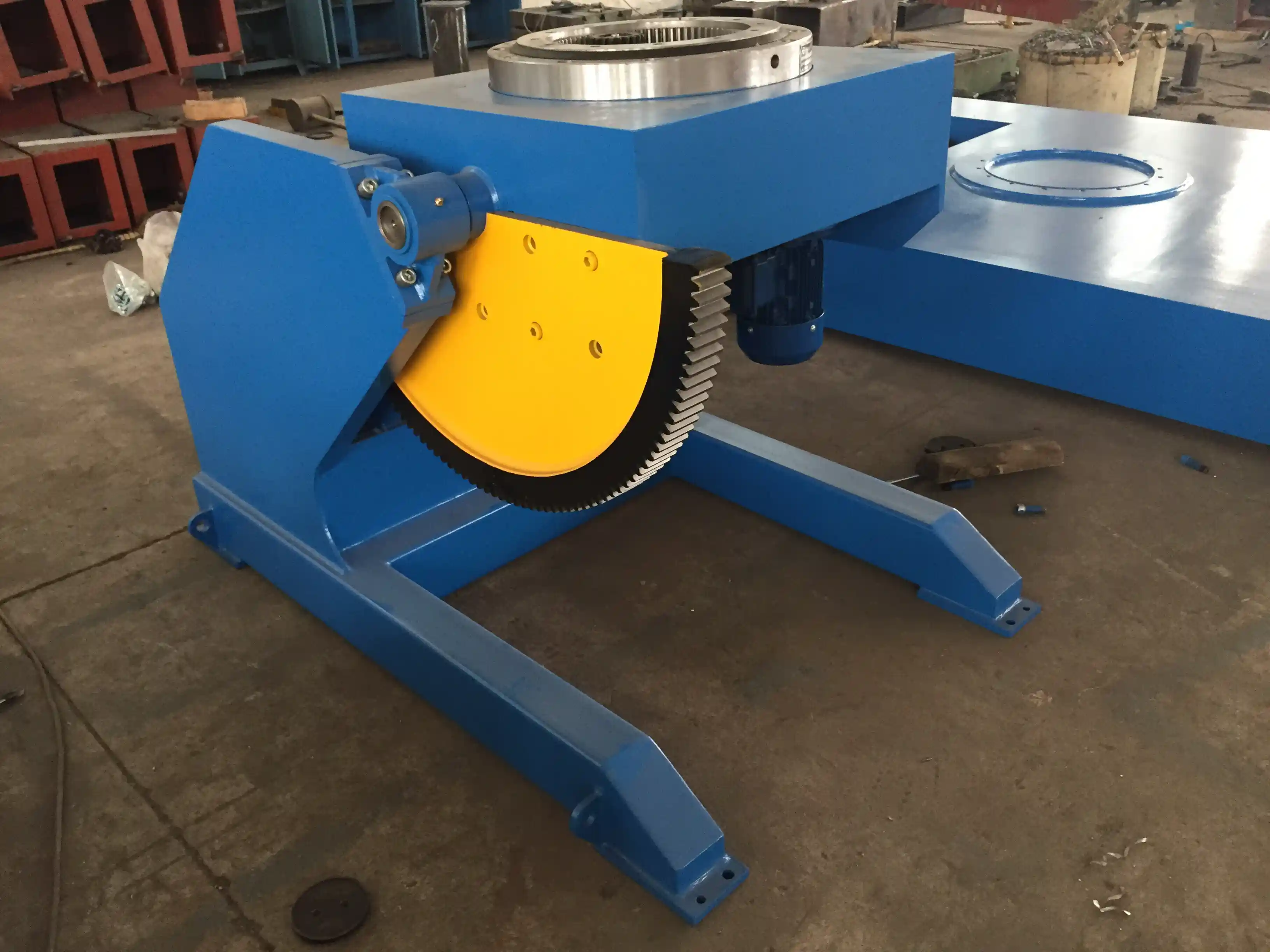
The drive train determines whether the positioner holds position during welding or drifts under load. Gearing should be properly matched to the table speed and torque requirement. Worm gear drives are common for fixed-height positioners because they provide self-locking characteristics during tilt. Servo-driven 3-axis units often use high-precision reducers and linear guideways for smooth motion and better repeatability.
Safety functions should not be optional. Review the following:
- Emergency stop and rapid braking behavior under full load.
- Overload shutdown limits and motor protection.
- Anti-fall protection on vertical adjustment systems.
- Enclosure rating for welding spatter and dust, commonly IP54 or higher.
- Manual pendant placement and operator visibility during rotation.
CE marking under the Machinery Directive [2] should cover the complete machine, not only the control panel. For safety-related control functions such as e-stops, position limits, and drive monitoring, the system should be designed to a recognized safety standard such as EN ISO 13849-1 [3]. Ask for the declaration of conformity and confirm which standards were used during design.
In tank and pressure vessel work, the positioner is often part of a longer seam-welding sequence, so safety and stability under cylindrical loads directly influence pass rates. <Improving Quality and Efficiency in Tank and Pressure Vessel Manufacturing: The Core Application Value of Positioners> covers how controlled positioning improves root pass consistency and reduces rework on circumferential seams.
5. Match Controls and Integration to Your Automation Roadmap
A supplier should understand how the positioner will be used today and how it may be used later. Even if you currently operate manually, selecting a control platform that can later integrate with robotic welding avoids costly retrofits.
Evaluate control systems on these points:
- PLC architecture and whether programs can be stored locally.
- HMI screen size, language support, and operator feedback.
- Speed presets for different joint types.
- External start/stop, arc-on, and position-confirmation signals.
- Robot interface readiness for ABB, KUKA, FANUC, or Yaskawa.
- Optional seam tracking or automated parameter control.
For high-mix shops, a positioner with 10 to 100 preset programs shortens changeover. For a dedicated production cell, synchronized axes and absolute encoders are more valuable than many stored routines. Clarify whether the supplier provides electrical drawings, IO assignments, and startup support before installation.
If the positioner is purchased for a manual station now, choose a PLC-ready system even if the robot interface is not initially purchased. This keeps integration costs lower later and avoids replacing the entire drive train when production scales up.
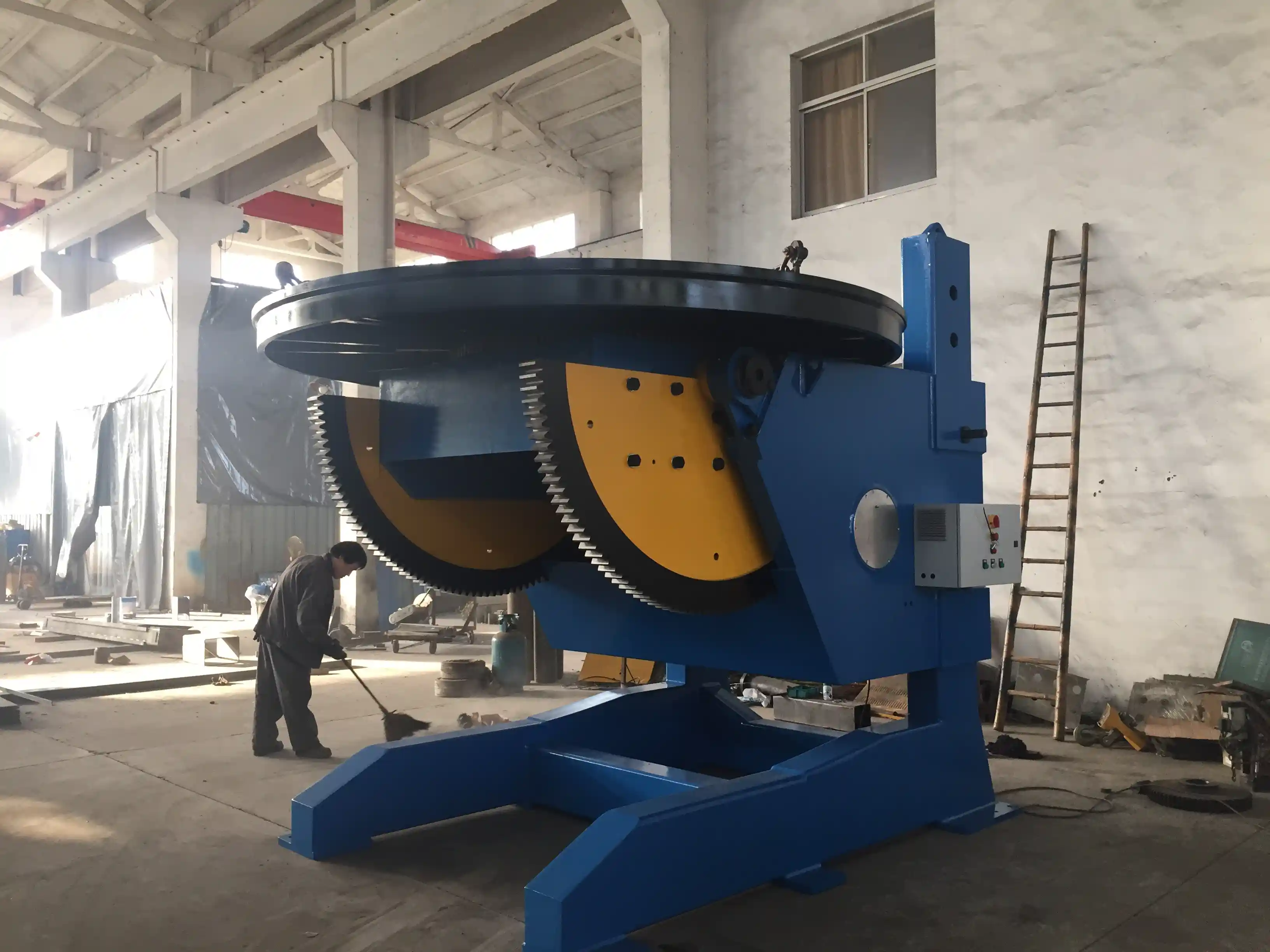
Complex workpieces often require not just rotation but coordinated tilt and turning. <Tired of Complex Welding Challenges? How a 3-Axis Positioner Can Boost Productivity by 70%> covers how synchronized 3-axis motion reduces repositioning time and supports automated welding of high-mix structural parts.
6. Assess Documentation, Certification, Support, and Total Cost
Purchase price is only one part of ownership cost. A positioner with poor documentation or unavailable spares becomes expensive when it stops production. A reliable supplier should provide:
- General arrangement and foundation drawings.
- Electrical schematics and parameter settings.
- CE declaration of conformity and applicable standards.
- Lubrication and maintenance schedule.
- Spare parts list with realistic delivery lead time.
- Startup support or video-guided commissioning.
For process consistency, ISO 9001:2015 is a reasonable baseline because it establishes documented quality controls for design and manufacturing [1]. However, certification alone does not guarantee performance. Ask for reference cases with similar workpiece weights and weld processes, and verify whether the supplier has experience in your industry.
Total cost should include foundation work, power supply, integration time, operator training, spare parts, and preventive maintenance over at least five years. A low-cost positioner may consume more labor in setup and inspection than a higher-precision unit. Compare the specification list, not only the quote.
Next Step: Validate Your Positioner Specification
Before placing an order, request a load-moment review, a dimensional drawing, and a controls interface list from the supplier. Confirm the unit can accommodate your largest realistic workpiece, not your current average part.
WUXI ABK MACHINERY CO., LTD supports welding positioner selection for pressure vessels, wind towers, structural steel, shipbuilding, and automated welding lines. Send your workpiece weight, center-of-gravity distance, tilt requirement, welding process, and automation plan to jay@weldc.com for a technical review.
Contact information:
- Mobile: +86-13815101750
- Tel: +86-510-83555592
- Fax: +86-510-83559158
- Email: jay@weldc.com
FAQ
How do I calculate the required load capacity for a welding positioner?
Start with the total weight of the workpiece and fixture, then multiply by the greatest horizontal distance from the rotation axis to the center of gravity. Compare this resulting moment with the supplier’s allowable eccentric load chart. Do not select a positioner based on weight alone.
What is the difference between tilt angle and turnover angle?
Tilt angle describes how far the table rotates from horizontal, while turnover angle generally describes the range through which the workpiece can be rotated or flipped. Fixed-height positioners may offer tilt ranges of 0–90°, 0–120°, or 0–135°, depending on the gear train and table design.
Can a standard positioner be customized for robotic welding?
Many standard positioners can be supplied with PLC control, external start signals, and robot interfaces such as ABB, KUKA, FANUC, or Yaskawa. The key is to specify this requirement at the quotation stage so the drives, encoders, and IO configuration match the robot cell.
What maintenance should a welding positioner receive?
Daily maintenance includes removing spatter, checking lubrication, and inspecting electrical connections. Periodic checks should cover bolt torque, gear backlash, and safety interlocks. Annual service typically includes bearing inspection, lubricant replacement, and mechanical or electrical recalibration.
References
[1] ISO 9001:2015, Quality management systems — Requirements. International Organization for Standardization.
[2] Machinery Directive 2006/42/EC, Directive of the European Parliament and of the Council on machinery.
[3] EN ISO 13849-1:2023, Safety of machinery — Safety-related parts of control systems — Part 1: General principles for design.
[4] AWS D1.1/D1.1M:2020, Structural Welding Code — Steel. American Welding Society.
If you’re interested, check out these related articles:
Low Efficiency in Pipeline Group Welding: How Intelligent Roller Racks Increase Productivity by 50%
Welding Rotator Precision Automation for Industrial Fabrication: Expert FAQ Guide
Innovative Applications of 10-Ton CNC Welding Rotators in Pressure Vessel Manufacturing
Wuxi ABK Professional Welding Rotary Equipment: Precision Welding Solution for Pressure Vessel Manufacturing
Improving Quality and Efficiency in Wind Power Manufacturing: The Key Role of Positioners in Tower Section Girth Welding
 English
  Español
  Français
  Deutsch
  Português
  Русский