Producing wind tower sections that exceed 6 meters in diameter pushes conventional welding positioners and rotators beyond their safe operating limits. Standard equipment may work for smaller tower diameters, but the increased weight, larger moment arms, and stricter alignment tolerances of mega sections demand a deliberate equipment strategy. From my work with wind tower fabricators, I know that getting the handling and positioning equipment right is the difference between reliable production and constant rework. This article walks through the key equipment types, capacity requirements, and integration steps for welding 6m+ tower sections efficiently.
The Load and Stability Challenge of 6-Meter-Plus Sections
A bottom tower section for a modern multi-megawatt turbine can stand 25 meters long, measure 6.2 meters in diameter at the base, and weigh over 100 tonnes when built from 45 mm plate. 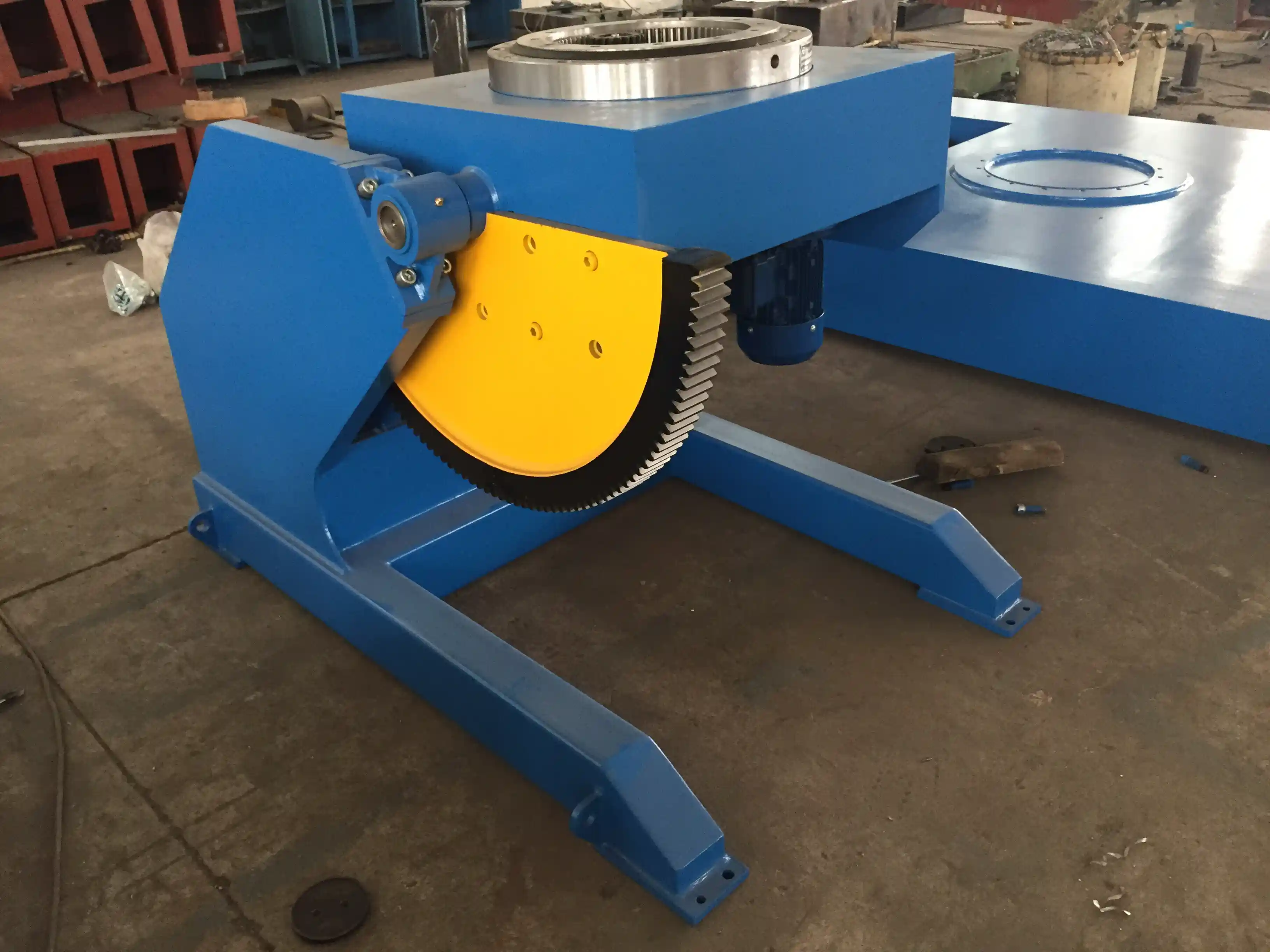 During girth welding, the section must be rotated smoothly while a welding manipulator maintains a constant torch position. If the rotator slips or the positioner’s tilt mechanism deflects under load, the weld seam shifts and misalignment accumulates. I have watched fabricators struggle when their existing 60-ton rotators could not hold a 5.8-meter section steady because the center of gravity sat too far forward. The resulting rework ate into margins. Mega sections demand equipment with not just high load ratings but also precise anti-creep control and the structural stiffness to resist deflection at full extension.
Welding Positioners for Large Wind Tower Sections: Capacity and Control
When you need to weld flanges, internal stiffeners, or longitudinal seams on a 6-meter-plus tower can, a fixed-height positioner often is not enough. You need adjustable height and the ability to tilt the workpiece under load for complete joint access. 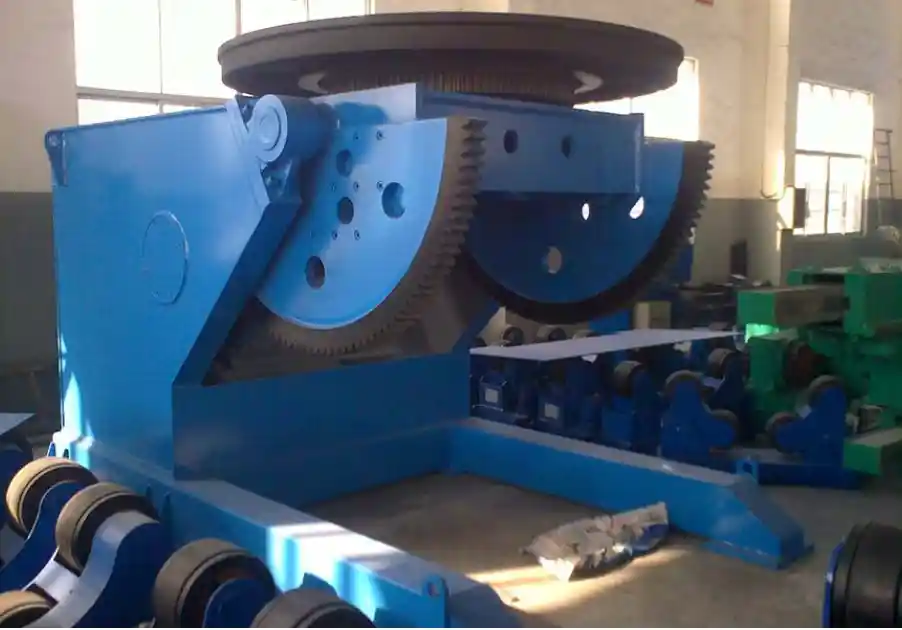 We recommend hydraulic lifting positioners with at least 30 tonnes capacity for the smaller end of the mega range and 100 tonnes or more for heavy base sections. For example, the WUXI ABK 100-ton adjustable height positioner uses ZG45 alloy rollers, AC frequency stepless speed control, and a slewing bearing good for ±0.5° rotation accuracy. That kind of precision under 100 tonnes of load is what prevents weld start-stop defects.
Beyond capacity, three-axis positioners add turning capability, which is useful when welding flanges onto ends. A model like the ABK 5-ton triple-axis positioning table may be too light for the full section, but it serves well for sub-assemblies and flange welding stations. For main section work, the larger L-type positioners are undersized for 6m+ sections; instead, look to the 30-ton adjustable height or 100-ton models.
If your project involves sections with both large diameter and long length, send your worst-case section weight and center-of-gravity estimate to jay@weldc.com. We can verify whether a 60-ton positioner is marginal or whether you need a 100-ton unit to avoid deflection issues.
Welding Rotators for 6-Meter-Plus Sections: Anti-Creep and Alignment
Rotators do the heavy lifting during longitudinal and girth seam welding. For sections over 6 meters, roller spacing, roller diameter, and drive synchronization become critical. 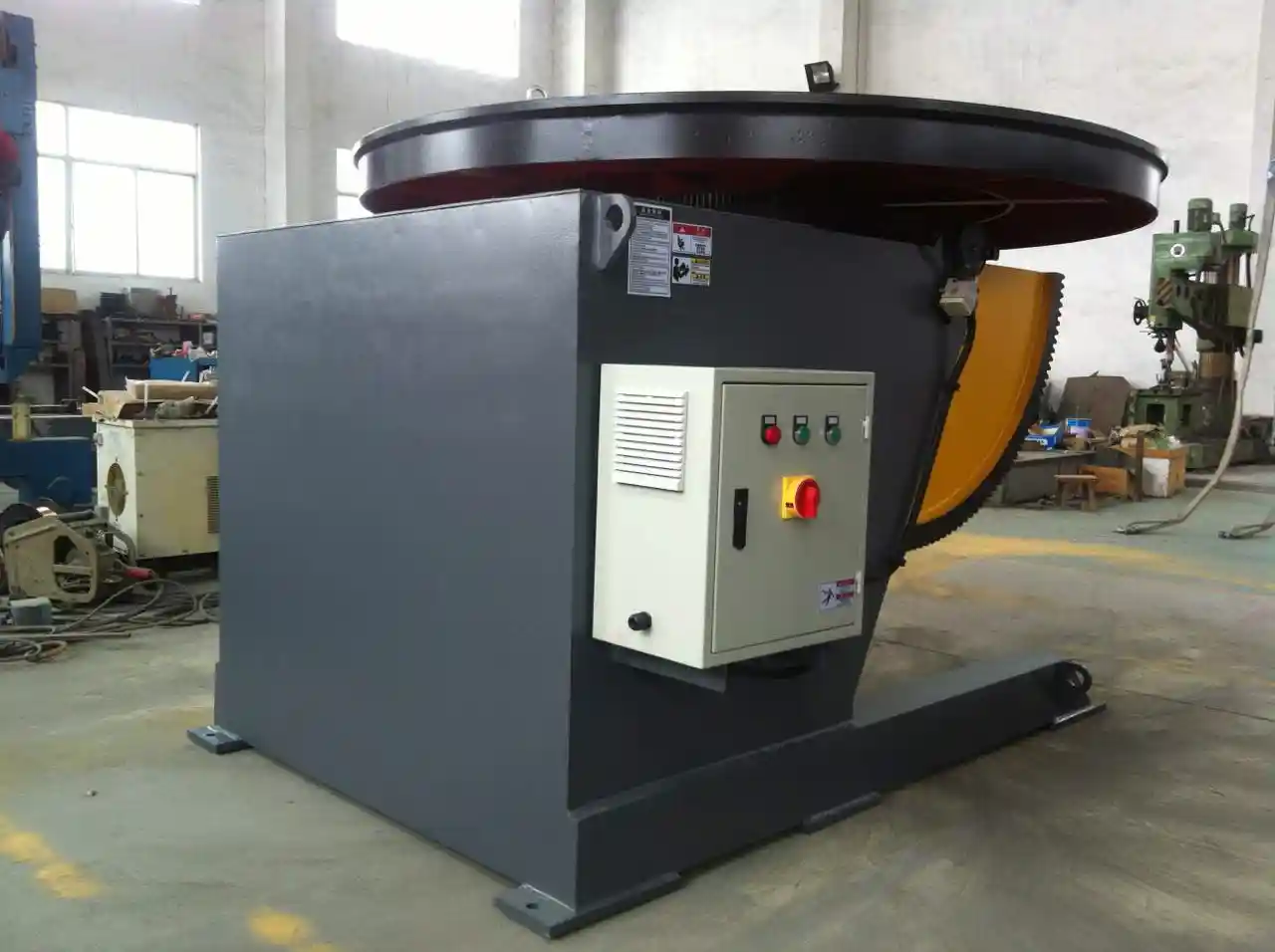 A standard 100-ton adjustable height rotator might list a vessel diameter range up to 5000 mm. To accommodate 6200 mm, you need the larger-capacity models that open the diameter range. The WUXI ABK 300-ton auto height adjusting rotator, for instance, handles diameters to 6000 mm with 5.5 kW dual motors and German NOVO displacement sensors providing 0.01 mm resolution. Even if your section falls just under 6000 mm, using a 300-ton unit gives you the roller diameter (800 mm) and frame stiffness to resist creep.
The table below compares heavy-duty rotator models relevant to large wind tower work:
| Model | Load Capacity | Diameter Range | Motor Power | Roller Diameter |
|---|---|---|---|---|
| HGZ-100 | 100 tons | 1000–5000 mm | 5.5 kW | 500 mm |
| HGK-200 | 200 tons | 800–5000 mm | 4 kW each | 700 mm |
| HGK-300 | 300 tons | 1000–6000 mm | 5.5 kW each | 800 mm |
| HGK-100 adjustable | 100 tons | 800–5000 mm | 3 kW each | 550 mm |
Note that the diameter range is the vessel circumference range the rotator can safely handle. If your sections exceed 6000 mm, discuss custom frame extensions with the manufacturer.
Anti-creep is not a luxury; it is a requirement. The hydraulic anti-creep system on the HGK-300 holds rotational position within 0.5 mm deviation. In my experience, even 1 mm of creep over a 20-minute weld pass causes the weld pool to wander, producing undercut or lack of fusion. That leads to costly ultrasonic testing failures.
Production Line Layout for Mega Wind Tower Manufacturing
Putting the positioners and rotators together into a production line requires space, floor loading, and logical flow. 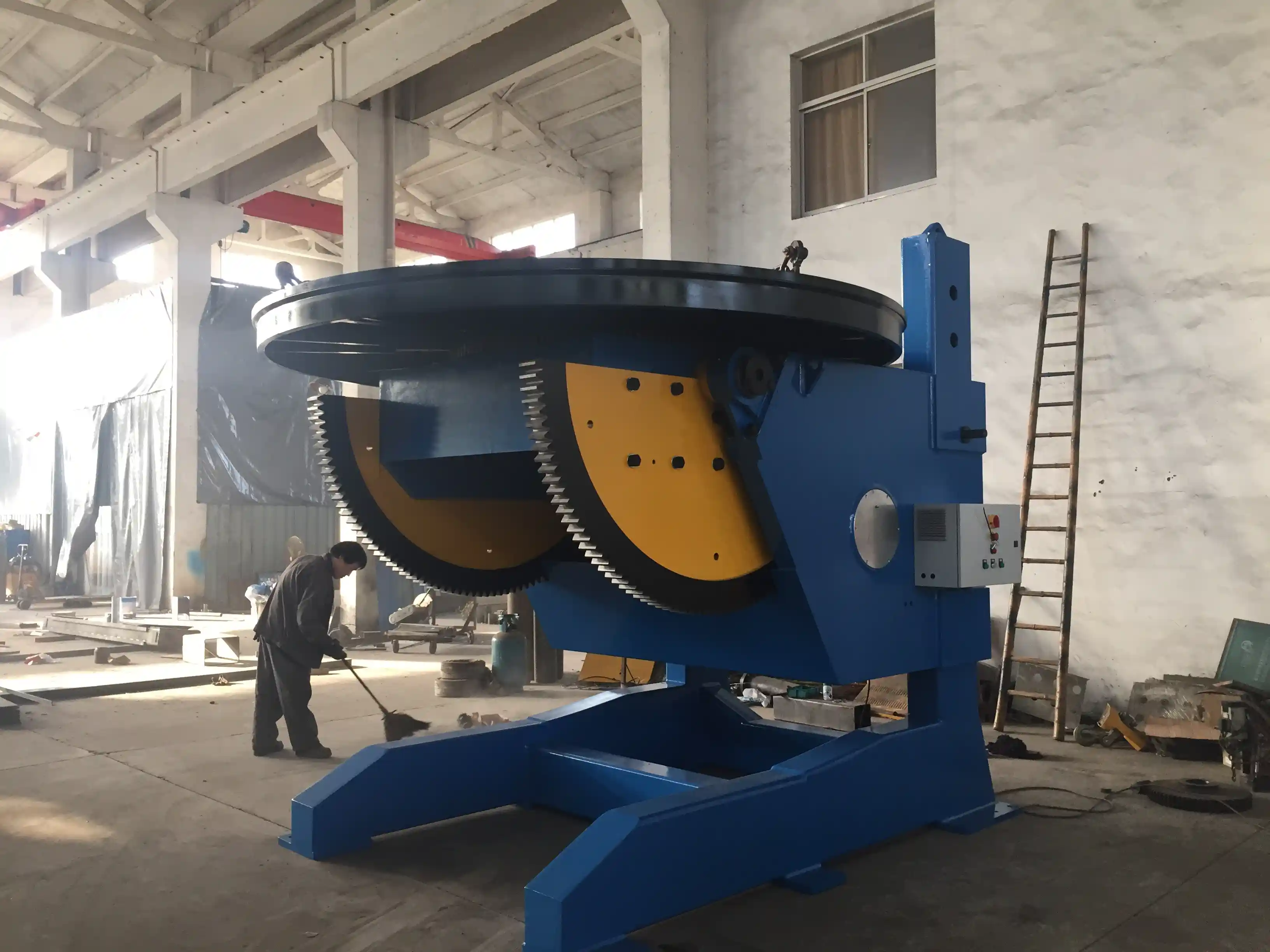 A typical high-volume line for mega sections starts with a fit-up station where two hydraulic alignment carriages bring sections into position. Then a welding manipulator on a column and boom travels alongside the rotator, laying down longitudinal seams. After that, a girth welding station uses a larger manipulator with tandem wire feed to join sections.
The key is coordination: the rotator’s rotation speed must synch with the manipulator’s travel and wire feed. PLC-based controls let you store programs for different section sizes. On one line we helped configure, the operator could switch from a 5.5-meter diameter to a 6.3-meter section with a recipe change in less than 10 minutes. That flexibility is critical when you serve multiple turbine models.
Heavy foundations are non-negotiable. A 300-ton rotator plus a 100-ton positioner, together with the workpiece, can exert several hundred tonnes of static and dynamic load. Plan for reinforced concrete pads at least 600 mm thick under each station. If ceiling height is limited, consider low-profile rotators like the HGK-60 low-profile model.
Selecting the Right Positioner and Rotator: Key Specifications
With many options, concentrate on three numbers: the maximum workpiece diameter, the heaviest section weight, and the required tilt or turning range. 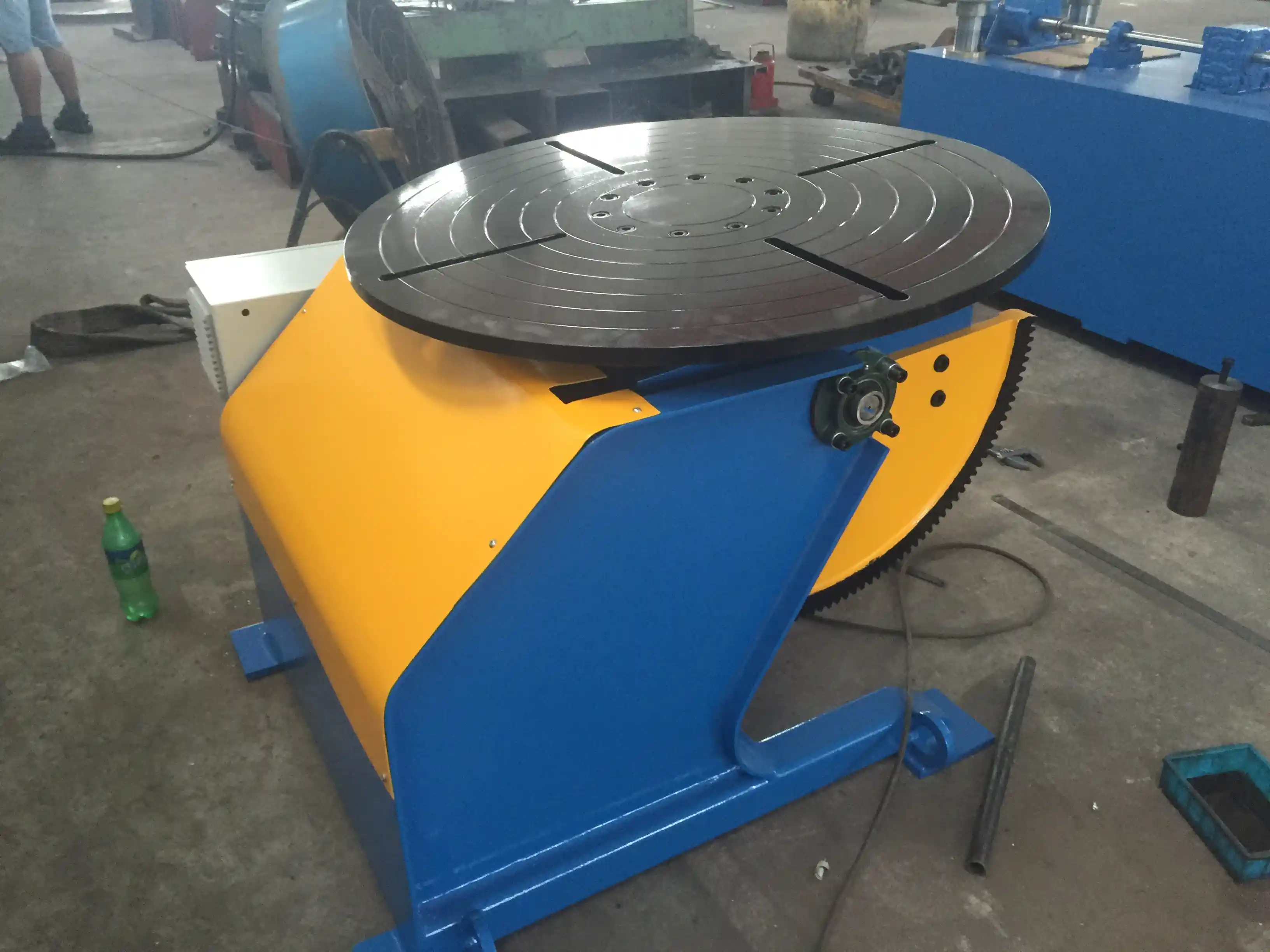 For a 6.2 meter section weighing 95 tonnes, the positioner must have a dynamic load rating above 100 tonnes and a tilt range of at least 90° (preferably 135° for access to internal rings). The rotator must have a wheel diameter and spacing to cradle a 6200 mm diameter without slipping, and anti-creep control.
Also check roller material. ZG45 cast steel rollers with 55-60 HRC hardness resist wear from the steel plate surface and provide good traction. PU rollers are more common on smaller rotators and are not suitable for heavy sections.
Precision specifications matter. Look for rotation accuracy of ±0.5° or better and positioning repeatability of 0.02 mm. These figures directly affect weld quality. If you see a positioner quoting ±1°, consider it only for rough positioning, not welding.
Common Questions About 6-Meter-Plus Wind Tower Production
Can we reuse our existing 60-ton rotators for 6-meter sections?
Possibly, but only if the rotator’s diameter range includes 6000 mm and the rollers are large enough to distribute the load. Most 60-ton units have a maximum vessel diameter around 4800 mm. Pushing beyond that risks roller overload and frame distortion. I have seen rotators permanently bent after running a single heavy section beyond their rated diameter. If your expected section weight is below the rated capacity but the diameter is near the limit, ask the manufacturer for a load-deflection analysis before using it.
What foundation do I need for a 100-ton positioner?
A 100-ton positioner plus a workpiece can create significant dynamic forces, especially during tilting. We recommend a reinforced concrete foundation with a minimum thickness of 600 mm for the base frame. Anchor bolts must be grade 8.8 or higher, torqued to specification. If you are on an upper-floor workshop, a structural engineer should evaluate floor loading. In one project, a 30-ton positioner on an insufficient floor caused cracking — not a risk worth taking.
How do we maintain alignment on such a long section?
Alignment relies on three things: a fit-up station with hydraulic alignment carriages that hold the section within ±0.5 mm, a rotator with self-aligning rollers that compensate for minor surface irregularities, and a seam tracking system on the welding manipulator. With longer sections, even small angular errors at one end translate to large displacement at the other. Laser alignment systems help, but the foundation stiffness and rotator frame rigidity are the first defense.
Is it better to invest in one mega-positioner or two separate units?
A single large positioner with both rotation and tilt capability reduces handling and set-up time, but can be costly. Two smaller positioners, one at each end, may work for long sections if they are synchronized. The choice depends on your production volume and section length. For lengths over 25 meters, I have found that a head-tail configuration with a heavy-duty headstock and tailstock provides better support and lower cost than a single massive positioner. However, the synchronization adds control complexity. Share your maximum section dimensions and throughput goals with us at jay@weldc.com, and we can help you weigh the trade-offs for your specific line.
If you’re interested, check out these related articles:
Achieving Perfect Welds on Large-Diameter Pipes with Professional Rolling Equipment
Exceptional Application Value: How Fixed-Height Welding Positioners Drive Advancements in Offshore and Shipbuilding Manufacturing
Ship Pipeline Coating Sagging Issues: How Intelligent Paint Roller Racks Boost Pass Rates to 98%
Pipe Rotators and Turning Rolls: Essential Equipment for Modern Pipeline Fabrication
Wind Tower Welding Challenges: How Advanced Hydraulic Lifting Systems Boost Production by 40%
 English
  Español
  Français
  Deutsch
  Português
  Русский