Storage tanks with high structural integrity keep showing up on more project lists, and the fabrication side of things gets complicated fast. Getting the shell rolling right and then making the welds actually work together—that’s where tanks either hold up for decades or start causing problems early. The whole sequence from raw plate to finished vessel has more interdependencies than most people realize, and small missteps in one stage tend to compound downstream.
Advanced Tank Shell Fabrication Fundamentals
Storage tanks serve as backbone infrastructure for oil and gas operations, chemical processing facilities, and water treatment plants worldwide. The fabrication process demands attention at every step because dimensional errors or material inconsistencies create cascading problems. Production schedules add pressure, but rushing through critical stages rarely ends well. Integrated systems that handle both shell rolling and welding within a coordinated workflow have become the practical answer to balancing throughput with quality requirements.
Shell Rolling Optimization for Cylindrical Tank Structures
The rolling stage sets up everything that follows. When cylindrical shells come off the rolling machine with inconsistent diameter or poor roundness, the welding crew inherits problems they can’t fully fix. Advanced plate rolling equipment with tight control systems produces shells that actually fit together properly. Material prep matters too—edge beveling and surface cleaning before cold forming reduces internal stresses and gives the welding process a better starting point. Skipping these steps or doing them halfway shows up later as fit-up headaches and weld defects.
Shell Rolling and Welding Integration Challenges in Tank Manufacturing
Several issues show up repeatedly when rolling and welding operations need to work together. Spring-back is probably the most persistent—metal wants to return toward its original flat state after rolling, and this creates ovality problems that complicate fit-up. When dimensional accuracy drifts during rolling, weld joint gaps become inconsistent, and the welding parameters that worked on one seam may not work on the next. Poor edge preparation introduces contamination or geometry problems that become defects once the arc starts. Controlling these variables through equipment capability and process discipline makes the difference between smooth production runs and constant troubleshooting.
Longitudinal and Circumferential Welding Integration
Both seam orientations need to produce sound welds without creating weak points where they intersect. Automation helps here because human welders, no matter how skilled, can’t maintain the same consistency over hundreds of meters of weld seam. Column and boom systems position the torch precisely and maintain consistent travel speed and standoff distance. Submerged Arc Welding handles the heavy lifting on thick-wall tanks—the high deposition rates and deep penetration produce welds that meet code requirements without excessive passes. Welding manipulators add the control and repeatability that pressure vessel and wind tower applications demand.
Automation Technologies and Tank Production Line Efficiency
Automated welding systems change the economics of tank production. Welding robots and column and boom manipulators work faster than manual welding and produce more consistent results. The labor reduction matters, but the quality consistency often matters more—every pass executes the same way, which means fewer repairs and more predictable inspection outcomes. Production line optimization through automation turns tank fabrication from a craft-dependent operation into a repeatable manufacturing process.
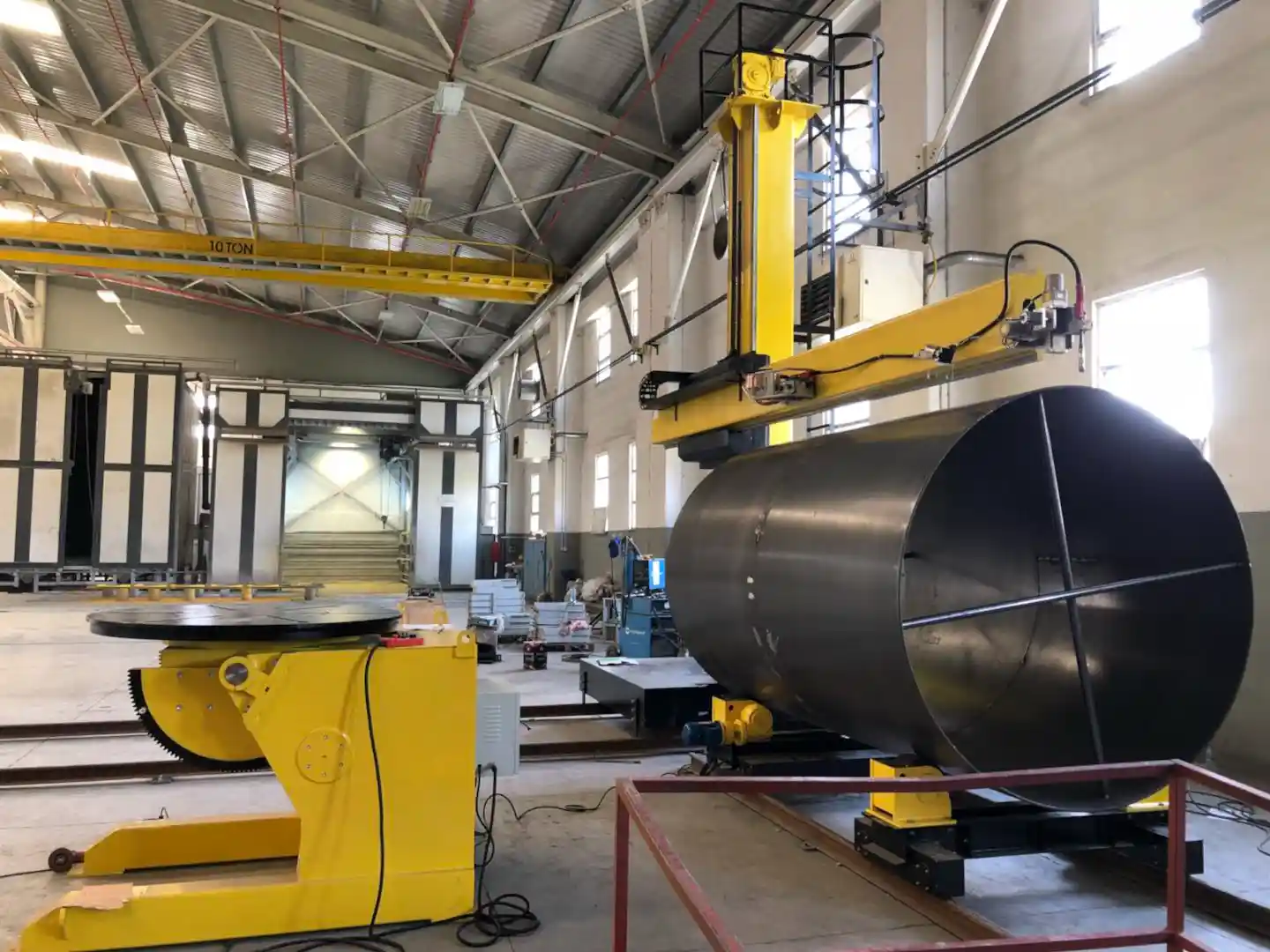
For additional perspective on managing floor space constraints while improving welding operations, the discussion in 《Workshop Space Too Small? How Column Booms Save 50% Floor Space While Boosting Safety & Efficiency》 covers relevant ground.
Quality Control for Tank Shell Integrity
Quality control catches problems before they become expensive. Non-destructive testing methods and inspection protocols throughout fabrication identify defects while correction is still practical. Waiting until final inspection to discover issues means rework or scrap, neither of which helps the schedule or budget. Systematic welding quality control ensures tanks actually meet the safety and performance standards they’re supposed to meet.
Critical Quality Control Measures for Tank Shell Fabrication
Several testing methods work together to verify tank integrity. Visual inspection catches surface defects and confirms proper weld bead appearance—it’s simple but catches a lot of problems early. Ultrasonic testing finds internal flaws like cracks or inclusions that don’t show on the surface. Radiographic testing gives a comprehensive internal view of weld structure, revealing discontinuities that other methods might miss. Hydrotesting comes last, verifying leak-tightness and structural soundness under actual pressure conditions. Each method addresses different failure modes, and skipping any of them leaves gaps in the quality picture.
WUXI ABK MACHINERY Integrated Tank Production Solutions
WUXI ABK MACHINERY CO., LTD. builds equipment for integrated tank production, drawing on experience in welding automation and CNC cutting systems. The product range includes welding manipulators and positioner equipment designed for the precision and throughput that tank fabrication requires. The LH8080 Welding Manipulator provides 8000 mm of horizontal and vertical travel with ±0.1 mm/m positioning accuracy—specifications that matter for large-scale tank work. The 3 Axis Welding Positioner handles 3-ton loads with ±0.05 mm positioning accuracy, making it suitable for robotic welding cells. These systems connect shell rolling and welding processes into a coordinated production flow.
| Product Model | Load Capacity | Positioning Accuracy | Key Features | Applications |
|---|---|---|---|---|
| Welding Manipulator LH8080 | N/A | ±0.1 mm/m | 8000mm travel, 360° rotation | Storage tank manufacturing, Wind tower welding |
| 3 Axis Welding Positioner (3 Tons) | 3000 kg | ±0.05 mm | 360° rotation, 0-90° tilt | Robotic welding stations, Pressure vessel welding |
| 5 Tons Adjustable Height Positioner | 5000 kg | ±0.5° | Hydraulic lifting, dual-motor drive | Wind towers, Pressure vessels |
| HGZ-30 Standard Welding Rotator | 30 tons | ±0.1mm/m | Anti-creep technology, PLC control | Pressure vessel fabrication, Wind tower production |
| 40 Ton Pipe Fit-Up Rotator | 40 tons | ±0.5mm | Hydraulic alignment, dual 4kW motor | Subsea pipeline fit-up, Large vessel fabrication |
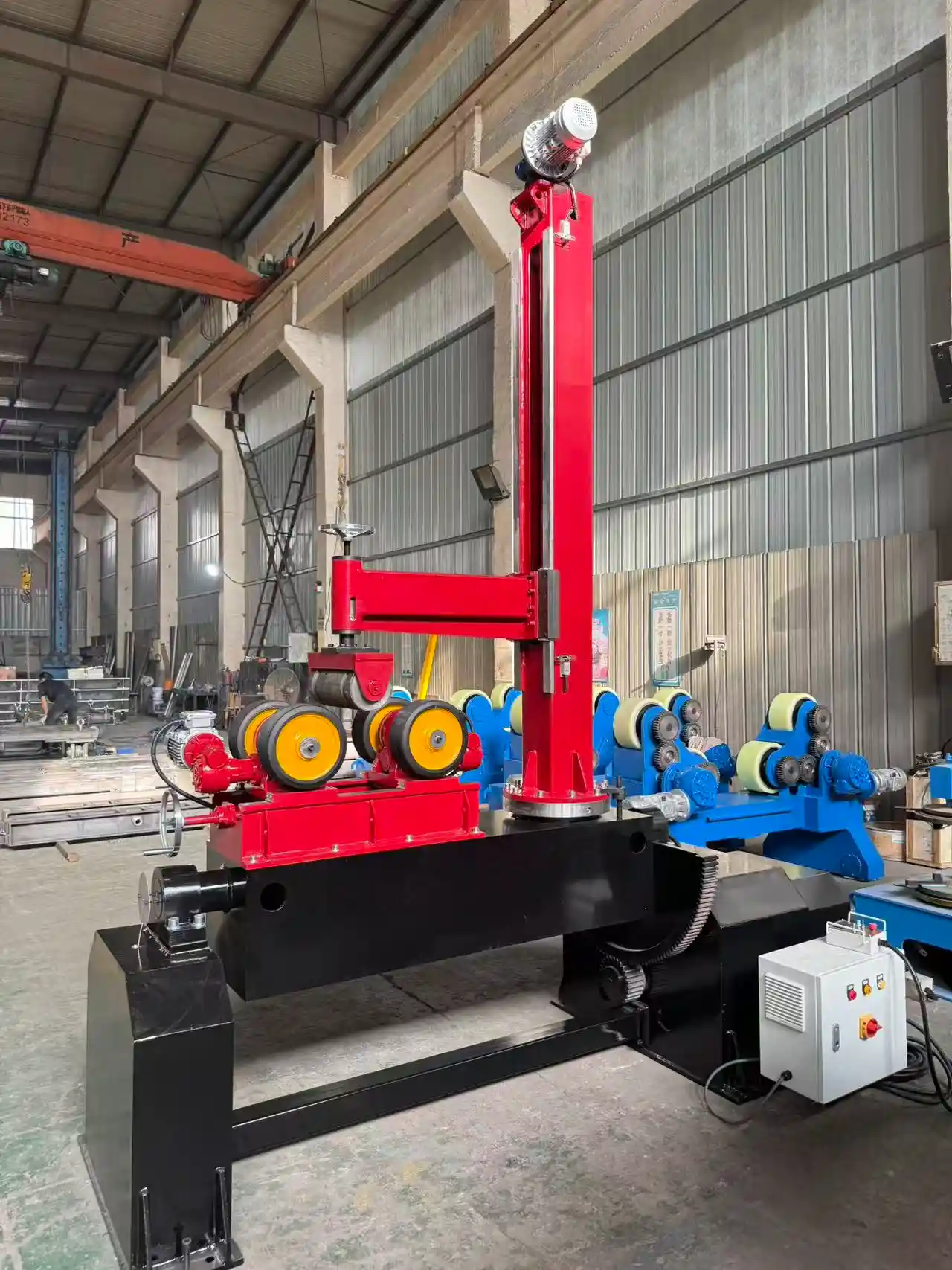
Custom welding lines tailored to specific requirements remain part of the offering, addressing the reality that heavy machinery fabrication often involves unique configurations.
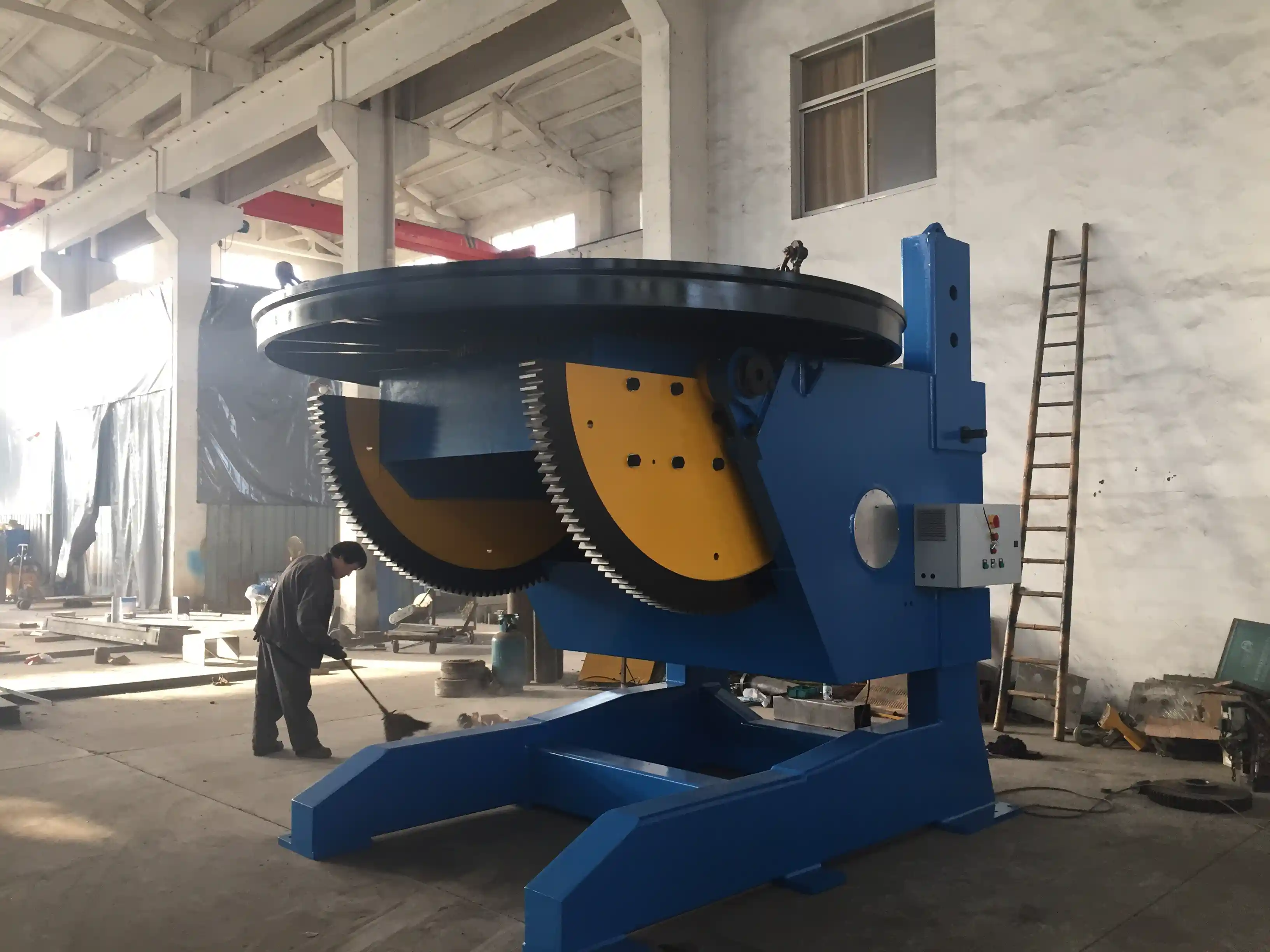
For those working on tank and pressure vessel manufacturing improvements, 《Improving Quality and Efficiency in Tank and Pressure Vessel Manufacturing: The Core Application Value of Positioners》 provides relevant technical discussion.
Integrated Tank Manufacturing Going Forward
Tank manufacturing will continue moving toward greater automation and smarter process control. Intelligent welding robots with real-time monitoring that can predict and prevent defects represent the direction of development. Industrial automation will enable more customization without sacrificing production speed. Sustainable practices focused on energy efficiency and material waste reduction will factor into equipment selection and process design. Manufacturers who adopt integrated solutions position themselves to handle evolving requirements and competitive pressures.
Tank Production Capability Enhancement
WUXI ABK MACHINERY CO., LTD. provides shell rolling and welding integration solutions for tank manufacturers looking to improve their operations. Contact us at +86-13815101750 or jay@weldc.com to discuss specific project requirements and production line optimization.
What are the primary benefits of an integrated tank manufacturing line combining shell rolling and welding?
An integrated tank manufacturing line improves production efficiency, reduces material handling between stations, tightens dimensional accuracy of tank shells, and produces better weld quality. The coordinated approach eliminates bottlenecks and optimizes the complete fabrication sequence, resulting in higher output and lower operational costs.
How does WUXI ABK MACHINERY ensure precision in cylindrical shell forming for large tanks?
WUXI ABK MACHINERY uses plate rolling machines with precise control systems and robust mechanical designs to achieve accurate cylindrical shell forming. The equipment accounts for material properties and spring-back behavior, producing consistent diameter and roundness that subsequent welding operations require.
What types of welding automation does WUXI ABK offer for tank shell integration?
WUXI ABK MACHINERY provides welding manipulators, column and boom systems, and specialized pipe welders for tank shell integration. These systems handle both longitudinal and circumferential seam welding, using processes like Submerged Arc Welding to produce consistent, high-quality welds.
Can WUXI ABK MACHINERY provide custom solutions for unique tank manufacturing requirements?
WUXI ABK MACHINERY designs and manufactures custom welding equipment and CNC cutting machines for specific client applications. The engineering team develops tank manufacturing lines that integrate shell rolling and welding processes according to particular project specifications.
 English
  Español
  Français
  Deutsch
  Português
  Русский