As an after-sales engineer, I frequently encounter questions regarding the optimal deployment of tank rollers in diverse fabrication environments. Proper installation and setup of these essential tools directly influence welding quality, operational efficiency, and workplace safety. We aim to provide clear, actionable guidance to ensure your fabrication shop maximizes the benefits of this technology.
Understanding the Critical Role of Tank Rollers in Modern Fabrication
Tank rollers, also known as welding rotators or turning rolls, are indispensable equipment in modern fabrication shops. They provide controlled rotation of cylindrical workpieces, enabling welders to maintain a consistent, ergonomic position for optimal weld quality. This capability significantly improves productivity and safety when handling large, heavy, or irregularly shaped cylindrical components.
1. Defining Tank Rollers and Their Core Functionality
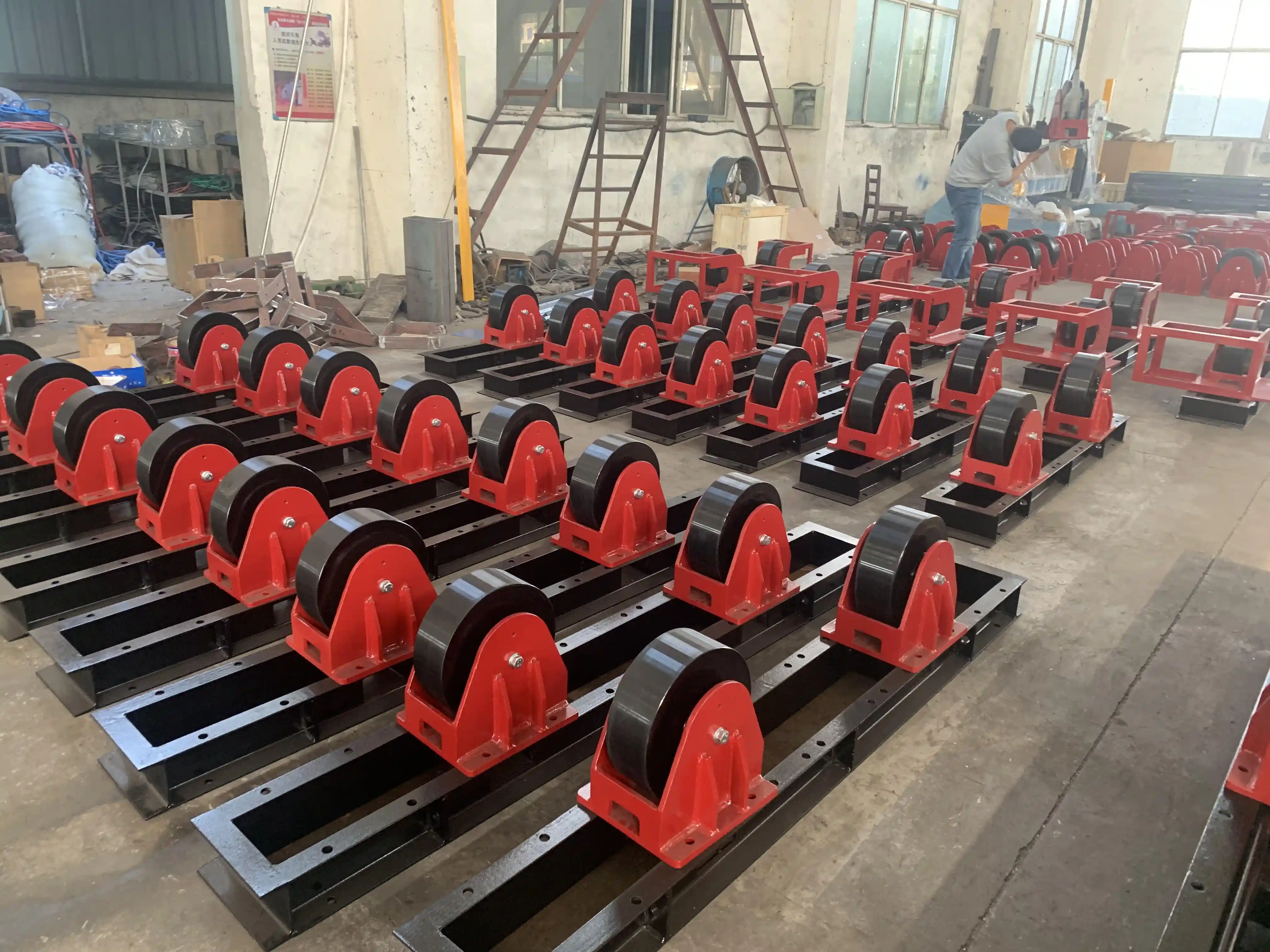
Tank rollers are specialized machines designed to support and rotate cylindrical workpieces during welding, grinding, cutting, or painting operations. They typically consist of a powered drive unit and one or more idler units, each equipped with robust rollers. The drive unit rotates the workpiece at a controlled speed, while the idler units provide essential support. This controlled rotation allows continuous welding, reducing stop-start operations and minimizing defects. We find these systems particularly effective for circumferential seam welding on vessels and pipes.
2. Key Benefits of Integrating Tank Rollers into Welding Workflows
Integrating tank rollers into welding workflows offers numerous advantages for fabrication shops. Firstly, they significantly enhance welding quality by providing stable and consistent rotation, which allows for continuous, uniform weld beads. This consistency minimizes defects, reduces rework, and improves the structural integrity of the fabricated components. Secondly, productivity increases because welders can work in optimal positions, reducing fatigue and accelerating the welding process. For instance, continuous welding passes eliminate the need for frequent repositioning. Thirdly, tank rollers improve safety by securely holding heavy and cumbersome workpieces, thereby reducing the risk of accidents associated with manual handling. Furthermore, they optimize material flow and reduce crane dependency, streamlining overall production.
3. Types of Tank Rollers and Their Specific Applications
Tank rollers come in various configurations, each suited for specific applications. Standard Welding Rotators (HGZ Series) are versatile, handling a wide range of cylindrical workpieces with capacities from 5 to 100 tons. These are ideal for general tank and pipe fabrication. Adjustable Height Welding Rotators (HGK Series) offer hydraulic or mechanical height adjustment, accommodating workpieces of varying diameters and allowing for precise alignment with other equipment, such as welding manipulators. Fit-Up Welding Rotators are specifically designed for assembling and aligning cylindrical sections before welding, ensuring precise fit-up and minimizing gaps. Each type addresses distinct fabrication challenges, contributing to overall efficiency and quality.
Step-by-Step Guide to Tank Roller Installation and Setup
Proper installation and setup are crucial for the safe and efficient operation of tank rollers. Following a systematic approach ensures optimal performance and extends the equipment’s lifespan.
1. Site Preparation and Foundation Requirements for Optimal Performance
Before installing any tank roller system, thorough site preparation is essential. The chosen location must have a level, stable concrete foundation capable of supporting the combined weight of the machine and the maximum workpiece load. We recommend a minimum concrete thickness of 200mm for most standard units, with heavier models requiring specialized foundations. Ensure adequate space surrounds the rollers for safe loading, unloading, and operator access. Additionally, consider overhead clearance for cranes or other lifting equipment. Proper ventilation and lighting are also critical for a safe working environment.
2. Unpacking and Assembling Your Tank Roller System Safely
Unpack all components carefully, verifying against the packing list to ensure everything is present and undamaged. For larger units, use appropriate lifting equipment, such as overhead cranes or forklifts, ensuring they meet the weight requirements. Assemble the drive and idler units according to the manufacturer’s instructions, paying close attention to bolt torques and alignment. We advise having at least two trained personnel for assembly to ensure safety and accuracy. Always follow lockout/tagout procedures during assembly.
3. Electrical Connections and Control System Integration for Seamless Operation
Connect the electrical power supply according to local codes and the manufacturer’s specifications. Ensure the voltage and frequency match the equipment requirements (e.g., 380V 50Hz 3-phase for WUXI ABK models). Properly ground all components to prevent electrical hazards. Integrate the control system, which often includes a PLC and HMI touchscreen, following the provided wiring diagrams. Test all emergency stop buttons and safety interlocks before proceeding. This step ensures safe and efficient operation.
4. Initial Calibration and Testing Procedures for Accuracy
After assembly and electrical connection, perform initial calibration and testing. First, verify roller alignment using a spirit level and measuring tools to ensure the rollers are parallel and level. Next, test the rotation speed control across its full range (e.g., 0.05-0.5 RPM for many models), confirming smooth and consistent movement. Load a test workpiece, if available, and observe its rotation for any wobbling or misalignment. Adjust roller spacing and height as needed to achieve stable rotation.
Optimizing Tank Roller Performance in Your Fabrication Shop
Achieving peak performance from your tank rollers requires adherence to best practices and proactive maintenance. These steps ensure consistent quality and operational efficiency.
1. Best Practices for Loading and Securing Workpieces on Rollers
Properly loading and securing workpieces prevents accidents and ensures stable rotation. Always use appropriate lifting equipment, such as cranes or forklifts, to place the workpiece onto the rollers. Position the workpiece centrally on both the drive and idler units to distribute the load evenly. Adjust the roller spacing to match the workpiece diameter, ensuring secure contact without excessive pressure. For tapered or irregularly shaped items, use specialized supports or additional idler units. Verify stability before initiating rotation.
2. Adjusting Roller Speeds and Alignments for Diverse Welding Projects
Optimal welding results depend on precise control over roller speeds and alignments. Adjust the rotational speed to match the welding process, material type, and desired weld bead characteristics. Slower speeds are typically used for root passes, while faster speeds suit fill and cap passes. Regularly check and adjust roller alignment to prevent workpiece creep or spiral movement, which can compromise weld quality. Some advanced systems feature automatic alignment functions for enhanced precision.
3. Integrating Tank Rollers with Automated Welding Systems
Integrating tank rollers with automated welding systems, such as robotic arms or welding manipulators, significantly boosts productivity and precision. Ensure compatibility between the tank roller’s control system (e.g., PLC) and the automated welding equipment. Synchronize the rotational speed of the rollers with the welding torch travel speed to maintain a consistent welding parameter. This integration allows for continuous, unmanned welding operations, drastically reducing cycle times and improving weld consistency. You may find more information on this topic in A New Era in Pipeline Welding Manufacturing: Precision Collaboration Between Positioners and Turning Rolls.
4. Essential Safety Protocols and Maintenance Tips for Longevity
Safety is paramount when operating heavy machinery. Implement strict lockout/tagout procedures during maintenance or repairs. Ensure all operators receive comprehensive training on safe operating procedures, including emergency stops and load limits. Regularly inspect rollers for wear, damage, or debris, and clean them as needed. Lubricate moving parts according to the manufacturer’s schedule to prevent premature wear. Periodically check electrical connections and control systems for faults. Adhering to these protocols ensures both operator safety and equipment longevity.
Selecting the Right Tank Roller for Your Fabrication Needs
Choosing the correct tank roller is critical for maximizing efficiency and achieving desired fabrication outcomes. Several factors influence this decision.
1. Evaluating Load Capacity and Workpiece Dimensions for Compatibility
The primary consideration is the load capacity and the range of workpiece dimensions your projects require. Assess the maximum weight and diameter of the cylindrical components you will handle. WUXI ABK offers a range of tank rollers with capacities from 5 tons (e.g., HGZ-5 Standard Welding Roller) to 300 tons (e.g., HGK-300 Auto Height Adjusting Welding Rotator). Ensure the selected model’s vessel diameter range accommodates your typical workpiece sizes. Overloading or using an undersized rotator can lead to equipment failure and safety hazards.
2. Comparing Adjustable Height vs. Fixed Height Rotators
Both adjustable height and fixed height rotators serve distinct purposes. Fixed Height Positioner Manufacturers are simpler, more economical, and suitable for consistent workpiece sizes and production lines. For example, our HBJ-10 1-Ton Fixed Height Welding Positioner is excellent for repetitive tasks. Adjustable Rotator Manufacturers, such as the WUXI ABK HGK Series, provide flexibility for varying workpiece diameters and integration with other machinery, offering hydraulic or mechanical height adjustments. This adjustability is beneficial for shops handling diverse projects or requiring precise alignment with automated welding systems.
3. Considering Features like Anti-Creep and PLC Control for Precision
Advanced features enhance precision and automation. Anti-creep mechanisms prevent cylindrical workpieces from drifting axially during rotation, maintaining weld seam alignment. PLC control systems allow for programmable welding sequences, precise speed control, and integration with robotic systems, improving repeatability and reducing manual intervention. For example, our HGZ-30 Standard Duty Welding Rotator features anti-creep technology and a touchscreen PLC with 20 preset programs. These features are crucial for high-quality, automated fabrication.
4. WUXI ABK Solutions for Enhanced Welding Productivity
WUXI ABK offers a comprehensive range of tank rollers designed to meet diverse fabrication needs. Our Adjustable Rotator Manufacturers provide flexibility for various workpiece sizes and integration with automated systems. The Standard Rotator Suppliers (HGZ Series) are robust and reliable for general-purpose applications. For specialized tasks requiring precise alignment, our Fit-Up Rotator Suppliers ensure optimal pre-weld conditions. We focus on delivering solutions that enhance welding quality, increase productivity, and ensure operator safety.
| Caraterística | WUXI ABK HGZ-10 (Standard) | WUXI ABK HGK-10 (Adjustable Height) | WUXI ABK 10 Ton Heavy Duty Fit-Up Rotator (Fit-Up) |
|---|---|---|---|
| Capacidade de carga | 10 toneladas | 10 toneladas | 50-ton combined load |
| Vessel Diameter | 320-2800mm | 300-3200mm | 1.5-6m |
| Controlo de velocidade | 100-1000mm/min (stepless) | 0.5-3 RPM (stepless) | 0.1-1.2m/min (stepless) |
| Positioning Acc. | ±0,1mm | ±0,1mm | ±0,5mm |
| Caraterísticas principais | ZG45 cast steel rollers, Siemens PLC, optional wireless | Dual-motor drive, precision sliding track, quick-lock | Hydraulic lifting, laser guidance, remote diagnostic |
| Aplicações | Wind tower flange welding, pressure vessel manufacturing | Wind tower flange welding, large-diameter pipe welding | Municipal pipeline fit-up, pressure vessel segment welding |
Real-World Applications of Tank Rollers in Various Industries
Tank rollers are integral to many heavy industries, facilitating the fabrication of large cylindrical structures with precision and efficiency.
1. Enhancing Efficiency in Pressure Vessel and Boiler Fabrication
In pressure vessel and boiler fabrication, tank rollers are essential for welding cylindrical shells and dished ends. They enable continuous circumferential welding, which minimizes heat input variations and reduces distortion. This leads to higher quality welds that meet stringent industry standards. The use of tank rollers also improves safety by securely holding heavy components, preventing accidental movement during welding. Our solutions contribute to the efficiency of pressure vessel manufacturing. For further reading, consider Wuxi ABK Professional Welding Rotary Equipment: Precision Welding Solution for Pressure Vessel Manufacturing.
2. Streamlining Wind Tower Section Welding and Assembly
Wind tower sections are large, conical, or cylindrical structures that require precise welding and assembly. Tank rollers provide the necessary support and rotation for these massive components, allowing for automated welding of girth seams. This streamlines the manufacturing process, reduces production time, and ensures the structural integrity required for wind energy applications. Adjustable height models are particularly useful for handling varying section diameters and integrating with other automated systems. To learn more, check Wind Tower Welding Challenges: How Advanced Hydraulic Lifting Systems Boost Production by 40%.
3. Improving Quality in Pipe and Large Diameter Vessel Manufacturing
For pipe and large diameter vessel manufacturing, tank rollers are critical for achieving high-quality welds. They facilitate precise rotation, ensuring consistent weld bead geometry and penetration. This consistency is vital for applications demanding high structural integrity, such as oil and gas pipelines or large storage tanks. Fit-up rotators play a crucial role in aligning pipe sections accurately, reducing misalignment issues that can lead to costly rework. You may also find Pipe Welding Misalignment Issues: How Intelligent Welding Pipe Rotators Boost Oil Pipeline Pass Rates insightful.
Inquire About Our Welding Automation Solutions
Elevate your fabrication capabilities with WUXI ABK’s advanced tank rollers and welding automation equipment. Our team of experts is ready to provide tailored solutions that enhance your welding quality, boost productivity, and ensure operational safety. Contact us today to discuss your specific requirements and discover how our innovative technology can transform your production processes.
Correio eletrónico: jay@weldc.com
Telemóvel: +86-13815101750
About the Author
Michael Zhou, Project Manager
Michael Zhou, an expert in welding automation, specializes in designing and optimizing welding lines and equipment. He helps enterprises improve welding efficiency and achieve higher-quality automated production.
FAQs
1. What are the primary safety considerations when operating tank rollers?
Safety is paramount. Always ensure proper grounding, operate within specified load capacities, and use appropriate lifting equipment for loading and unloading workpieces. Implement strict lockout/tagout procedures during maintenance. Operators must receive thorough training on emergency stops and safe operating practices to prevent accidents.
2. How do I choose the correct load capacity for my tank roller?
To choose the correct load capacity, identify the heaviest cylindrical workpiece you intend to process. Select a tank roller system with a rated capacity exceeding this maximum weight. Consider both static and dynamic loads, and factor in any eccentric loading scenarios to ensure stability and prevent equipment damage.
3. Can tank rollers be integrated with robotic welding systems?
Yes, many modern tank rollers feature PLC control systems designed for seamless integration with robotic welding systems. This allows for synchronized rotation and welding operations, enhancing precision, repeatability, and overall automation. Ensure the control interfaces are compatible for effective integration.
4. What is the typical maintenance schedule for welding rotators?
A typical maintenance schedule includes daily inspections for wear and debris, weekly lubrication of moving parts, and monthly checks of electrical connections and safety interlocks. Annual comprehensive overhauls should involve replacing worn components, re-greasing, and recalibrating the system to maintain optimal performance.
5. How do adjustable height tank rollers benefit complex fabrication projects?
Adjustable height tank rollers provide crucial flexibility for complex projects involving workpieces of varying diameters or when precise alignment with other welding equipment is necessary. Their ability to adjust vertically ensures optimal positioning for welding, reducing setup times and accommodating diverse fabrication requirements efficiently.
 English
  Español
  Français
  Deutsch
  Português
  Русский