In modern tank manufacturing workshops, an impressive scene of industrial automation is becoming commonplace: giant tank cylinders with diameters exceeding thirty meters rotate smoothly on heavy-duty turning rollsenquanto as tochas de soldadura montadas em manipuladores de lança de coluna trace perfect welding paths along the circumferential seams. This seemingly simple yet technically sophisticated equipment combination is profoundly changing the quality standards and production efficiency of the traditional tank manufacturing industry. As global energy storage and chemical storage project scales continue to expand, requirements for tank welding quality and construction progress are increasingly stringent. Traditional manual welding methods can no longer meet the rigorous demands of modern tank engineering for welding quality consistency and production speed.
A inovação tecnológica da tank welding systems has brought revolutionary solutions to tank manufacturing enterprises. The precise coordination between welding manipulators and turning rolls creates an almost ideal welding environment: the tank body maintains stable rotation while achieving precise torch positioning. This innovative equipment combination not only ensures the stability of the entire welding process but, more importantly, guarantees that every circumferential weld can be completed in the optimal welding position. For thick-walled tanks requiring multi-layer, multi-pass welding, this stability means each weld layer can achieve ideal fusion, ultimately forming a dense and uniform weld structure, thereby ensuring the overall quality and service life of the tank.
Technical Challenges and Innovative Solutions in Tank Manufacturing
The development of modern tank engineering presents higher requirements for welding technology. Current large-scale tank projects typically feature diameters exceeding thirty meters, heights reaching twenty meters, wall thicknesses of forty millimeters, with single section cylinder weights over fifty tons. These oversized workpieces face numerous special challenges during welding: continuity and consistency of circumferential welds, straightness control of longitudinal welds, effective control of welding deformation, and most critically, stability of welding quality assurance. These challenges not only affect production efficiency but are directly related to the safe operation of the tank system.
Tank rotating rollers provide an ideal rotating platform for tank welding through their precise speed control systems. This equipment ensures stable rotation speed of tank cylinders during the welding process, laying the foundation for welding quality stability. Combined with the precise control of large manipulators, accurate tracking and positioning of welding torches on tank circumferential seams is achieved. This innovative equipment combination effectively solves the core technical challenge in tank welding—how to maintain stable welding position and process parameters during prolonged welding operations. According to actual application data statistics, this automated welding system can improve welding efficiency by 3-5 times while increasing the first-pass weld qualification rate to over 99.8%, leading the industry.
Core Technical Elements for Ensuring Tank Welding Quality
In the tank welding manufacturing process, the quality of circumferential welding is a key factor determining the reliability of the entire tank system. The successful implementation of tank circumferential welding depende principalmente de três elementos fundamentais: controlo estável da velocidade de rotação, sistema preciso de posicionamento da tocha e rigidez estrutural fiável do equipamento. Precision roller systems achieve stepless speed regulation within the 0.1-120rpm range through advanced frequency control technology, ensuring speed stability under various welding process requirements. This precise speed control directly determines the uniformity of welding heat input and is the primary condition for avoiding welding defects.Simultaneously, welding operating equipment maintains the optimal relative position between the torch and tank groove through its robust mechanical structure and precise transmission system. Even during continuous welding operations lasting several hours, it ensures the torch continuously and accurately tracks the weld trajectory. This precise control capability is decisive for guaranteeing tank circumferential weld quality, directly affecting the service life and safe operation performance of the tank system. Modern welding equipment is also equipped with real-time monitoring systems that can continuously monitor and record various parameters during the welding process, providing complete data support for quality traceability.
Practical Application of Automated Welding Systems in Tank Manufacturing
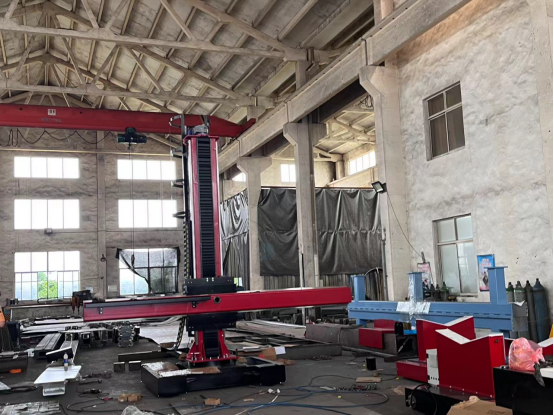
In the production system of modern tank manufacturing plants, the collaborative operation of welding manipulators and turning rolls has formed a standardized production mode. Typical equipment configuration includes a set of heavy roller groups e um large welding manipulator. Depending on specific tank diameter and height requirements, multiple sets of turning rolls can be configured for collaborative work. This flexible configuration scheme can adapt to welding requirements for various specifications of tanks with diameters of 10-40 meters, heights of 20 meters, and weights up to 100 tons, demonstrating excellent equipment adaptability and versatility.
For tanks of different specifications and materials, this welding system demonstrates excellent adaptability. During circumferential welding of standard tanks, the turning rolls drive the cylinder to maintain uniform rotation while the manipulator’s torch remains fixed, achieving ideal flat position welding. When welding large-diameter tanks, the system can configure multiple sets of turning rolls for synchronous drive, ensuring excellent stability and roundness of extra-large cylinders during rotation. This flexible configuration scheme enables one system to meet the welding requirements of various specification tanks, significantly improving equipment utilization and return on investment. Additionally, the system can adjust welding parameters and rotation speed according to different welding process requirements, ensuring optimal welding quality for each type of tank.
Advanced Welding Processes for Special Material Tanks
With the diversified development of tank materials, welding of special materials such as stainless steel, aluminum alloy, and corrosion-resistant alloys places higher demands on equipment. These special materials often have extremely strict requirements for heat input control and interpass temperature management, where any parameter deviation may lead to welding quality issues. Sistemas de soldadura inteligentes conseguir uma gestão precisa e a otimização de vários parâmetros de processo durante a soldadura através da tecnologia de controlo digital colaborativo.
When welding special material tanks, rolos giratórios ajustáveis pode controlar com precisão a velocidade de rotação de acordo com os requisitos específicos do processo de soldadura, garantindo que cada camada de soldadura é concluída dentro da gama ideal de entrada de calor. Entretanto, automatic welding manipulators monitor and adjust welding parameters in real-time, ensuring the optimal welding thermal cycle is maintained throughout the welding process. This intelligent collaborative control system effectively guarantees the performance consistency of special material tank welded joints, providing reliable technical support for the safe operation of tank systems. The system is also equipped with a comprehensive process database that can store and call welding parameters for different materials, greatly improving production standardization.
Scientific Selection Points for Professional Tank Welding Equipment
Selecting suitable tank welding equipment requires comprehensive consideration of multiple technical and economic factors. First, equipment performance parameters must fully meet production requirements. The load capacity of tank welding machinery needs to fully consider the weight distribution characteristics and rotational inertia of tank cylinders, ensuring excellent stability and safety during equipment operation. The speed range of turning rolls must comprehensively cover all tank welding process requirements, while the operating accuracy of manipulators must meet the special needs of tank circumferential welding—these are key technical indicators to consider during selection.
Second is equipment reliability and environmental adaptability. Tank welding operations typically require continuous uninterrupted operation for several hours, and the equipment must withstand the severe test of long-term continuous work. Choosing professional fabricantes de equipamento de soldadura é crucial. Estes fabricantes experientes utilizam normalmente componentes de alta qualidade e processos de fabrico rigorosos, fornecendo apoio técnico completo e garantias de assistência. Além disso, o nível de inteligência do equipamento é uma importante consideração de seleção moderna. Avançado equipamento de soldadura de reservatórios devem possuir funções inteligentes, tais como armazenamento de parâmetros de processo, monitorização do processo de soldadura e rastreabilidade dos dados de qualidade. Estas funções são importantes para garantir a qualidade da soldadura e melhorar a eficiência da produção.
Tecnologias-chave para a configuração de sistemas e otimização de processos
When configuring tank welding systems, several key technical details require special attention. The driving method of turning rolls directly affects the stability of tank rotation. Modern servo direct drive systems have better control accuracy and reliability than traditional chain drives. The material and structural design of rollers largely determine equipment service life and maintenance costs. Polyurethane-coated rollers have better friction performance and tank protection effects than traditional steel rollers. For welding large-diameter thin-walled tanks, special attention must be paid to the synchronization control accuracy of multiple turning roll groups, as any slight non-synchronization may cause tank deformation or welding defects.
Professional equipment factories can usually provide customers with complete process solutions, including equipment selection recommendations, process development support, installation and debugging services, and technical training. They also provide customized function configurations according to customers’ specific production needs. For example, specialized welding process packages for specific tank materials, or data interface solutions integrated with factory production management systems. These professional value-added services can help enterprises quickly achieve the technical benefits of automated welding, shorten equipment debugging cycles, and improve return on investment.
Tendências de Desenvolvimento Inteligente e Direcções de Inovação Tecnológica
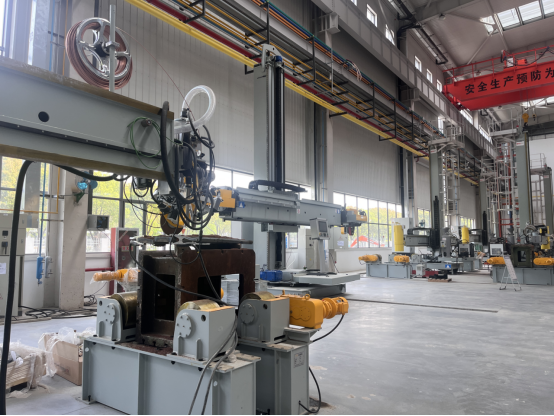
With the rapid development of industrial Internet of Things technology, the combination of welding manipulators and turning rolls is evolving toward comprehensive digitalization and intelligence. The next generation of sistemas de soldadura inteligentes integrará mais dispositivos de deteção e algoritmos de controlo mais avançados para conseguir uma otimização autónoma e uma tomada de decisões inteligente no processo de soldadura. Através da análise de grandes volumes de dados e da tecnologia de aprendizagem automática, o sistema pode aprender autonomamente os parâmetros ideais do processo a partir de dados históricos de soldadura e fazer ajustes adaptativos dos parâmetros de acordo com as condições de trabalho em tempo real, melhorando continuamente a qualidade e a eficiência da soldadura.
The deep application of digital twin technology will bring a brand-new change to tank welding manufacturing. Equipment digital models built in virtual space can real-time map the operating status of physical equipment, achieving online optimization of process parameters and predictive maintenance of equipment health. Engineering technicians can real-time manage multiple welding workstations through remote monitoring platforms, significantly improving the refinement level of production management and operational efficiency. This intelligent management mode not only improves equipment utilization but also reduces labor costs, providing strong support for enterprises’ sustainable development.
Vias de inovação tecnológica no contexto do fabrico ecológico
In the context of green manufacturing and sustainable development, the tank manufacturing industry places higher requirements on energy conservation and environmental protection. New-generation welding equipment is developing toward higher efficiency and environmental friendliness. High-efficiency welding systems utilizam uma tecnologia avançada de retorno de energia para converter a energia cinética gerada durante a travagem do equipamento em energia eléctrica de retorno à rede, reduzindo significativamente o consumo de energia operacional e os custos de funcionamento do equipamento. Os sistemas inteligentes de gestão de energia podem otimizar a eficiência da utilização de energia do equipamento em tempo real, de acordo com os requisitos do processo de soldadura, conseguindo uma gestão de energia refinada.
Entretanto, os fabricantes de equipamento também estão a prestar mais atenção à compatibilidade ambiental dos materiais e ao impacto ambiental do ciclo de vida completo do equipamento. Através da conceção ecológica, modern welding equipment is easier for component replacement and system upgrades, effectively extending equipment service life and reducing resource consumption and waste generation. These technological innovations not only help manufacturing enterprises reduce operating costs and improve market competitiveness but also make positive contributions to the sustainable development of the entire tank manufacturing industry. Additionally, environmental indicators such as noise control and electromagnetic radiation protection during equipment operation are receiving increasing attention, reflecting enterprises’ social responsibility for environmental protection.
Technological innovation in the tank welding field continues to advance, with soluções de soldadura automatizadas trazendo vantagens competitivas significativas para as empresas transformadoras. Escolher uma empresa fiável parceiros de fabrico de equipamento and establishing long-term technical cooperation relationships can ensure enterprises receive continuous professional support in equipment updates and technological upgrades. In the future, with the deep application of intelligent technology, the collaboration between welding manipulators and turning rolls will become more precise and intelligent, providing more advanced and reliable manufacturing solutions for the tank manufacturing industry, promoting the continuous improvement of global tank engineering construction levels, and making greater contributions to the development of world energy storage facilities.
solução de soldadura automatizada:
modern welding equipment:
https://www.weldmc.com/product-category/welding-automation/
tank welding equipment:
https://www.weldmc.com/product-category/welding-automation/tank-welding-equipment/
tank rotating roller:
https://www.weldmc.com/product-category/welding-automation/welding-rotator/
large welding manipulator:
https://www.weldmc.com/product/welding-manipulator/
heavy-duty turning rolls:
https://www.weldmc.com/product-category/welding-automation/welding-rotator
 English
  Español
  Français
  Deutsch
  Português
  Русский