In fabrication shops, the choice between a сварочный вращатель и сварочный позиционер usually starts with one question: does the part need to rotate like a cylinder, or does the weld face need to be tilted into a better torch position? A rotator supports cylindrical workpieces on powered or idler rollers and turns them around a horizontal axis. A positioner rotates the worktable and, depending on the model, tilts or turns the part so the welder can keep the joint in a consistent position. Both improve deposition control and reduce manual repositioning, but they are not interchangeable.
Welding Rotators: Continuous Rotation for Cylindrical Work
A welding rotator, also called turning rolls or pipe rotators, uses a set of rollers to support and rotate a vessel, pipe, or tower section. The drive frame rotates the cylinder, while an adjustable idler frame keeps the part centered. Rotators work best when the dominant weld path is a long circumferential seam and the workpiece has enough diameter to rest securely on the rollers.
Selection usually turns on five values:
- Maximum vessel or pipe weight
- Minimum and maximum workpiece diameter
- Roller center distance and frame spacing
- Required surface speed in millimeters or meters per minute
- Anti-creep behavior during multi-pass submerged arc welding
Typical rotator configurations span from 5 t to 300 t for heavy pressure vessels, tank shells, wind tower sections, and pipeline spools. Adjustable-height rotators add vertical alignment for vessels with offset centers or field-fit joints. Self-aligning rollers reduce the risk of axial drift while maintaining steady rotation.
Welding Positioners: Controlled Tilt and Multi-Axis Access
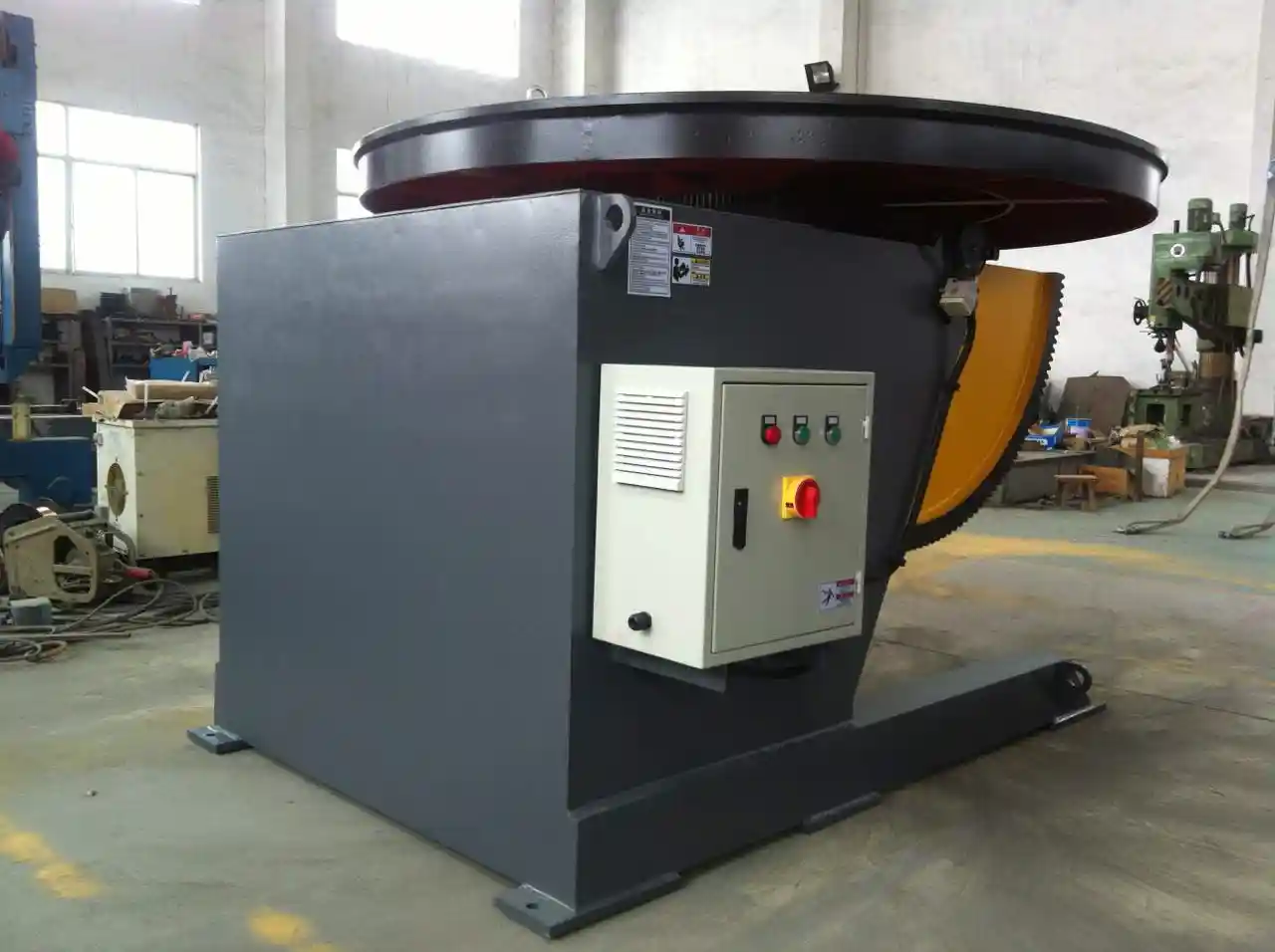
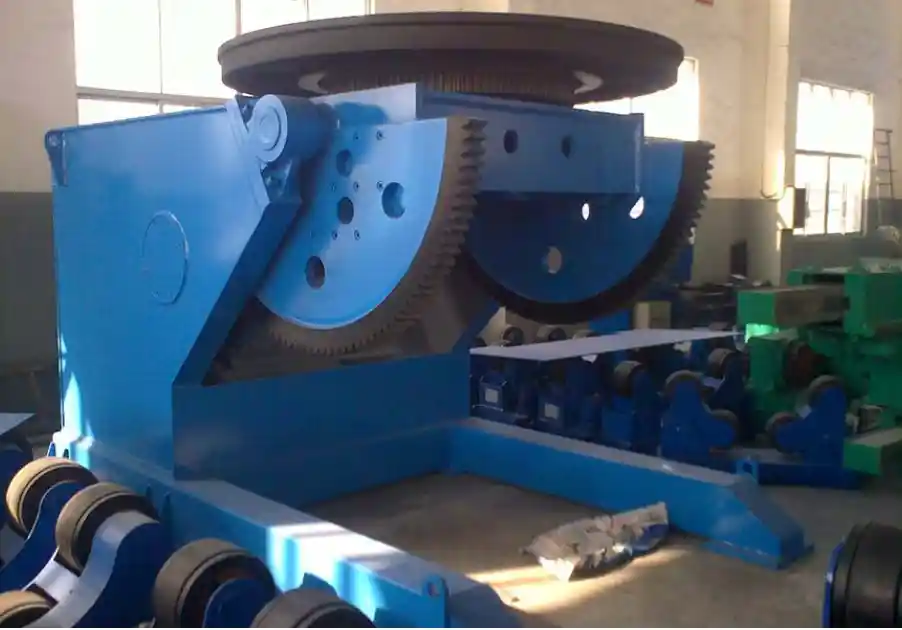
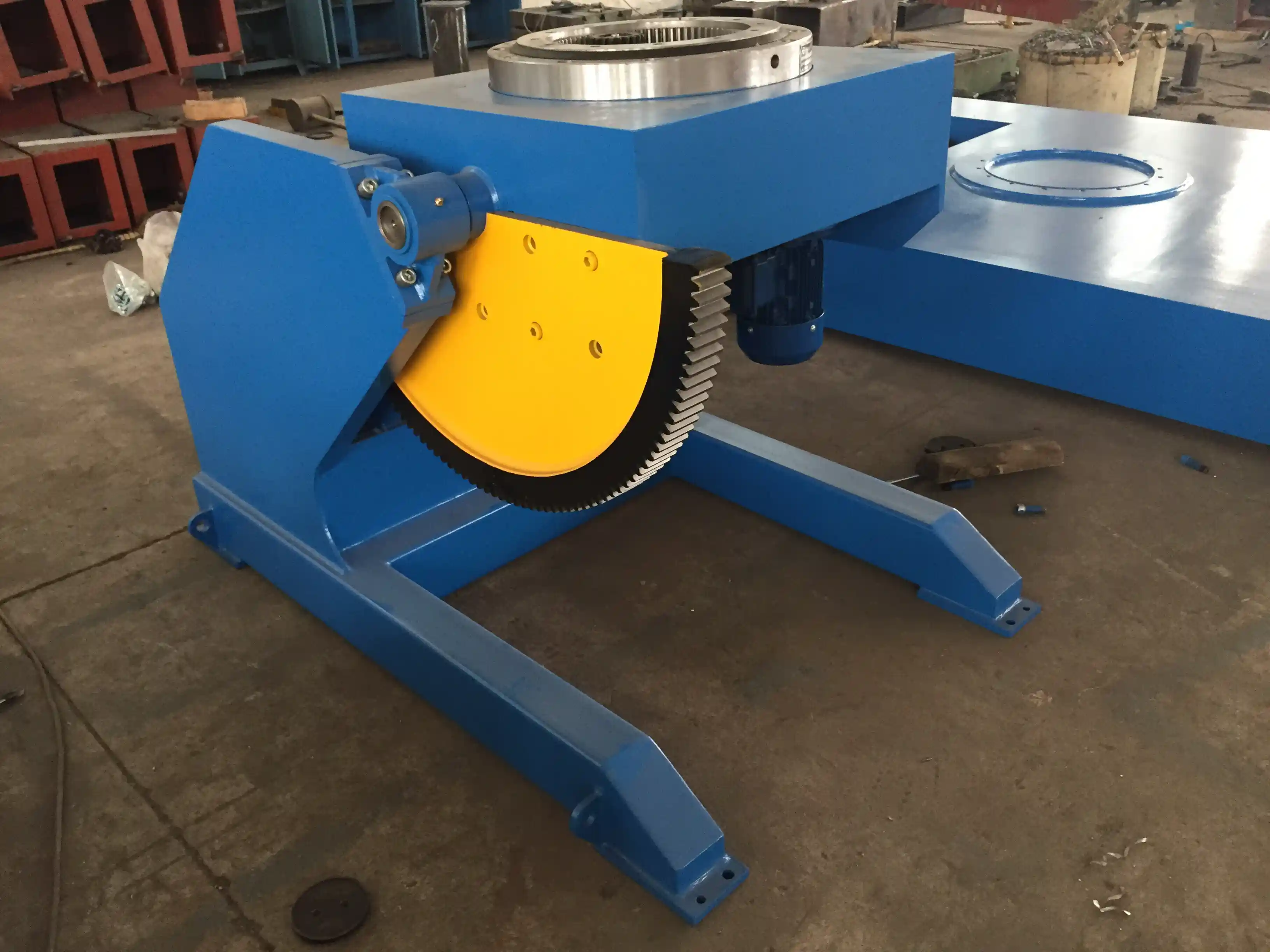
A welding positioner uses a worktable, head-tail fixture, or L-type support to rotate and tilt the workpiece. The key advantage is access: instead of rotating the part around one fixed axis, the operator can bring multiple weld faces into a comfortable torch position.
Positioner types include:
- Fixed-height turntables for small-to-medium fabrications
- Adjustable-height positioners for large eccentric loads
- Head-tail positioners for long shafts, pipes, and structural members
- Three-axis positioners for robotic welding cells and complex multi-face components
- L-type positioners for parts that require rotation plus controlled tilting
A 3-осевой сварочный позиционер is often the better choice when the weld path changes direction several times on one assembly. The rotation axis handles circumferential movement, the tilt axis brings angled joints into position, and the turn axis supports repositioning without lifting the part from the fixture.
Comparison at a Glance
| Decision Factor | Welding Rotator Often Fits | Welding Positioner Often Fits |
|---|---|---|
| Workpiece shape | Cylindrical shell, pipe, vessel, tower section | Structural frame, bracket, flange, non-round assembly |
| Main weld path | Long circumferential seam | Multiple mixed-angle joints |
| Primary movement | Horizontal rotation on rollers | Rotation plus tilt or turn |
| Load support | Rollers under the shell | Worktable, L-support, or head-tail fixture |
| Automation pairing | Submerged arc, column boom, gantry welding | Robotic MIG, TIG, or SAW cells |
| Typical project | Tank, pressure vessel, wind tower, pipeline | Pump housing, chassis, flange, rail and machinery component |
The table is not a rigid rule. A large cylindrical part may still need a positioner if the joint requires tilt access, and a long structural part may run well on a head-tail positioner instead of a roller rotator.
How to Decide: Five Project-Level Checks
The most reliable way to choose is to review the workpiece, weld path, load center, automation goal, and floor layout as one system. Long cylindrical girth welds usually favor a rotator, while mixed-axis structural welds usually favor a positioner, but the details are in the load and joint sequence.
Long cylindrical workpieces with circumferential seams tend to favor a rotator when weld access is best managed by horizontal rotation. <Трубовращатели и токарные валки: Основное оборудование для современного производства трубопроводов> covers rotator sizing, fit-up alignment, and pipeline fabrication workflow.
Mixed-axis structural parts and multi-plane joint access tend to favor a positioner. <Революция в судовой сварке: как позиционеры для сварки повышают качество и эффективность> covers positioner-enabled weld access and shipbuilding production gains.
For tank and pressure vessel work, the equipment decision is usually tied to shell diameter, joint sequence, and circumferential seam access. <Повышение качества и эффективности производства резервуаров и сосудов высокого давления: Основные возможности применения позиционеров> covers how positioners improve repeatability in vessel fabrication.
1. Workpiece Shape
If the part is round and the main weld runs around the outside, a rotator is usually the simpler choice. If the part has corners, brackets, flanges, or multiple angled joints, a positioner will save repositioning time.
2. Load and Eccentricity
Load capacity alone is not enough. A positioner must handle the tilting moment created when the center of gravity moves away from the table center. Rotators must handle the combined shell weight and fit-up force without losing alignment.
3. Weld Position and Joint Access
A rotator keeps the joint at roughly the same height on a cylinder. A positioner changes the joint angle so the torch can stay in a stable flat or horizontal position. If the job includes overhead welding, vertical-up joints, or awkward internal seams, a tilting or three-axis positioner usually improves consistency.
4. Automation and Control Integration
For submerged arc welding, a rotator paired with a сварочный манипулятор is common for longitudinal and circumferential seams. For robotic welding, a positioner with PLC control, servo drives, and robot-ready interfaces often fits better. Check whether the equipment can store programs, coordinate with a torch or robot, and stop safely on loss of signal.
5. Shop Floor and Material Flow
Rotators need enough space for the vessel length plus the idler frame. Positioners need space for the tilted part sweep, especially when the table rotates with a long assembly. A heavy positioner may also need a foundation pad or reinforced floor section.
Need a direct recommendation? Send the workpiece weight, diameter or envelope, weld length, and target cycle time to jay@weldc.com. The engineering team will return one rotator or positioner configuration plus a load-center and speed review.
Reading the Specification Sheet
The useful numbers on a rotator or positioner are not always the headline load capacity. For a rotator, check the diameter range, roller drive speed, and anti-creep accuracy. For a positioner, check the table diameter, tilt range, eccentric load rating, and center-of-gravity limits.
A fabrication quality system built around ISO 3834 [1] treats positioning equipment as part of the welding process validation, not an isolated fixture. That means the speed range, repeatability, and brake behavior should be documented before the equipment enters production. If the part moves erratically or the table drifts during welding, the weld procedure cannot be considered repeatable.
Safety, Quality, and Code Compliance
Positioning equipment should be selected with the same seriousness as the welding power source. The main areas to evaluate are:
- Emergency stop placement and brake response
- Slip rings or cable management for continuous rotation
- Protection rating for spatter, dust, and shop conditions
- Overturning stability under maximum eccentric load
- Overload shutdown and fault signaling
For safety review, ISO 12100 [2] provides a useful framework for risk assessment and risk reduction on machinery. For structural fabrication governed by AWS D1.1 [3], the joint quality still depends on the procedure and the welder or operator, but positioning equipment supports the access and travel speed needed to meet the specification.
Engineering Support and Inquiry
WUXI ABK MACHINERY CO., LTD supports rotator and positioner selection for tank, vessel, wind tower, pipeline, boiler, and structural fabrication projects. If the right equipment is not obvious from the checks above, send a inquiry with the following information:
- Workpiece type, diameter or envelope, and maximum weight
- Weld length, joint type, and welding process
- Required rotation or tilt range
- Available power supply
- Automation and robot interface requirements
Contact: jay@weldc.com
Мобильный: +86-13815101750
Тел: +86-510-83555592
Факс: +86-510-83559158
ЧАСТО ЗАДАВАЕМЫЕ ВОПРОСЫ
Which is better for pressure vessel circumferential seams: a rotator or a positioner?
A rotator is often the better starting point for long vessel shell girth seams because it supports the cylinder and rotates it under a fixed welding head. A positioner may still be needed when the vessel has heads, flanges, or angled branch connections that require multiple face positions.
Can a welding positioner replace a welding rotator?
Not for every cylindrical job. A positioner can rotate a workpiece, but supporting a long, heavy vessel on a single table is more difficult than supporting it on two roller frames. A rotator is usually simpler for long shells; a positioner is usually better for mixed-access assemblies.
What load information should be provided before choosing equipment?
Provide the maximum part weight, the center-of-gravity distance from the table or roller center, the outer diameter or envelope, and the length. If the part will be tilted, also provide the expected eccentric moment.
Do rotators and positioners work with submerged arc welding?
Yes. Rotators are commonly paired with column boom manipulators and submerged arc welding for longitudinal and girth seams. Positioners also work with submerged arc when the part must be rotated and tilted to keep the weld in a suitable position.
How important is anti-creep control on a welding rotator?
It is important for long multi-pass girth welds. If the cylinder drifts axially during rotation, the joint can move away from the torch centerline and the bead placement becomes inconsistent. Adjustable rollers, alignment systems, and controlled drive speed help manage creep.
References
[1] International Organization for Standardization. ISO 3834-2:2021, Quality requirements for fusion welding of metallic materials — Part 2: Comprehensive quality requirements.
[2] International Organization for Standardization. ISO 12100:2010, Safety of machinery — General principles for design — Risk assessment and risk reduction.
[3] American Welding Society. AWS D1.1/D1.1:2020, Structural Welding Code — Steel.
Если вам интересно, ознакомьтесь со следующими статьями по этой теме:
Wind Tower Welding Problems Again: How Intelligent Growing Line Rotators Boost Productivity by 50%
Чрезмерное смещение при сварке трубопроводов: решение для прецизионного позиционирования сварного поворотного стола от компании Wuxi ABK
Сварочный вращатель Прецизионная автоматизация для промышленного производства: Руководство эксперта по часто задаваемым вопросам
 English
  Español
  Français
  Deutsch
  Português
  Русский