
When fabricators evaluate welding positioner manufacturers, they are not simply buying a turntable with a motor. They are buying positional stability that determines weld quality, cycle time, rework, and operator safety. A custom welding positioner should be developed around the load case, joint geometry, welding process, and automation interface, not selected from catalog capacity alone.
This guide explains how to evaluate custom welding positioner solutions and what engineering information manufacturers need before quoting a machine.
Start With the Load Case, Not Only the Catalog Capacity
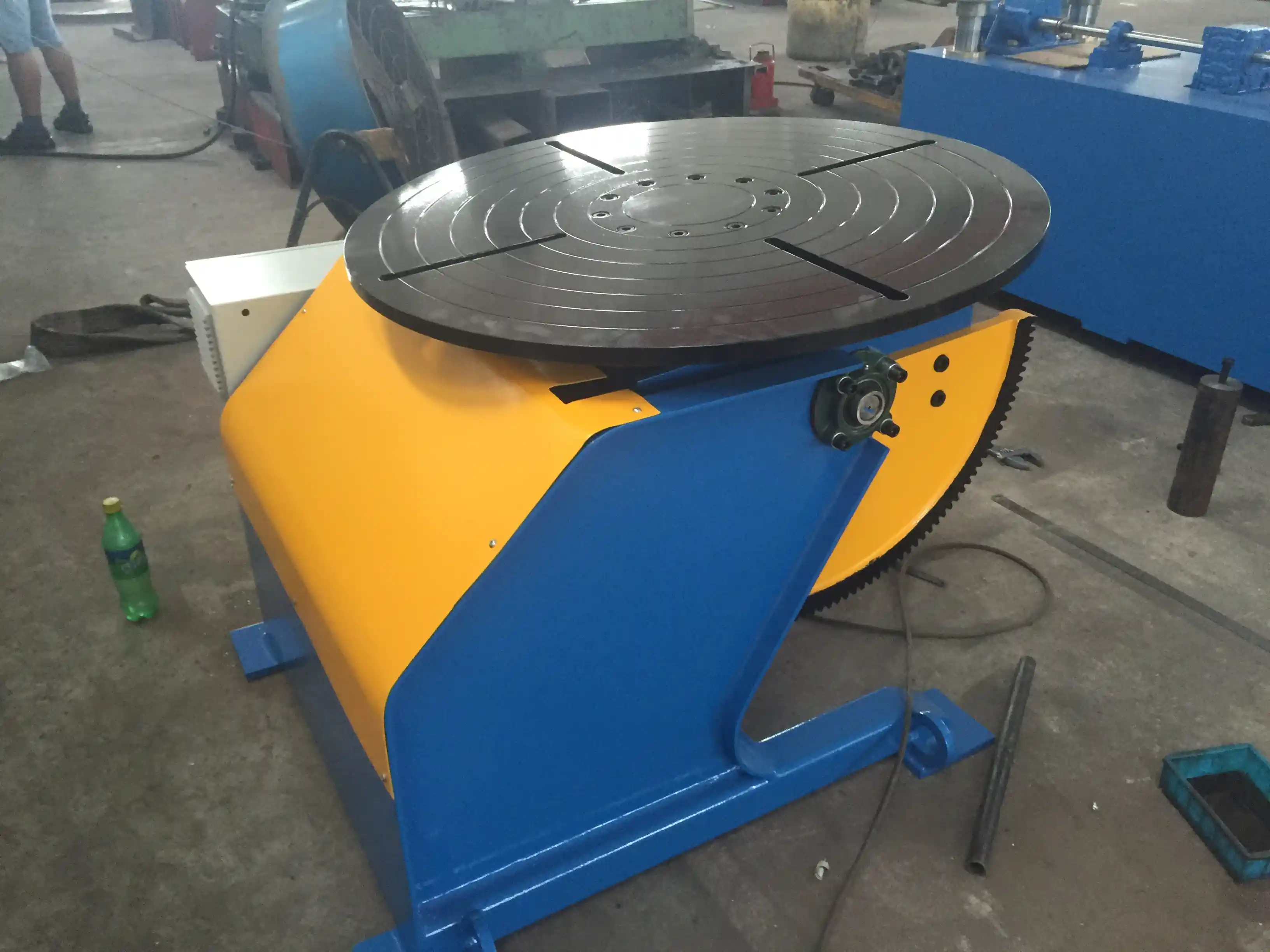
Load capacity is a starting point, not a complete specification. A positioner must support the workpiece in every orientation the weld requires. The critical inputs are not only weight but also center-of-gravity offset, eccentric distance, overturning moment, and the maximum rotating diameter when the table tilts.
For example, a component may weigh 3,000 kg but create far higher stress on the slewing bearing when its center of gravity is offset from the table center. That is why a credible welding positioner manufacturer will ask for the maximum eccentric distance, center-of-gravity distance, and the rotating diameter at 90° overturn before confirming a model.
| Input parameter | Why it matters for custom configuration |
|---|---|
| Maximum load | Defines static table and frame capacity |
| Maximum eccentric distance | Governs bending and overturning load on the bearing |
| Center-of-gravity distance | Determines the required dynamic torque and reducer sizing |
| Rotating diameter at full tilt | Identifies interference and clearance limits |
| Worktable diameter and T-slot layout | Determines fixture and tooling compatibility |
| Welding process and duty cycle | Influences drive, slip-ring, and control selection |
A 1-ton fixed-height positioner may list a maximum eccentric distance of 150 mm and a maximum center-of-gravity distance of 200 mm. A 5-ton unit may list values of 200 mm and 300 mm respectively. These figures are product-specific engineering limits, not marketing assumptions, and they should be confirmed against the actual workpiece envelope.
In heavy fabrication, strong load distribution is the difference between stable rotation and alignment drift during a long weld. <Основные проблемы и высокоточные решения в области сварочных позиционеров в ветроэнергетике и судостроении: всесторонний технический анализ> covers the load and accuracy problems that appear when positioners are under-specified for large cylindrical sections.
Positioning Accuracy and Repeatability Define First-Pass Quality
Welding positioner accuracy is often discussed as a single number, but two distinct concepts matter in production: placement accuracy at a set position and repeatability when returning to that position. A machine that positions within ±0.5° may be suitable for manual or semi-automatic pipe welding, while a robotic cell may require finer repeatability.
The difference becomes visible in long cylindrical seams. If a positioner drifts or loses synchronization, the welding torch no longer tracks the seam centerline, leading to undercut, lack of fusion, or excessive weld cap variation. Under ISO 3834 quality requirements for fusion welding, manufacturing operations should be controlled to maintain dimensional and positional stability [1]. That includes the equipment used for workpiece positioning, not only the welding power source.
For high-precision applications, servo-driven three-axis positioners may list values such as ±0.05 mm positioning accuracy and 0.02 mm repeatability. These are relevant when integrating with ABB, KUKA, FANUC, or Yaskawa robotic systems. An AC frequency-driven fixed-height positioner may instead list a rotation accuracy of ±0.5°, which is often more practical for heavy manual welding of large weldments.
The key is not to compare numbers across different machine classes but to match the positioner’s accuracy class to the weld joint tolerance. A fabricator welding long pressure vessel seams can accept a different positioning window than a manufacturer producing repetitive robotic fillet welds.
Accurate rotation directly influences torch placement and weld consistency on cylindrical parts. <Как повысить качество сварки труб с помощью высокоточного сварочного позиционера> covers how positioner control affects pipe joint fit-up, travel speed, and final weld quality.
Custom Configuration: Drive, Control, Safety, and Interface
Most custom welding positioners are assembled from proven modules, but the integration choices determine how well the machine performs in a specific factory.
Система привода
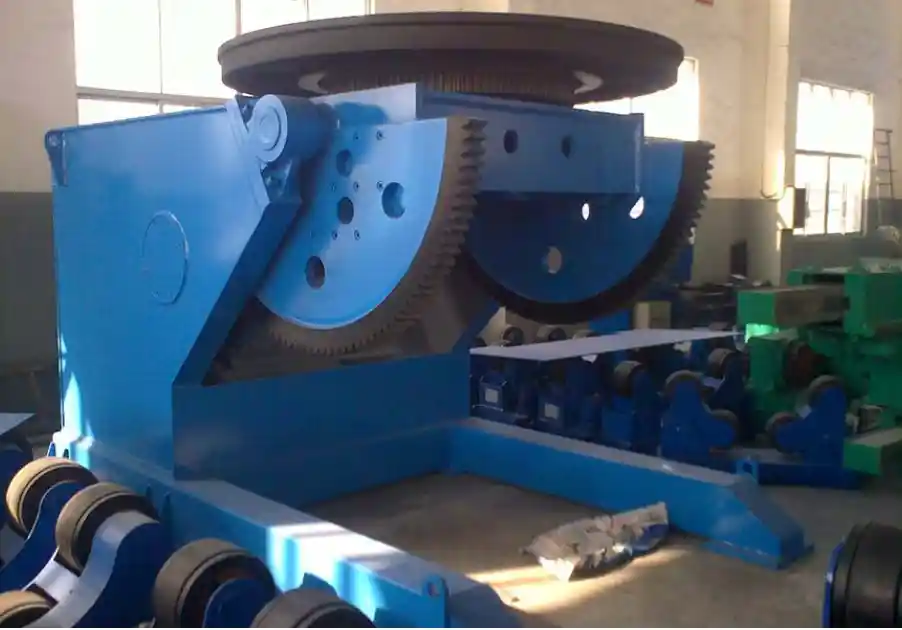
AC frequency-controlled drives provide stepless speed control and are widely used in fixed-height and adjustable-height positioners. Servo drives offer tighter positioning and smoother acceleration for robotic cells. The reducer type and gear precision affect backlash, running smoothness, and long-term repeatability.
Tilt and rotation
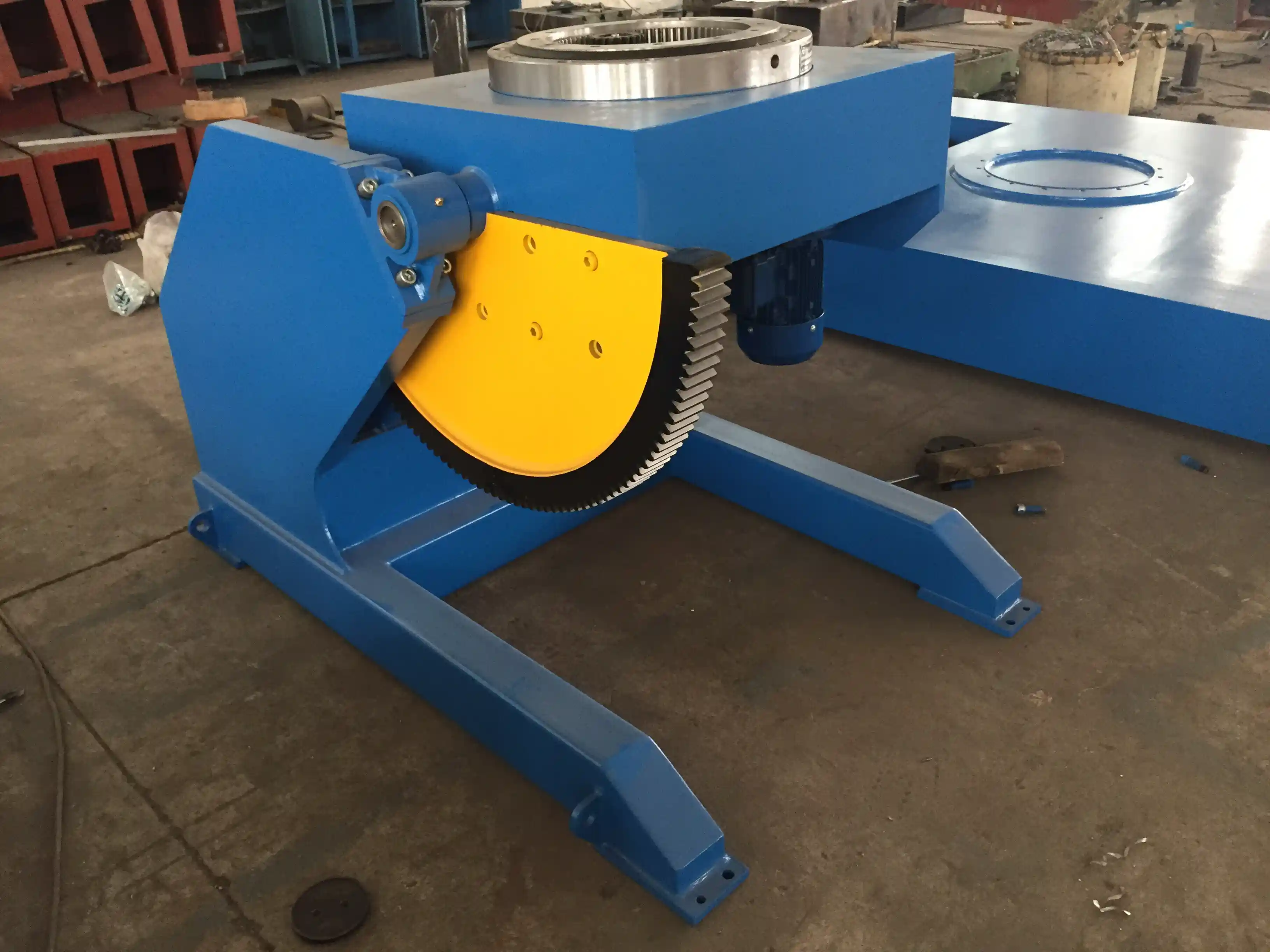
A standard positioner may rotate 360° continuously and tilt from 0° to 90° or 0° to 135°. Turning capability may be 90°, 120°, or 180° depending on the workpiece geometry. The custom selection depends on whether the operator needs to weld in a flat or horizontal position and whether the fixture requires full overweld rotation.
Control system
PLC and HMI controls allow stored programs, rotation speed settings, and integration with external automation. For robotic applications, the positioner should support external axis control through common robot interfaces. For manual plants, a simpler pendant or touchscreen with basic speed adjustment may be sufficient.
Safety and protection
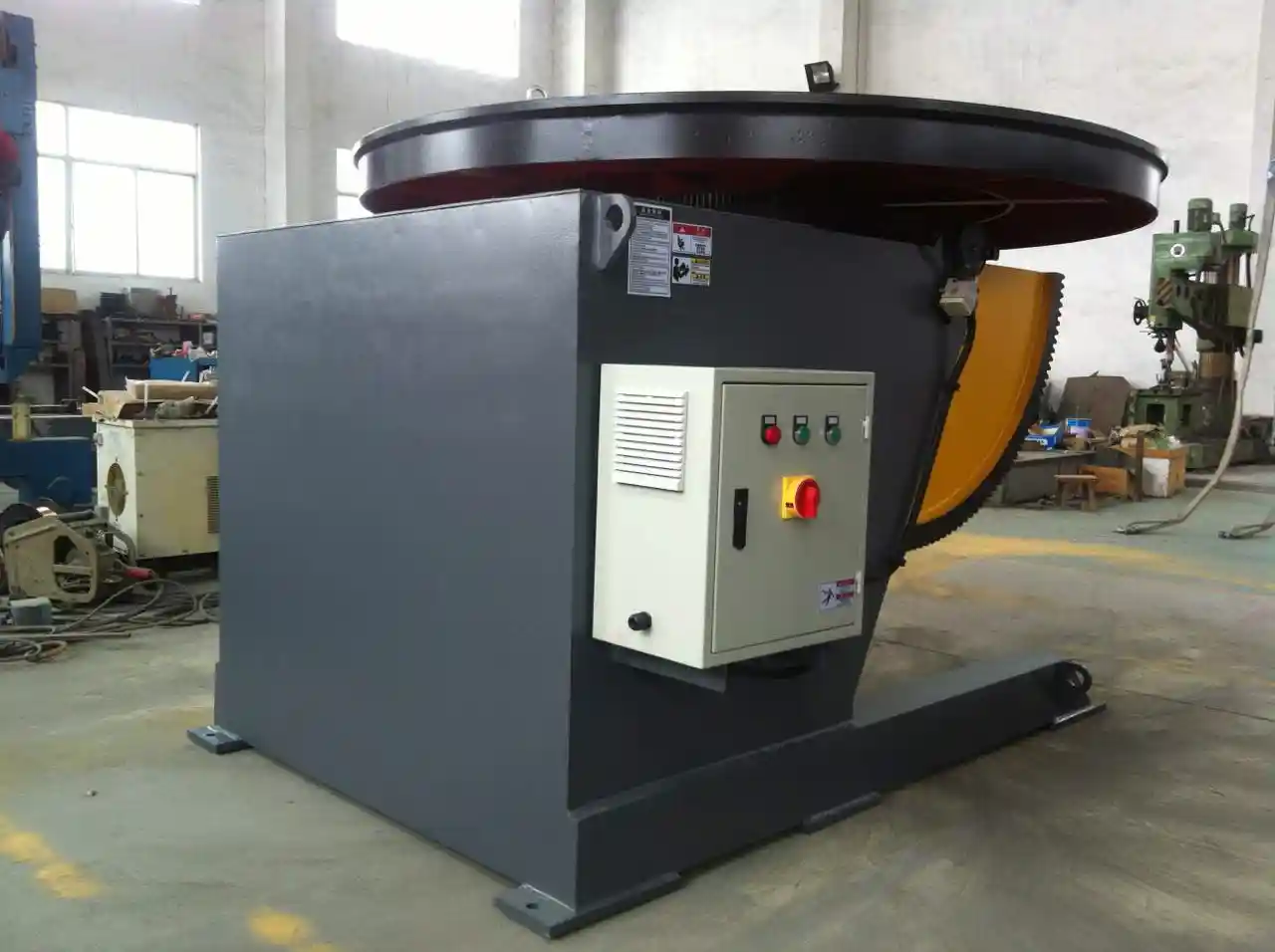
Safety functions such as overload shutdown, emergency braking, anti-fall pins, and slip rings for continuous rotation protect both operators and tooling. In dusty or spatter-heavy workshops, an IP54 control cabinet and sealed drive components reduce electrical failure. Explosion-proof options may be required in specific coating or chemical environments.
Supplier Evaluation: What Separates a Qualified Manufacturer
A qualified welding positioner manufacturer should be evaluated on engineering capability, documentation, and production control rather than only price. Three areas deserve close attention.
Quality system and compliance
For international supply, the manufacturer should provide relevant CE documentation under the Machinery Directive 2006/42/EC [4]. For structural fabrication, alignment with AWS D1.1 or an equivalent structural welding code may be part of the project requirement [3]. ISO 3834 can be used to assess whether the manufacturer maintains comprehensive quality requirements for fusion welding [1].
Factory testing and reference verification
A reliable supplier should be able to run the positioner under load before shipment and provide test data or video evidence. This includes table runout, tilt repeatability, and emergency-stop function. Reference checks should focus on similar workpiece types, not only company size.
After-sales and spare-part strategy
Custom positioners require long-term support because replacement gears, slewing bearings, and servo drives must match the original design. The supplier should document lubrication points, inspection intervals, and critical spare parts.
Complex multi-axis welding cells are often ordered with commissioning and robot integration in mind. <Tired of Complex Welding Challenges? How a 3-Axis Positioner Can Boost Productivity by 70> covers how synchronized turning, rotating, and tilting improve access to complex weld joints and support robotic production.
Maintenance and Long-Term Ownership
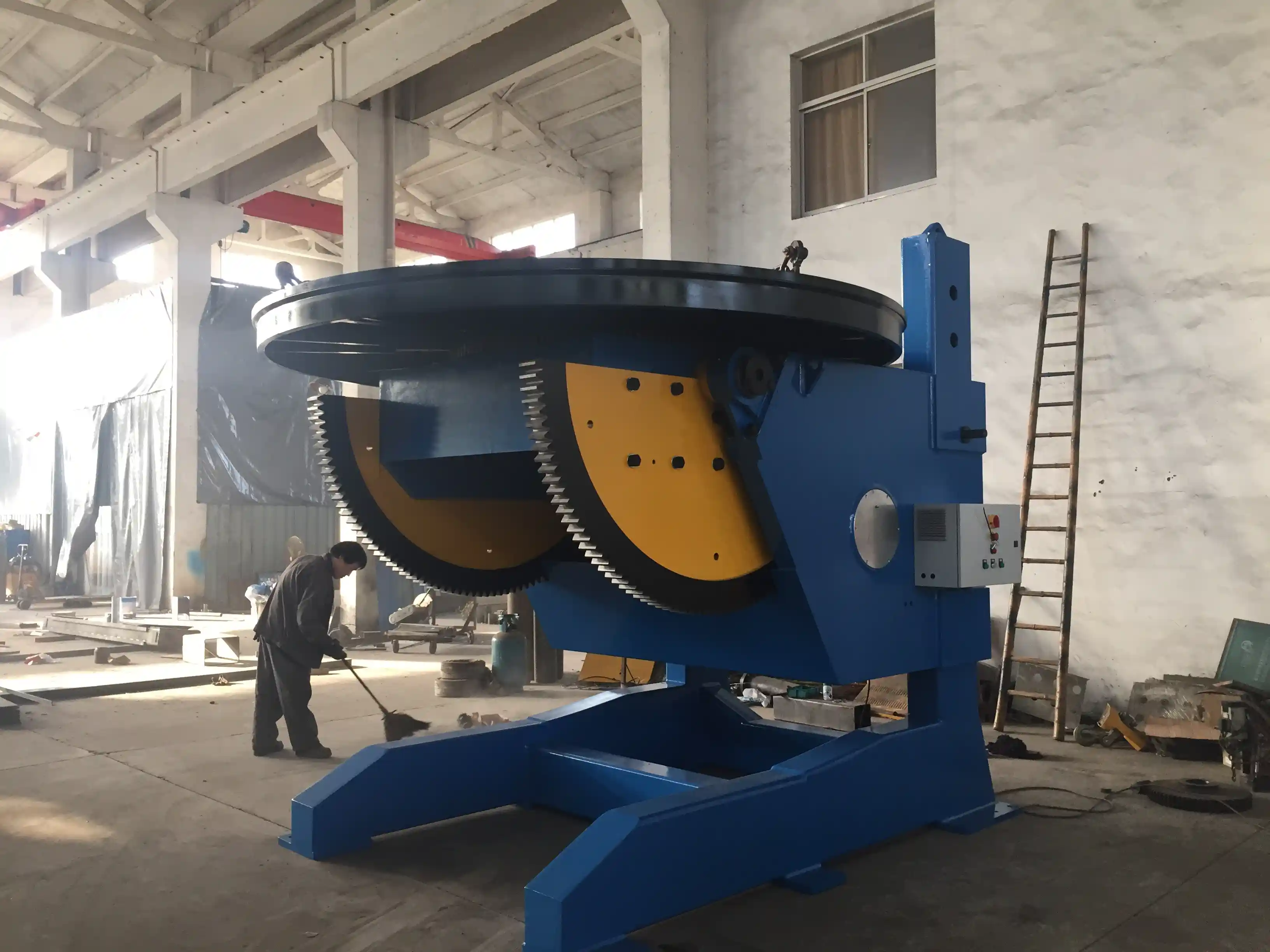
Positioner reliability depends on consistent maintenance. A custom positioner may include a slewing bearing, reverse gears, worm reducers, conductive slip rings, and a steel box-type base. Each of these needs scheduled attention.
Daily inspections should remove weld spatter from the table and base, check lubrication, and confirm that electrical connections are intact. Monthly inspections should verify bolt torque, gear wear, tilt limit settings, and emergency-stop response. Annual service should include bearing inspection, re-lubrication, control calibration, and replacement of worn seals.
The objective is to maintain the original positioning tolerance and prevent unplanned downtime. A structured maintenance schedule is easier to implement when the manufacturer supplies clear service guidance with the machine.
Request a Custom Welding Positioner Specification
A custom positioner quotation should be based on the following inquiry set. Send the workpiece envelope and process data to WUXI ABK MACHINERY CO., LTD for an engineering review.
Электронная почта: jay@weldc.com
Тел: +86-510-83555592
Mobile/WhatsApp: +86-13815101750
Inquiry checklist:
- Maximum worktable load and duty cycle
- Maximum workpiece diameter at 0° and at full tilt
- Maximum eccentric distance and center-of-gravity distance
- Required rotation speed range and tilt range
- Turning angle and table diameter
- Welding process: SAW, MIG/MAG, TIG, or robotic welding
- Robot brand and external axis interface, if applicable
- Power supply and site environment, including any ATEX requirement
- Desired certification or documentation package
Часто задаваемые вопросы
What information do welding positioner manufacturers need for a custom quote?
The most important inputs are workpiece weight, center-of-gravity offset, maximum eccentric distance, rotating diameter at tilt, table diameter, tilt and turning angles, welding process, and control interface. Without these, a supplier cannot correctly size the frame, bearing, reducer, and drive.
What is the difference between fixed-height and adjustable-height welding positioners?
A fixed-height positioner has a constant worktable height and is usually simpler and more rigid. An adjustable-height positioner uses hydraulic or mechanical lifting to change table height, which is useful when the same cell must handle different component sizes or when the operator needs a lower loading position.
How is load capacity different from dynamic load?
Load capacity is the nominal static weight the positioner can support. Dynamic load includes the additional moment created by an offset center of gravity, acceleration, and rotation. A small workpiece with a large offset can generate more dynamic stress than a heavier but more balanced component.
Which welding processes can be used with a custom positioner?
Positioners are used with submerged arc welding, MIG/MAG, TIG, and robotic welding. The main requirement is that the positioner control must be compatible with the welding system and, for robotic cells, with the robot external axis control.
What certifications should a welding positioner manufacturer hold?
For most export markets, CE marking under the Machinery Directive 2006/42/EC is required [4]. ISO 9001 indicates a managed quality system. For welding-intensive production, ISO 3834 provides a framework for fusion welding quality requirements [1]. Project-specific structural specifications may also reference AWS D1.1 [3].
References
[1] ISO 3834-2:2021, Quality requirements for fusion welding of metallic materials — Part 2: Comprehensive quality requirements. International Organization for Standardization, 2021.
[2] ISO 14732:2013, Welding personnel — Qualification testing of welding operators and weld setters for mechanized and automatic welding of metallic materials. International Organization for Standardization, 2013.
[3] AWS D1.1/D1.1M:2020, Structural Welding Code — Steel. American Welding Society, 2020.
[4] Directive 2006/42/EC of the European Parliament and of the Council of 17 May 2006 on machinery, Official Journal of the European Union, 2006.
Если вам интересно, ознакомьтесь со следующими статьями по этой теме:
Wind Tower Welding Problems Again: How Intelligent Growing Line Rotators Boost Productivity by 50%
Как повысить качество сварки труб с помощью высокоточного сварочного позиционера
Неоценимое значение для практического применения: как позиционеры с фиксированной высотой способствуют развитию морского и судостроительного производства (Часть 2)
 English
  Español
  Français
  Deutsch
  Português
  Русский