In the demanding world of offshore engineering and shipbuilding, the quality of every weld joint is crucial to structural safety and longevity. This industry maintains exceptionally stringent requirements for welding precision, and achieving such high manufacturing standards often depends on the auxiliary equipment that supports core processes. Among these essential tools, the стандартный сварочный вращатель plays an indispensable role. It is far more than simple tooling; it represents fundamental equipment for elevating the manufacturing capabilities of the offshore industry. This article delves into the applications of standard welding rotators in offshore and shipbuilding manufacturing, revealing how they enable offshore equipment manufacturers to achieve more efficient and reliable weld quality through precise positioning and stable rotation, thereby supporting the entire offshore engineering construction sector.
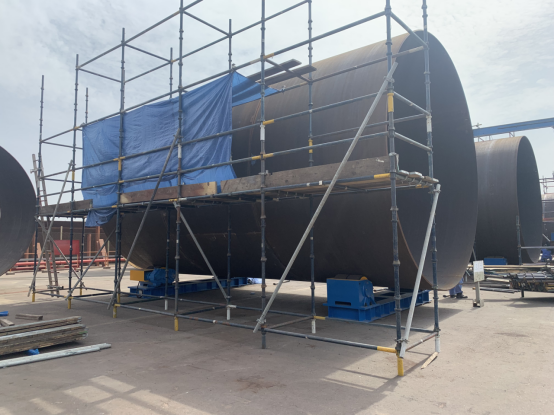
The Core Value of Standard Welding Rotators in Offshore Manufacturing
The manufacturing process for offshore engineering equipment is complex and rigorous, involving welding operations for large-scale piping systems, pressure vessels, and various cylindrical structures. These components are typically massive and heavy, requiring full circumferential welding. Relying on traditional hoisting and flipping or manual positioning is not only inefficient but also makes it difficult to ensure welding position stability and optimal accessibility. This is precisely where welding rotation equipment demonstrates its value. Its core function is to achieve precise positioning and uniform rotation of the workpiece, enabling welding operations to consistently occur in the ideal “flat” or “downhand” position. For shipyard equipment suppliers committed to卓越品质, investing in high-performance welding rotators is a crucial step toward enhancing overall manufacturing capability.
Enhancing Weld Quality and Consistency
Weld quality is fundamental to the service life of offshore equipment. The pipe welding system, through its stable rotation and precise speed control, ensures the welding pool always remains in the optimal position for formation. This delivers multiple benefits: stable rotation avoids common defects like undercut or lack of penetration caused by unstable workpiece movement; constant travel speed results in consistent weld width and aesthetic appearance, providing not only high strength but also superior corrosion resistance; through preset rotation parameters, each weld is completed with identical speed and quality, standardizing the production process—a vital aspect for manufacturing that must meet strict offshore engineering standards.
Specific Applications of Standard Welding Rotators in Shipbuilding
In modern shipbuilding factories, the application of welding rotators permeates several key production stages. From the prefabrication of hull piping systems to the manufacturing of propulsion systems, this shipbuilding fabrication tool plays an irreplaceable role.
Ship Piping System Manufacturing and Installation
A ship’s interior is filled with various piping systems transporting water, oil, and gas. Using a universal welding rotation system for girth welding on these pipes is the optimal choice for achieving high-quality, efficient production. By securing the pipe section on the rotator, the equipment rotates it uniformly, allowing the welder to apply the weld from a fixed position, resulting in a uniform, well-sealed, perfect girth weld. This method is particularly suitable for manufacturing critical systems like ship engine exhaust pipes and hydraulic pipelines, ensuring the reliability of offshore engineering welding quality.
Shafting and Rudder System Component Manufacturing
Critical components such as a ship’s propulsion shaft, intermediate shafts, and rudder stocks demand exceptionally high weld quality. These parts are typically made from forged or cast blanks and undergo welding assembly after rough machining. The welding positioning apparatus provides stable rotational support for these key components, ensuring precise positioning and constant speed during overlay welding or butt welding. After implementing standard welding rotators, one renowned marine equipment manufacturer saw the pass rate for propulsion shaft welds increase from 92% to 99.5%, significantly reducing rework costs.
Pressure Vessel and Tank Manufacturing
Various pressure vessels, storage tanks, and separators in offshore equipment are typical cylindrical structures. The manufacturing of these devices requires extensive girth welding operations, a need perfectly met by industrial rotation equipment. Precise control over the welding speed ensures every girth weld meets design requirements. Particularly in the manufacture of tanks for Liquefied Natural Gas (LNG) carriers, the stable operation of the welding rotator guarantees the specific process requirements for welding cryogenic materials.
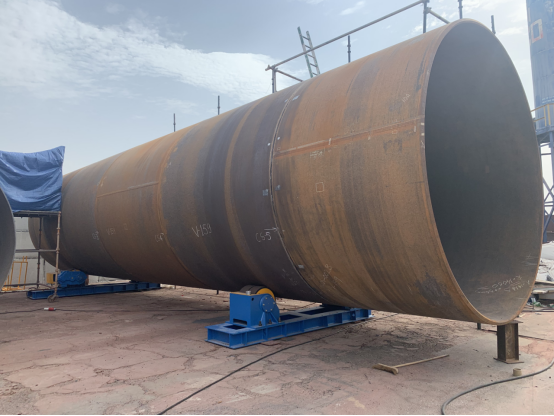
Selecting Suitable Welding Rotators for Offshore Applications
Given the specific demands of the offshore and shipbuilding industry, selecting the appropriate welding rotator is crucial. A professional welding equipment supplier should provide targeted technical solutions to help clients make the best choice.
Technical Parameters and Performance Considerations
When selecting a welding rotator, the first step is to assess whether its technical parameters meet production needs. The load capacity must cover the maximum weight of the workpieces processed in the factory, including a safety margin. Simultaneously, the speed adjustment range must satisfy different process requirements, from low-speed overlay welding to relatively high-speed capping passes. For welding materials specific to the offshore industry, such as stainless steel and low-temperature steel, the equipment requires even finer speed control capabilities.
Environmental Adaptability and Reliability
The manufacturing environment for offshore engineering equipment is complex, necessitating devices with excellent environmental adaptability. Designs featuring dust prevention, splash resistance, and corrosion resistance ensure stable operation in harsh industrial conditions. This is especially true for heavy-duty welding systems handling large columns for offshore platforms, where the motors and control systems require special protective design. One offshore platform manufacturer previously experienced frequent production stoppages due to insufficient equipment protection等级. After switching to specially designed welding rotators, equipment failure rates decreased by 80%.
Innovative Technologies and Future Development Trends
With the continuous advancement of smart manufacturing technologies, welding rotators are also undergoing technical innovation. Future intelligent welding solutions will focus increasingly on equipment intelligence, networking, and flexibility.
Intelligent Control Technology
New generations of welding rotators are beginning to integrate intelligent control systems, utilizing PLCs or dedicated controllers for precise speed control and position memory. Some advanced models are also equipped with remote monitoring capabilities, allowing real-time collection of operational data for predictive maintenance. The application of this advanced manufacturing technology significantly enhances equipment reliability and service life.
Flexible Manufacturing Systems
To adapt to the high-mix, low-volume production characteristics of offshore equipment, modern welding rotators are developing towards greater flexibility. Modular designs allow for quick roller changes and center distance adjustments to accommodate workpieces of different diameters. Some innovative equipment manufacturing plants have also developed combined rotator systems that can flexibly configure the number of rollers based on workpiece length, optimizing resource allocation.
Integrated Solutions
Welding rotators are transitioning from standalone process equipment to integrated manufacturing cells. Through coordinated control with welding power sources, manipulators, and positioners, they form complete автоматизированные сварочные камеры. Such integrated solutions are playing an increasingly important role in the manufacturing of large structures like offshore platform jackets and hull segments.
Заключение
In the challenging fields of offshore engineering and shipbuilding, the focus on every manufacturing detail reflects the supreme pursuit of safety and quality. The стандартный сварочный вращатель, as a key piece of equipment supporting the core process of welding, offers value far beyond simply “rotating a workpiece.” It is a central force in enhancing weld quality, optimizing production workflows, ensuring operational safety, and driving automation upgrades. For any offshore equipment manufacturer aiming to maintain competitiveness in the industry, selecting the right welding equipment supplier and investing in advanced, reliable welding rotation equipment is undoubtedly a strategic decision demonstrating foresight. It ultimately translates into sturdier, more reliable marine equipment, contributing an indispensable force to humanity’s exploration and utilization of the oceans.
стандартный сварочный вращатель:
https://www.weldmc.com/product-category/welding-automation/welding-rotator/standard-welding-rotator/
welding equipment supplier:
welding rotation equipment:
https://www.weldmc.com/product-category/welding-automation/welding-rotator
equipment manufacturing plants:
https://www.weldmc.com/product-category/welding-automation
heavy-duty welding systems:
universal welding rotation system:
https://www.weldmc.com/product-category/welding-automation/welding-rotator
 English
  Español
  Français
  Deutsch
  Português
  Русский