
Choosing a welding positioner by tonnage alone is one of the most expensive selection mistakes in heavy fabrication. A 5-ton machine does not automatically handle every 5-ton weldment, because rated capacity means little without eccentric distance, center-of-gravity position, rotation mode, and dynamic load. This guide explains how to read load ratings, size a positioner for real workpieces, and avoid the capacity errors that later appear as vibration, creep, weld misalignment, or drive failure.
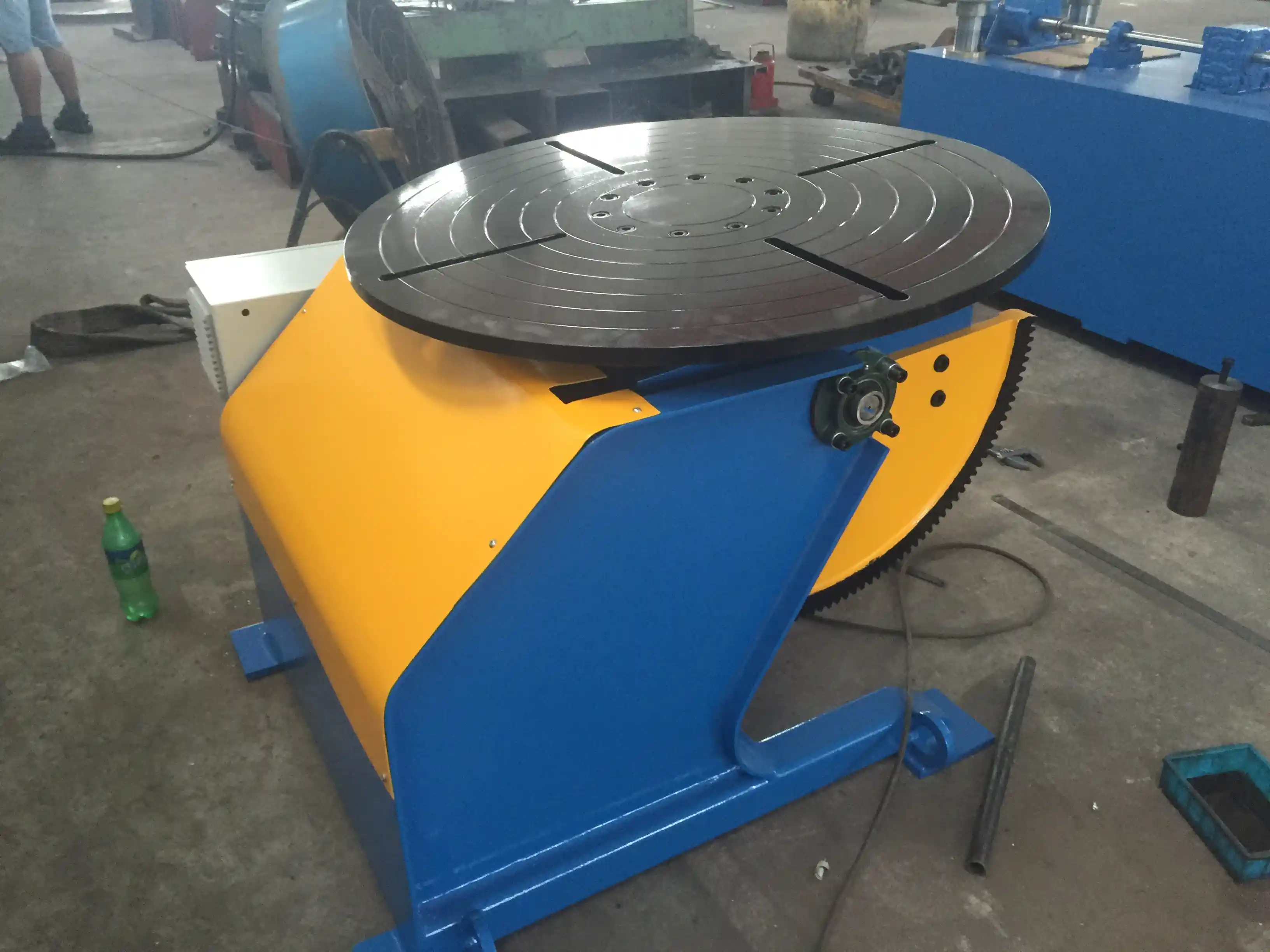
What Load Capacity Actually Means
In a welding positioner catalog, the headline number is usually the maximum workpiece weight on the table in a defined orientation. That rating assumes the load is reasonably centered and within the manufacturer’s specified center-of-gravity and eccentric-distance limits. Once the center of gravity moves away from the table center, the overturning moment increases. The positioner may creep, tilt, or trip overload protection even if the workpiece weighs less than the rated tonnage.
The important terms to compare are:
| Term | What it means | Why it matters |
|---|---|---|
| Rated load capacity | Maximum workpiece weight at a defined center-of-gravity position | Base selection point only |
| Dynamic load capacity | Load the drive can accelerate, rotate, and stop smoothly | Prevents drive overheating and instability |
| Maximum eccentric distance | Allowable offset from table center to load center | Determines whether an uneven weldment is safe |
| Maximum center-of-gravity distance | Allowable vertical distance from table face to load center | Affects tilting and overturning stability |
| Overturning moment | Weight multiplied by offset distance | The real load on bearings, gears, and brakes |
| Повторяемость | Ability to return to the same position | Critical for robotic and high-precision welding |
For example, WUXI ABK’s 1-ton fixed-height positioner lists a maximum eccentric distance of 150 mm and a maximum center-of-gravity distance of 200 mm. A 1,000 kg part placed within that envelope is appropriate. The same part shifted farther from the table center may exceed the design moment even though the scale still reads one ton.
Start with Weldment Geometry, Then Choose Capacity
A practical sizing sequence is:
- Determine the actual workpiece weight, not an estimate from raw material dimensions.
- Add the weight of clamping, tooling, tacked attachments, and weld metal.
- Locate the combined center of gravity in three dimensions.
- Calculate the maximum eccentric distance from the table center.
- Compare that moment with the manufacturer’s moment rating.
- Confirm that the required tilt and rotation angles are within the machine’s working range.
- Leave reserve for production variation and future workpieces.
A positioner should be specified from the worst-case production part, not the average part. If the current product mix includes a vessel head with off-center nozzles, that condition often controls the selection even when the part is not the heaviest item in the shop.
Fixed, Adjustable, and Multi-Axis Positioners
Capacity class is not the only decision. The type of positioner must match the workpiece and welding process.
| Positioner type | Typical strength | Common match |
|---|---|---|
| Fixed-height turntable | Simple, rigid, economical | Pipe flanges, small structural parts, circumferential seams |
| Fixed-height tilting positioner | Controlled tilt and rotation | Pressure vessel parts, excavator booms, robotic cells |
| Adjustable-height positioner | Flexible working height | Large vessels, wind tower sections, long weldments |
| 3-осевой позиционер | Turning, tilting, and continuous rotation | Complex structural parts, automated welding lines |
| Head-tail positioner | Supports both ends of a long workpiece | Shafts, pipes, beams, long vessels |
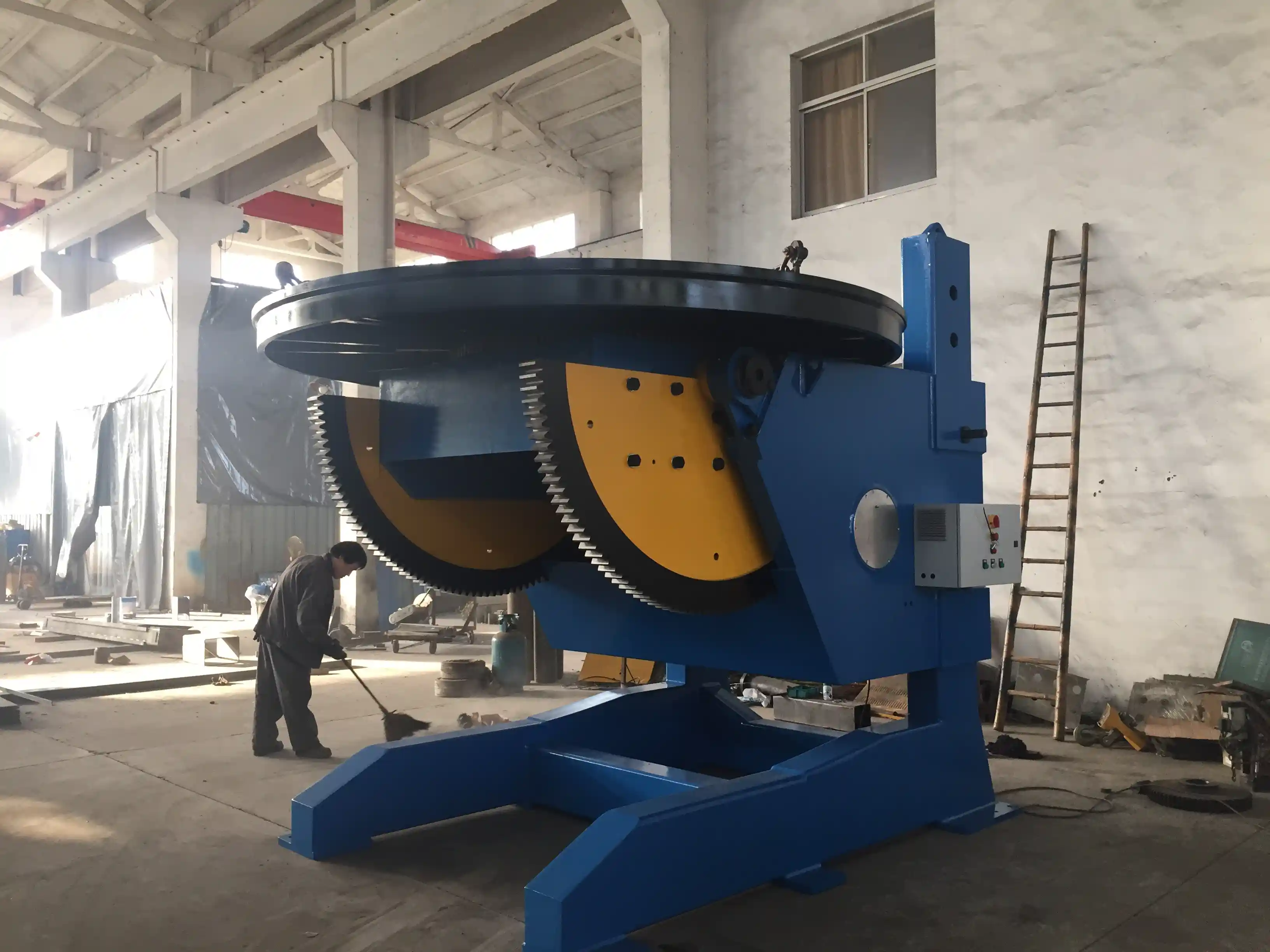
A 3-axis machine gives more motion freedom, but its load capacity often has tighter eccentric limits because the table is designed to move through multiple orientations. A fixed-height machine may be the better choice when the only requirement is stable rotation of a cylindrical part.
Fixed-height positioners solve specific access and stability problems in offshore and shipbuilding fabrication.
(https://www.weldmc.com/news/exceptional-application-value-how-fixed-height-welding-positioners-drive-advancements-in-offshore-and-shipbuilding-manufacturing/2197/) covers where fixed-height machines fit in production.
Application-Based Capacity Planning
Capacity class should follow the largest workpiece in the current production plan, with reserve for tooling and future work. The table below gives a practical starting point.
| Workpiece type | Typical capacity class | Key selection factor |
|---|---|---|
| Small brackets, flanges, and housing parts | 1–2 ton | Table diameter and eccentric distance |
| Pipe and shaft assemblies | 2–5 ton | Head-tail support and rotation speed |
| Pressure vessel sections | 5–30 ton | Adjustable height and overturning stability |
| Wind tower sections | 30 ton and above | Large table, high-torque drive, foundation load |
| Complex structural weldments | 3-axis 1–5 ton | Tilt range, turning angle, robot interface |
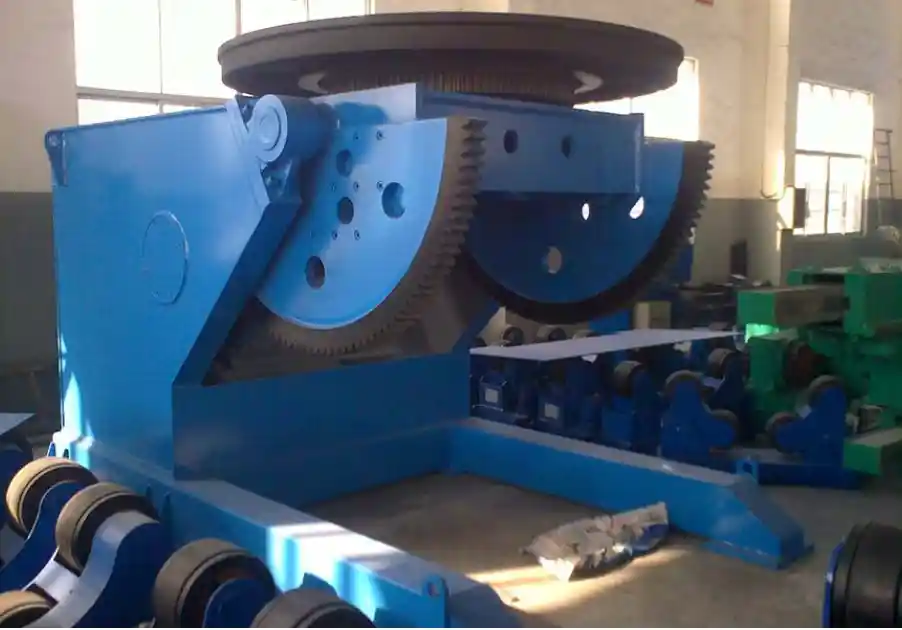
Wind tower and shipbuilding components are rarely simple cylinders. They combine off-center mass, large diameters, and long weld paths, so the positioner must control both rotation and alignment over long arcs.
Wind power and shipbuilding components are rarely simple cylinders; they combine off-center mass, large diameters, and long weld paths.
(https://www.weldmc.com/news/core-pain-points-and-high-precision-solutions-of-welding-positioners1-in-the-wind-power-and-shipbuilding-industries-comprehensive-technical-analysis/1670/) covers how positioners address those production pain points.
Eccentric Load and Overturning Moment
The correct load calculation is:
Required holding moment = workpiece weight × distance from table center to center of gravity
The positioner drive, gear reducer, slewing bearing, and brake must hold that moment, not just the weight. On a tilting machine, the moment changes as the table tilts. A part that is stable at 0° can create a very different load at 90°, especially when the center of gravity is high above the table face.
Using the product data above, a 1,000 kg load at 150 mm creates a moment at the design limit for that 1-ton positioner. The same load at 300 mm would exceed the intended envelope. That is why selection by weight alone fails: two identical-weight parts may require completely different positioner sizes.
Automation Systems and Robot Compatibility
When the positioner is integrated into a robotic welding cell, it becomes a motion axis of the automation system. Backlash, repeatability, and communication interface matter as much as load capacity. Servo-driven machines with PLC control and high repeatability support consistent travel speed, which is important for automated GMAW, FCAW, or SAW processes.
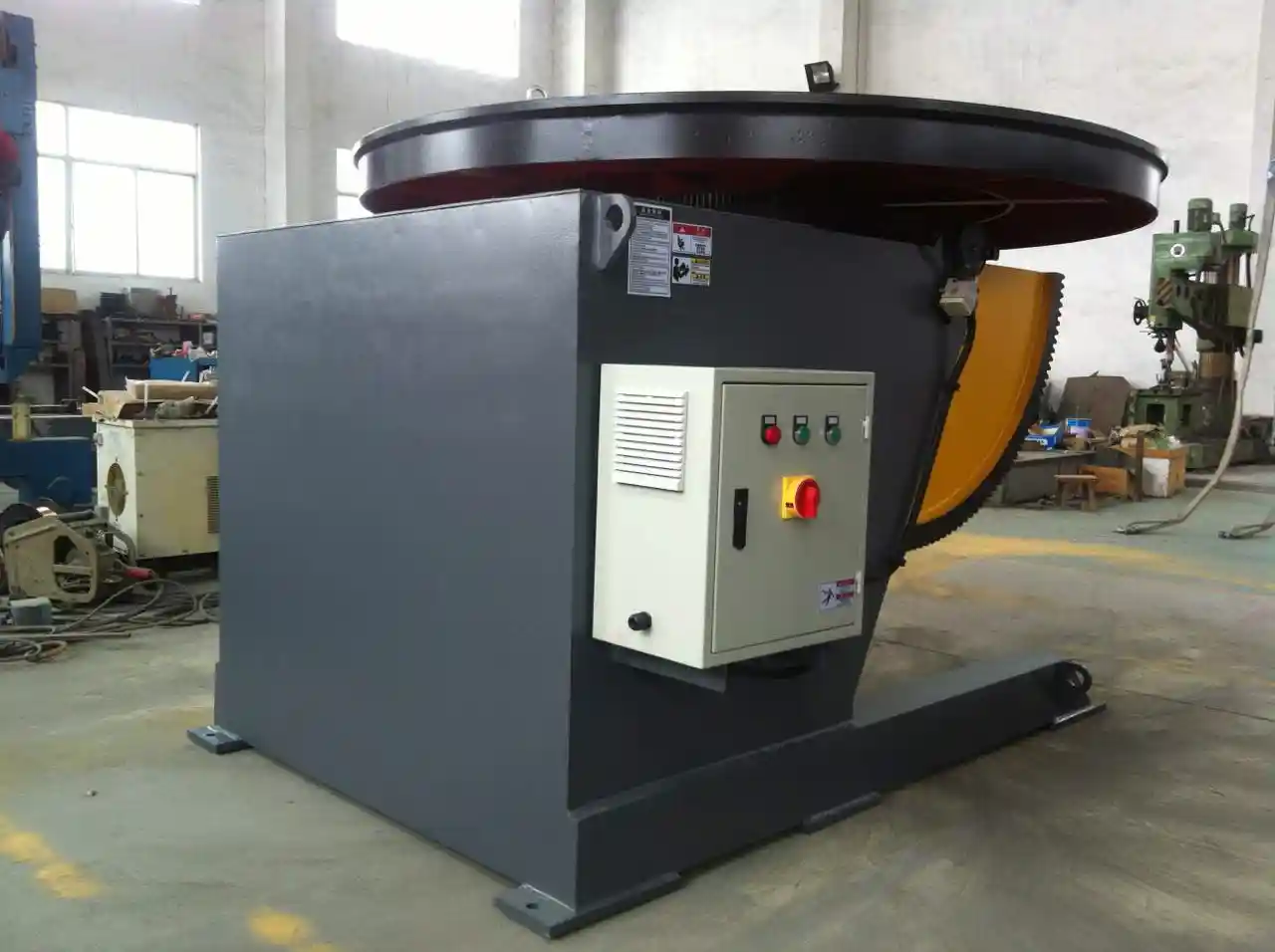
For robotic applications, confirm that the positioner can communicate with the robot controller, provide safe interlock signals, and maintain position under repeated start-stop cycles. In high-mix production, 100 or more preset welding programs can reduce changeover time and setup errors.
High-precision positioning improves pipe welding because it controls rotation speed and stable orientation.
(https://www.weldmc.com/news/how-to-improve-the-quality-of-pipe-welding-through-a-high-precision-welding-positioner/1657/) covers the quality effects of positioner precision.
Safety, Foundation, and Verification
Heavy positioners transfer overturning loads into the floor. Anchor bolts, grouting, and foundation flatness should follow the manufacturer’s installation drawing. Safety functions deserve the same review as load ratings:
- Brake motor to prevent drift during welding
- Anti-fall pins or mechanical locks
- Emergency stop and overload shutdown
- Electrical protection suitable for the workshop environment
- Slip rings or cable management for continuous rotation
Before production, run the positioner with a representative load. Check for abnormal noise, uneven rotation, excessive motor temperature, and position drift. These checks often reveal a wrong sizing assumption before it becomes a weld defect.
Need a Capacity Sizing Check? Send Your Workpiece Data
If the workpiece is not a simple cylinder, a quick technical review can prevent an expensive capacity mistake. Send the part drawing, weight, center-of-gravity location, and required welding position to jay@weldc.com, or call +86-13815101750 for a direct sizing discussion. Include the welding process and production volume so the review covers drive duty and automation requirements.
Request a Capacity Review or Quotation from WUXI ABK
WUXI ABK Machinery Co., Ltd manufactures welding positioners from 1-ton fixed-height machines to heavy adjustable-height positioners and 3-axis servo systems for robotic welding cells.
To request a selection review or quotation, contact:
- Электронная почта: jay@weldc.com
- Мобильный: +86-13815101750
- Тел: +86-510-83555592
- Факс: +86-510-83559158
Please include these details in the inquiry:
- Workpiece weight, dimensions, and material
- Center-of-gravity distance from table center
- Required rotation, tilt, and turning angles
- Welding process and robot brand, if automated
- Production volume per shift
- Available power supply and foundation condition
Explore the welding positioner and welding turntable solutions for standard and custom configurations.
ЧАСТО ЗАДАВАЕМЫЕ ВОПРОСЫ
What happens if I choose a positioner capacity too close to the workpiece weight?
The machine may still lift and rotate the part, but it may creep, vibrate, or trip overload protection because the overturning moment is too high. The rating is not only about weight; it also includes center-of-gravity position and dynamic load.
How does eccentric load affect positioning accuracy?
Eccentric load increases the moment on the slewing bearing, gears, and brake. Over time, this can produce uneven rotation, position drift, and accelerated wear. Keeping the load within the manufacturer’s eccentric and center-of-gravity limits helps maintain repeatable motion.
Can a welding positioner be upgraded later?
Some components, such as controls, programs, robot interfaces, or water-cooled tables, can be added or modified. The load-bearing structure and drive train are more difficult to upgrade, so the initial capacity should be selected for the largest expected workpiece and moment condition.
What data should I prepare before asking for a positioner quotation?
Prepare the workpiece weight and dimensions, center-of-gravity location, fixture weight, required motion axes, welding process, production volume, power supply, and robot brand if automation is planned. Clear data leads to a more accurate capacity recommendation.
References
[1] AWS D1.1/D1.1M:2020, Structural Welding Code—Steel, American Welding Society, 2020.
[2] ISO 3834-2:2021, Quality requirements for fusion welding of metallic materials — Part 2: Comprehensive quality requirements, International Organization for Standardization, 2021.
[3] ASME Boiler and Pressure Vessel Code, Section IX: Welding and Brazing Qualifications, American Society of Mechanical Engineers, 2023.
Если вам интересно, ознакомьтесь со следующими статьями по этой теме:
Чрезмерное смещение при сварке трубопроводов: решение для прецизионного позиционирования сварного поворотного стола от компании Wuxi ABK
Достижение идеальных сварных швов на трубах большого диаметра с помощью профессионального прокатного оборудования
 English
  Español
  Français
  Deutsch
  Português
  Русский