
Most welding positioner price questions start with a tonnage number, but the quote changes more from type, tilt range, control architecture, and workpiece geometry than from raw table capacity. I have worked on wind tower lines, pressure vessel cells, and structural steel projects where two machines rated for the same load came back with very different prices because one was a fixed height L type unit and the other was a 3 axis servo positioner with robot interface. This guide explains the price bands by capacity and type, the specifications that move cost, and the questions procurement teams should ask before comparing supplier quotes.
Welding Positioner Price Drivers That Matter Before You Compare
Capacity is only the starting point. A welding positioner quote is really a combination of structural rating, motion axes, drive quality, control system, and optional integration features. A 5 ton load rating on a fixed height positioner does not mean the same thing as a 5 ton rating on a 3 axis positioner with dynamic loading, and the price difference reflects that.
The base structure accounts for a significant share of cost. Heavy Q235-A steel box bases, stress relieved frames, and larger worktables require more material and machining time. A 1 ton HBJ-10 table is 1200 mm in diameter, while a 5 ton HBJ-50 moves to 1500 mm. The larger table carries more overturning moment capacity and costs more to cast or machine true. Load rating alone would miss that difference.
Drive and reducer selection is the second cost lever. AC frequency stepless speed regulation is common on fixed height positioners, while servo driven axes with THK linear guides and SEW reducers appear on 3 axis robotic positioners. The servo package raises precision to plus or minus 0.05 mm and repeatability to 0.02 mm, but it also raises cost because the control loop, drives, and feedback devices are a different class of hardware.
Control architecture matters for automated cells. Siemens PLC with HMI touchscreen and 100 plus preset programs is not entry level equipment, yet it is standard on WUXI ABK fixed height models. When buyers need ABB, KUKA, FANUC, or Yaskawa robot compatibility, the positioner must expose coordinated axis control and safety interlocks. That integration cost appears on the quote even before the first weld is made.
Buyers often focus on table loading but under-specify dynamic center of gravity limits. <Основные проблемы и высокоточные решения в области сварочных позиционеров в ветроэнергетике и судостроении: всесторонний технический анализ> covers how overturning moment, eccentric distance, and center of gravity distance change positioning accuracy in heavy fabrication, which is exactly where two similar tonnage ratings separate in real performance.
The table below shows how capacity, table size, and axis complexity move across fixed height models in the same product family. It is a useful first comparison for shops deciding whether a standard positioner can handle their workpiece envelope.
| Модель | Грузоподъемность | Worktable Diameter | Угол поворота | Точность позиционирования | Typical Automation Fit |
|---|---|---|---|---|---|
| HBJ-10 | 1 тонна | 1200 мм | 0 to 90 degrees | Plus or minus 0.5 degrees | Manual or basic mechanized welding |
| HBJ-20 | 2 тонны | 1200 мм | 0 to 120 degrees | Plus or minus 0.5 degrees | Manual, MIG/TIG, small robotic cell |
| HBJ-30 | 3 тонны | 1400 mm | 0 to 90 degrees | Plus or minus 0.5 degrees | Robotic welding station entry |
| HBJ-50 | 5 тонн | 1500 мм | 0 to 120 degrees | Plus or minus 0.5 degrees | Pressure vessel and structural welding |
Fixed Height vs Adjustable Height vs 3 Axis Positioner Pricing
Type affects price more than tonnage in many of the quotes I review. A fixed height 1 ton positioner is a production workhorse for consistent part families. An adjustable height positioner adds hydraulic lifting or manual height adjustment for varying workpiece diameters. A 3 axis positioner adds synchronized turning, rotating, and tilting for robotic cells and complex joint access. The step from fixed height to 3 axis can multiply the quote, not because the steel is heavier, but because the motion control architecture is completely different.
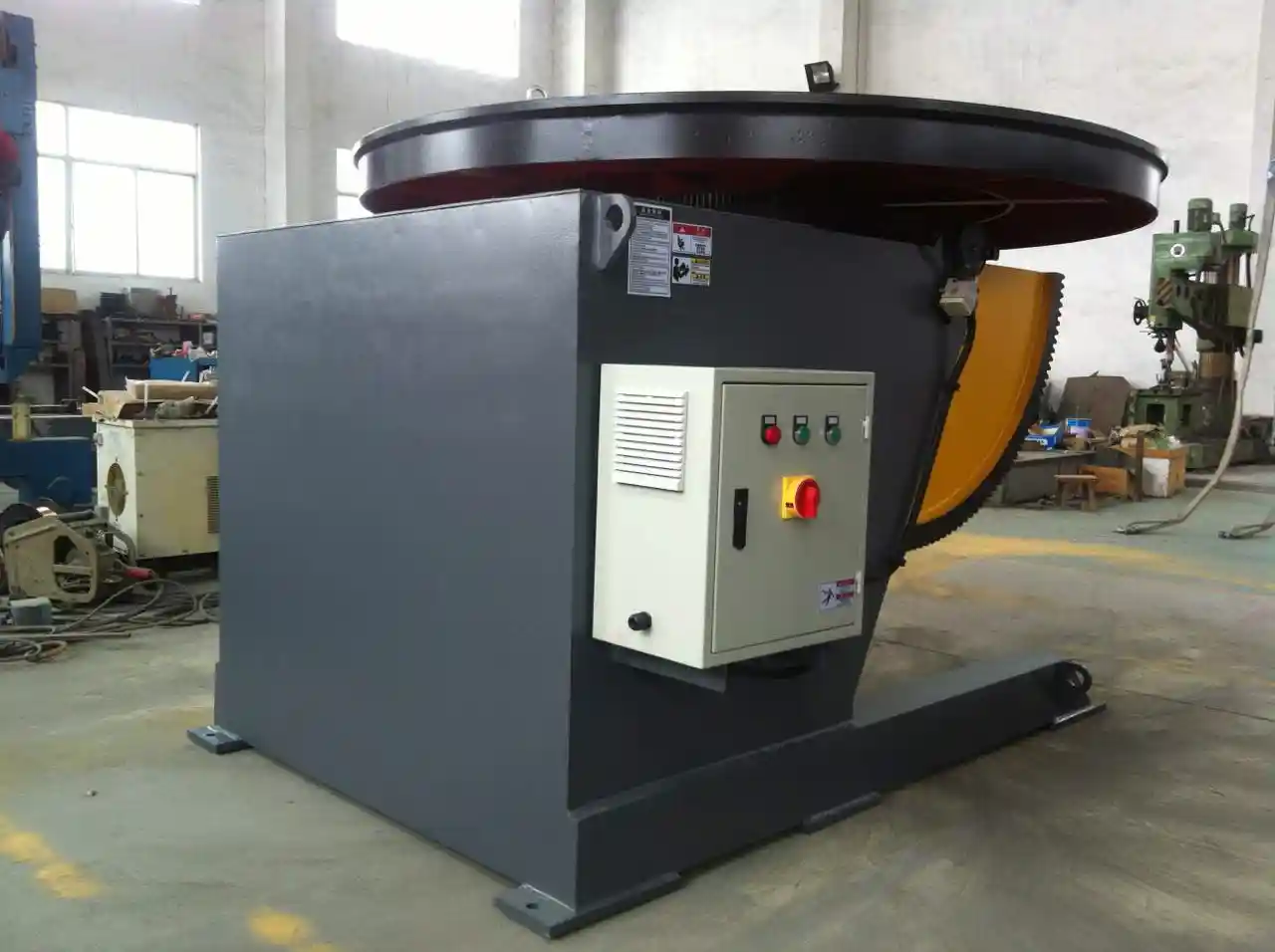
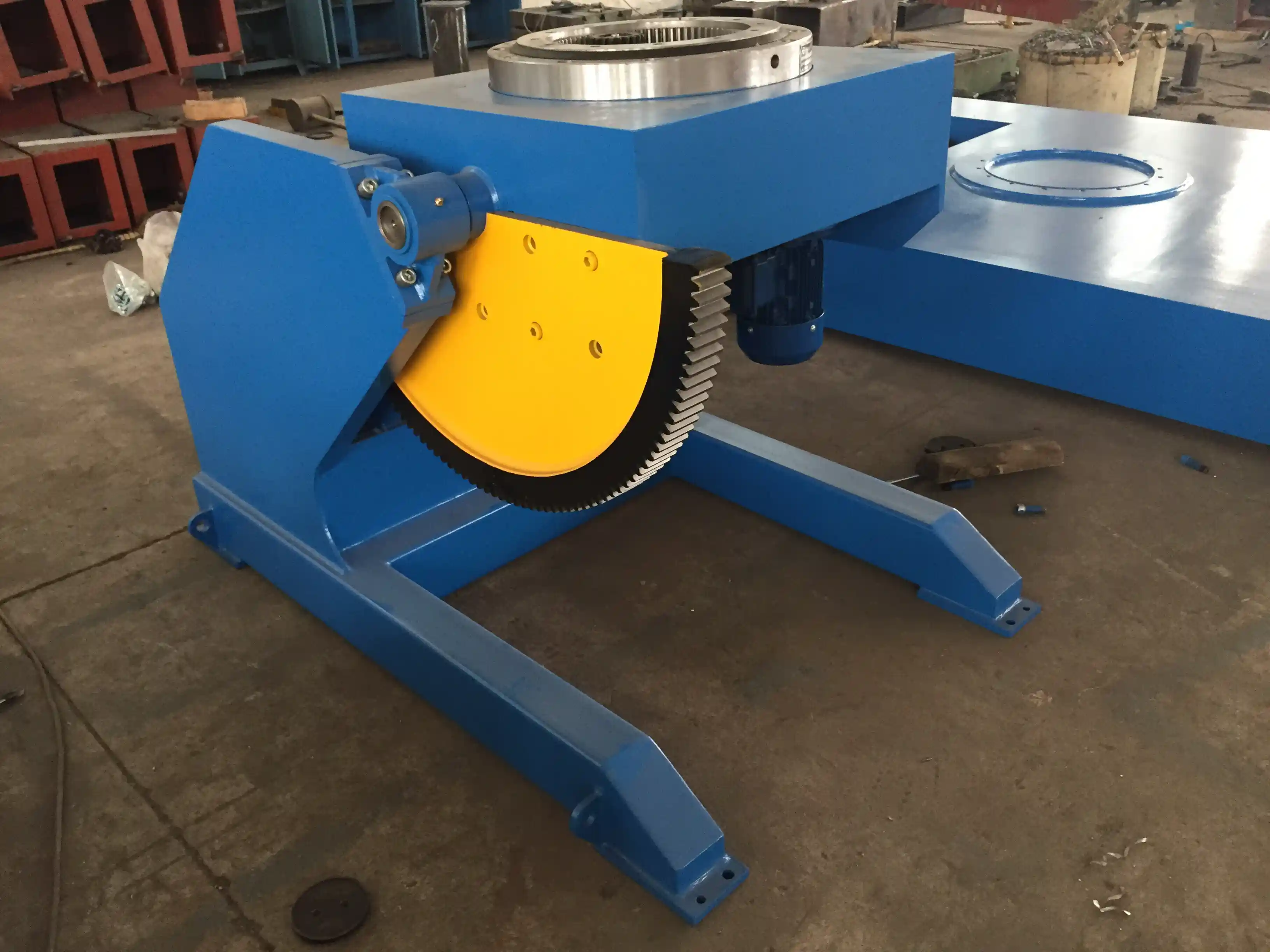
Fixed height positioners use a simpler drive layout. Rotating speed is typically 0.05 to 0.5 RPM with AC frequency stepless regulation. Turnover angle on the HBJ-20 and HBJ-50 reaches 120 degrees, and some units offer tilt up to 135 degrees through a cycloidal worm dual stage reducer. That is enough for many pressure vessel and structural parts. Buyers who do not need height change or robotic coordination should not pay for it.
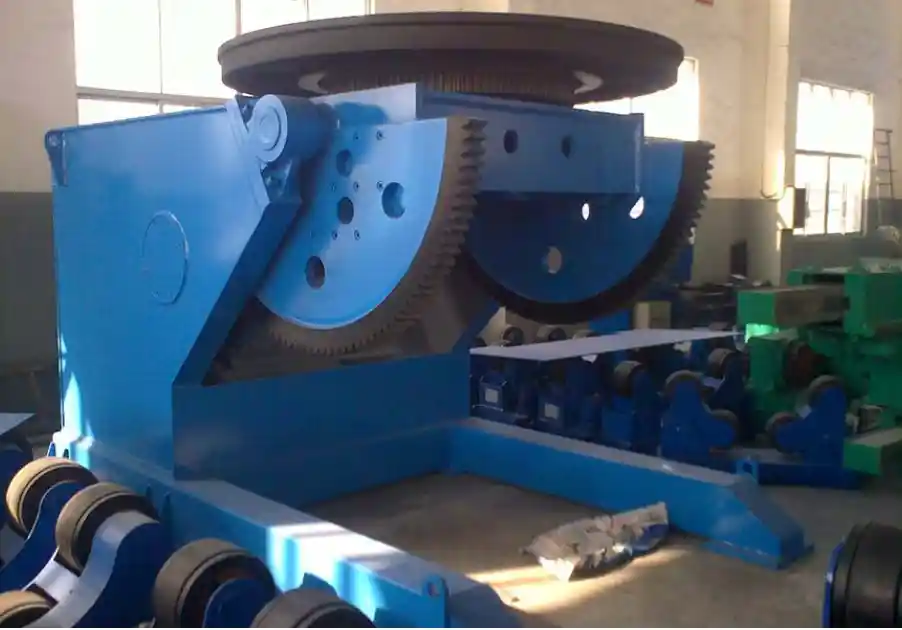
Adjustable height positioners add a lifting column or hydraulic elevation stage. The 30 ton adjustable height positioner in our range has a 1000 to 2000 mm height adjustment and hydraulic lifting. A 100 ton adjustable height unit uses manual height adjustment and a 1800 mm worktable. That flexibility is valuable when a shop welds both small flanges and larger tank sections, but it increases cost through the lifting mechanism, larger base structure, and additional safety checks.
3 axis positioners are built for coordinated motion, not just part rotation. The 1 ton, 2 ton, 3 ton, and 5 ton 3 axis models in our catalog use servo drives, Siemens PLC touchscreen control, and robot interfaces. They tilt 0 to 90 degrees, turn 180 degrees, and rotate 360 degrees continuously. Position accuracy is plus or minus 0.05 mm with 0.02 mm repeatability. When I prepare a quote for one of these systems, the controls integration and robot safety handshake take more engineering time than the mechanical frame.
If the project involves long cylindrical parts rather than compact weldments, a head and tail positioner is often the better price choice than an oversized single table unit. The HBT series uses two bases, one powered head and one adjustable tail, to support pipes, shafts, and structural components. A 1 ton head and tail positioner with 1000 mm worktable diameter can position parts that would be unstable on a single 1 ton table because the load is distributed between two support points.
Cylindrical components on a single positioner can create eccentric loading that the table was never sized for. <Достижение идеальных сварных швов на трубах большого диаметра с помощью профессионального прокатного оборудования> explains how rolling equipment and positioners should be selected around diameter, wall thickness, and support spacing rather than total weight alone.
Capacity Bands and What They Should Cost You in Configuration
Capacity bands are useful for budget planning, but the price spread within a band can be wider than the step to the next band. I have seen a configured 3 ton 3 axis positioner quoted higher than a straightforward 10 ton fixed height turntable because the controls and servo package dominated the cost. Buyers should therefore use capacity as a filter, not as the final price anchor.
For small parts up to roughly 1 ton, entry pricing is concentrated in fixed height positioners and compact turntables. These machines handle pipe flanges, small structural weldments, and repair work. A 200 kg rotary turntable with 0.37 kW power and 600 mm table suits batch production of small pipe and flange assemblies. The HBJ-10 1 ton unit brings a 1200 mm table and turn over capability to 90 degrees, which is a practical step up for larger parts without moving into servo territory.
Mid capacity equipment from 2 to 10 tons covers most general fabrication and pressure vessel seam welding. This is where buyers should be most careful about under-specifying. The 2 ton and 5 ton fixed height positioners share many frame components with their lighter counterparts, but the larger table and stronger reducers cost more. A 10 ton welding turntable includes a 2000 mm table, 0.05 to 0.5 RPM speed range, and a 2.2 kW drive. It is sized for large vessel circumferential seams and energy equipment, and it needs a proper foundation.
Heavy capacity positioners above 20 tons shift from standard products to engineered configurations. The 20 ton equipment may use a 2000 mm table and 4 kW drive, while the 30 ton model moves to a 3000 mm table. At this level, foundation requirements, crane access, and installation planning become part of the cost. Buyers should line up these site conditions before comparing base machine prices.
At 30 tons and above, adjustable height positioners are common for wind tower sections and large pressure vessels. Our 30 ton adjustable height model provides hydraulic lifting over a 1000 to 2000 mm height range with AC frequency stepless speed control. The 100 ton adjustable height version uses a 1800 mm table and a 135 degree turn over angle. These machines are capital investments where transportation and commissioning can exceed the cost of a small accessory package.
Quote Variables That Procurement Teams Overlook
The largest avoidable price errors come from quoting a machine without a clear workpiece envelope. Every positioner needs three limits defined: maximum load, maximum center of gravity distance, and maximum eccentric distance. The HBJ-10 lists a maximum eccentric distance of 150 mm and maximum center of gravity distance of 200 mm. If a part exceeds either value, the positioner will not behave as expected at the table edge, even if total weight is below the rated load. In my experience, incomplete load descriptions are the most common reason a first quote misses the target machine.
Power supply is another variable. Standard systems are specified for 380 V 50 Hz three phase, but many fixed height models can be configured from 200 to 600 V. Buyers in markets with 60 Hz supply or nonstandard voltage should confirm this before order. The cost difference is usually modest compared with the cost of a transformer installed at the last minute.
Safety and protection features can be optional or standard depending on the model. IP54 rated cabinets protect against dust and spatter in normal welding environments. ATEX Zone 1 explosion proof options are available on some fixed height positioners, but they add cost and documentation. Water cooled tables and CNC synchronization are also optional on selected models. These options are not universal upgrades; they are specific solutions for specific conditions.
A useful practice is to request the quote in two scopes. The first scope is the base positioner ready to operate. The second scope adds the integration items: robot handshake, seam tracking, water cooled table, explosion proof certification, or special voltage. That separation shows whether the budget difference is mechanical or controls driven. It also prevents suppliers from hiding a necessary integration item in a line item that is easy to overlook.
If your program involves heavy parts with off center loads, it is worth confirming the center of gravity calculation and table edge capacity before finalizing the specification. Share your maximum part weight, center of gravity distance, and required tilt angle with the manufacturer so the quote is based on the actual load case, not only nominal tonnage.
How to Compare Welding Positioner Quotes Without Losing the Technical Thread
Price comparison works only when the specifications are normalized. A quote that appears cheaper may be a smaller table, lower turnover angle, no servo control, or no robot interface. I recommend building a five line comparison sheet: load capacity, table diameter, rotation and turnover range, positioning accuracy, and control type. If any of those lines is missing, request it before comparing.
Turnover angle changes more than just flexibility. A 0 to 90 degree turnover positioner can rotate the part to a horizontal or vertical plane, but it cannot hold every angle between without the right reducer configuration. Units with 0 to 120 or 0 to 135 degree range are often specified for weldments that need backhand or overhead positions. The price increase is not for an angle on a label; it is for the reducer and structure that maintain control through that range under load.
Positioning accuracy is a common source of mismatched pricing. Fixed height positioners in the HBJ series state plus or minus 0.5 degree rotation accuracy, which is appropriate for manual and mechanized welding of structural parts. 3 axis positioners for robotic cells state plus or minus 0.05 mm positioning accuracy and 0.02 mm repeatability. Those are different measurement types: one is angular table accuracy, the other is precise positioning in a servo cell. A buyer comparing them as equivalent numbers would misread both quotes.
Warranty and service terms should be compared after the technical scope is aligned. A lower machine price is not a lower total cost if the local spare parts channel is weak or there is no commissioning support. For export buyers, I advise asking about documentation, spare parts availability, and remote support before release. The specification sheet is only the first layer of the purchase.
Common Questions About Welding Positioner Pricing
Does a higher tonnage welding positioner always cost more?
Not always. A 3 ton 3 axis positioner with servo drives, THK guides, SEW reducers, and robot compatibility can be more expensive than a 5 or even 10 ton fixed height positioner because the motion control architecture is different. Use tonnage to shortlist machines, but let axis configuration and control requirements drive the final price comparison.
What is the cost difference between fixed height and adjustable height positioners?
The difference comes from the lifting mechanism, base structure, and added safety components. A fixed height unit is rigid and simpler to manufacture. An adjustable height unit includes hydraulic or manual elevation, larger structural supports, and additional checks. The exact gap depends on lift range and load, but adjustable height adds meaningful cost when the application requires changing workpiece diameters.
Is a 3 axis positioner worth the price for a job shop?
It depends on the work mix and whether robotic welding is planned. If the shop mostly welds parts that can be positioned with rotation and 90 degree turnover, a fixed height unit is the economical choice. If the work requires coordinated motion, repeatable weld positions, or robot integration, a 3 axis positioner reduces setup time and rework. For one off manual jobs, the servo capability is often unnecessary.
Why do two 5 ton positioners have different prices?
Table size, turnover angle, reducer type, and control package are the usual reasons. One 5 ton unit may use a 900 mm table, another a 1500 mm table. One may use AC frequency speed regulation, another a servo drive with touchscreen and preset programs. The price difference is real but it is tied to configuration, not brand padding.
What specifications should I send to get an accurate price?
Send the workpiece envelope first: maximum weight, center of gravity distance, eccentric distance, required rotation and turnover angles, and part dimensions. Add power supply, robot interface if applicable, and any special protection requirements. That information lets the manufacturer size the frame, reducer, motor, and control correctly. For capacity near 30 tons or higher, also confirm foundation and crane access before finalizing the quote. Share your drawings and required part positions with jay@weldmc.com or call +86-13815101750, and we will return a specification matched price instead of a catalog list.
Если вам интересно, ознакомьтесь со следующими статьями по этой теме:
Слишком маленькое пространство мастерской? Как колонные стрелы экономят 50% пространство на полу, повышая безопасность и эффективность
Инновационные способы применения 10-тонных сварочных поворотных устройств с ЧПУ в производстве сосудов под давлением
 English
  Español
  Français
  Deutsch
  Português
  Русский