I’ve spent enough time on shop floors and in commissioning meetings to see how one tiny weld flaw in a tube can snowball into downtime, safety scares, and expensive fixes. That’s why we treat tube welding inspection as non‑negotiable: it safeguards structural integrity, keeps operations reliable, and lets us catch issues early with the right NDT methods. Below, we walk through why inspection matters, the common defects to watch for, the key NDT techniques and acceptance criteria, how to embed inspections into production, and the technology trends reshaping what’s possible—all with the practical focus we use in our own projects.
Understanding the Critical Role of Tube Welding Inspection
1. Why Tube Welding Inspection is Essential for Structural Integrity
Tube welding inspection underpins both structural integrity and day-to-day reliability. Even small weld defects can degrade a tube’s mechanical properties, raising the risk of premature failure under stress, pressure, or corrosive conditions. Sectors like oil and gas, power generation, and chemical processing depend on defect-free tube welds to avoid catastrophic incidents and environmental harm. In practice, robust inspection programs protect people, assets, and the environment.
2. Common Challenges and Defects in Tube Welding
Tube welding comes with inherent process and material challenges. Typical defects include porosity, incomplete fusion, lack of penetration, cracks, and undercut—often tied to incorrect parameters, contamination, or poor joint preparation. Pinpointing and sizing these discontinuities calls for specialized Non-Destructive Testing (NDT). Finding them early prevents minor flaws from growing into serious structural vulnerabilities.
Exploring Non-Destructive Testing (NDT) Methods for Tube Welds
Non-Destructive Testing (NDT) lets us evaluate weld quality without harming the component. Each method targets particular defect types, so selection depends on the base material, joint geometry, and likely discontinuities.
1. Visual Inspection: The First Line of Defense in Weld Quality
Visual inspection (VT) is the starting point and often the quickest win. Qualified inspectors check the weld surface for visible issues—cracks, porosity, undercut, and poor bead profile. It’s cost-effective, offers instant feedback, and helps catch obvious problems before they compound. The tradeoff: VT only sees surface conditions, not internal flaws. Good lighting and magnification significantly improve results.
2. Radiographic Testing: Detecting Internal Flaws in Welded Tubes
Radiographic Testing (RT) uses X-rays or gamma rays to penetrate the weld and form an image on film or digital media. It shines at revealing internal volumetric defects such as porosity, slag inclusions, and lack of penetration, and it creates a permanent record of internal condition. RT does require radiation safety controls and can be slower on complex geometries.
3. Ultrasonic Testing: Advanced Techniques for Weld Defect Identification
Ultrasonic Testing (UT) relies on high-frequency sound waves to find internal and surface-breaking discontinuities. A transducer sends waves through the part; reflections indicate potential defects. UT is very sensitive to planar indications like cracks and lack of fusion, provides real-time feedback, and avoids radiation risks. Advanced options, including Phased Array Ultrasonic Testing (PAUT), deliver detailed imaging and accurate sizing.

4. Eddy Current Testing: Surface and Near-Surface Defect Detection in Tubes
Eddy Current Testing (ECT) is ideal for conductive materials when you need to focus on surface and near-surface defects. An alternating magnetic field induces eddy currents; disruptions caused by flaws are measured by the probe. ECT is especially effective on thin-walled tubes and heat exchanger tubing. It’s fast, light on surface prep, and readily automated.
5. Liquid Penetrant Testing: Revealing Surface-Breaking Discontinuities
Liquid Penetrant Testing (PT) exposes surface-breaking defects in non-porous materials. After applying the penetrant and allowing time for it to seep into discontinuities, the excess is removed and a developer is used to draw out the penetrant, making the flaw visible. PT is simple, economical, and broadly applicable, but it only addresses surface indications and demands thorough cleaning.
6. Magnetic Particle Testing: Identifying Surface and Subsurface Flaws in Ferromagnetic Tubes
Magnetic Particle Testing (MPT) detects surface and shallow subsurface flaws in ferromagnetic materials. Once magnetized, the presence of a defect distorts the field, causing magnetic particles to gather and form a visible indication. It’s highly sensitive to cracks and comparatively quick to perform, though it is limited to ferromagnetic materials.
Establishing Acceptance Criteria for Tube Welding Inspection
1. Overview of Industry Standards and Codes for Tube Welds
Industry codes set the baseline for acceptable weld quality. ASME (American Society of Mechanical Engineers), AWS (American Welding Society), and API (American Petroleum Institute) publish application-specific requirements, defining allowable defect types, sizes, and locations. Working to these standards is fundamental to safety and reliability.
2. Key Factors Influencing Acceptance Criteria for Different Applications
Acceptance criteria depend heavily on service conditions and criticality. Operating pressure and temperature, corrosivity, and cyclic loads influence how strict the limits must be. For example, nuclear applications typically impose far tighter restrictions than non-critical structural uses. Design engineers specify the relevant parameters and acceptance levels.
3. Interpreting NDT Results Against Defined Acceptance Standards
Interpreting NDT data calls for both technical skill and familiarity with the applicable standards. Technicians compare any detected indications with specific limits for size, type, and location. Clear procedures reduce subjectivity and ensure compliance, while thorough documentation supports traceability and quality assurance.
Best Practices for Implementing Effective Tube Welding Inspection Programs
Getting inspection programs right takes planning and discipline. We favor a systematic approach that integrates inspection into production and invests in people.
1. Integrating NDT into the Welding Production Workflow
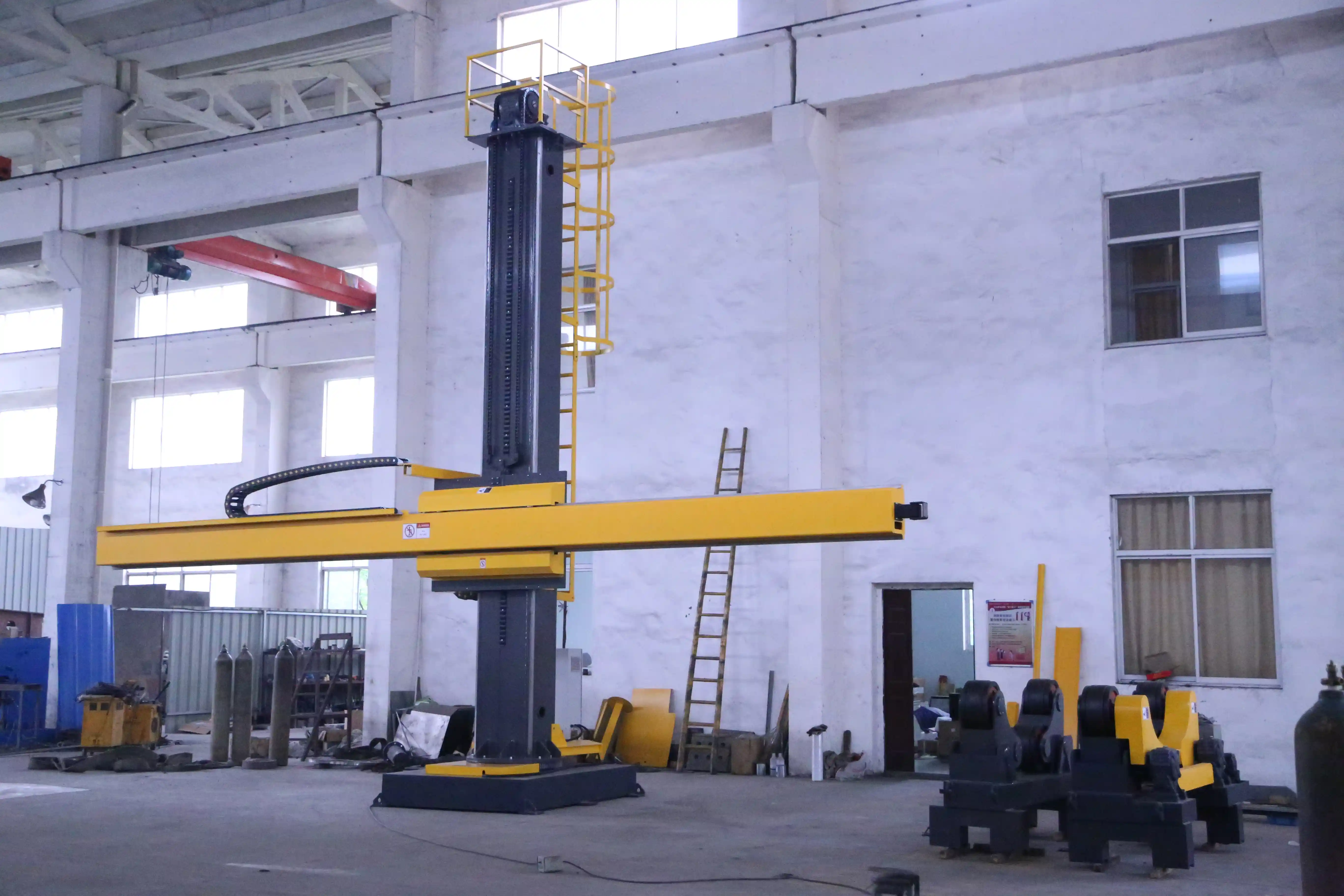
Embedding NDT at the right stages prevents bottlenecks and surprises. That often means interpass checks on multi-pass welds and final inspections after post-weld heat treatment. Catching issues early curbs rework and keeps schedules intact. Our welding manipulators and positioners help ensure precise, consistent welds, reducing the likelihood of defects that demand extensive NDT.
If you’re interested, check 《Boosting Productivity In Pressure Vessel Fabrication The Strategic Use Of Welding Manipulators And Turning Rolls》.
2. Training and Certification Requirements for NDT Personnel
Accurate inspection depends on qualified people. Training and certification through organizations like ASNT (American Society for Non-destructive Testing) verify that technicians understand each method’s principles, how to operate equipment, and how to interpret results in line with the codes. Ongoing development keeps skills aligned with new technologies and standards.
3. Leveraging Technology for Enhanced Inspection Accuracy and Efficiency
Modern tools elevate both accuracy and throughput. Automated ultrasonic systems rapidly cover large areas and build detailed defect maps. Digital radiography streamlines imaging and data management compared to film. Integrating such technologies reduces human error. We use precise positioning tools—such as our 3 Axis Positioner—to deliver consistent weld quality, which pays dividends at the inspection stage.
If you’re interested, check 《Tired Of Complex Welding Challenges How A 3 Axis Positioner Can Boost Productivity By 70》.
The Future of Tube Welding Inspection: Innovations and Trends
Inspection technologies are moving fast, and the gains are tangible—more accuracy, wider coverage, and better efficiency. We track and adopt these advances where they add value.
1. Advancements in Automated and Robotic NDT Systems
Automated and robotic NDT systems are reshaping how inspections get done. Robots handle repetitive tasks with high precision, trimming inspection time and limiting personnel exposure to hazards. Many platforms combine multiple NDT methods for broader coverage—especially helpful with complex geometries or high volumes.
2. The Role of Artificial Intelligence and Machine Learning in Weld Inspection
AI and ML are raising the bar on defect detection and classification. By learning from large NDT datasets, models spot patterns, sharpen sizing and characterization, and reduce false calls. The result is a faster, more consistent inspection workflow and stronger overall quality assurance.
3. Emerging NDT Technologies for Complex Tube Geometries
Cutting-edge methods are tackling complex geometries and advanced materials. Phased Array Ultrasonic Testing (PAUT) and Time-of-Flight Diffraction (TOFD) offer excellent sizing and location accuracy for intricate welds. Guided Wave Testing (GWT) enables long-range screening from a single access point—ideal when reach is limited. These tools expand where and how we can inspect tubes effectively.
Partner with WUXI ABK for Superior Welding Solutions
At WUXI ABK MACHINERY CO., LTD, we are committed to delivering high-quality welding equipment that meets stringent industry standards. Our expertise in welding manipulators, positioners, and rotators ensures precise and consistent welds, reducing the need for extensive rework. We understand the critical role of robust tube welding inspection in ensuring structural integrity and operational safety. Partner with us to enhance your welding processes and achieve unparalleled quality. Contact us today to discuss your specific needs.
Электронная почта: jay@weldc.com
Мобильный: +86-13815101750
Тел: +86-510-83555592
Об авторе
Jay Li, R&D Director
Jay Li, welding automation expert with 20+ years of experience, specializes in wind tower welding lines, H-beam welding lines, and pipe welding equipment, helping companies improve quality and production efficiency.
Вопросы и ответы
1. What are the primary NDT methods used for tube welding inspection?
The primary NDT methods for tube welding inspection include Visual Testing (VT) for surface flaws, Radiographic Testing (RT) for internal volumetric defects, and Ultrasonic Testing (UT) for internal planar flaws. Other methods like Eddy Current Testing (ECT) and Magnetic Particle Testing (MPT) are also employed for specific applications and materials.
2. How do acceptance criteria differ for various tube welding applications?
Acceptance criteria vary based on the application’s criticality, such as pressure vessels versus general structural components. Industry codes like ASME and AWS define these criteria, considering factors like operating pressure, temperature, and potential environmental impact. More critical applications typically have stricter acceptance limits for defect size and type.
3. Can NDT methods detect all types of weld defects in tubes?
No single NDT method can detect all types of weld defects. Each method has specific strengths and limitations. For instance, RT is excellent for volumetric flaws but less sensitive to tight cracks, while UT excels at detecting planar defects. A combination of NDT methods is often necessary for comprehensive defect detection.
4. What role does automation play in modern tube welding inspection?
Automation significantly enhances modern tube welding inspection by improving accuracy, repeatability, and speed. Automated systems, often integrated with AI and ML, reduce human error and minimize exposure to hazardous conditions. They enable efficient inspection of large volumes and complex geometries, contributing to higher quality and productivity.
5. How often should tube welds be inspected to ensure long-term integrity?
The frequency of tube weld inspections depends on several factors, including the application, operating environment, material, and regulatory requirements. Initial inspections typically occur post-fabrication. In-service inspections are then performed at regular intervals, often dictated by industry codes or risk-based inspection programs, to monitor for degradation.
 English
  Español
  Français
  Deutsch
  Português
  Русский