
Chemical tank fabrication brings together plate cutting, shell rolling, circumferential welding, nozzle fitting, and final inspection under stricter dimensional and material requirements than many general structural jobs. Plant engineers evaluating equipment need to connect shell diameter, wall thickness, material grade, and code exposure to the correct cutting, rolling, rotating, positioning, and welding systems. A practical selection approach uses the governing welding and construction requirements as the starting point before any drive size or fixture is chosen [1].
1. Code Requirements Set the Equipment Baseline
Chemical storage tanks and process vessels are not a single code category. Large atmospheric storage tanks in chemical terminals and tank farms commonly follow API 650, which governs shell design, plate tolerances, roundness, and weld joint categories for field-erected vertical cylindrical tanks [2]. Vessels that operate under internal pressure, including reactors, accumulators, and separation vessels, fall under ASME Boiler and Pressure Vessel Code Section VIII, which adds joint efficiency, inspection, and qualification requirements [3]. These code drivers influence equipment decisions in three places: groove preparation accuracy, fit-up control during shell assembly, and the ability to keep the joint in a flat or horizontal welding position.
For the welding team, this means the line should not be selected as a collection of standalone machines. Plate edge quality, roller alignment, rotator speed stability, and manipulator positioning accuracy must work together to hold the same groove and alignment window that the inspection plan requires.
2. Plate Cutting and Edge Preparation
Most chemical tank shells begin as plate cut to width before rolling. The cut edge sets the first tolerance stack-up for welding. CNC plasma, flame, and laser cutting systems can deliver the squareness and bevel angles needed for single- or double-V grooves, but only when cutting speed, torch height, and nesting are controlled. AWS D1.1 provides acceptance limits for joint fit-up and groove preparation for welded steel structures, and the same discipline applies to many storage tank shell and bottom joints [4]. Fabricators should specify edge beveling capability, accurate torch height control, and consistent cut-face quality rather than selecting a cutting table on speed alone.
Relevant cutting platforms include Découpeur plasma CNC, Coupeuse à flamme CNCet Machine de découpe laser, with the process matched to plate thickness and edge condition requirements.
3. Shell Rolling, Fit-Up, and Rotator Selection
After edge preparation, plate sets are rolled into shell courses. Mechanized rolling and adjustable-height machine à rouler les tuyauxs help maintain consistent curvature before the longitudinal seam is tacked. Once a course is rolled, adjustable welding rotators carry the cylindrical shell and rotate it at controlled speed for fit-up, root pass, and submerged arc fill. The rotator selection is driven by maximum vessel diameter, shell weight, and required rotational speed range. For chemical tank work, the aiming point is stable rotation with low axial creep, because course-to-course mismatch directly affects roundness, weld orientation, and final inspection.
Systems such as Pipe Rolling Machine et Rouleau réglable pour tuyaux provide rolling and alignment support, while Tank Welding Solutions combine fit-up and weld-positioning capacity for larger shell sections.
Shell roundness and controlled rotation are central to repeatable tank work. <Des soudures parfaites sur des tubes de grand diamètre grâce à un équipement de laminage professionnel> covers rolling equipment setup for consistent root gap and seam tracking.
Planning a chemical tank line? If you are matching rolling, rotator, and seam-welding capacity to specific shell diameters and material grades, contact WUXI ABK at jay@weldc.com with your tank diameter range, wall thickness, and daily output target for a direct equipment recommendation.
4. Long Seam and Circumferential Welding Automation
Once fit-up is stable, the next productivity decision is how the longitudinal seam and circumference are completed. Submerged arc welding is the main production choice for shop-fabricated tank shells because it offers deep penetration and high deposition on long, regular joints. Vertical electrogas welding is applied for vertical seams on heavy storage tank shells, while automatic girth welding machines combine travel, torch guidance, and seam tracking for circumferential joints between courses.
Rather than automating only the arc, the most effective lines automate joint access. A manipulateur de soudage positions the head over the seam while the rotator controls travel; the combination keeps the operator away from direct weld zone and provides a repeatable travel speed and stick-out.
| Process | Typical use | Supporting equipment |
|---|---|---|
| Submerged arc | Long shell seams and girth seams | Welding manipulator, rotator |
| Vertical electrogas | Vertical field-erected tank seams | Automatic electrogas carriage |
| Girth welding | Course-to-course circumferential joints | Tank roller system, automatic girth machine |
| FCAW/MCAW | Nozzles, fittings, and short joints | Positioner, boom manipulator |
Course-to-course welding benefits from coordinated rotation and head positioning. <Wuxi ABK Professional Welding Rotary Equipment: Precision Welding Solution for Pressure Vessel Manufacturing> covers rotary equipment integration for reliable pressure vessel seams.
5. Positioners and Manipulators for Nozzle and Fitting Welds
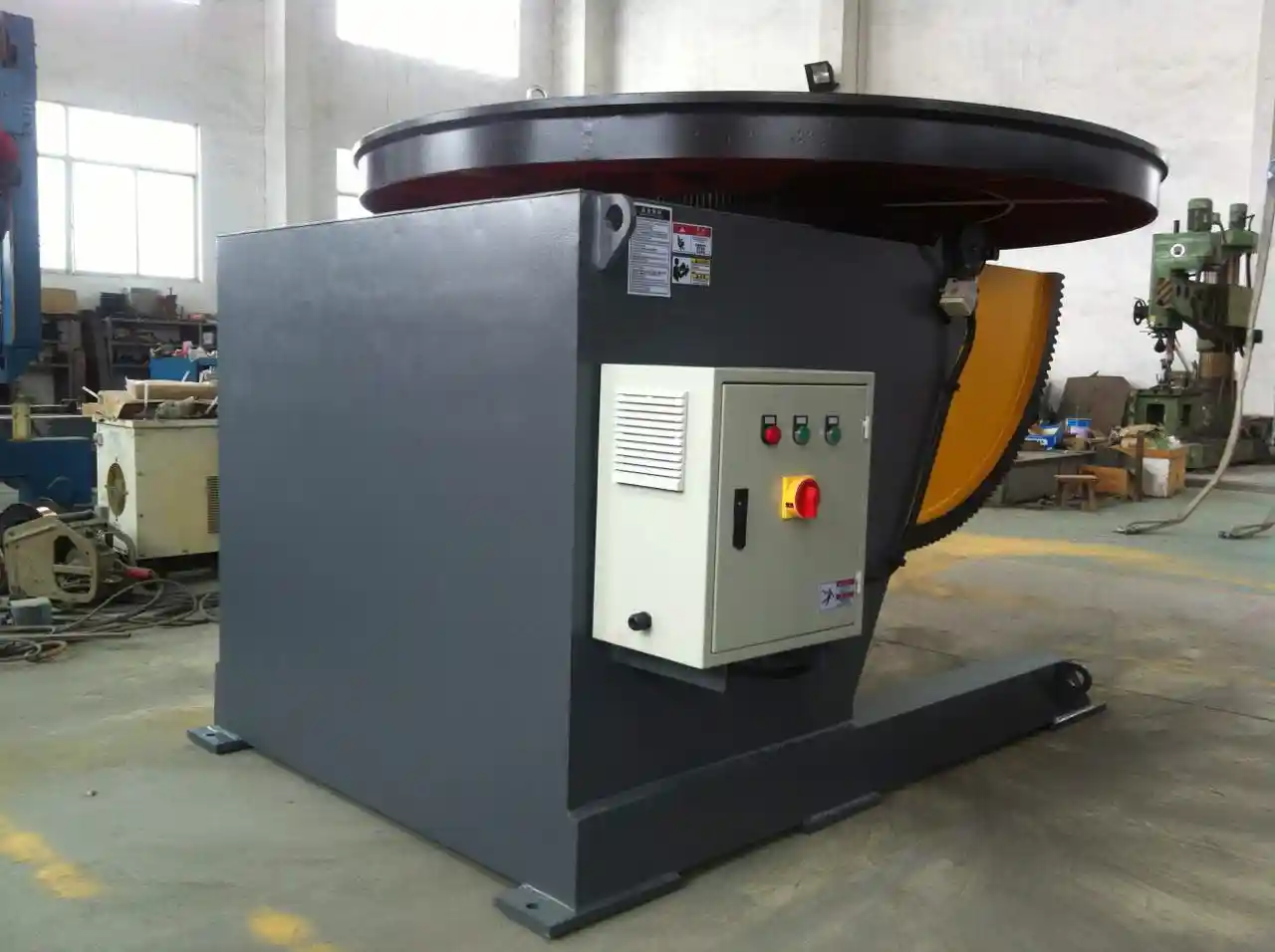
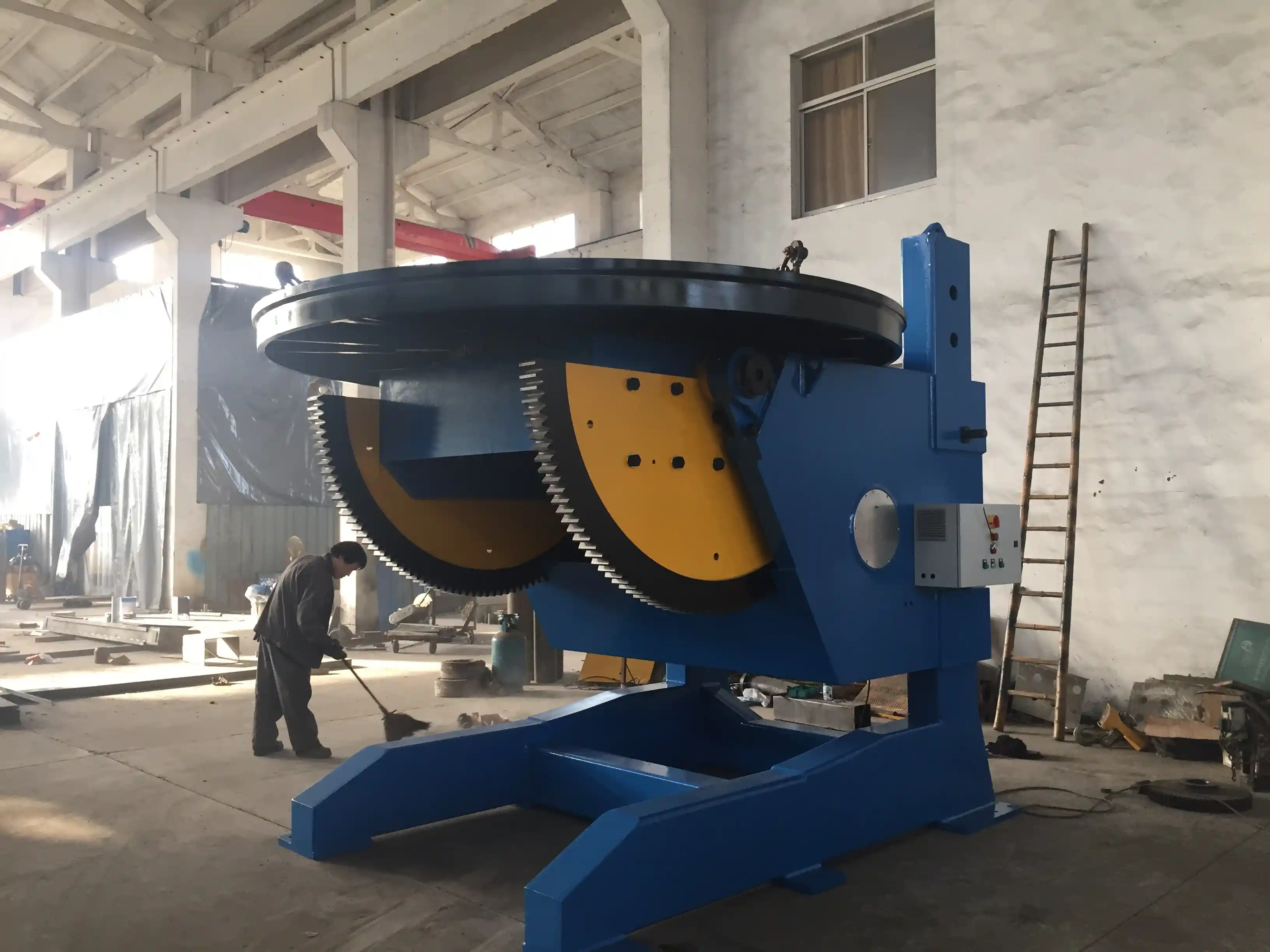
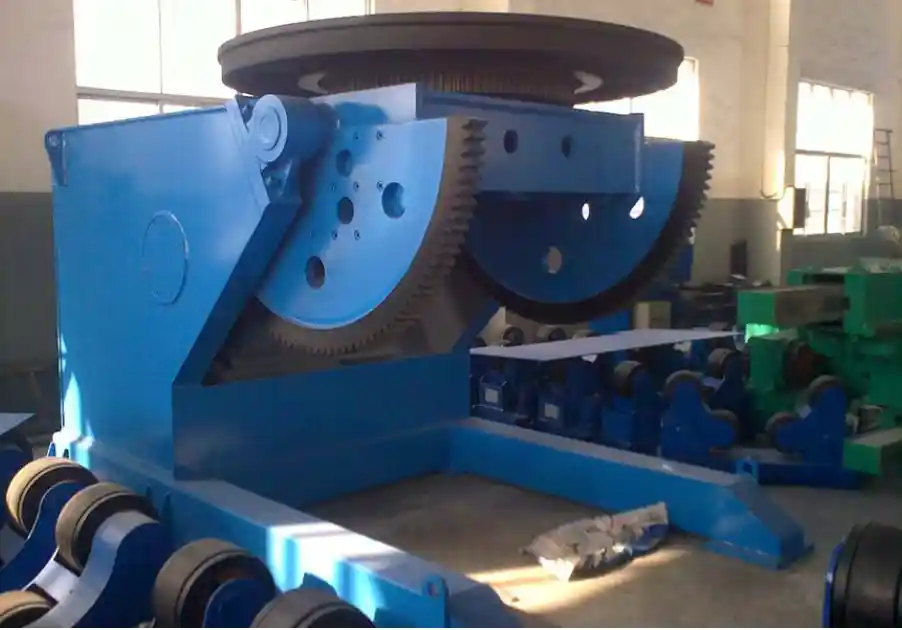
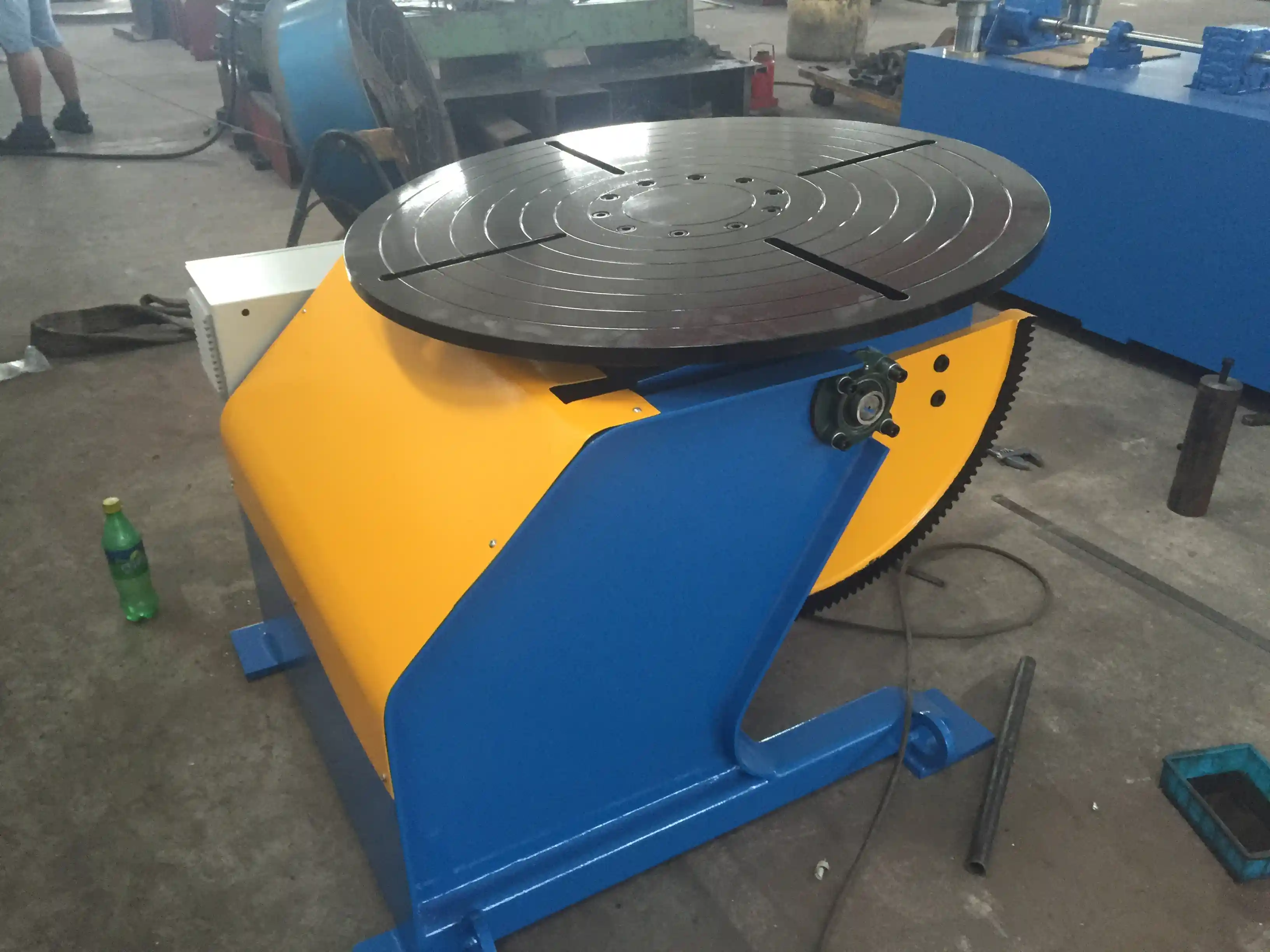
Nozzles, manways, flanged connections, and reinforcing pads move the welding position away from simple straight seams. A fixed or adjustable welding positioner rotates the shell so each nozzle lands in a comfortable flat or horizontal position. This reduces the need for out-of-position welding and helps keep the same qualified procedure parameters.
Because chemical tanks vary in diameter and nozzle layout, practical lines pair the positioner with a column and boom manipulator. The manipulator carries the welding head; the positioner orients the work. Specifications to compare include load rating at stated center-of-gravity distance, rotation speed range, tilt angle, repeatability, and compatibility with the planned process.
Typical links: Manipulateur de soudage, Positionneur de soudage réglable, Positionneur de soudage à 3 axeset Tank Welding Solutions.
Precision positioning becomes more important when nozzles, flanges, and short seams are added to large cylindrical workpieces. <Applications innovantes des rotateurs de soudage CNC de 10 tonnes dans la fabrication de récipients sous pression> covers rotator selection for heavy pressure vessel welding applications.
6. Inspection, Documentation, and Quality Control
Equipment performance should be evaluated alongside weld quality documentation. ISO 3834-2 defines quality requirements for fusion welding, including welding coordination, procedure qualification, consumable control, traceability, and inspection [5]. Automated lines support these requirements when the control system records speed, current, voltage, and operator identification for each weld.
From a practical standpoint, the line should also support NDT access. Shell seams need enough clearance for ultrasonic or radiographic testing; nozzle areas need positioning that lets inspectors reach both sides of the joint. A well-planned equipment layout reduces the amount of handling between welding and inspection.
7. Specification Support and Project Inquiry
WUXI ABK MACHINERY CO., LTD supplies welding manipulators, positioners, rotators, tank welding systems, and CNC cutting equipment for chemical tank and pressure vessel fabrication. To receive a technical proposal, include the following project details:
- Tank diameter range and maximum shell length
- Material grades and wall thickness
- Governing code: API 650, ASME Section VIII, or both
- Target daily or monthly output
- Available workshop clearance and crane capacity
- Required welding processes: SAW, GMAW, FCAW, EGW
Contact Zhang Jian at WUXI ABK MACHINERY CO., LTD:
- Courriel : jay@weldc.com
- Tél : +86-510-83555592
- Mobile : +86-13815101750
8. Frequently Asked Questions
What is the main difference between API 650 and ASME Section VIII for equipment selection?
API 650 focuses on atmospheric vertical storage tanks, while ASME Section VIII applies to pressure vessels. Pressure work generally requires more conservative joint geometry, more detailed documentation, and higher positioning precision for nozzle and head attachment.
Which welding process is most common for chemical tank shell seams?
Submerged arc welding is widely used for longitudinal and circumferential seams in shop fabrication because of deposition rate and consistent penetration. Vertical electrogas is common for vertical field-erected tank seams.
How do I size a welding rotator for a chemical tank shell?
Use maximum vessel diameter, total shell weight, center-of-gravity distance, and rotation speed. The rotator should support the full course weight on the driving and idler rolls and maintain stable rotation without axial creep.
Can the same positioner handle nozzles and long seams?
Usually no single positioner is optimal for both. Rotators work best for shell seams, while tilting or axis positioners work better for nozzle, flange, and fitting welds. A combination of rotator and manipulator often gives the best coverage.
What information should I prepare before requesting a tank fabrication line quote?
Tank diameter and length, material grade and thickness, code requirements, production volume, available crane capacity, and preferred welding process are the core inputs for sizing cutting, rolling, rotator, manipulator, and automation packages.
9. References
[1] American Petroleum Institute, API Recommended Practice 582, Welding Guidelines for the Chemical, Oil, and Gas Industries, 3rd ed., Washington, DC: API, 2023.
[2] American Petroleum Institute, API Standard 650, Welded Tanks for Oil Storage, 13th ed., Washington, DC: API, 2020.
[3] American Society of Mechanical Engineers, BPVC Section VIII, Rules for Construction of Pressure Vessels, New York, NY: ASME, 2023.
[4] American Welding Society, AWS D1.1/D1.1M, Structural Welding Code—Steel, 24th ed., Miami, FL: AWS, 2020.
[5] International Organization for Standardization, ISO 3834-2, Quality requirements for fusion welding of metallic materials—Part 2: Comprehensive quality requirements, Geneva: ISO, 2021.
Si cela vous intéresse, consultez ces articles connexes :
Améliorer la qualité et l'efficacité dans la fabrication de l'énergie éolienne : Le rôle clé des positionneurs dans le soudage des sections de tours
Faible efficacité dans le soudage de groupes de pipelines : Comment les rayonnages à rouleaux intelligents augmentent la productivité par 50%
Problèmes de désalignement lors du soudage de tuyaux : comment les rotateurs intelligents de tuyaux améliorent le taux de réussite des soudures sur les oléoducs
Problèmes d'affaissement des revêtements de pipelines maritimes : comment les supports de rouleaux de peinture intelligents font grimper le taux de réussite à 98%
 English
 Español
 Français
 Deutsch
 Português
 Русский