In the grand theater of petroleum pipeline manufacturing, the quality of every single weld is crucial to the safety and smooth flow of the energy artery. This industry pursues precision with an almost stringent demand, and the key to achieving such high standards often lies in the auxiliary equipment that supports the core processes. Among these, the posición equipment for welding plays an indispensable role. It is not merely simple tooling but a core piece of equipment that elevates the level of manufacturing. This article delves into the application of positioners in petroleum pipeline fabrication, revealing how they facilitate more efficient and reliable weld quality for manufacturers through precise positioning and rotation, thereby safeguarding the construction of energy infrastructure.
The Central Role of Positioners in Pipeline Fabrication
The pipeline manufacturing process is complex and rigorous, involving multiple steps, with girth welding being one of the most critical stages. Large-diameter pipelines are typically assembled from multiple pipe sections, requiring full-access welding both internally and externally. Relying on manual labor or simple machinery to move these massive structures is not only inefficient but also makes it difficult to ensure the stability of the welding position and optimal accessibility.
This is precisely where welding manipulation equipment excels. Its core function is to achieve precise positioning of the workpiece—that is, to rotate, tilt, or elevate the pipeline to the most ideal position as required by the welding operation. This allows welding operators or automated welding systems to always work in the most comfortable “flat” or “downhand” position, avoiding difficult positions like overhead or vertical welding, thereby significantly improving the stability and consistency of weld quality. For a industrial pipe fabrication facility striving for excellence, investing in high-performance positioners is a crucial step towards enhancing overall manufacturing capability.
Enhancing Weld Quality and Uniformity
Weld quality is fundamental to the lifespan of a petroleum pipeline. Professional pipe production facility ensure the welding pool is always in the optimal position for formation through their stable rotation and precise speed control. This offers multiple benefits:
- Elimination of Welding Defects: Stable rotation avoids common defects such as undercut or lack of penetration caused by unstable workpiece movement.
- Improved Weld Bead Appearance: Constant travel speed results in consistent weld width and uniform ripple pattern, which not only provides high strength but also superior corrosion resistance.
- Standardization of Processes: Through preset rotation parameters, each weld can be completed with the same speed and quality, standardizing the production process. This is vital for pipeline products that must meet stringent industry standards (such as API standards).
How Positioners Optimize the Pipeline Fabrication Process
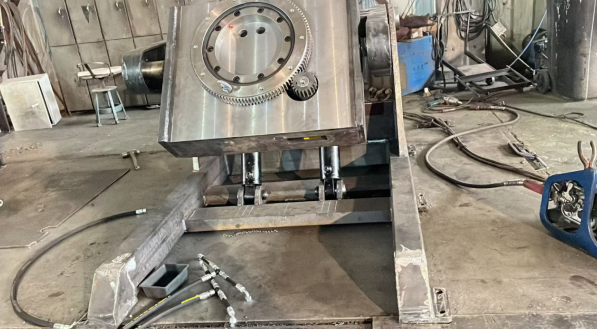
Beyond improving quality at a specific point, positioners act as an “efficiency engine” for the entire manufacturing workflow. In modern pipe fabrication plant production lines, positioners are often integrated with automated welding systems to form an efficient work cell.
Enabling Automated Integration
For large-scale pipeline production, automation is an inevitable trend. The automated welding setup crucially incorporates the positioner. It acts as the “coordinated partner” to welding robots or automatic welding machines, receiving commands from the control system and moving in precise sync. For instance, when welding an internal girth seam, the positioner rotates the pipe at a constant speed while the welding torch remains stationary inside. This close coordination drastically reduces the welding cycle time and minimizes human intervention, forming the foundation for “unmanned” or minimally manned workshops.
Ensuring Operational Safety
Pipeline components are often massive and extremely heavy. Manually flipping or moving these workpieces poses significant safety risks. Heavy-Duty Turntable Systems are designed with safety as a paramount concern. Through robust mechanical structures and reliable locking mechanisms, they securely clamp the workpiece and perform positioning movements smoothly. This fundamentally prevents personal injury and equipment damage that could result from workpiece tipping or slipping, providing workers with a safe and reliable working environment.
Selecting the Right Positioner: Key Considerations
Faced with a plethora of products on the market, how does one select a suitable positioner for petroleum pipeline manufacturing? This requires a comprehensive evaluation of multiple technical parameters and actual working conditions. A competent industrial equipment supplier should offer professional technical consultation to help clients make the optimal choice.
Load Capacity and Size Range
This is the most fundamental consideration. The positioner’s load capacity (tonnage) must cover the maximum weight of the pipes produced by the factory, including a safety margin. Simultaneously, the size range of its chucks or roller racks needs to accommodate pipes from the smallest to the largest diameter. Selecting a Heavy-Duty Turntable System is particularly important for fabricating thick-walled, large-diameter trunk lines.
Control Precision and Drive Type
The rotational accuracy of the positioner directly impacts welding quality. Systems typically driven by servo motors or frequency conversion motors offer smoother stepless speed regulation and more precise positional control. Precision Weld Manipulation is a prerequisite for high-quality welds, making the stability and accuracy of the electrical control system a key evaluation point.
System Integration and Flexibility
An ideal positioner should possess good compatibility and scalability. It should easily communicate and integrate with existing welding robots, specialized welding machines, or Manufacturing Execution Systems (MES). This kind of Advanced Manufacturing Solution forms the basis for building the smart factories of the future. Furthermore, the equipment should also possess a degree of flexibility to adapt to trends like high-mix, low-volume production.
Analyzing Practical Application Scenarios for Positioners
To understand the value of positioners more concretely, let’s examine several typical scenarios in petroleum pipeline manufacturing.
Longitudinal Seam Welding of Pipe Cans
After steel plates are rolled into a cylindrical shape, the longitudinal seam must be welded. Here, the pipe section is fixed onto the welding manipulation equipment. The positioner rotates the longitudinal seam into the optimal horizontal position for the automatic welding torch’s travel path, resulting in a perfect, straight longitudinal weld.
Girth Seam Joining of Pipe Sections
This is the most common application. After two pipe sections are aligned, the pipe welding rotation equipment rotates the entire assembly at a uniform speed. The welder or welding robot simply applies the weld from a fixed position to complete the entire circumferential girth seam, ensuring both efficiency and quality.
Attachment of Fittings and Flanges
Pipeline systems include numerous tees, elbows, and flanges. When welding these components onto the main pipe, precision weld manipulation becomes particularly critical. The positioner can make fine angular adjustments to bring complex spatial welds into the best possible position, ensuring the reliability of these critical connection points.
Repair and Maintenance Work
Positioners also prove useful during the repair and maintenance of pipeline products. By securing the damaged pipe section onto the positioner, the affected area can be easily rotated to the most accessible position for work, significantly reducing repair difficulty and improving the quality of the repair.
Future Outlook: Trends in Positioner Technology
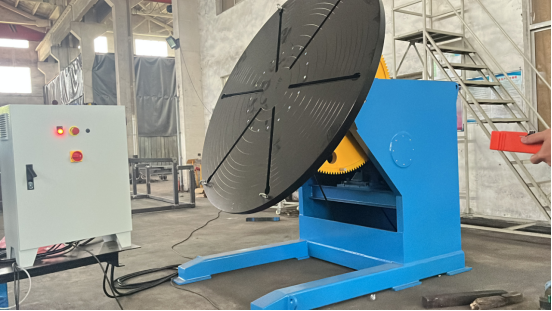
As the waves of Industry 4.0 and smart manufacturing sweep across the globe, positioner technology is also continuously evolving. The future Industrial posición systems will not be mere mechanical devices but intelligent terminals deeply integrated with sensor technology, data analytics, and artificial intelligence.
- Adaptive Control Technology: By integrating vision sensors or laser scanners, positioners can identify the weld seam in real-time and automatically adjust rotation speed and angle, achieving true “adaptive” welding.
- Data Collection and Analysis: Positioners will become nodes in the factory data network, uploading real-time operational parameters, load status, and energy consumption data. This supports advanced manufacturing solutions, enabling predictive maintenance and process optimization.
- Modularity and Flexibility: To adapt to increasingly diverse product structures, future positioners will adopt more modular designs, allowing for quick reconfiguration to meet the positioning needs of workpieces with varying diameters, lengths, and weights.
Conclusion
In the fundamental manufacturing industry of petroleum pipelines, which is vital to the national economy and livelihood, the focus on every detail reflects the supreme pursuit of safety and quality. The welding positioner for pipes, as a key piece of equipment supporting the core process of welding, offers value far beyond simply “rotating a workpiece.” It is a central force in enhancing weld quality, optimizing production workflows, ensuring operational safety, and driving automation upgrades. For any pipe fabrication plant aiming to maintain competitiveness in the industry, choosing the right industrial equipment supplier and investing in advanced, reliable Welding Manipulation Equipment is undoubtedly a strategic decision with foresight. It ultimately translates into stronger, more reliable energy pipelines, contributing an indispensable force to the uninterrupted flow of the industrial bloodstream.
Pipeline Welding Positioner:
https://www.weldmc.com/product-category/welding-automation/welding-positioner/
industrial equipment supplier:
https://www.weldmc.com/product-category/welding-automation/
welding positioner for pipes:
https://www.weldmc.com/product-category/welding-automation/welding-positioner
pipe welding rotation equipment:
https://www.weldmc.com/product-category/welding-automation/welding-rotator/
Professional pipe production facility:
https://www.weldmc.com/product-category/welding-automation
positioning equipment for welding:
https://www.weldmc.com/product-category/welding-automation
 English
  Español
  Français
  Deutsch
  Português
  Русский