Selecting appropriate tank rollers is crucial for the safe and efficient fabrication of oil storage tanks. Incorrect selection can lead to significant operational risks, including equipment damage and compromised weld quality. We emphasize the importance of matching roller specifications to workpiece requirements to ensure structural integrity and optimize production workflows. Understanding capacity and load ratings is fundamental for any successful project.
Understanding the Critical Role of Tank Rollers in Oil Storage Tank Fabrication
1. The Importance of Precision and Stability in Welding Large Cylindrical Structures
Welding large cylindrical structures, such as oil storage tanks, demands exceptional precision and stability. These tanks often involve considerable weight and dimensions, requiring robust support systems during fabrication. Tank rollers provide the necessary controlled rotation, enabling continuous welding processes. This controlled movement minimizes manual handling, reducing the potential for human error and improving overall weld quality. Consistent rotation speed and stable support are paramount for achieving uniform weld beads and preventing structural distortion.
2. How Tank Rollers Enhance Efficiency and Safety in Manufacturing
Tank rollers significantly enhance manufacturing efficiency by automating the rotation of heavy workpieces. This automation reduces labor requirements and accelerates welding cycles. Furthermore, these systems improve safety by securely holding the tank sections, mitigating risks associated with handling large, unstable loads. Features like anti-creep mechanisms and emergency stops contribute to a safer working environment. The ability to precisely position workpieces also minimizes reworks, saving time and resources.
For further insights into enhancing welding processes, you may find Boilers and Pressure Vessels: How Welding Rotators Enhance Manufacturing Efficiency particularly useful.
Key Factors Influencing Tank Roller Capacity Selection for Oil Storage Tanks
1. Analyzing the Weight and Dimensions of Oil Storage Tank Sections
Accurate assessment of the oil storage tank sections’ weight and dimensions is the foundational step in selecting tank rollers. We must consider the maximum weight of the tank, including any internal fixtures or reinforcements during welding. The diameter and length of the tank sections dictate the required roller spacing and overall system configuration. Overlooking these parameters can lead to overloading, equipment failure, and safety hazards.
2. Calculating Dynamic vs. Static Load Ratings for Optimal Performance
Understanding the distinction between dynamic and static load ratings is critical for optimal performance and equipment longevity. Static load refers to the maximum weight the rollers can support when the workpiece is stationary. Dynamic load, conversely, accounts for the additional stresses and forces exerted during rotation and welding operations. Always select rollers with a dynamic load rating that exceeds the maximum anticipated working load to ensure a margin of safety and prevent premature wear.
3. Considering Vessel Diameter and Length for Roller Configuration
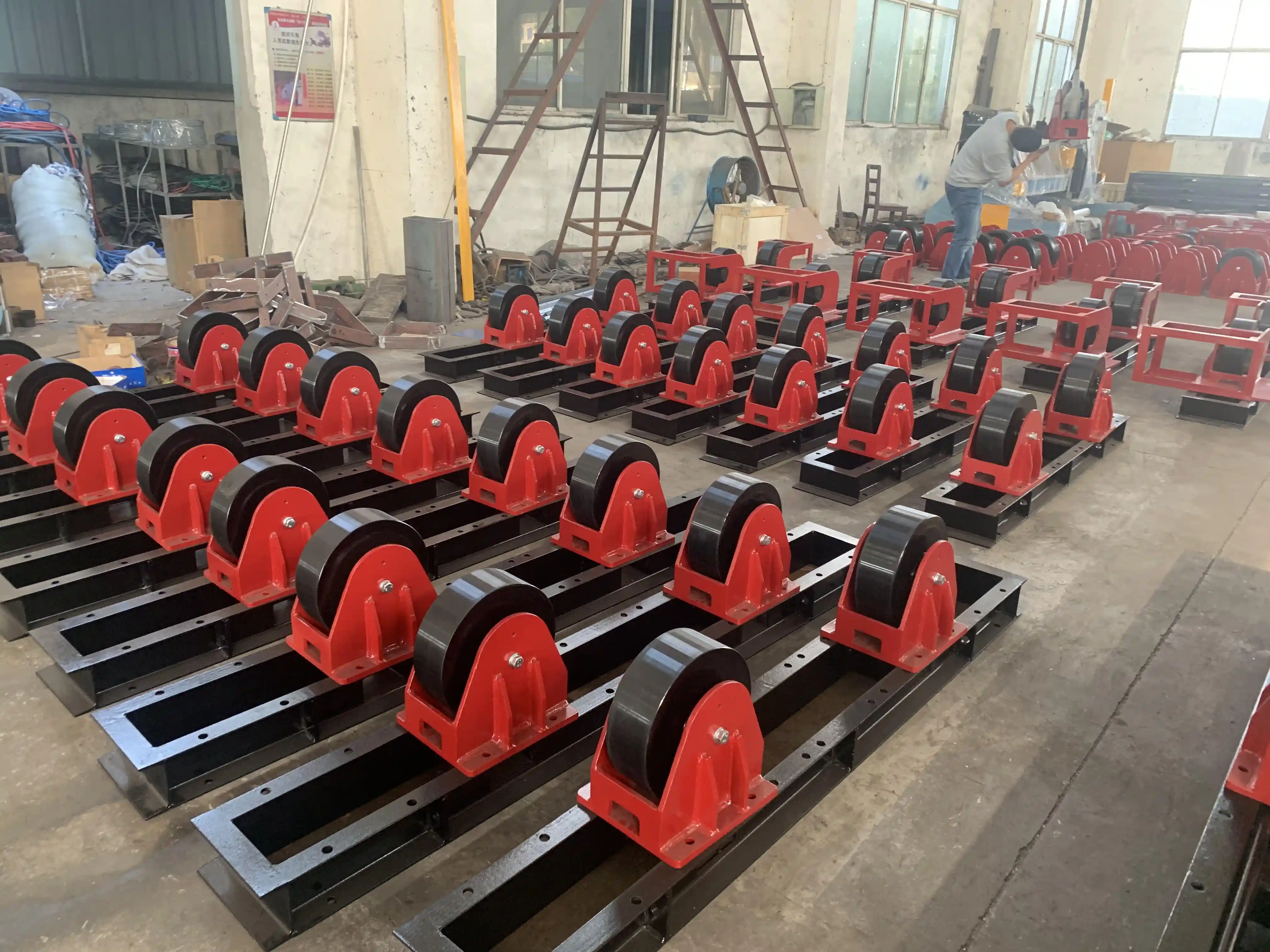
The vessel diameter and length directly influence the type and number of roller units required. Larger diameters necessitate wider rollers and potentially adjustable height mechanisms to maintain proper contact and support. Longer vessels may require multiple sets of drive and idler rollers to prevent sagging and ensure uniform rotation. Proper roller configuration prevents deformation and ensures consistent welding quality along the entire circumference.
| Parameter | HGK-5 (Adjustable Height) | HGZ-5 (Standard) | HGK-100 (Adjustable Height) | HGZ-100 (Standard) |
|---|---|---|---|---|
| Грузоподъемность | 5 tons | 5 tons | 100 tons | 100 tons |
| Vessel Diameter Range | 250-2800mm | 250-2300mm | 800-5000mm | 1000-5000mm |
| Wheel Diameter | 250mm | 250mm | 550mm | 500mm |
| Мощность двигателя | 2×0.37 kW | 0.75kW | 2×3 kW | 5.5kW |
| Speed Control | 0.5-3 RPM (stepless) | 100-1000mm/min | 0.5-5 RPM (stepless) | 100-1000mm/min |
| Anti-Creep | Yes | Yes | Yes | Yes |
| Приложения | Small pressure vessels | General cylinders | Large storage tanks | Nuclear equipment |

WUXI ABK Tank Roller Solutions: Matching Equipment to Oil Storage Tank Requirements
1. Exploring Adjustable Height Welding Rotators (HGK Series) for Diverse Tank Sizes
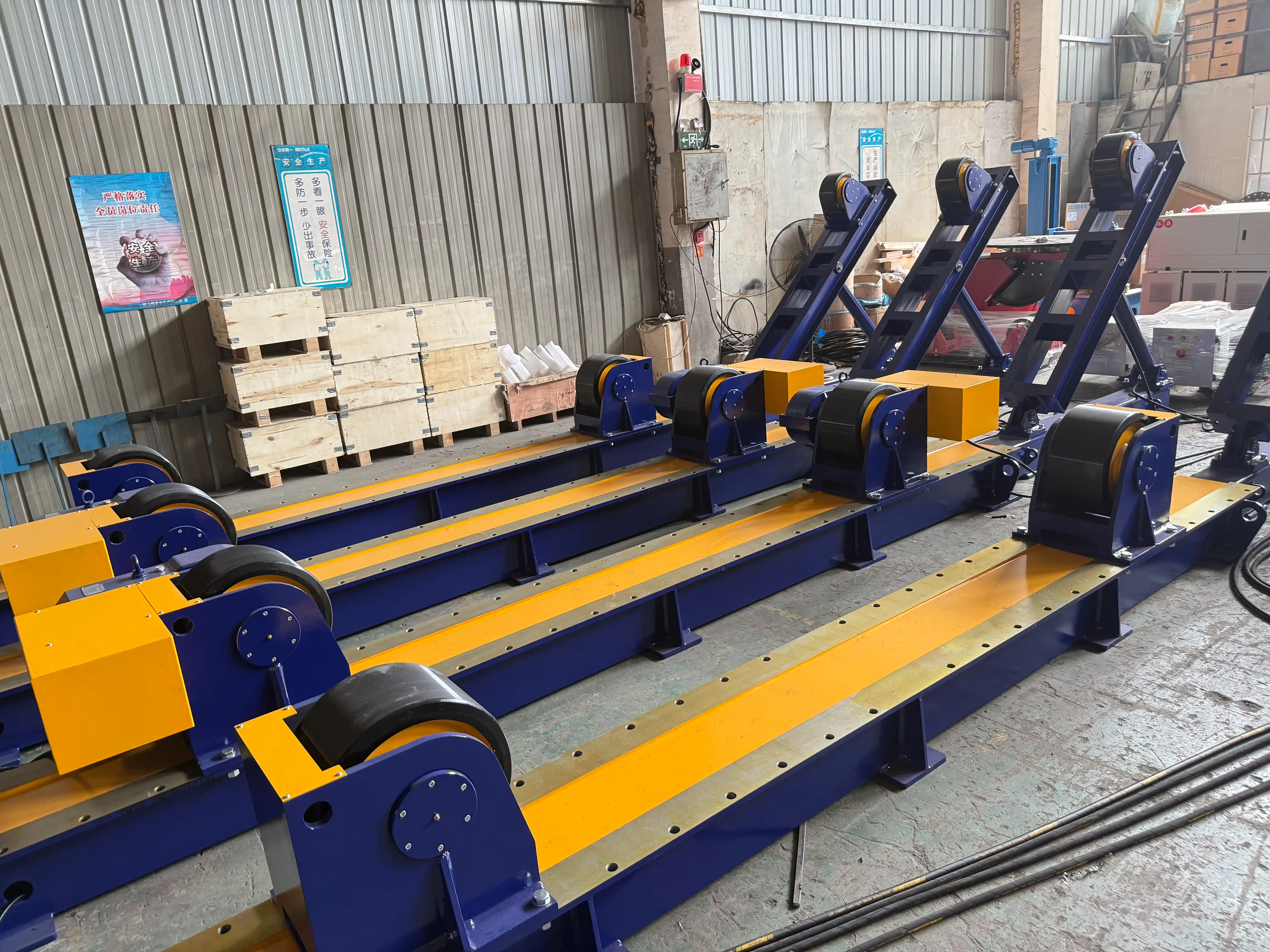
The WUXI ABK HGK Series of adjustable height welding rotators offers unparalleled versatility for fabricating oil storage tanks of varying diameters. These systems feature hydraulic elevation adjustment, allowing operators to quickly adapt to different vessel sizes. For instance, the HGK-20 can handle vessels from 500-4500mm in diameter with a 20-ton capacity, while the HGK-300 accommodates up to 6000mm diameter and 300 tons. This adaptability reduces setup times and increases operational flexibility.
If you are working on large-diameter components, you might be interested in Достижение идеальных сварных швов на трубах большого диаметра с помощью профессионального прокатного оборудования.
2. Utilizing Standard Welding Rotators (HGZ Series) for Consistent Production Needs
Our HGZ Series standard welding rotators are engineered for robust performance and consistent production in fabricating cylindrical workpieces, including many oil storage tank components. These models provide reliable rotation with high precision for a specified range of vessel diameters and weights. For example, the HGZ-50 handles up to 50 tons with a diameter range of 750-4500mm, making it suitable for oil refinery storage tanks. Their straightforward design ensures durability and ease of operation for long production runs.
3. Integrating Heavy-Duty Welding Turntables (HB Series) for Specialized Applications
For certain specialized applications, such as welding tank nozzles or complex sub-assemblies before final integration, our HB Series heavy-duty welding turntables offer precise positioning. While primarily designed for flat or irregularly shaped workpieces, larger models like the HB-100 (10-ton capacity) and HB-300 (30-ton capacity) can support heavy components that require precise angular positioning rather than continuous rotation. These turntables provide exceptional stability and accuracy for intricate welding tasks.
For more information on optimizing welding processes, consider reading Революционное решение для сварки сосудов под давлением: Технический анализ вращающихся на 360 градусов сварочных позиционеров.
Practical Guide to Ensuring Proper Load Rating and Safe Operation
1. Best Practices for Distributing Load Evenly Across Roller Units
Proper load distribution is paramount to prevent localized stress and premature wear on tank rollers.
1. Position the workpiece centrally on the rollers.
2. Ensure an adequate number of roller units support the entire length of the tank section.
3. Verify that each roller unit carries a proportionate share of the load.
4. Utilize adjustable roller spacing to conform to the vessel’s geometry.
5. Regularly inspect rollers for signs of uneven wear, indicating improper load distribution.
2. Implementing Anti-Creep Mechanisms and Advanced Control Systems
Modern tank rollers incorporate anti-creep mechanisms to prevent the workpiece from drifting axially during rotation. These systems maintain precise alignment, which is critical for continuous welding processes. Advanced control systems, often PLC-based, allow for precise speed regulation, programmable welding sequences, and integration with other automated equipment. This enhances both the quality of welds and the safety of operations.
3. Regular Maintenance and Inspection for Extended Equipment Lifespan
Consistent maintenance and inspection routines are essential for maximizing the lifespan and reliability of tank rollers.
1. Conduct daily visual checks for damage, debris, or loose components.
2. Lubricate moving parts according to the manufacturer’s schedule.
3. Verify electrical connections and safety interlocks regularly.
4. Inspect rollers for wear, ensuring smooth and consistent contact with the workpiece.
5. Calibrate speed and positioning systems periodically to maintain accuracy.
The Impact of Correct Tank Roller Selection on Project Success
1. Achieving High-Quality Welds and Reducing Rework
Selecting the correct tank rollers directly contributes to achieving high-quality welds. Precise control over workpiece rotation and stability minimizes imperfections, such as uneven bead profiles or lack of fusion. This precision reduces the need for costly and time-consuming rework, improving overall project timelines and material utilization. Consistent support ensures that the welding arc remains at an optimal distance and angle throughout the entire circumference.
2. Optimizing Production Timelines and Cost Efficiency
The right tank rollers streamline the fabrication process, significantly optimizing production timelines. Reduced manual handling, faster setup times, and minimized reworks translate into substantial cost savings. Automated systems allow for continuous operation, maximizing throughput and labor efficiency. Investing in appropriately rated equipment prevents costly breakdowns and extends operational life, further enhancing long-term cost efficiency.
3. Enhancing Worker Safety and Operational Reliability
Properly selected and maintained tank rollers enhance worker safety by providing a stable and controlled environment for handling heavy, cylindrical workpieces. Features like emergency stops, overload protection, and anti-creep mechanisms protect personnel from potential hazards. This commitment to safety also improves operational reliability, reducing downtime due to accidents or equipment failures. A reliable system ensures consistent output and predictable project completion.
Partner with WUXI ABK for Your Tank Roller Needs
Choosing the right tank rollers for your oil storage tank fabrication projects is a critical decision that impacts quality, efficiency, and safety. At WUXI ABK MACHINERY CO., LTD, we offer a comprehensive range of welding rotators and turntables designed to meet the rigorous demands of heavy industry. Our expertise ensures you receive equipment perfectly matched to your specific operational requirements.
Contact us today to discuss your project needs and discover how our solutions can enhance your production capabilities.
Мобильный: +86-13815101750
Тел: +86-510-83555592
Email: jay@weldc.com
About the Author
Michael Zhou, Project Manager
Michael Zhou, expert in welding automation, specializes in designing and optimizing welding lines and equipment. He helps enterprises improve welding efficiency and achieve higher-quality automated production.
FAQs
1. What is the primary difference between adjustable height and standard welding rotators for oil storage tanks?
Adjustable height welding rotators, like our HGK series, feature a hydraulic or mechanical system to raise or lower the workpiece, accommodating a wide range of vessel diameters. Standard welding rotators, such as the HGZ series, maintain a fixed height, making them suitable for workpieces within a specific, narrower diameter range. Adjustable height models offer greater flexibility for diverse projects.
2. How do I determine the exact load capacity required for my specific oil storage tank project?
To determine the required load capacity, calculate the maximum weight of the tank section, including any internal components or welding accessories. Consider both static and dynamic loads. We recommend adding a safety margin of at least 20-30% to this calculated weight to account for unforeseen variables and ensure equipment longevity.
3. What are the benefits of using anti-creep technology in tank rollers?
Anti-creep technology prevents the cylindrical workpiece from drifting axially along the rollers during rotation. This ensures that the welding seam remains precisely aligned under the welding head, which is crucial for achieving consistent weld quality and minimizing manual adjustments. It contributes significantly to automation and precision.
4. Can WUXI ABK tank rollers integrate with automated welding systems?
Yes, our tank rollers, particularly the HGK and advanced HGZ series, are designed for seamless integration with automated welding systems. They often feature PLC control systems compatible with robotic welding cells and welding manipulators. This integration allows for programmed welding sequences and enhanced overall automation.
5. What maintenance is recommended to ensure the longevity and performance of tank rollers?
Regular maintenance includes daily visual inspections for wear and tear, lubrication of moving parts, and checking electrical connections. Periodic checks (monthly/quarterly) involve torqueing bolts, inspecting drive mechanisms, and testing safety features. Annual deep maintenance should include replacing worn bearings, re-lubrication, and recalibrating positioning systems.
 English
  Español
  Français
  Deutsch
  Português
  Русский