Time on the shop floor keeps proving the same point: optimal efficiency and quality in membrane panel production come from strategic equipment integration. Disparate machines tend to create bottlenecks and inconsistencies. With careful planning and implementation of integrated systems, manufacturers can significantly enhance throughput, reduce operational costs, and raise product quality. We will explore how advanced welding and cutting equipment, when combined as one coordinated system, transforms manufacturing processes.
Understanding the Challenges in Membrane Panel Production
1. The Complexities of Traditional Membrane Panel Manufacturing
Traditional membrane panel manufacturing runs through many discrete steps, with frequent manual intervention. Material handling, precise cutting, fit-up, and welding all sit in the sequence. Each stage brings its own risk, from holding dimensional accuracy to keeping weld quality consistent across large panels. That complexity raises the chances of errors and rework.
2. Identifying Common Bottlenecks and Inefficiencies
Manual steps often choke the flow. Fatigue brings variations in speed and quality. Moving material between stations takes time and invites inefficiency. Without real-time data exchange between machines, proactive adjustments and optimization are out of reach, which compounds the problem.
3. The Impact of Manual Processes on Quality and Throughput
Manual welding and handling hit both quality and throughput. Inconsistencies like porosity or incomplete fusion trigger costly repairs. The slower cadence of manual work caps daily output. Together these factors raise manufacturing costs and extend lead times, which drags on competitiveness.
Strategic Approaches to Equipment Integration for Membrane Panels
1. Implementing Advanced Welding Automation for Precision
Advanced welding automation systems are key to achieving high precision and repeatability in membrane panel fabrication. Automated welding maintains consistent heat input and travel speed, minimizing defects. The result is better weld quality and less post-weld rectification.
2. Leveraging Robotic Systems for Enhanced Productivity
Robotic welding systems deliver high speed and accuracy, which drastically lifts productivity. They handle repetitive tasks with consistent precision, cutting cycle times and improving material use. Robotics also improve safety by removing human operators from hazardous welding environments.
3. Integrating Material Handling and Positioning Equipment
Tight integration of material handling and positioning equipment streamlines the entire production line. Automated conveyors, manipulators, and positioners move workpieces efficiently between stages. This reduces manual labor, minimizes damage during transit, and maintains a continuous workflow.
If you are interested in improving the quality of pipe welding, check How To Improve The Quality Of Pipe Welding Through A High Precision Welding Positioner.
Key Equipment for an Integrated Membrane Panel Production Line
Integrating specialized equipment forms the backbone of an efficient membrane panel production line. Each component plays a vital role in optimizing the overall process. We will examine the core machinery required for achieving smooth, high-quality fabrication.
1. The Role of Welding Manipulators in Automated Welding
Welding Manipulators are fundamental to automated longitudinal and circumferential seam welding. They provide precise control over the welding torch’s position and movement. This ensures consistent weld quality and penetration.
| Model Parameters | Horizontal Travel | Vertical Travel | Rotation | Rotation Speed | Boom Elevating | Boom Forward | Trolley Speed | Rail Distance | Applications |
|---|---|---|---|---|---|---|---|---|---|
| LH8080 | 8000 mm | 8000 mm | ±180° | 0.12 m/min | 0.4 m/min | 0.12–1.2 m/min | 0.2–2 m/min | 2700 mm | Boiler fabrication, Pressure vessel welding, Storage tank manufacturing, Wind tower welding, Chemical and petrochemical equipment, Heavy steel structure production |
| LH4580 | 4500 mm | 8000 mm | ±180° | 0.12 m/min | 0.4 m/min | 0.12–1.2 m/min | 0.2–2 m/min | 2000 mm | Boiler fabrication, Pressure vessel welding, Storage tank manufacturing, Wind tower welding, Chemical and petrochemical equipment, Heavy steel structure production |
| LH5060 | 5000 mm | 6000 mm | ±180° | 0.12 m/min | 0.4 m/min | 0.12–1.2 m/min | 0.2–2 m/min | 2000 mm | Boiler fabrication, Pressure vessel welding, Storage tank manufacturing, Wind tower welding, Chemical and petrochemical equipment, Heavy steel structure production |
| LH3040 | 3000 mm | 4000 mm | ±180° | 0.12 m/min | 0.4 m/min | 0.12–1.2 m/min | 0.2–2 m/min | 1500 mm | Boiler fabrication, Pressure vessel welding, Storage tank manufacturing, Wind tower welding, Chemical and petrochemical equipment, Heavy steel structure production |
| LH1235 | 1200 mm | 3500 mm | Manual 360° | 0.12 m/min | 0.4 m/min | 0.12–1.2 m/min | Manual | 1000 mm | Boiler fabrication, Pressure vessel welding, Storage tank manufacturing, Wind tower welding, Chemical and petrochemical equipment, Heavy steel structure production |
These machines feature high-strength box-beam structures and linear guideways for stable operation. Positioning accuracy reaches ±0.1 mm/m, ensuring precise weld placement. Optional features like flux recovery and seam tracking further enhance performance.
2. Precision Positioning with Welding Positioners
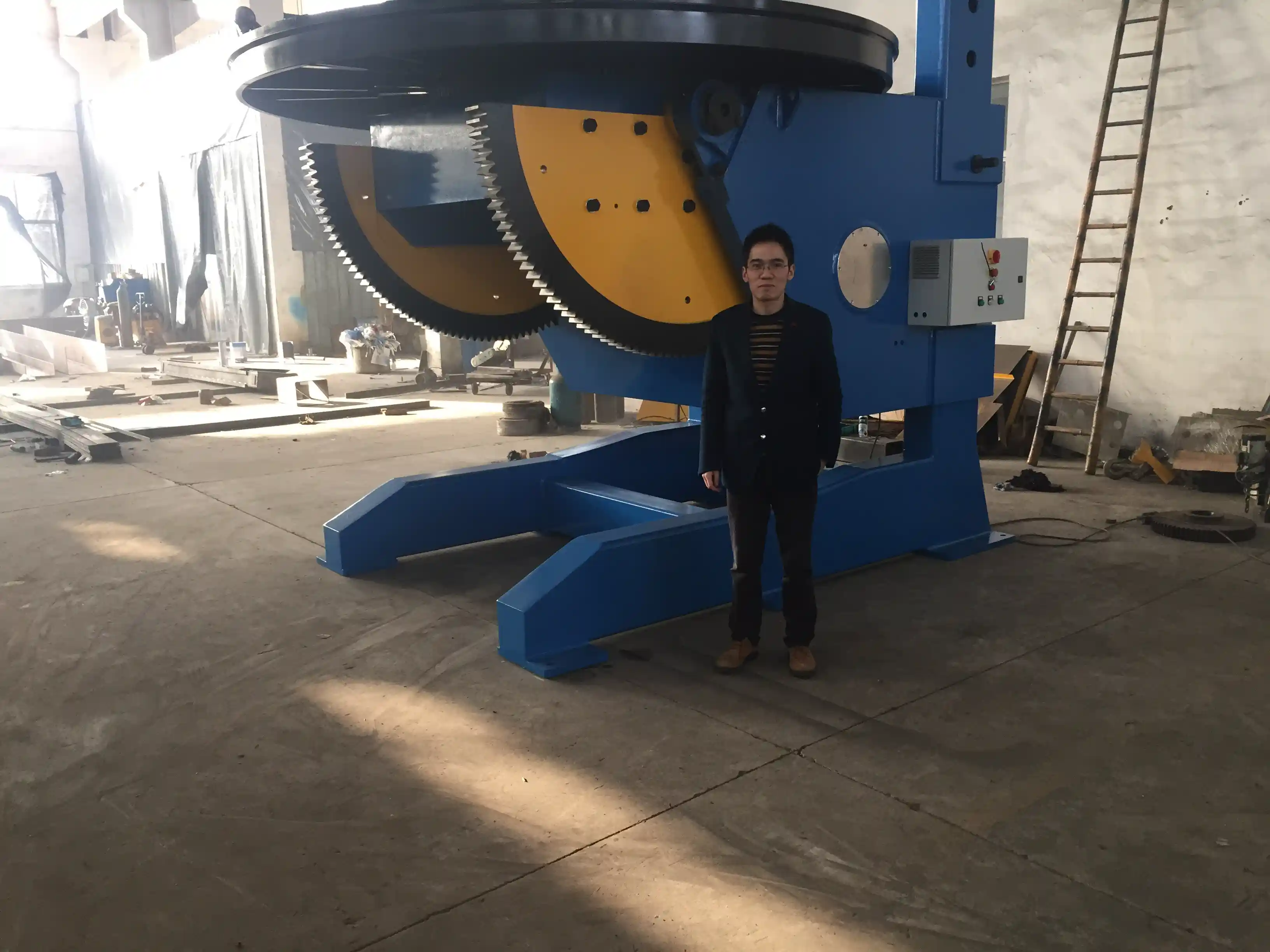
Welding Positioner Suppliers precisely orient workpieces for optimal welding access. They enable rotation, tilting, and turning, reducing the need for manual repositioning. This capability improves weld quality by allowing operators or robots to maintain consistent torch angles.
| Modèle | Max Load | Tilt Range | Rotation | Turning Range | Position Accuracy | Répétabilité | Système de contrôle | Robot Compatibility | Applications |
|---|---|---|---|---|---|---|---|---|---|
| 1 Ton 3 Axis Positioner | 1 ton | 0-90° | 360° continuous | 180° | ±0.05 mm | 0.02 mm | Siemens PLC + 10-inch HMI | ABB, KUKA, FANUC | Automotive part welding, Aerospace component fabrication, Heavy equipment repair, Pressure vessel seam welding |
| 2 Ton 3 Axis Positioner | 2 tons | 0-90° | 360° continuous | 180° | 0.05 mm | 0.02 mm | PLC + touchscreen | ABB, KUKA, others | Automated welding cells, Pipe and flange welding, Small and medium structural part fabrication, Robotic MIG and TIG welding systems |
| Positionneur de soudage 3 axes 3 tonnes | 3000 kg | 0-90° | 360° continuous | 180° | ±0.05 mm | 0.02 mm | PLC + touchscreen | ABB, KUKA, FANUC, Yaskawa | Automotive chassis welding, Aerospace parts manufacturing, Precision machinery fabrication, Robotic welding stations, Metal structure assembly |
| Triple Axis Positioner 5 Tons | 5000 kg | 0-90° | 360° continuous | 180° | ±0.05 mm | 0.02 mm | PLC + touchscreen | ABB, KUKA, FANUC, Yaskawa | Pressure vessel welding, Automotive component fabrication, Structural steel assembly, Shipbuilding fixtures, Robotic MIG, TIG, and SAW welding |
These positioners often feature servo-driven structures with high positioning accuracy and repeatability. They integrate well with robotic systems, enhancing overall automation. Overload shutdown and emergency braking ensure safe operation.

3. Maximizing Efficiency with Welding Rotators
Welding Rotator Manufacturers provide continuous rotation for cylindrical workpieces, key for pipe and vessel fabrication. They ensure a stable platform for welding, preventing distortion and improving weld quality. Adjustable height and self-aligning rollers accommodate various workpiece diameters.
| Modèle | Capacité de charge | Wheel Diameter | Vessel Diameter Range | Wheel Velocity | Motor Power | Applications |
|---|---|---|---|---|---|---|
| 5-Ton Height Adjustable Pipe Rotator | 5 tons | 250mm | 200-2000mm | 6-60 m/h | 2×0.37 kW | Pressure vessel fabrication, pipeline girth welding, wind tower component manufacturing, shipbuilding parts production, structural steel welding |
| 10-Ton Adjustable Height Pipe Rolling Machine | 10 tons | 300mm | 300-3200mm | 6-60 m/h | 2×0.55 kW | Wind tower flange welding, pressure vessel manufacturing, large-diameter pipe welding, structural steel fabrication, offshore platform components |
| 20-Ton Adjustable Height Pipe Roller | 20 tons | 350mm | 500-4500mm | 6-60 m/h | 2×1.1 kW | Heavy steel structure welding, LNG tank fabrication, petrochemical vessel manufacturing, large pipeline construction, bridge component fabrication |
| 40-Ton Adjustable Height Welding Rotator | 40 tons | 450mm | 500-4800mm | 6-60 m/h | 2×1.5 kW | Offshore platform construction, boiler manufacturing, heavy machinery component welding, nuclear power equipment fabrication, large pressure vessels |
| 60-Ton Low Profile Adjustable Welding Rotator | 60 tons | 500mm | 500-5000mm | 6-60 m/h | 2×2.2 kW | Large-diameter pipe welding, structural steel fabrication for bridges, heavy vessel manufacturing, offshore platform construction, chemical plant equipment |
| 100-Ton Adjustable Height Pipe Rotator Equipment | 100 tons | 550mm | 800-5000mm | 6-60 m/h | 2×3 kW | Pressure vessel fabrication, wind tower production, shipbuilding components, large-diameter pipeline welding, energy equipment manufacturing |
| 200-Ton Variable Height Welding Roller System | 200 tons | 700mm | 800-5000mm | 6-60 m/h | 2×4 kW | Heavy pressure vessel manufacturing, wind tower fabrication, shipbuilding and offshore structures, large-diameter pipeline welding, energy equipment production |
| 300-Ton Auto Height Adjusting Welding Rotator | 300 tons | 800mm | 1000-6000mm | 6-60 m/h | 2×5.5 kW | Super-large pressure vessels, LNG storage tanks, offshore oil platforms, nuclear power equipment, heavy metallurgical machinery |
These rotators offer stepless speed control and anti-creep mechanisms, ensuring precise and stable rotation. They are vital for maintaining consistent weld quality on large, heavy workpieces.
For more information on welding rotators, refer to Welding Rotator Precision Automation For Industrial Fabrication Expert FAQ Guide.
4. Advanced CNC Cutting Machines for Accurate Panel Preparation
CNC Plasma Cutter and CNC Flame Cutter machines provide highly accurate and efficient panel preparation. These machines precisely cut membrane panel components according to digital designs. This minimizes material waste and ensures perfect fit-up for subsequent welding processes. Their automation capabilities reduce manual handling and measurement errors.
Designing and Implementing an Integrated Production Line
1. Assessing Current Production Needs and Future Goals
Begin by thoroughly evaluating existing production processes, identifying bottlenecks, and defining future production targets. Consider current output, quality requirements, and potential growth. This initial assessment informs equipment selection and system design.
2. Step-by-Step Planning for Equipment Selection and Layout
Develop a detailed plan outlining equipment specifications and factory layout. Select machines that offer compatibility and scalability. Optimize the physical arrangement of equipment to minimize material travel and maximize workflow efficiency.
3. Ensuring Seamless Communication with PLC and HMI Control Systems
Implement robust PLC and HMI control systems to manage and monitor the integrated line. These systems ensure reliable communication between different machines. They also provide operators with real-time data and control capabilities.
4. Best Practices for Installation, Commissioning, and Training
Follow manufacturer guidelines for installation and commissioning to ensure optimal performance. Conduct thorough testing of the integrated system. Provide thorough training to operators and maintenance staff for smooth operation and troubleshooting.
The Tangible Benefits of Integrated Membrane Panel Production
1. Achieving Superior Weld Quality and Consistency
Integrated systems deliver highly consistent and high-quality welds. Automated processes reduce human error and variability. This results in stronger, more reliable membrane panels that meet stringent industry standards.
2. Significantly Boosting Production Throughput and Speed
Automation dramatically increases production speed and throughput. Machines operate continuously and efficiently, minimizing idle time. This allows manufacturers to meet higher demand and shorten delivery schedules.
3. Reducing Operational Costs and Material Waste
Optimized material flow and reduced rework lower operational costs. Precision cutting and welding minimize material waste. Energy-efficient machines also contribute to overall cost savings.
4. Enhancing Worker Safety and Ergonomics
Automated systems reduce the need for manual handling and welding in hazardous areas. This significantly improves worker safety. Ergonomic workstations further enhance comfort and reduce the risk of injury.
Partner with WUXI ABK MACHINERY for Advanced Solutions
WUXI ABK MACHINERY CO., LTD. specializes in advanced welding equipment and CNC cutting machines. We offer end-to-end solutions for optimizing your membrane panel production line. Our expertise in equipment integration ensures enhanced efficiency, precision, and safety. Contact us to discuss your specific needs and discover how our tailored solutions can improve your manufacturing operations.
Courriel : jay@weldc.com
Mobile : +86-13815101750
FAQ
1. What are the primary benefits of integrating equipment in a membrane panel production line?
Integrating equipment in a membrane panel production line offers several key benefits. It enhances overall efficiency by streamlining workflows and reducing manual intervention. This leads to improved product quality, increased throughput, and significant reductions in operational costs and material waste.
2. How do welding manipulators and positioners contribute to automation in membrane panel fabrication?
Welding Manipulator Manufacturers precisely control the welding torch for consistent seams, while Welding Positioner Suppliers orient workpieces optimally. This combination allows for automated, high-precision welding, reducing manual labor and improving weld quality. They are fundamental to achieving fully integrated automation in fabrication.
3. What role do CNC cutting machines play in an integrated production line?
CNC cutting machines, such as CNC Plasma Cutter and CNC Flame Cutter, provide highly accurate and efficient preparation of membrane panel components. They ensure precise cuts according to digital designs, minimizing material waste and guaranteeing perfect fit-up for subsequent welding processes. This accuracy is crucial for overall product quality.
4. How can WUXI ABK MACHINERY assist in designing and implementing an integrated membrane panel production line?
WUXI ABK MACHINERY offers extensive expertise in designing and implementing integrated production lines. We provide customized solutions, from initial assessment and equipment selection to installation, commissioning, and thorough training. Our goal is to ensure smooth integration and optimal performance for your specific manufacturing needs.
5. What are the typical ROI considerations for investing in an integrated production line?
Investing in an integrated production line often yields significant ROI through increased productivity and reduced labor costs. Improved weld quality minimizes rework, saving time and materials. Enhanced safety also reduces accident-related expenses, contributing to a faster return on investment.
 English
  Español
  Français
  Deutsch
  Português
  Русский