I’ve spent enough time on shop floors to see how tube-to-tube welding can make or break a production day. When it’s done manually, quality wavers, throughput slows, and costs creep up—especially on complex joints or tight timelines. But when we put well-planned automation in place, the whole picture changes: welds tighten up, lead times shrink, and teams can focus on higher-value work. In our experience, the right automated setup doesn’t just add speed—it brings repeatability, precision, and consistency that are hard to achieve any other way.
Understanding the Challenges of Traditional Tube-to-Tube Welding
Traditional tube-to-tube welding operations face numerous obstacles that hinder productivity and quality. These challenges stem from the inherent complexities of manual processes and the evolving demands of modern manufacturing. Addressing these issues is crucial for any company aiming to remain competitive.
1. Manual Welding Limitations and Inconsistencies
Manual tube-to-tube welding depends heavily on the welder’s skill, which naturally introduces variability. Fatigue, subtle differences in technique, and human error can all affect weld integrity and appearance, driving up rework and scrap. Holding tight control over key parameters—like arc length and travel speed—becomes increasingly difficult over long shifts. Manual methods also struggle with intricate joint geometries and tight tolerances common in tube-to-tube work. Add in frequent setups and adjustments, and production cycles slow even further.
2. Labor Shortages and Skill Gaps in Welding Operations
The industry-wide shortage of skilled welders is real and growing. Replacing retiring experts or scaling production can be challenging, especially since tube-to-tube welding requires advanced proficiency. Training newcomers takes time and money, and even then, consistency may lag behind veteran performance. The result is pressure on throughput and rising operational costs.
3. Safety Concerns and Ergonomic Risks in Tube Welding
Manual welding exposes teams to heat, UV radiation, fumes, and sparks. On top of that, awkward postures and repetitive motions can lead to ergonomic strain and injuries. These realities increase absenteeism and workers’ compensation claims, and they can impact morale. Maintaining compliance and safety standards also adds to overhead.
How Automated Tube-to-Tube Welding Enhances Productivity
Automated tube-to-tube welding solutions offer a transformative approach to these traditional challenges. By leveraging advanced technology, manufacturers can significantly improve efficiency, quality, and safety. This shift allows businesses to meet stringent industry standards and accelerate production schedules.
1. Achieving Unmatched Precision and Repeatability
Automated systems deliver consistent execution, hitting programmed parameters every time and removing human variability from the equation. With high-precision sensors and control algorithms, they maintain stable arc characteristics and steady travel speed. The outcome is strong, defect-free welds that cut down on rework and inspection. For applications under strict quality control, that level of repeatability is indispensable.
2. Significant Increases in Welding Speed and Throughput
Automation keeps the arc on longer and moves at speeds manual methods can’t match. Continuous operation without breaks lifts throughput, enabling more components to be produced in less time. Shorter cycles translate into faster deliveries and higher overall output. Systems that can tackle multiple tasks concurrently push efficiency even further.
3. Optimizing Resource Utilization and Reducing Material Waste
Automated control minimizes errors and scrap, tightening material use. By preventing over- or underwelding, systems reduce filler and shielding gas consumption. Less rework means lower energy use and fewer consumables. The net effect is lower costs and a more sustainable process—benefits that show up directly on the bottom line.
Key Technologies for Advanced Tube-to-Tube Welding Automation
Implementing advanced automation requires specific technologies designed to handle the intricacies of tube-to-tube welding. These systems ensure optimal workpiece manipulation and precise weld execution. We utilize these technologies to deliver superior performance and reliability.
1. Precision Welding Positioners and Manipulators for Optimal Part Alignment
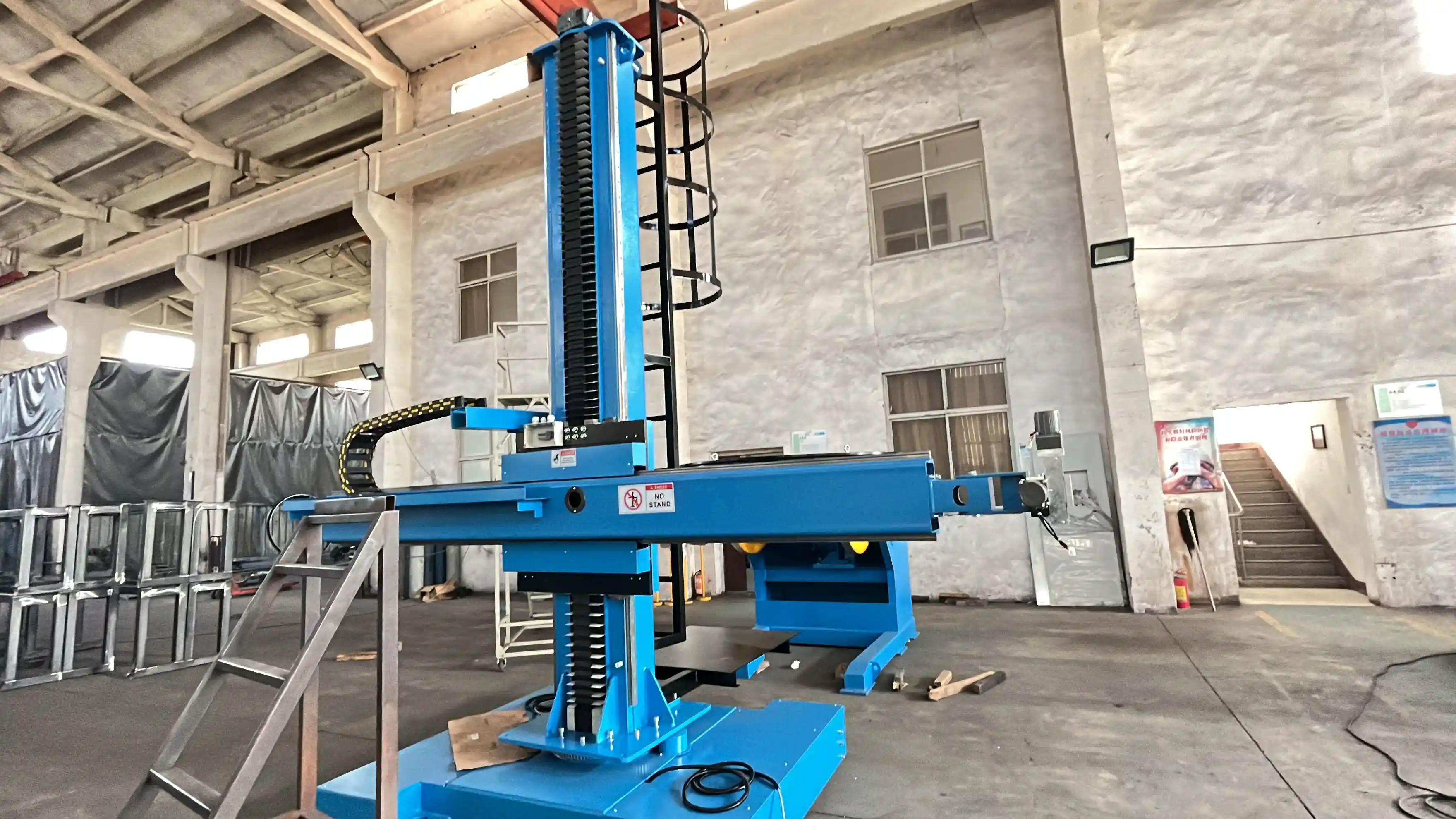
Precision welding positioners and manipulators are fundamental to automated tube-to-tube welding. They securely hold and orient workpieces, providing stable and repeatable positioning. This ensures the weld joint is always in an optimal position for the welding torch. Our [[Welding Manipulator ManufacturersWelding Manipulator]] products, for example, offer precise control over longitudinal and circumferential seams. They feature high-strength box-beam structures and linear guideways, ensuring positioning accuracy of ±0.1 mm/m.
| Modèle | Horizontal Travel | Vertical Travel | Rotation | Applications |
|---|---|---|---|---|
| LH8080 | 8000 mm | 8000 mm | ±180° | Boiler fabrication, Pressure vessel welding |
| LH4580 | 4500 mm | 8000 mm | ±180° | Storage tank manufacturing, Wind tower welding |
| LH5060 | 5000 mm | 6000 mm | ±180° | Chemical and petrochemical equipment |
| LH3040 | 3000 mm | 4000 mm | ±180° | Heavy steel structure production |
| LH1235 | 1200 mm | 3500 mm | 360° (manual) | General fabrication |
These manipulators are essential for achieving consistent weld quality and reducing setup times. They integrate seamlessly with automated welding systems, enhancing overall productivity.
For more insights into how positioners enhance welding precision, consider reading The Art Of Pipeline Fabrication How Positioners Enhance Welding Precision And Efficiency.
2. Automated Welding Rotators for Seamless Cylindrical Component Welding
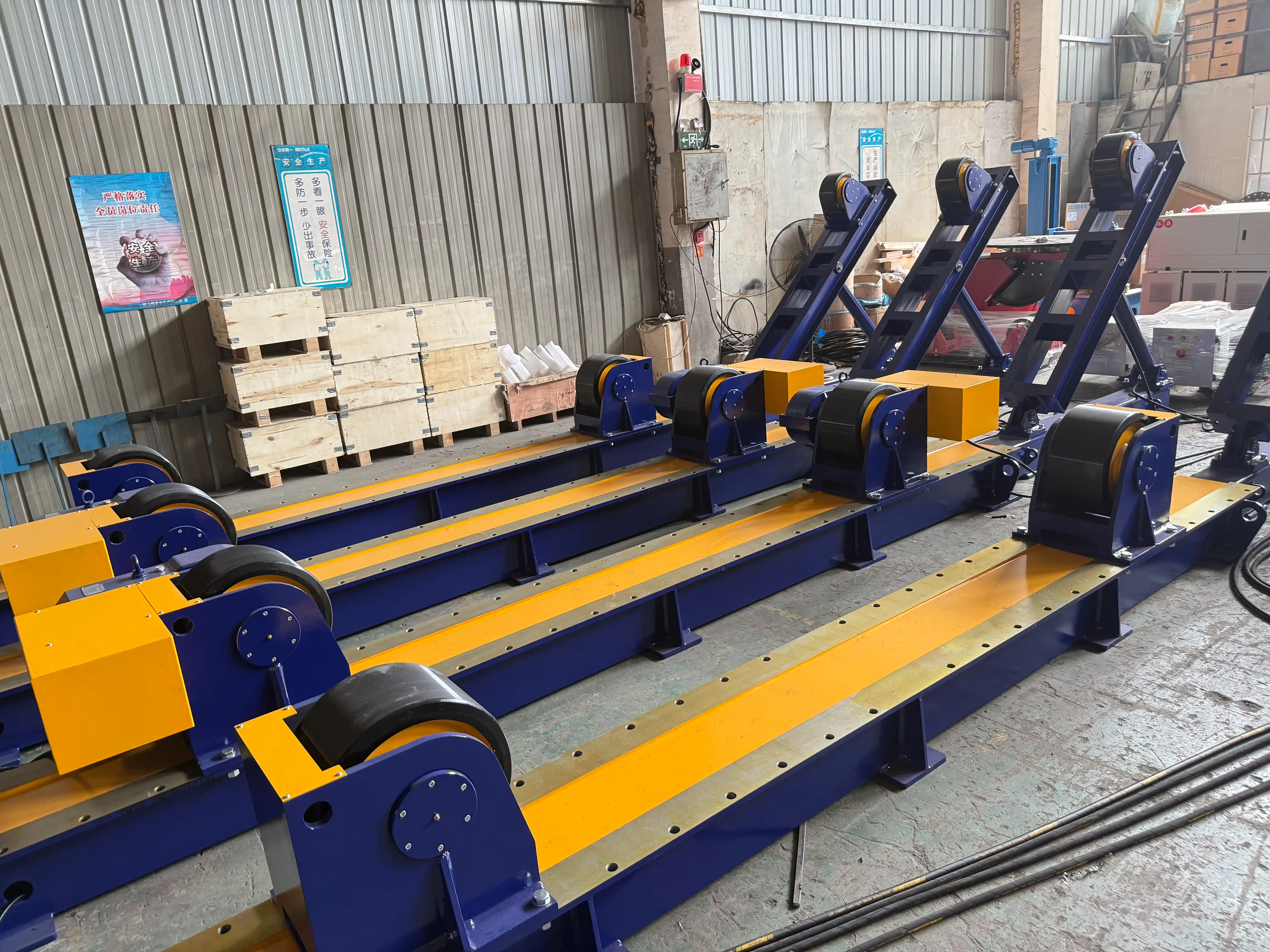
Automated [[Welding Rotator Manufacturerswelding rotator]]s are critical for welding cylindrical components like pipes and vessels. They rotate the workpiece at a controlled speed, allowing for continuous, uniform welds. This eliminates stop-starts, which can introduce defects. Our adjustable height pipe rotators, such as the HGK series, provide precise rotation for various vessel diameters. For instance, the HGK-100 handles loads up to 100 tons and vessels up to 5000mm in diameter, with stepless speed adjustment from 0.5-5 RPM.
| Modèle | Capacité de charge | Vessel Diameter Range | Wheel Velocity | Motor Power |
|---|---|---|---|---|
| HGK-5 | 5 tons | 250-2800mm | 6-60 m/h | 2×0.37 kW |
| HGK-10 | 10 tons | 300-3200mm | 6-60 m/h | 2×0.55 kW |
| HGK-20 | 20 tons | 500-4500mm | 6-60 m/h | 2×1.1 kW |
| HGK-40 | 40 tons | 500-4800mm | 6-60 m/h | 2×1.5 kW |
| HGK-60 | 60 tons | 500-5000mm | 6-60 m/h | 2×2.2 kW |
| HGK-100 | 100 tons | 800-5000mm | 6-60 m/h | 2×3 kW |
These rotators are vital for producing high-quality circumferential welds with minimal distortion. They are widely used in pressure vessel fabrication and pipeline construction.
You might also find Pipe Rotators And Turning Rolls Essential Equipment For Modern Pipeline Fabrication informative.
3. Robotic Integration for Enhanced Flexibility and Complex Geometries
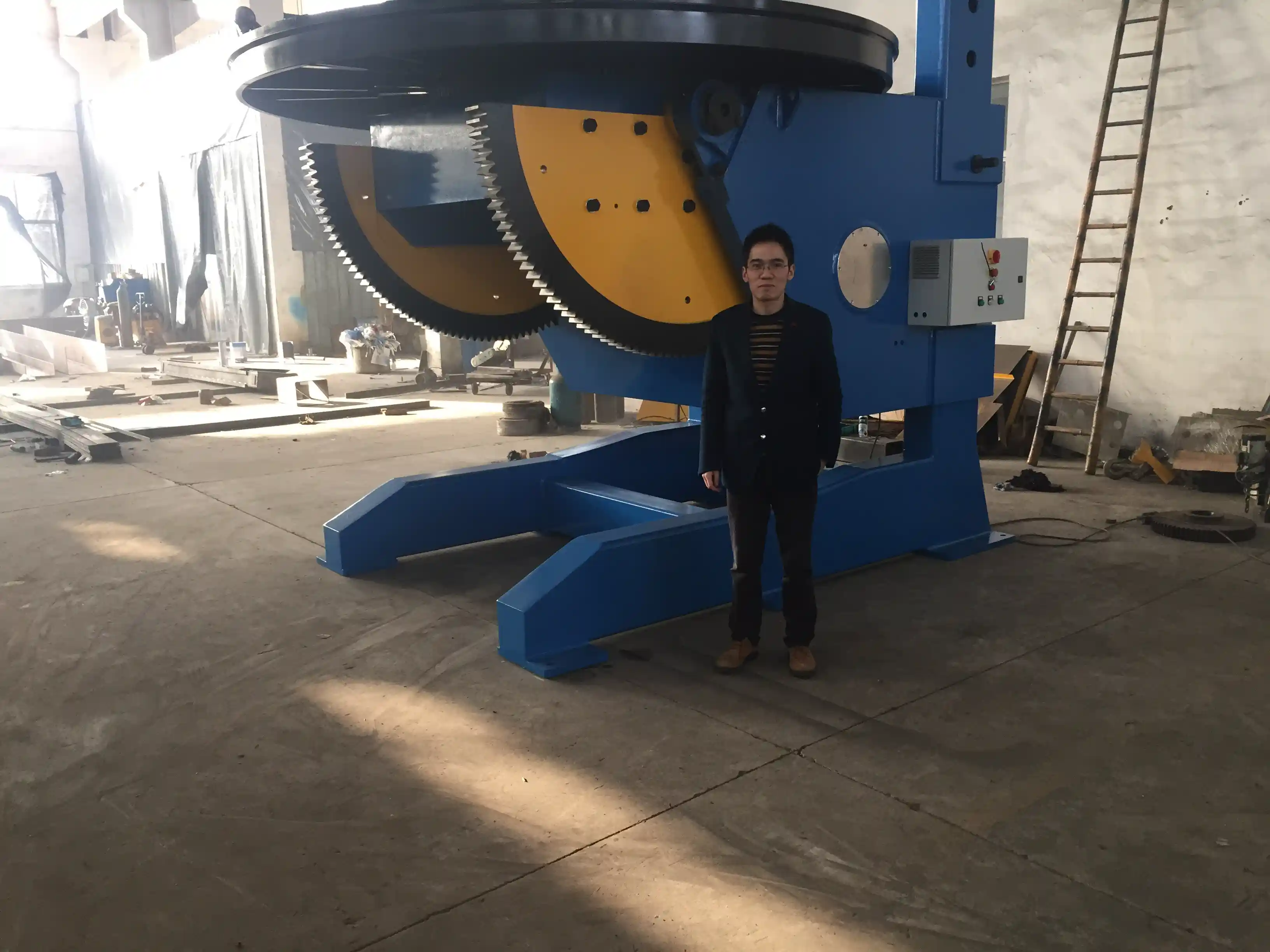
Robotic welding systems bring unparalleled flexibility and adaptability to tube-to-tube welding. They can handle complex joint designs and varying tube configurations with ease. Robots offer multi-axis movement, allowing access to difficult-to-reach areas. They integrate seamlessly with [[3 Axis Positioner3 Axis Positioner]]s and rotators, creating fully automated cells. This enhances productivity and ensures consistent quality even for intricate parts. Robotic systems are programmable, enabling quick changeovers between different products.
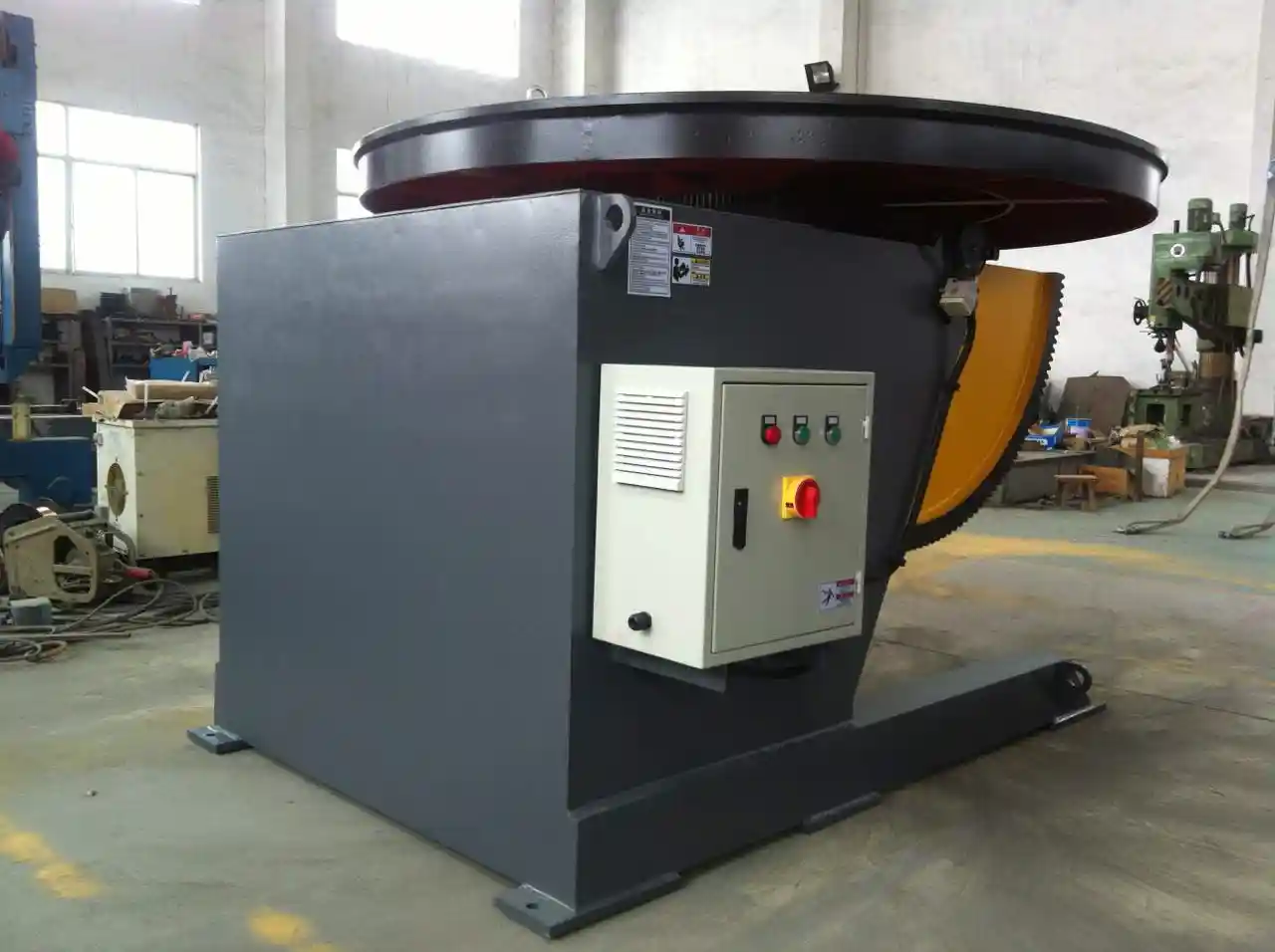
For example, our [[3 Axis Welding Positioner3 Axis Welding Positioner]]s, such as the 1-ton, 2-ton, 3-ton, and 5-ton models, provide synchronized turning, rotating, and tilting. They achieve positioning accuracy of ±0.05 mm and repeatability of 0.02 mm. These systems are compatible with leading robotic brands like ABB, KUKA, and FANUC.
| Modèle | Max Load | Positioning Accuracy | Répétabilité | Système de contrôle |
|---|---|---|---|---|
| 1 Ton 3 Axis Positioner | 1 ton | ±0.05 mm | 0.02 mm | Siemens PLC + HMI |
| 2 Ton 3 Axis Positioner | 2 tons | 0.05 mm | 0.02 mm | PLC + Touchscreen |
| Positionneur de soudage 3 axes 3 tonnes | 3000 kg | ±0.05 mm | 0.02 mm | PLC + Touchscreen |
| Table de positionnement à trois axes 5 tonnes | 5000 kg | ±0.05 mm | 0.02 mm | PLC + Touchscreen |
This integration allows for high-volume production of complex assemblies with minimal human intervention. Robotic welding is a cornerstone of modern manufacturing efficiency.
To learn more about optimizing welding processes, check out Tired Of Complex Welding Challenges How A 3 Axis Positioner Can Boost Productivity By 70
Implementing Tube-to-Tube Welding Automation: A Strategic Approach
Adopting tube-to-tube welding automation requires careful planning and execution. A strategic approach ensures a smooth transition and maximizes the benefits of the new technology. We guide our clients through each step, from assessment to integration.
1. Assessing Your Current Welding Processes and Needs
Start by taking a clear-eyed look at current welding operations: production volumes, quality metrics, labor costs, and safety records. Pinpoint bottlenecks, inconsistency drivers, and problems automation can directly address. Factor in tube types, materials, and joint configurations. With that baseline, it’s much easier to set realistic, measurable objectives for the automation project.
2. Selecting the Right Automation Equipment for Your Applications
Match equipment to your workload and geometry. Consider part size, weight, complexity, and target cycle times. Large-diameter pipes may call for [[Pipe Rotator EquipmentPipe Rotator Equipment]] with higher capacities, while intricate assemblies benefit from robotic cells with advanced motion control. Also evaluate how well each machine integrates with your existing line. We offer options spanning [[Welding Manipulator ManufacturersWelding Manipulator]]s, [[Welding Positioner SuppliersWelding Positioner Suppliers]], and [[Welding Rotator ManufacturersWelding Rotator Manufacturers]] to cover a range of industrial requirements.
3. Training and Integration for a Smooth Transition to Automation
Training is the hinge between investment and results. Operators, maintenance teams, and engineers should be comfortable with operation, programming, troubleshooting, and safety. A phased rollout—starting with pilot cells and scaling up—helps maintain production continuity while you fine-tune processes and parameters.
The Tangible Benefits of Automated Tube-to-Tube Welding
The investment in automated tube-to-tube welding yields substantial, measurable benefits for manufacturers. These advantages extend beyond immediate productivity gains, impacting long-term operational efficiency and market competitiveness. We have observed these positive outcomes across various industries.
1. Measuring Return on Investment (ROI) Through Productivity Gains
Automation accelerates throughput and cuts labor costs, so ROI typically arrives faster than many expect. Shorter cycle times and higher capacity offset the upfront equipment spend. We work with clients to model their data and quantify expected gains, so the financial case is clear before a single cell goes live.
2. Elevating Weld Quality and Meeting Stringent Industry Standards
Automated control reduces defects—porosity, lack of fusion, distortion—by holding tight to optimal parameters. Fewer reworks and rejects save time and materials, while consistent results support compliance with demanding standards in sectors like pressure vessels and pipelines. Better quality also strengthens product reliability and customer confidence.
3. Creating a Safer and More Efficient Work Environment
By moving people away from heat, fumes, sparks, and heavy handling, automation materially improves safety. Injury risk falls, insurance costs ease, and the overall work environment becomes more orderly and efficient. Those improvements pay dividends for both teams and operations.
Call to Action
Ready to transform your tube-to-tube welding operations and achieve unparalleled productivity? Contact WUXI ABK MACHINERY CO., LTD. today to discuss how our advanced welding automation solutions can meet your specific needs. Our team of experts is prepared to provide tailored recommendations and support.
Mobile : +86-13815101750
Tél : +86-510-83555592
Courriel : jay@weldc.com
A propos de l'auteur
Jay Li, Directeur R&D
Jay Li is a welding automation expert with over 20 years of experience. He specializes in wind tower welding lines, H-beam welding lines, and pipe welding equipment, helping companies improve quality and production efficiency.
FAQ
1. What types of tubes can be welded using automation?
Automated systems can weld a wide variety of tubes, including those made from carbon steel, stainless steel, aluminum, and exotic alloys. They handle various diameters and wall thicknesses, commonly found in industries like oil and gas, petrochemical, automotive, and power generation. The adaptability of automated solutions makes them suitable for diverse applications.
2. How difficult is it to integrate automated welding systems into an existing production line?
Integration difficulty varies depending on the existing infrastructure and the chosen automation level. Basic systems might be straightforward, while complex robotic cells require more planning. We recommend a phased approach, starting with a detailed assessment and pilot projects. This minimizes disruption and ensures a smooth transition.
3. What are the typical maintenance requirements for automated welding equipment?
Automated welding equipment requires regular preventive maintenance, including cleaning, lubrication, and inspection of mechanical and electrical components. Software updates and calibration are also necessary to maintain precision. Consistent maintenance schedules extend equipment lifespan and ensure optimal performance.
4. Can automated tube-to-tube welding systems handle different material thicknesses?
Yes, automated systems are designed to handle a range of material thicknesses. Advanced control systems allow for precise adjustment of welding parameters, such as current, voltage, and travel speed, to suit different material properties and thicknesses. This flexibility is crucial for diverse manufacturing needs.
5. What is the expected lifespan of automated tube-to-tube welding equipment?
The lifespan of automated welding equipment typically ranges from 10 to 20 years, depending on usage, maintenance, and environmental conditions. High-quality components and robust construction contribute to longevity. Regular maintenance and timely part replacement are key to maximizing operational life.
 English
  Español
  Français
  Deutsch
  Português
  Русский