A pressure vessel workshop runs on layout decisions and workflow choices that either help or hurt you every shift. Get the equipment placement wrong, and you’re watching operators walk unnecessary distances while bottlenecks form at predictable points. Get it right, and material moves through the shop with a rhythm that makes the whole operation feel lighter.
Equipment Placement That Actually Works in Pressure Vessel Shops
The placement of equipment determines how smoothly material flows from receiving dock to final assembly. Workshop layouts need to account for the full production sequence, not just individual station efficiency. When you map out where each piece of equipment sits, you’re really mapping out how many steps your team takes, how often forklifts cross paths, and where delays will stack up.
Choosing Welding Equipment for Pressure Vessel Work
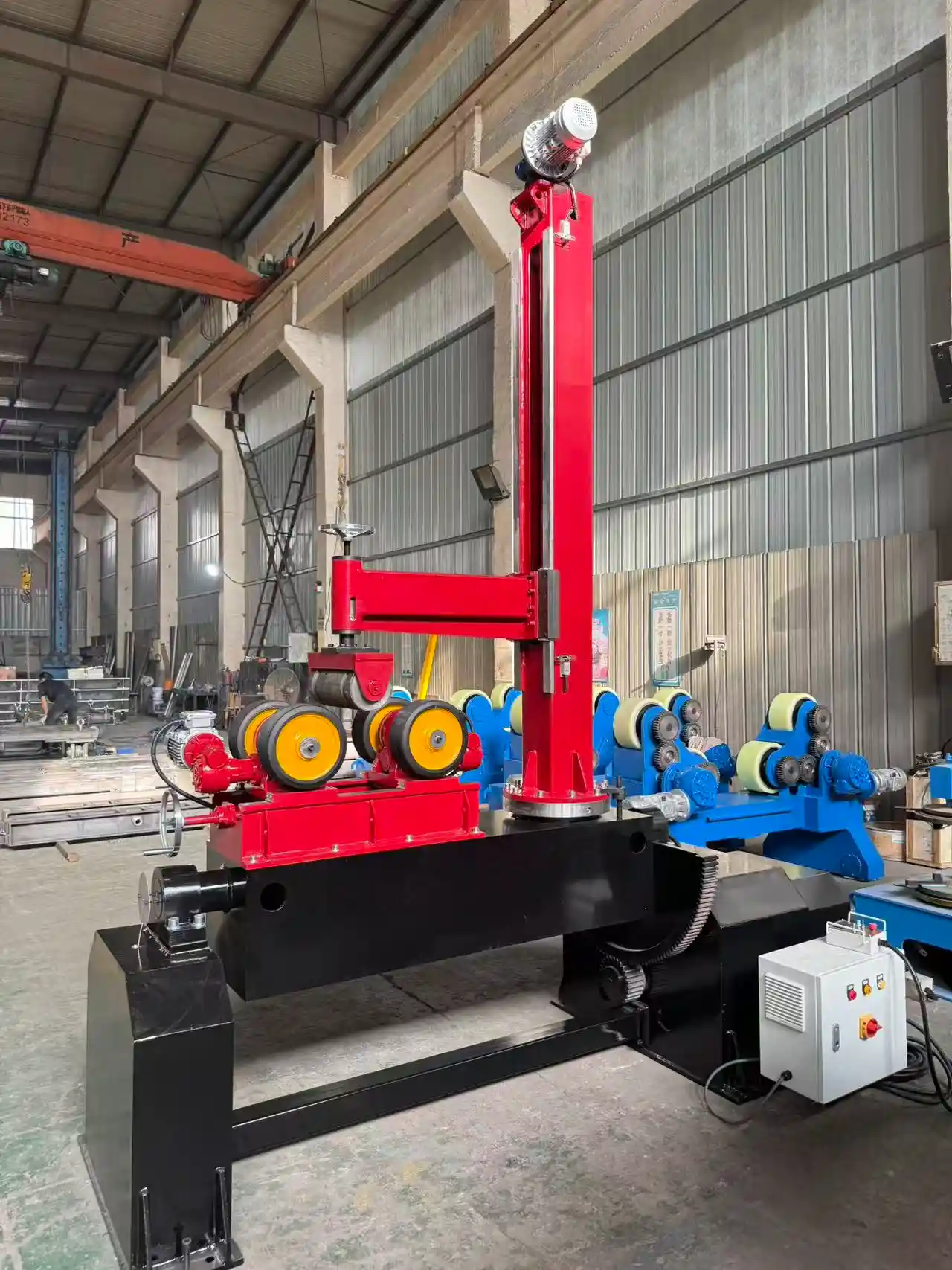
The welding equipment you select shapes what’s possible in terms of precision and cycle time. Longitudinal and circumferential seams on pressure vessels demand a Manipulateur de soudage that can handle the reach and positioning requirements. The LH8080 model delivers 8000 mm of horizontal and vertical travel with ±0.1 mm/m positioning accuracy. When the geometry gets complicated and you need multi-axis capability, a Positionneur à 3 axes rated for 1 ton provides synchronized turning, rotating, and tilting at ±0.05 mm accuracy. These positioners integrate with robotic systems from ABB, KUKA, and FANUC. Heavier components call for the Positionneur à trois axes with its 5-ton capacity.
| Equipment Type | Key Feature | Précision | Applications |
|---|---|---|---|
| Manipulateur de soudage | Column & Boom System | ±0,1 mm/m | Pressure Vessel Welding, Wind Towers |
| 1-Ton 3-Axis Positioner | Synchronized 3-axis movement | ±0,05 mm | Pressure Vessel Seam Welding, Robotics |
| 5-Ton Triple Axis Positioner | Heavy-duty, servo-driven | ±0,05 mm | Pressure Vessel Welding, Structural Steel |
Material Handling That Keeps Things Moving
Heavy components need to move through the shop without creating traffic jams or safety hazards. Overhead cranes, conveyors, and automated guided vehicles each solve different parts of this problem. The right combination cuts manual handling time and keeps operators focused on value-adding work rather than logistics. Thoughtful integration of these systems reduces transit time while making better use of floor space.
Tightening Up Workflow for Better Output
Workflow improvements touch every stage from raw material intake through final inspection. The goal is removing friction points that slow production and add variability to lead times.
Building Quality Control Into the Process
Quality control in pressure vessel fabrication isn’t optional. The inspection stages and non-destructive testing methods you choose determine whether defects get caught early or become expensive problems later. Ultrasonic testing, radiography, and magnetic particle inspection each reveal different types of flaws. Documentation that tracks every step ensures ISO compliance and gives you traceability when you need it.
For more on precision and efficiency improvements, 《Solution révolutionnaire pour le soudage des appareils à pression : Analyse technique des positionneurs de soudage rotatifs à 360 degrés》 covers relevant ground.
Safety and Compliance Realities in Pressure Vessel Shops
Industry safety standards and regulatory requirements exist because pressure vessel work carries real risks. Workshop design and daily operations both need to reflect this.
What safety considerations matter most in a pressure vessel workshop?
Personal protective equipment for everyone in the shop is the starting point. Emergency protocols need to be clear and practiced, with evacuation routes and first-aid stations positioned where they’re actually accessible. Ventilation systems have to manage welding fumes and airborne particles effectively. Machine guarding on equipment like the Manipulateur de soudage et Positionneur de soudage réglable prevents accidental contact. Regular risk assessments catch hazards before they become incidents.
What Automation Actually Does for Pressure Vessel Production
Automation changes what’s possible in terms of precision, speed, and consistency. Robotics, CNC cutting machines, and automated welding lines reduce the variability that comes with manual processes.
Les Manipulateur de soudage models like the LH8080 include automated parameter control that maintains consistent weld quality across complex pressure vessel geometries. The Positionneur de soudage à 3 axes in the 3-ton configuration delivers ±0.05 mm positioning accuracy with 0.02 mm repeatability, which makes it well-suited for robotic welding cells. Less manual intervention means higher throughput and lower labor cost per unit.
| Fonctionnalité | Soudage manuel | Soudage automatisé |
|---|---|---|
| Cohérence | Variable | Haut |
| Vitesse | Modéré | Haut |
| Précision | Operator-dependent | Superior |
| Sécurité | Risque plus élevé | Reduced risk |
| Coût du travail | Haut | Lower per unit |
《Fatigué des défis complexes du soudage ? Comment un positionneur 3 axes peut améliorer la productivité par 70%》 goes deeper on automation benefits.
Where Pressure Vessel Workshop Management Is Heading
Industry 4.0 concepts are reshaping how pressure vessel fabrication shops operate. AI, IoT, and digital twins are moving from buzzwords to practical tools.
AI-driven analytics can optimize production schedules and flag equipment maintenance needs before failures occur. IoT sensors provide real-time machine performance data that prevents unplanned downtime. Digital twin technology lets you simulate and optimize processes using virtual replicas of physical assets before committing to changes on the shop floor. These capabilities point toward manufacturing environments that are more adaptive and less reactive.
Common Questions About Pressure Vessel Workshop Optimization
How can workflow automation improve pressure vessel manufacturing efficiency?
Automation handles repetitive tasks that otherwise consume operator time and introduce variability. Robotic welding and automated material handling maintain consistent quality while shortening production cycles. The efficiency gains show up in both output volume and reduced rework.
What are the key regulatory standards for pressure vessel fabrication?
ASME Boiler and Pressure Vessel Code (BPVC) and the European Pressure Equipment Directive (PED) set the requirements for design, manufacturing, inspection, and testing. Meeting these standards is both a safety matter and a legal requirement.
What is the typical lifespan of welding equipment in a pressure vessel workshop?
Equipment lifespan depends on usage intensity, maintenance practices, and build quality. Well-maintained equipment like the Manipulateur de soudage et Positionneur de soudage réglable can remain productive for 10-15 years or longer. Regular maintenance and timely part replacement protect that investment.
How does WUXI ABK MACHINERY ensure the quality of its welding equipment for pressure vessel applications?
WUXI ABK MACHINERY builds quality through material selection, precision engineering, and adherence to CE and ISO standards. Equipment including the Manipulateur de soudage et divers Solutions pour les plateaux tournants de soudage goes through rigorous quality control before reaching customers.
What are the benefits of using a welding manipulator and positioner in pressure vessel fabrication?
Les Manipulateur de soudage gives precise torch control for consistent seam quality. The Positionneur de soudage réglable puts workpieces at optimal angles, reducing awkward positions and improving ergonomics. The combination increases efficiency and cuts rework rates.
Partner with WUXI ABK MACHINERY for Advanced Fabrication Solutions
WUXI ABK MACHINERY CO., LTD. has been manufacturing welding and CNC cutting equipment since 1999. Our wind tower welding lines, H beam welding lines, pipe welders, and welding manipulators are built for the demands of pressure vessel fabrication. Reach us at +86-13815101750 or jay@weldc.com to discuss what your workshop needs.
 English
  Español
  Français
  Deutsch
  Português
  Русский